Friday, 28 May 2021

You Can Say That, But Not That

There’s nothing like inconsistency in foul language.

Take for example the Ub Iwerks cartoon Room Runners (1932). Flip the Frog lands at the bottom of the stairs and says, quite clearly, “Damn!”

Later in the cartoon, the rooming house manager spies Flip trying to skip out on his rent. After a take, she says “Well, I’ll be....” and mouths “damned” but it’s not on the soundtrack.


A telephone gets in a “Damn!” in The Cuckoo Murder Mystery, a 1930 Flip cartoon, while a bull says it in the 1933 Flip short Bulloney. Flip says it Ragtime Romeo in 1931, mouths it in 1932’s Funny Face, while a chequers-losing horse utters it in Fire-Fire, also in 1932.

Those of you who keep track of this kind of thing will know if there were other Flip cartoons where it happened.

Thursday, 27 May 2021

And If Ya Feel Like Singin'...

The cat that hated people (from the Tex Avery cartoon of the same name) enumerated why he hated people before deciding, at the end of the cartoon, they weren’t so bad after all.

He did it in a series of sight gags. Here’s one where the cat explains what happens when you feel like singing (if you’re a cat on a fence outside at night, that is).


The cat plops away with the boot inside him (and a solo oboe playing) as Tex wipes into the next scene.

Walter Clinton, Louie Schmitt, Grant Simmons and Bill Shull are the animators, with Pat McGeehan voicing the cat.

Wednesday, 26 May 2021

Eva of Hooterville

Green Acres started out as an attempt to get two prime-time series to cross over so viewers would tune in both of them. It ended as a surreal tale of a rural town where the odd was normal. Both Green Acres and Petticoat Junction were apparently set in Hooterville. They were like two different towns, as if the Green Acres version had fallen into an alternate universe.

It made perfect sense, then, to plop into the proceedings a Hungarian actress who was known for marriages, sisters and not much else.

For someone whose accent was difficult to cut through, Eva Gabor was always quotable. Here are two pieces by Hal Humphrey of the Los Angeles Times Syndicate, the first from August 14, 1965 (before the series started) and the other from October 2, 1968. Albert was signed for the show in April (Producer Paul Henning had wanted Gale Gordon) while Gabor was inked near the end of June and John Daly was hired in July to narrate the pilot (CBS turned down a request to have Walter Cronkite do it). Pat Buttram was added to the cast in August, with Variety reporting he was to get third billing and appear in 10 of the first 13 episodes.

Eva Gabor To Star In Corny TV Show 'Green Acres' On CBS
By HAL HUMPHREY

HOLLYWOOD — The first question popping into mind while watching Eva Gabor film a scene for a new TV series called Green Acres is, "What's a chic Hungarian like her doing in a barnyard?"
Eva's answer is not too convincing. She says that she loves to work and especially to do broad comedy.
"I did Present Laughter' with Noel Coward, and isn't that broad comedy?" Eva replies defensively.
Broad, yes, but Noel Coward never had Eva Gabor chasing a rooster while wearing a Jean Louis negligee, which is one of her ecapades in an early Green Acres episode.
In addition to being regularly involved with such corn-hall hijinks in Green Acres every Wednesday night at 9 (CBS) beginning Sept. 16, Eva also must find time to make occasional appearances in that other bucolic bash known as Petticoat Junction, a CBS series which inexplicably is about to begin a third TV season Incredible as it may seem, there is to be what someone already has gleefully tagged as a "cross-pollination" between Green Acres and Petticoat Junction. Eva and her TV husband (Eddie Albert) moves to Hooterville Valley because he has a yen to return to the land, and Hooterville Valley happens to he where Petticoat Junction is located along with Kate Bradley (Bed Benaderet), proprietor of the Shady Rest Hotel, and a gaggle of unforgettable characters.
Each week this rural version of Peyton Place with a laugh track and its interchanging characters is designed to keep the viewer hooked for a half-hour on Tuesday and Wednesday nights. The producers had some difficulty getting Miss Benaderet to cross-pollinate until she received extra compensation, but that is all settled now.
Eva does not say what her contract calls for, moneywise. "It is confusing, I have so many managers and agents, but I am sure they worked out something nice."
Apparently Eva had the lords of Hooterville over somewhat of a barrel. She was not cast in the role until late June and then would not hear of doing a weekly series without Gene Hibbs, one of Hollywood's most expensive and expert makeup men, and Peggy Shannon, a hairdresser of equal stature in her field. Put them with the famous dress designer Jean Louis and his gowns and we have one of TV's most expensive one-women packages.
About the funniest thing to happen so far in this goulash Eva finds herself a part of was her first visit to the Petticoat Junction set where the mountain dialects are thicker than goat cheese.
"People say they don't understand my accent Migawd! I haven't understood a word said yet on that Petticoat show. Is that English?"
It isn't likely there will be any cross pollination of the Hungarian and Hooterville dialects, however.
"Nothing ruins my accent," affirms Eva. "I tried for years. I went to Columbia University to lose it, and it was no use."
She may be underestimating the power of our hillbilly dialect, which has been growing more widespread in this country every year. A form of it is even spoken in the White House now, and joining Eddie Albert and Eva in Green Acres is Pat Buttram who thinks "right" is spelled R-A-T like in "rat now."


Humphrey hears Gabor’s odd take on a husband-wife relationship in this column. For someone who depended on a husband for everything, she sure dumped them a lot. I think Brown was her fourth. He was gone within a few years of this story.

Eva Gabor Says U.S. Women Better Wives
By HAL HUMPHREY

HOLLYWOOD—Eva Gabor would like us to know that American women are more beautiful than European women ("American women have great figures"), and that they also make as good wives as those in Europe.
"I never bought this ides that European women make better wives. I think that must have been started by some clever European woman. American women make good mothers and surely know how to run the house," says Hungarian-born Eva who co-stars as Eddie Albert's wife in the CBS comedy series, Green Acres.
I suggested to Eva that perhaps there were more career women in the United States than in Europe, giving credence to the rumor (or canard, as Eva believes) that European women make better wives.
"Why in the world would a woman want to compete with a man? The whole idea is repulsive. I work, but I am also a woman, and if I don't have a happy home, I have nothing. My husband is my anchor. He's everything," Eva says, without taking a breath.
She has been married to Richard Brown (former stockbroker and now an executive at Filmways TV Productions which turns out Green Acres) for nine years and insists she depends on him for "everything."
"When I lose the house key, as I did the other day, I call Richard to find out what I should do," says Eva.
"You didn't have any ideas?"
"Of course, but he would know better what to do. What's the use of having a husband who doesn't know better than you do? I don't want to be independent. I still ask Richard his opinion before I buy a dress."
Eva goes on to say, too, that she offers a lot as a wife. She redecorated a home they bought in Palm Springs recently. This she did on her own, but still consulted Richard now and then. As for the money she makes from Green Acres, which is considerable, Eva refuses to discuss whether it's more than Richard makes.
"I don't even want to know about it. Yes, I make a lot of money, but Richard takes care of that entirely. If a career woman is too self-reliant, she should unlearn it a bit, and have a better marriage."
Now, the question is, has Eva's philosophy on marriage come from her European background, or from her years in the United States where she has lived a good while ("since I was a kid, but I won't tell you when that was, because then you'd know my age").
Eva considers what she has said is just common sense for any woman, no matter where she comes from.
"You have to be feminine, A woman should look like a woman, and if she wears pants, she should do it when nobody sees her," Eva adds.
This season (the fourth) had an episode of "Green Acres" calling for Eva to wear coveralls, but designed by Nolan Miller, her new couturier, and are blue satin. Apparently, these pants she doesn't count.
After taping a guest appearance in which she sang and danced on the "Phyllis Diller Show," Eva began taking singing lessons.
"I thought if I'm going to be singing, it might be useful and interesting to know what I'm doing," she says.
Filming a weekly series and being the kind of wife Eva believes in is a difficult assignment. She's a bit unhappy, too, that "Green Acres" is airing a half-hour later this season, because she's very superstitious.
"But I'm prepared to stagger along for this fourth year, because I know how difficult it is in our business to get a hit. I just hope that new time doesn't affect it. Wouldn't you think they'd leave things alone when they're successful?"

Tuesday, 25 May 2021

Drybrush Sylvester

Here’s how the ink and paint department handles some dry-brush work in Kit For Cat, a 1948 cartoon from the Friz Freleng unit.

Sylvester is trying to find refuge from the cold by knocking on Elmer’s door. Elmer opens it, Sylvester bangs on his head, then realises it’s his meal ticket at the door, so he flips over and pretends to be frozen stiff.


Ken Champin, Virgil Ross, Manny Perez and Gerry Chiniquy are the animators on this cartoon, with good gags and situations from Mike Maltese and Tedd Pierce. At one point, the kitten Sylvester is trying to get rid of turns on a radio mystery show, starring Mel Blanc as Melvin and Bea Benaderet as Beatrice. Arthur Q. Bryan fudds it up. For a guy who said he hated using Elmer, Friz made some solid, funny cartoons with him.

Monday, 24 May 2021

Hans Conried, Taxidermist Killer

A taxidermist with murder on his mind comes into focus as Woody Woodpecker emerges from being blacked out in Woody Dines Out. Woody glances at a sign then realises what’s about to happen.


A head shake, a shock take and then three drawings of Woody going back to his “pass out” position.


Don Williams is the credited animator but Emery Hawkins, Pat Matthews and others worked on it. Showman’s Trade Review of May 20, 1944 says “Walt Lantz has signed Hans Conreid and Jack Mather to record voices for his Cartune, ‘Woody Dines Out’,” but Mather isn’t heard in this one. The cartoon was released in May 1945.

Sunday, 23 May 2021

A Writer Gets in on the Feud

It was supposed to last for the first 2½ months of 1937, but nobody wanted to let it go. That included Paramount Pictures, which put the Jack Benny/Fred Allen feud on the big screen in the feature Love Thy Neighbor three years later. And to promote it, James F. Scheer wrote this feature story in the December 1940 edition of Hollywood magazine.

Benny made for good copy for the magazine; earlier in the year, it did a pictorial on Buck Benny Rides Again, and published a few stock pictures of Jack, including one with his daughter Joan.

Scheer’s story is pure fan-rag baloney. It treats the feud as serious though, in reality, the two former vaudevillians had hung out together when Jack’s show was still based in New York. The “insults” are the product of someone’s imagination, either Scheer or maybe some Paramount publicity writers. I doubt Jack Benny would use “olfactory” in a sentence. The story ignores all of Jack’s vaudeville career prior to enlisting in the service in 1917. It is true Benny chain-smoked cigars in the ‘30s and Allen chewed on chaw. And Fred and Portland really did have a very modest apartment in New York City.

This Can’t Be Love
By JAMES F. SCHEER

■ This is the saga of two residents of glass houses who have been throwing stones, fists, half-Nelsons, slurs, and, among other sundry properties, the well-known Bull at one another.
It is the saga of Fred (Two-Fist) Allen and, as Fred says, "Jack (Two-Face) Benny," anti-one-another stars of Paramount's musicomedy Love Thy Neighbor, whose other entries on the asset side include Mary Martin and that colored duo, Rochester and Theresa Harris.
The actual enmity, friendship, or whatever-it-is-ship of Benny Kubelsky, as Jack Benny was christened on the day the Waukegan, Illinois, stork airmailed him to Mom Benny, and John F. Sullivan, alias Fred Allen, cannot be packed into a few words.
Not even in a few paragraphs. Some say Buck Benny feels mildly nauseous toward Allen. Others say Fred feels the same way toward Benny. But unless you prod one with slurring barbs from the other, you are likely to find them as eloquent about one another as Geronimo.
Take a walk down Paramount's Avenue D. But walk on the wide whitewashed line in the center — that is, if you don't want to become a participant in the Allen-Benny feud, which has been raging since '36.
The right half is painted "Fred Allen's Side"; the left half, "Jack Benny's Side." Their dressing rooms face one another a hand-grenade distance across Avenue D.
A black-lettered sign on Sound Stage A warns: DANGER— FLYING QUIPS! And gals and guys, once you're in there, you're on your own.
Among those who find Benny and Allen not exactly Damon and Pythias is George McCall, radio commentator, who does not dare visit the set since he joined Captain Allen's Slur-Slingers, Company 1492 1/2, by saying, "When they put Benny's footprints in the lobby of Grauman's Chinese Theater, Fred Allen's footprints walked away."
Sources close to the scene say Captain Buck Benny's Company is "too reserved and gentlemanly to point out that neither combatant has yet dropped an oxford in Sid Grauman's wet cement."
But the Bennyites won't refuse to admit that the script of Love Thy Neighbor calls for wrestling and fistcuffing for Neighbors Fred Allen and Jack Benny, respectively. They want the best man to win, knowing it is Benny, despite the pugilistic, Cambridge, Massachusetts, name of Fred Allen — John F. Sullivan. He is, however, no relative of boxing's John L.
On the set of Love Thy Neighbor, the boys either let their barbs fly at one another in person or deliver them by word or note through third parties. "So Allen is taking boxing lessons?" Benny laughed and plopped into his canvas-backed chair. Slicked up in a black overcoat, top hat, knitted white silk scarf, mirror-shine patent leather shoes, and a New Year's Eve whoopee horn in his pocket, he flexed a bicep menacingly. "No doubt he's preparing for things to come." Allen espionage agents reported this to their chief, who cracked bitingly, "It might be a tough battle, but Jack has the advantage. I'm only two-fisted. He's two-faced!"
Answered Benny, "The only things athletic about Fred are his feet. He's so afraid of pain that I suspect he takes a local anesthetic when he gets a manicure." Face screwed into a typical Allenesque grimace, Fred shot back, "Benny has so few red corpuscles that he can't even see red. He is so anemic that when he wheel-chaired past a dozen kennels of bloodhounds at a local prize dog show, not one of them lifted a nostril with an acknowledging sniff."
That should have put Jack in the hands of the receivers, but after a five-minute conference with gag-writers Bill Morrow and Eddie Beloin, he preserved his dignity by sending only a stern note of reply to Allen:
"Despite Mr. Allen's physical culture campaign, it is doubtful whether he could go one round by himself. Strength is such an absent quality in Mr. Allen's makeup, which I hesitate to refer to as physical makeup, that if we put on the gloves together and began to spar, I would be shadow boxing inside three seconds."


■ Amid this verbal and written exchange of lefts and rights, the timorous bystander who wishes to preserve his neutrality wonders just how this Allen-Benny feud made its debut.
Well, to abbreviate it, the feud had its coming out in the New York winter season of 1936 — to be exact, the raw cold evening of December 30. Fred Allen customarily invited a handful of amateurs to participate in each week's broadcast, and on that night Stewart Canin, a ten-year-old violinist bowed his way through a tricky solo, The Bee.
"That should make Jack Benny mighty ashamed of himself," ad-libbed the ace ad-libber. "He's been trying to play that piece for forty years and hasn't succeeded yet."
It was just a quip that passed in the night — apparently.
Next Sunday Jack made a remark that "a certain reformed juggler" had done him an injustice and retorted, "When I was ten years old, I could play The Bee too."
Thus came love to Neighbors Benny and Allen, who have been swapping slams from Hollywood and New York ever since.

■ Jack was born on St. Valentine's Day — "and what a boon to the comic valentine industry," Fred dryly admits. Like most kids, Jack went to Junior and Senior High school with only a mild distaste for teachers. His distaste for working in his dad's haberdashery shop was anything but mild.
Helping customers select chapeaux for bald pates and orange neckties with barber-pole stripes to match a cerise suit went against the Benny artistic grain, which began to assert itself when Jack traded a Honus Wagner bat, a pair of clamp skates, a Hohner harmonica, and two bucks for his first fiddle.
Every exercise in the books and Rubinstein's Melody in F took an awful beating — as did neighbors who were not psychic enough to see a future in music for Jack.
Anyhow, as a high school student, he tried, to crash Waukegan's only theater with his own orchestra. He did, but his bandsmen didn't. After all, the manager could use only one ticket-taker. Later Jack established a non-stop talk record, convinced the manager he should be on the stage fiddling, and did until fire inspectors closed the theater because of old age.
Then it was vaudeville. During World War I, he played in The Great Lakes Review for sailors training at the Great Lakes Naval Station. Nobody threw him even a rusty penny. In desperation he began talking more and playing less. He passed the hat, got it filled with coins, jokingly asked for "a second helping," and got it.
On that day Buck Benny became a monologuist and began getting regular bookings. Fred Allen's name was just another item in Variety and Billboard to Jack. They hadn't actually met until six months before their feud started.
In rapid order Jack made his debut in The Hollywood Review at M-G-M, went to New York for a leading role in Earl Carroll's Vanities, and broadcast one night as guest of a columnist. Next week he was signed to a long-term radio contract. Every Sunday night listener knows the rest.

■ Fred Allen says his life really began at about half the age Walter Pitkin claims life begins.
As a young fellow who set "returned" books back in the proper stalls at the Boston Public Library for twenty cents an hour, Fred spied a tome on juggling. Eureka! He read it from frontispiece to rear cover, and when the librarian wasn't around, practiced juggling books.
He had Shakespeare, Chaucer, Milton, and Shelley up in the air all at once for the first time in their history when the head librarian walked into the room. Fred's animated hands froze. Shakespeare slapped the concrete floor. Shelley nose-dived. Milton ended up sprawled on Shakespeare, and Chaucer landed — kerplunk! — on the librarian's high forehead. End of act two!
An improved juggler, Fred went on the stage, copped a prize at a Boston theater one night, and was about to receive the award from the famous fighter, John L. Sullivan, master of ceremonies, when the great John L. asked him his name. Fred said it as it was written on his birth certificate — John F. Sullivan. "Sullivan?" barked John L. "That's no name for a juggler."
It wasn't. So when Fred — and a hundred others — wanted an audition for a vaudeville troupe, he changed his name to Allen, because the person in charge asked for applicants in alphabetical order.
Early in his career, he earned his reputation as the acme of ad-libbers. He dropped one of his circling ten-pins and a couple of tennis balls, and the loud m-cee asked, "Where did you learn how to start to try to juggle?"
Fred glanced out at the audience and retorted in his twangy, nasal best: "I studied a correspondence course in baggage smashing!"
Fred, whose mind is perpetual motion machinery on jokes and witticisms, hesitated in tackling radio, thinking he might not be funny unseen. It didn't take him long to learn he was wrong.
Since 1936, Allen and Benny have known each other — from a distance. Fred dislikes Hollywood. Jack likes Hollywood. Consequently, the boys have never really been together long enough to know each other well.
But what Fred started on that winter night's broadcast doesn't seem to stop.

■ When Fred and his party got off at the Union Station in Los Angeles to begin work in Love Thy Neighbor, Benny wasn't there. He was at NBC rehearsing that evening's program, but he had a committee of beauteous babes, carrying insulting signs, and a city official — a street sweeper — to greet Fred.
"Benny wouldn't dare meet me himself," rasped Allen. "He's afraid I'd pull his hair out — and he'd have to go home to get some more!"
Jack waived the remark and approached Fred the next day, extending the olive branch.
"I'm not one to bear a grudge," he explains. "We offered Allen and his party the chance to stay with us. But in his usual sour fashion he refused. Mary and I were very disappointed. We had gone to the trouble of cleaning out the whole cellar."
And, later, when Jack had returned from his Hawaiian trip, he broke into the conference of Producer-Director Mark Sandrich, Allen, and script writers, asking them to delay the picture.
"I'm in swell condition," said Jack, "but I think I should have a short rest before going to work with Allen, because I am somewhat weary mentally. I was met in Honolulu by 27,000 people, which is four fans and two Kanakas more than greeted Shirley Temple. They were lovely to me, but they all put leis around my neck. And carrying 27,000 leis — it is bad luck to take them off — sort of dulls the mind and the olfactory nerves after three weeks."
Allen, frowning his vinegar frown, disgust puckering his eyes, said dryly, "The only reason there weren't 27,000 people to greet Benny on his return here is that extras cost more in Los Angeles than they do in Honolulu — and Benny wouldn't put out that much dough!"
Before Love Thy Neighbor went into production, Producer-Director Mark Sandrich promised Fred that Jack would positively not play The Bee in the picture.
"He won't?" screamed Allen. "He can't!"
So history is becoming repetitious, and Benny feels the sting of The Bee.
And speaking of Jack, he was chatting through his teeth which were clenching the ever-present, roly-poly, brown cigar:
"You know, one of the most charming qualities is tolerance — tolerance for Allen. How many headlines have you ever read to this effect: 'Comedian Benny Tears Out Jugular Vein of Obscure Radio Performer?' None — yet!"
Allen was outside earshot. Allen espionage agents were out of sight, and the remark fell on ears but not the right ones.
The whole setup is crazy — this Love Thy Neighbor business. Benny and Allen have been slamming each other for years. And now attacks are more venomous than ever. Jack doesn't like Fred's habit of chewing tobacco. Fred doesn't like Jack's smoking so many cigars. Jack thinks Fred's boxing is done purely in the mind. Fred thinks Jack's vigorous "in the hills" hiking is something dreamed up in the minds of Benny's publicists.
Allen likes living in a two-by-nothing apartment with his wife, Portland, officiating at the range. Benny likes lavish surroundings — a dozen baths and a swimming pool. Allen is almost a Peter the Hermit.
Benny is a social-smoothy who loves company in quantity. There is one thing Jack likes about Fred — "His lovely middle name: Florence."

■ As tastes differ, so do Benny and Allen. They do not associate from lack of common interests, rather than from animosity. Let anyone outside the Benny circle toss a disparaging remark at Allen, and watch Jack blow a fuse. Let anyone disparage Benny, to Allen, and watch Allen come back with a slicing remark.
They are each other's common sadistic property, and let no man try to put in an oar. It's a case of brother abuse brother — but with a limited entry.
Neighbors Allen and Benny may dispute about who should get top billing in the picture; they may wrangle because Fred has seventeen changes of costume and Jack has but three; they may spar about which of them will cop the Oscar for 1940, but it is all good, wholesome, homecooked stuff.
In a philosophical mood, Fred often wonders whether he or Jack, whom he calls "the streamlined Joe Miller," will leave his humorist's footprints on the sands of time. He is not sure about this.
But there is one thing about which he is reasonably certain. It's the footprints in the lobby of Grauman's Chinese Theater, and he says, "If Sid Grauman ever stoops to inviting Jack Benny to put his footprints in the lobby of the theater, I'll keep my feet at home!"

Saturday, 22 May 2021

Terry Lind

When the 1940s rolled around and credits loosened up on theatrical cartoons, named appeared briefly, and then vanished.

One is Terry Lind, a background painter with the Walter Lantz studio. Lind started there in September 1944, with a screen credit for the first time on The Loose Nut, released on December 17, 1945. Her name appears on most of the studio’s cartoons released in 1946 and then she disappears. Yes, Terry Lind is not a “he.”

She also turned up at Warner Bros. but with cartoons made so far in advance, but it’s tough to say when she actually worked there. And with credits wiped off Merrie Melodies of the day and replaced with a Blue Ribbon title, it’s unknown how many cartoons she worked on. Surviving screen credits show she painted the backgrounds for Rhapsody Rabbit, released November 9, 1946, and the Oscar-winning Tweetie Pie, released May 3, 1947. Author Joe Adamson’s research found Lind painted the backgrounds for the former in April 1946. Her name appears on the original credits Friz Freleng’s OF Thee I Sting, released August 17, 1946 (thanks to Devon Baxter, who copied the credit portion of the reel).

Some more digging found a maddening reference to Lind in the December 20, 1944 edition of “Top Cel,” the newsletter of the New York local of the Screen Cartoonists Guild. It simply says “Terry Lind back at work after illness.” But where? Not all the news involved East Coast studios (eg. the same issue announced Bernadette and Sidnet Pillet were now working for Lantz).

It turns out Lind was employed by the Fleischers in Miami. The Pittsburgh Press published this story in 1939.

Junked!
Noted Paintings Useless When Film Is Done

HOLLYWOOD, Nov. 27 – More than 100 paintings by some of the foremost artists of the country today became mere bits of paper, in so far as the Fleisher Studios were concerned.
The paintings are backgrounds for scenes in “Gulliver’s Travels.” They are the equivalent of sets in non-cartoon movies.
The backgrounds are finished pieces of work drawn with such minute detail that no flaw can be detected when the scene is amplified 100 times by projecting it on a movie screen. All of them are water colors.
However, once the characters in “Gulliver’s Travels” have been superimposed on paintings and photographed, the paintings have no further value to the studio. The paintings are the work of such artists as Louis Jambor, Erich Schenck, Robert Connavale, Shane Miller, Robert Little, Henry Farnham, Helen Freeman, Hemia Calpini, Robert Owen, Terry Lind, Louis Sylvester, Harry Wylie and Starke Davis.


Fortunately, the studio didn’t junk them. Not right away. On January 7, 1940, the News revealed a showing of the artwork by the background department at the studios of Associated Artists in the Leamington Hotel. There were oils by Robert Little, oils and drawings by Shane Miller and Robert Connavale, and water colours and etchings by Earl Klein, Ralph Wolfe and Lind, among others.

So who was Terry Lind? Fortunately, the Miami Herald reported on some of her background in Doris Reno’s column published August 24, 1941.

A TALENTED and attractive young lady out at the Fleischer Studios can either remember her childhood with extraordinary detail or else she knows children who let her in on secrets—or else, finally, she's still in possession of a child's heart—for those adorable drawings of child attitudes and moods she has over at Washington Art Galleries (in the Washington Storage Company building, Miami Beach) simply insist ou the truth of one of the above statements.
Terry Lind's child water-colors — for children as well as about them—show children in straight short colored frocks in varying attitudes skipping; hesitating, advancing, with flowers growing out of their hair with enchanted bands and feet that grasp at all fairy things in a child’s world. They are rhythmic, well-designed and organized, necessarily modern but one thing is important to repeat—they are not like so many of the modern books labeled "children's books" designed in make their appeal to parents while purporting to be made for the child alone. Terry Lind's child fantasies express childhood to parents and elders but they are for children and children like them.
Terry, one of the background artists out at Fleischer's, was born in Cleveland, studied at the School of Art there and at John Huntington Polytechnic school. Later, in New York, she was assistant medical artist at the College for Physicians and Surgeons and drew literally books full of diseases and psychopathic charts. After that she designed silks for a New York textile studio before removing to Miami three years ago for the express purpose or being with Fleischer's. Terry has more sophisticated water-colors and etchings at the Washington Galleries, too—Balinese dancers, sit sorts of strange Oriental studies. But I’ll take the child things, thank you.


The Herald’s Reno checked in with her again on August 31, 1947, stating Lind “has just founded in Hollywood her own studio for doing color backgrounds for technicolor pictures. After leaving Miami she worked for Walt Disney on animation then did background work for the "woodpecker" cartoons.” She last appears in the 1941 Miami directory. The 1944, 1946 and 1948 California Voters Lists have a Miss Theresa A. Lind, artist, at 12329 Huston Avenue in Los Angeles. That’s where our trail goes cold. I can find no birth or death record even resembling part of her name that could be her.

Did she have a different name at birth? Did she have two legal names? The answers are probably out there somewhere.

My thanks to Devon Baxter for his help in photo-clipping and trying to help unravel the mystery.

Friday, 21 May 2021

He's Too Bizet to See the Conductor

A trombonist isn’t too careful where he’s playing in a sketchy rendition of Bizet’s “Carmen” in the 1929 Mickey Mouse short The Opry House.


This is one of 47 drawings in an elaborate but perfectly timed cycle. I’ve slowed it down to 75% speed of what it is in the cartoon.


Ub Iwerks supposedly drew this if we believe the re-created opening title card. My guess is Les Clark worked on this as well.

Thursday, 20 May 2021

Kill the Umpire? Nah, Kill the Other Guy

There’s more than just a baseball game being played by the stick figures in Tex Avery’s Batty Baseball (released April 22, 1944).

If you look in the upper left in front of the dugout, someone is chasing someone else with a baseball bat. He lunges for him at the base-path from third to home, but misses.


The guy being chased trips on the field between the mound and the base path between third and home. He gets up and the crazy guy starts to chase him around the pitcher’s mound, across the base path from home to first, lunges and misses again.

>>

This is all in a separate cycle than the game on the field. 44 drawings.

Ray Abrams, Ed Love and Preston Blair are the credited animators. John Wald (later the announcer on Fibber McGee and Molly) does the play-by-play. Oh, as for the score, The Independent Film Journal of April 29, 1944 reported:
As an outstanding example of musical scoring for animated cartoons, M-G-M’s Technicolor cartoon, "Batty Baseball” was shown recently to the National Association of American Composers and Conductors. Sigmund Spaeth, president of the Association, giving the last of a series of music in the films, illustrated his talk with showings of various outstanding scoring jobs. Scott Bradley, of M-G-M’s music department on the coast, did the score for “Batty Baseball.”
Considering Bradley did not agree with Avery on the contents of an appropriate cartoon score, we wonder what his reaction was.

Wednesday, 19 May 2021

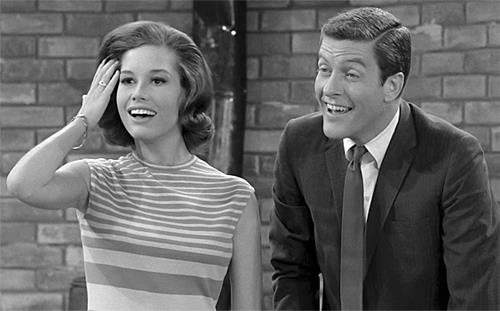
The Wife, Mother and Ruby Keeler of 1961

Rose Marie had been a star on stage and radio back in the late ‘20s. Morey Amsterdam had been a variety show pioneer in early network television in the late ‘40s. Dick Van Dyke found success in a top Broadway musical in the earliest ‘60s.

And then there was Mary Tyler Moore.

To the world in 1961 she was pretty much unknown. Looking through newspapers before 1960, there are brief references to her appearing in Bourbon Street Beat and Bronco. But her casting on the Dick Van Dyke Show proved to be a stroke of genius. Her Laura Petrie was a completely different kind of wife and mother than anything else on television; in fact the whole show seemed smarter than comedies before it, which still had a foot stuck in old radio.

One could make the argument that her best years were ahead when she got her own situation comedy.

However, let’s look at a couple of stories from the early Van Dyke era. The first appeared in papers around March 23, 1963 and explain Tyler Moore’s background and how she was cast. National Enterprise Association columnist Erskine Johnson makes a comparison I never thought about before.

Chorine Set To Star, a la Ruby Keeler
By ERSKINE JOHNSON

HOLLYWOOD — (NEA) — Remember those old movie musicals with a chorus girl, usually Ruby Keeler, becoming a star through a series of fortunate but highly improbably events?
Well, here's the same story—for real. The new background is television, but the events are just as improbable.
Meet the heroine—gorgeous brunette Mary Tyler Moore, ex-chorus girl. She plays Laura Petrie on The Dick Van Dyke Show on CBS. And as a sophisticated comedienne she has Carole Lombard's flair and a voice as offbeat as Myrna Loy's.
As Laura, she's Van Dyke's ever-lovin' wife. As a team, Van Dyke domestic comedy as William Powell and Myrna were in the "Thin Man" series.
Third From Left
Let's flash back to 1959 Eddie Fisher has a big musical show on NBC-TV. There is a line of shapely chorus girls, and the third from the left is Mary Tyler Moore.
But acting, not dancing in the chorus, is Mary's goal. Just like Ruby Keeler's.
Now fade out and fade in on the television series, "Richard Diamond." The show opens on a telephone operator whose face you never see. You just see a pair of shapely legs and hear her sultry voice.
Diamond's name for her "Sam." Pretty improbable.
In the first 18 shows Mary Tyler Moore was Sam. She received no billing but a lot of publicity as the show's doll of mystery. When she asked for more money to play the role she was fired and replaced by another "Sam."
She pouted to her agent at the time: "They won't let me see my fan mail."
Everyone at the studio where "Diamond" was filmed knew why they wouldn't let pretty Mary see her fan mail. As "Sam," she was receiving more letters than the star.
It was "Sam" who turned the trick for Mary. After seeing those legs and hearing that voice, casting directors were curious about the face. Once they met her, they hired her—and showed her face, too.
After leaving the chorus and before becoming "Sam," Mary was turned down for the role of Danny Thomas' eldest daughter. "Too sophisticated," said Danny. She worked in commercials used on "The Adventures of Ozzie and Harriett."
She also found time to become the wife of television executive Grant Tinker.
Directors Impressed
It's 1962 [sic] now in our flashback. Carl Reiner, who created the Dick Van Dyke show, is looking for a girl to play Laura. As executive producer of the show, Danny Thomas suddenly remembers Mary Tyler Moore.
She's called in for an interview and hired for the role, which Reiner describes merely as "Van Dyke's charming wife."
But Mary's flair for comedy soon became obvious. The role became bigger and the lines became sharper. Directors were impressed with her ability.
One of them, John Rich, said, "She's like a sponge. She soaks up everything you suggest and it comes out as sparkling as if she had just thought of it." Her offbeat voice has been an asset, too. Personally, it gives Mary the shudders.
"It's so strident and nasal," is her analysis. It's the added touch in the chorus girl-to-Sam-to-Laura saga.
Come to think about it. Ruby Keeler's plots WERE that improbable.


This syndicated feature story ran in papers the weekend of August 4-5, 1962. By then, the Van Dyke show had been renewed through the forcible intervention of co-producer Sheldon Leonard, who convinced the sponsor to take another whack at it. Tyler Moore talks mainly about her wardrobe and being a mother.

Mary Tyler Moore Emancipates Housewife
By ISOBEL ASHE

HOLLYWOOD—There's a slight slim young actress out in Hollywood who has probably done more for the housewife in the past year than any one since the man who invented the first washing machine.
She is Mary Tyler Moore, who plays Dick Van Dyke's wife on the latter's CBS television series every Wednesday night.
And what has she done for the saintly state of the homemaker? Just freed her from the house-dress category and put her into capris. Pants, that is, not the island.
It should be noted, of course, that if all women were constructed like Mary Tyler Moore, capris would have achieved more popularity years earlier.
Known Fact
However, it's a known fact, although not listed in latest Bureau of Census figures, that the average housewife does wear pants of one type or another while toiling over a vacuous vacuum or dirty dishes. Ergo, says Mary:
"I decided to play the part honestly. I wear pants at home, all my friends wear pants at home. I wore pants on the show. And there was a lot of opposition at first. Some people said they were too tight.
"Other people said I shouldn't wear them at all. Carl Reiner, our producer, was on my side. So I held out against the opposition and, you know, the mail from viewers was in our favor too."
Mary concedes that many housewives who affect capris in their own homes shouldn't. But she won't set herself up as an expert on wardrobe advice.
From her long career as a dancer, prior to TV comedy and drama, she's blessed with slim hips, and still works out regularly at the American School of Dance in Hollywood.
"I can lose four pounds in 1 1/2 hours there," she says with satisfaction. "Of course it's all liquid, at first, but if I keep at it for a few weeks, regularly, the excess weight comes off too."
During the summer hiatus from filming the Van Dyke series, Mary has faced a weight problem. On June 1st she married NBC vice-president-in-charge-of-programming Grant Tinker.
"And he eats breakfasts! You know how it is when you're alone. A cup of black coffee for breakfast, no lunch if you're working around the house. And no weight problem.
"But now I'm doing the toasted English muffins with butter and jelly, all sorts of goodies. And I know there are some exercises in store before we shows," she smiles.
Mary shared the reaction of her co-stars when the renewal of the Van Dyke show was in doubt.
Broke Down
"I broke down and cried when I learned we were going to continue for another year," she confesses, “I'd been out all day during errands, and both Grant, who'd beard the news, and Carl Reiner had been phoning all day.
"When I got home, there was a big bunch of roses from Grant with a card reading: 'Take those to Sheldon Leonard. I knew he’d been east meeting with the sponsors. So I understood the message, and I just sat down on the floor and wept."
A girl with carefully thought out career plans, Mary hopes the Van Dyke series will continue at least another two seasons, and then she will try for a Broadway musical.
It was as a dancer, doing refrigerator and range commercials as a pixie, that she got her first job in television, and she later danced on several of the live variety shows that emanated from Hollywood a few seasons ago.
"I just don't believe you can ever stand still in our business. You need goals, and have to point toward them. Otherwise you get stale and stodgy. I suppose that's true of anyone in any field, however.
"Even as a native New Yorker, though, I wouldn't care to go back there to live permanently. I was nine when we moved to Hollywood, and I didn't go back until last season when I went to do publicity for the show.
"And I was really astounded. People are so rude there. If you smile at a cab driver, be looks at you like you're some kind of a nut. And I like to wear pants when I go to the store. Can't do that in New York, of course.
Recognized
"Actually I can't do it here very much any more, either, I'm starting to be recognized by the fans. It's wonderful.
"But I find myself feeling I should check to make sure the lipstick is on right, my hair's combed. There's a responsibility involved. You can’t be a slob."
Of particular amusement to Mary was the rerun of a recent Van Dyke Show, a flashback sequence where she and Dick explain to their television son the circumstances leading to his birth. And via padding, she looked very, very, pregnant.
The next day she was shopping in swank Beverly Hills shop where most of the sales personnel know the activities of celebrities, and, were aware of her recent marriage. A couple of them commented, jokingly: "Ought you to be so active in your condition?" There is, of course, no condition. They were referring to the show they'd seen the night before.
"It was very embarrassing, just the same," she felt.
In actuality Mary is the mother of a young son by a previous marriage. Ritchie was six years old on July 3.
“I let him stay up to see the show on nights when he isn’t too tired, and he isn't at all confused by the fact that I have another little boy on the show also named Ritchie.
"I never even had to explain it to him. He sort of grew up knowing Mommy is an actress, and he really take it very much for granted.
"I'm more of a heroine among the other kids in the neighborhood than I am to my own child. I heard some of them saying to him one day: ‘Your mother's a television star, isn't she?’ And he said, ‘Yeah’, and went right on playing.
"If I had an inflated ego he'd have punctured it right then. But it's better he reacts that way, and doesn’t make a big thing out of it. He sort of understands.
Asks Questions
"Take today for example. He wanted to know where I was going. I explained I was to be interviewed by a writer. ‘What's interviewed?’ he asked. And I told him that a writer asks questions and then writes the story. ‘Will they write about me?’ he wanted to know. And I told him probably, since I do talk about him a lot. And that was it. He accepts it.
"Let him be an actor? Oh, I don't know. I don't think I'd want him to be a child actor. A friend of mine used his boy on his show for a brief walk-on. The youngster learned seven or eight lines for the scene, and when it was edited down, as sometimes happens, there were two lines left.
"Well, the child saw the show and was crushed and shattered. How do you explain it to him? For that matter, bow do you explain it to an adult? In this business you lose your objectivity in many ways. "And I wouldn't want Ritchie to be hurt. Oh sure, if Dick and Carl ever want him to do a walk-on on the Van Dyke show I wouldn't object, but as a regular career, uh-uh, not just yet."
Mary has firm views on child-raising as well as on her career. Without hedging, she says: “I’m an old-fashioned mother. I believe a good, hard, deliberate, well-planned spanking is necessary now and then. And I think he's grateful for it.
"Kids want guidance and discipline. Just as they want well-set-out chores. Ritchie dries the silver for me, tidies his room every day, and puts all his toys away when he's finished playing with them.
"I get very out of patience with my friends who let their children rule their homes. It's an adult world they're going to live in, and I figure they have to learn to get along with grown-ups. How better to start than at home, I always say."
And so it isn’t really an acting job that Mary Tyler Moore does on the Dick Van Dyke show every Wednesday night.
“I'm playing myself," she says honestly. "An average young housewife who is in love with her husband and son. It’s an ideal situation. And I get paid for it too!"


Not all of Tyler Moore’s post-Van Dyke career was a success. She wanted to do feature films, and her movies in the ‘60s were middling at best. She wanted to a musical/variety show on TV and despite David Letterman and Michael Keaton being in her cast, it didn’t go over.

None of this was truly devastating. After all, she had been part of two of the biggest sitcoms in television history.