Showing posts with label cartoon commercials. Show all posts

Saturday, 22 March 2025

First, a Cartoon From Our Sponsor

Animated commercials in the 1950s are loads of fun. They have great designs, good writing and excellent voice acting. And they provided jobs to animators who had worked on theatrical cartoons.

How many of the actual commercials still exist is anyone’s guess. But thanks to publications like Television Age, we can view frame grabs of a whole pile of them. The trade magazine came out twice monthly and for several years featured articles about animated spots on TV.

Below are some of the ones found in the May 2, 1960 edition.


We’ve talked about some of these companies before. Animation, Inc. was run by Earl Klein, ex-layout man for Chuck Jones. Playhouse Pictures was, more or less, Bill Melendez` baby at one time. Pantomime Pictures later made the Roger Ramjet cartoons. Ray Patin was a former Warners and Disney animator. In New York, Pelican Films’ big creative guy was Jack Zander, Elektra Films was operated by Abe Liss, an ex-UPA artist, while HFH was owned by Howard Henkin, Ronald Fritz and Dan Hunn. And the Albuquerque company was, in 1960, creatively run by Dan Bessie, an ex-assistant animator at MGM.

Television Age included news blurbs about commercial or animation production, usually mentioning executives. The May 2nd issue has line of note: “Stephen Muffatti, formerly with Transfilm, Inc., has been appointed director of commercials for Terrytoons, Inc.” Mufatti went back much further, employed at the Fleischer studio and directing Cubby Bear cartoons for Van Beuren.

Even more interesting are the following two items: “Format Films has added several new staffers to work on the Popeye series being animated for King Features. Hanna-Barbera Productions is in negotiation with CBS-TV for a 90-minute animated Huckleberry Hound spectacular.” How far Hanna-Barbera got on the Huck special is anyone's guess, but you have to wonder where the studio found the staff to work on it. The Flintstones was in production, and that would have taken up much of the studio's efforts. The Format staff members added are not mentioned, but the April 12, 1960 edition of the Hollywood Reporter said Harris Steinbrook, Doris Collins and Ruben Apodaca (assistant animators), Evelyn Sherwood and Jane Phillipi (checkers) and Boris Gorelick (background) had been hired to work under Jack Kinney.

It also mentioned awards by the Art Directors’ Club of New York, with a gold medal going to an animated spot for Instant Butter-Nut coffee produced by Stan Freberg and awards of distinctive merit to Alex Anderson and Fred Crippen for a cartoon commercial for Rival Dog Food Co., produced by Pantomime, and an Olin Mathieson Chemical Corp. spot by Saul Bass produced by Playhouse.

Here’s another strip of frames.


Since we’re passing along cartoon news from May 2, 1960, allow me to give you items from the pages of The Hollywood Reporter of that date:

Format Doing Nine Spots
Hebert Klynn, president of Format Films, has signed contracts to do a series of nine animated cartoon TV spots for the Reddi-Starch Co. Leo Salkin will direct the spots, and June Foray, Shepard Menkin and Paul Frees have been signed to record them.


Jay Ward Expands
Jay Ward Productions moves tomorrow to larger quarters at 8218 Sunset Blvd. Move is being made to accommodate a staff of 125 artists, who are preparing three new animated TV series.


Cartoon Strip For TV
New York.—Affiliated Television Productions has acquired rights to the cartoon strip “There Oughta Be a Law” from the McClure Newspaper Syndicate, syndicated in newspapers in over 180 markets. It will be made into a half-hour animated series for national sponsorship.


Among the Ward projects was Super Chicken, which finally became part of the George of the Jungle series toward the end of the decade. Format was still a year away from getting The Alvin Show on TV while the Oughta project was one of a number which was either never made or never sold.

Saturday, 1 February 2025

They Animated Cigarettes

It’s safe to say anyone reading this grew up watching old theatrical cartoons. There was a time when anything outside of Disney was pretty much ignored until we were blessed with animation researchers who started building a base of fact and knowledge that, about four decades later, is practically taken for granted. It seems inconceivable today that people had to be told a person named Arthur Q. Bryan voiced a cartoon character.

There has been an awful lot of digging over the years. More digging remains. With the passage of time, animation history becomes more difficult to research.

One area is animated television commercials. Very little is known about the studios and animators who made the majority of them. The lack of credits is a factor. Adding confusion is an advertiser or its agency would not use the same studio for all its spots, or would hire a different studio the following year, maybe on the other side of the country.

Trade magazines of the 1950s and 1960s can be somewhat helpful. Some animated spots were subjects of feature stories. Some were advertised with frames showing what they looked like. Some won awards and the trades would name the studio, the director and maybe even the designer.

Unfortunately, the lack of information results in educated guesses which may not be correct. A good example is the stop-motion commercials for American Tobacco’s Lucky Strike cigarettes. The assumption by some is they were made at the Jam Handy studio in Detroit. After all, Jam Handy did some fine stop-motion work, and objects in some of its industrial shorts did some high-stepping like the cigarettes.

It turns out Jam Handy had nothing to do with the original Lucky Strike marching cigarette commercials that appeared on TV in 1948. We have the trade magazines to thank for providing some details. The spots were the product of Sarra, Inc. out of New York.

Sarra was an extremely active producer. It took out trade ads showing frames from its spots. Some were live action. Some were animated. Who animated for the studio, I couldn’t tell you. Perhaps Devon Baxter will eventually turn up information in the animation union local’s newsletter (if they were a union shop). For now, let’s talk about its marching cigarettes.

This story and poor-quality photo (and incorrect spelling of the announcers’ names) come from the May 1948 edition of Business Screen magazine.


Sarra Television Commercials Set a Standard
♦ SARRA, Inc. has included among their recent releases the first of a series of black and white third dimensional animated film commercials, especially prepared for television, for the American Tobacco Company, together with a production story, filmed at Willow Run, for the Kaiser-Frazer Car Company.
The Kaiser-Frazer spot, produced by Cullen Landis, Director of Motion Pictures for Sarra, has been appearing on Sunday evenings as a commercial announcement on the K-F sponsored Major Bowes Amateur Hour over WABD, New York [the Du Mont flagship station].
The Lucky Strike commercial, produced in Sarra’s New York studio, represents the coordinated efforts of John Boor, of American Tobacco, John Freese, of Foote Cone & Belding, Valentino Sarra and Bob Jenness, who is creating and directing the program for the Sarra organization.
Squads of marching Lucky Strike cigarettes burst from the background of a tobacco leaf and perform intricate maneuvers to the tune of a snappy martial air with the familiar announcements of Basil Rysdale and Andre Barouch in the background.
Extensive tests were conducted by Valentino Sarra and Director Bob Jenness for lighting effects and background created expressly for the video medium. For example, a rough, contrasty background of finely corrugated wood was discovered to be far superior to a neutral shade of board or cork. As the video receiver frame usually contains a narrower angle of view than the film frame being televised, action in the Lucky commercials is confined to center portions of the frame during photography. Extra footage is photographed to allow for fades and smooth transitions at the beginning and end of the show.
The Lucky Strike commercials have been used many times on New York stations as well as 17 other stations throughout the country,
(All Lucky Strike television activity has recently been assigned to N, W. Ayer & Co.)
Variety Accolade to Luckies
♦ VARIETY commenting recently on a Lucky Strike television show (WABD—New York) said that the commercial was one of the best parts of the program. Other video critics have praised Luckies for taking the lead in smart visual selling.


Television Age of November 1953 profiled Sarra in a feature story. It pointed out the 48-second animation and stop-motion opening for the Lucky Strike Hit Parade was made in 1948 at a cost of $9,500 and was used for four years.

It also revealed something about two of the creative people at the studio, names you likely don’t know.


Chief creative man in the firm’s tv setup is Rex Cox, who has been with Sarra for six years following an 11year stretch as an animator and story director for Walt Disney. For every production Rex works with a story board which he describes as being “a series of rough sketches indicating the action and staging of a film.” Sarra does no work on speculation. The fee for submitting a story board is from $350 to $500.

When stop-motion is required, tv production chief, Bob Jenness, credited with 18 years of experience in the field with animators like George Pal and Charles Mintz, steps in. He defines his specialty as “animation done in three dimension.” The basic technique is the same as in animation except models instead of drawings are used. For each job Jenness must create different devices—called jigs—by which he controls the movements of the models and props.


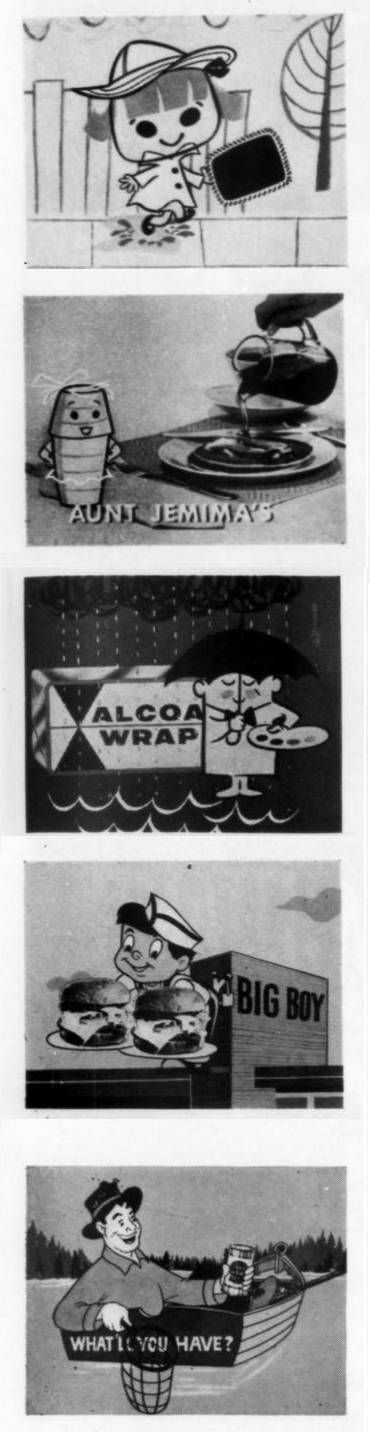
At the time, Sarra was responsible for the animated and live-action opening “Come see, come save at A & P” for Paris and Peart, Stopette’s live and stop-motion “Poof ... there goes perspiration” for Earle Ludgin and Pabst’s animation and stop-motion “What’ll you have?” spots for Warwick & Legler. We caution the article does not state exactly which footage it is referring to. Claiming the “Poof!” opening on What’s My Line? is what it mentioned is only speculation, unless further information is made available, though another article reveals Sarra made commercials for a powder that appeared during the show. Fact A + Fact B don’t always equal Fact C. To the right are some frames of some of the animated commercials made by Sarra in the 1950s; the top one is for something named Musterole.

There is a post-script to the story involving someone stop-motion fans should be familiar with. Ray Harryhausen sued Sarra in 1957, claiming he brought the stop-motion cigarette march idea to the company and it was rejected. The next thing he knew, there it was on television. If you want more information, a transcript of the testimony can be found here.

Sunday, 17 November 2024

Tralfaz Sunday Theatre: Magoo is No Dim Bulb

You couldn’t help but see the incongruity of someone who couldn’t see, selling light bulbs.

As Television Age of March 21, 1960 put it in a feature story on General Electric signing with UPA to use Mr. Magoo in its TV ads: “The advertiser felt no hesitation in choosing for its salesman a bumbling, half-blind little guy who obviously sees no better with GE light bulbs than without, evidently feeling the humorous approach would work in its favor. Magoo himself has worked for other advertisers—most notably Stag beer—in regional campaigns, but GE intended to promote its use of the character to such an extent that Magoo and GE bulbs would be synonymous.”

And Television Age was told by G.E’s ad manager that it moved its money from print into spot TV because it worked for Lestoil, which had cartoon ads parodying Dragnet.

Sales Management magazine of February 17, 1961 pointed out G.E. spent a million dollars on Magoo TV spots in the fall of 1960, and another $100,000 in accompanying promotion among its dealers.

It boiled down to one simple fact: people loved Mr. Magoo.

Rather than go on and on about what trade publications had to say, let’s give you something a little more fun—a 1963 G.E. promotional film for the company’s retailers. Not only does it feature some Magoo commercials, but Jim Backus is on camera to give an explanation. And there’s a cameo appearance by the NBC peacock (a little washed out, but the print is old).


Saturday, 30 December 2023

Paul Fennell

Animated television commercials were still popular with ad agencies and clients as 1960 drew to an end. Small production houses continued to make them on both coasts and in a number of other cities, including Albuquerque.

Below are some far-too-low resolution frames taken from the pages of Television Age for November and December 1960.

A bit of a key if you haven’t caught these compilations before—

Ray Fatava was a former animator for Gene Deitch at Terrytoons. Elektra was fronted by Abe Liss, ex-UPA animator. Ray Patin was an ex-Disney and Warners animator; his art director was John Dunn. Lars Colonius had been a Disney man, who later made the favourite fallout paranoia film Duck and Cover. Film Fair was run by Gus Jekel. Playhouse Pictures was owned by Ade Woolery with Bill Melendez as one of his top creative people. Animation Inc. was led by Earl Klein, who was a layout artist for Chuck Jones in the war years. Fred Crippen was the president of Pantomime. Pelican was the company started by ex-MGM animator Jack Zander. And Joe Oriolo was in charge of the Felix the Cat TV cartoons made at Paramount and distributed by Trans-Lux. In what looks like a promo frame below, Felix is doing a send-up of Ed Murrow's Person to Person TV show, complete with lit cigarette and ashtray.


A number of studios aren’t represented in the frames above, including Quartet Films (Art Babbitt, Arnold Gillespie, Stan Walsh and Les Goldman), Grantray-Lawrence (Ray Patterson, Grant Simmons), Cascade Pictures (Tex Avery and Bill Mason), Herb Klynn’s Format Films (gearing up to produce The Alvin Show) and Paul Kim and Lew Gifford out of New York.

One other name missing from the list is Paul J. Fennell, who seems to have wound down his studio on North La Cienega Blvd. and accepted a job as a director at Hanna-Barbera before being hired four months later in July 1959 as an associated producer by Larry Harmon Productions, makers of Bozo the Clown TV cartoons and sub-contracted to make some of the Popeye cartoons for Al Brodax of King Features, as well as Dick Tracy and Mr. Magoo TV shorts for UPA. An ad in Billboard in its Dec. 16, 1957 issue marks the studio’s 12th anniversary with a list of clients, including Campbell Soups, Kellogg, Philco and U.S. Rubber, makers of Keds running shoes. The company animated Kedso the Clown. The studio’s art director was Ed Benedict before he went to MGM.

But Fennell went back long before that and was one of the veterans who stuck around animation for decades. Chuck Jones says his first job at Leon Schlesinger’s studio in 1933 was assisting Fennell, who had been hired from Disney to animate when Schlesinger parted with producers Hugh Harman and Rudy Ising earlier in the year.

Fennell was born November 9, 1909 in Grafton, Nebraska. The 1930 Census reports he was a private at the U.S. Naval Air Station near San Diego. In April the following year, his career took a large turn as he was hired at Walt Disney. After his stint at Schlesinger, he was employed by Harman and Ising on their MGM cartoons; Bill Hanna said he was the uncredited co-director of To Spring. Hugh and Rudy were bounced in 1937; by December that year, Fennell was hired at Ub Iwerks’ newly refinanced Animated Cartoons, Inc., which was renamed Cartoon Films, Ltd. Through some set of circumstances, Iwerks returned to Disney and Fennell took over the operations, making animated commercials for movie theatres and the Gran’ Pop Monkey cartoons originally intended for British cinemas. Among his animation staff were Rudy Zamora, Don Williams, Tom McKimson and Ed Benedict.

We’ll allow the Los Angeles Tidings, a Catholic newspaper, of October 1, 1954 to fill us in about Fennell’s biography and his post-war studio.

Inside TV Commercials
When those little figures in the cartoon commercials dance across your TV screen, do you flip to another channel while Junior howls: “I want to see the funnies?"
Or do they "get" you as they must be getting millions of others?
These little creatures of crayon are big business in TV today. Yet few persons realize the time, effort, and hard cash that go into the making of each single, one-minute cartoon.
According to Paul J. Fennell, one-time Disney animator, who now operates his own studies at 404 La Cienega Blvd., it takes staff of about 20 talented artists, technicians and ideas experts from 10 days to two weeks to turn out a commercial cartoon you'll see on your TV set in one minute flat.
At the Fennell studio, equipment and processes are just the same as at the vast Disney plant. The scale is smaller, but the objective is the same. And Paul Fennell is quick to point out that the inspiration behind the commercial cartoon had its source in the fertile land of Walt Disney.
Told It to the Marines.
Back in 1931, Fennell, "always able to draw a little," joined the Disney staff. He was there 3 1/2 years. He worked too for Schlesinger’s cartoon department at Warners and for Paramount in New York, where he drew some of the early caricatures of Popeye.
Paul Fennell himself was a marine. He joined them first when only 19 and got into that Nicaragua jaunt. His second hitch, during World War II, found him at the photo-science labs operated by the Navy where, directly under late Secretary of the Navy James Forrestal, he organized a team to "draw pictures of battles: not to fight them."
Every naval engagement had to be filmed to instruct personnel and inform strategists. This couldn't be done during actual battles, so it had to be reconstructed by Fennell and others. They used "doodles" for ships, and in cartoon form tested the deployment of US and enemy warships.
When Paul Fennell, by this time a lieutenant colonel, left the service in 1945, he'd had a lot of additional experience. Friends offered to put up the cash to enable him to "start on his own." Shaking a bit, he agreed. For one thing, his wife Lucille—a convert, by the way—already had presented him three of the four children they now have. They had the family—it's now two of each—but, as yet, no home.
The firm now is debt-free, and the Fennells have a fine home out in the San Fernando Valley parish of St Francis de Sales. Prayer, faith and enterprise have been rewarded.
Precision Amazing.
The Fennell studio, humming like a hive, turns out such familiar animated cartoon characters as the Campbell Soup Kids; the tumble-haired boy with a Cheerio muscle in his arm; Snap, Krackle and Pop, the Rice Krispy trio; and several other of the little folks you let into you home for a minute, now and again.
Everything is done with precise sketches and suitable forms of animation. You would be amazed how many different drawings have to be made.
Even a one-minute cartoon often meant drawing and coloring 1,000 different, consecutive pictures. The backgrounds, all drawn separately, change from 20 to a hundred times—which multiplies the chores.
Success Speaks Well.
There's more to it, however, than just drawing. These cartoon creatures—whether used in commercials or theatrical films—begin to live, to take on personality. Then, like real mortals, they begin also to reflect examples, good or bad.
Paul Fennell, a life-long Catholic, makes sure that what they say, sing or do is always morally decent.
He speaks more of "keeping them in good taste,” but says “they're comical and amusing only when they’re clean.”
And his success proves that at least some of the more important TV sponsors are thinking along the same healthy lines.


Among Fennell’s other projects were illustrating the children’s book “The Bear Facts” by Polly Cuthbertson (1947), a award-winning, 18-minute short for Penn Mutual Life Insurance named A Century of Security (also 1947) and a ten-minute film for the National Tuberculosis Association called You Can Help (1948). The company even registered the music for a jingle for Schmidt’s Ale (1951).

Larry Harmon’s studio fizzled out in the early 1960s, as did many of the commercial operations; Harmon’s Laurel and Hardy series was finally produced at Hanna-Barbera. Friz Freleng brought in Fennell and put him “in charge of cartoon blurbs” (Daily Variety, Feb. 9, 1966) but I don’t believe he was credited with any cartoons at DePatie-Freleng. He then was hired for a decade-long run at Filmation.

In 1984, he was among the honourees by the Screen Cartoonists Guild for a half century in animation. He died January 18, 1990.

We leave Mr. Fennell now to post some ads from the year-end edition of Television Age for 1960.


Saturday, 28 October 2023

Commercials at Animation, Inc.

A few weeks ago, we posted frames of animated commercials reprinted in Television Age magazine. We’re going to post a few more below, this time from 1958.

The frame to the right is, of course, not a cartoon. But Arnold Stang has a connection to animation so I thought I’d include this one. Plus, I love Arnold Stang. No, I don’t know where to find the commercials on-line.

This frame was also used in trade ads for Sarra, with the caption: “It's quite a stunt to slice off the top of a man's head and make it funny! SARRA does it with trick photography and Arnold Stang's head and histrionics. In a series of 60-second and 20-second live action commercials for Scripto Pens, Stang ‘talks off the top of his head’ while the announcer's hands demonstrate ‘coloressence’ and other features of the product. A technical feat produced by SARRA for SCRIPTO, INC., through DONAHUE & COE, INC.”

The one problem with the on-line copies of Television Age is the resolution is not very good. The reproduced frames are not very sharp and some are too dark. For example, you can barely tell that Happy Joe Lucky is riding a horse and the pack of Lucky Strikes in his hand is very fuzzy. But the frames do give you an idea of the animation styles employed in the different commercials.


Pelican was run by Jack Zander, Academy by Ed Gerschman, ex-UPA business agent, Playhouse by Ade Woolery and Animation, Inc. by Earl Klein, whose name appeared in a few cartoons when he was in the Chuck Jones’ unit at Warners.

The company and Klein were profiled in the April 7, 1958 edition of Television Age. By this time, among the animators were Irv Spence and Ed Barge. Bob Kurtz was later a creative director with the company. Someone had a brown nose after writing this. Oh, Earl, tell potential clients again how much money of theirs you won't spend.

Originality builds Animation
Earl Klein’s youthful firm finds excitement in creating commercials

May 1 of this year marks the third anniversary of Animation, Inc., of Los Angeles—three years that have seen the youthful film production company grow from a trio of employes to a staff of 20, and from a handful of clients to a list boasting such important tv-advertising names as Heinz, Johnson’s Wax, Campbell’s, Kroger and Betty Crocker, among others.
Animation, Inc., has a staff of talented people who produce film commercials that not only entertain and sell products, but consistently win top art and advertising awards, as well. Naturally, also, the company uses up-to-the-minute techniques such as xerography or a new color transmission off black-and-white film. But, in the case of the success enjoyed by the fledgling concern, the catalyst seems to have been the dominant personality of president Earl Klein.
No doubt about it, when Earl Klein left Storyboard, Inc., after producing a number of award-winning commercials, and formed his own animation studio, his individualistic approach met resistance from the advertising agencies. “I enjoy the thrill and excitement of creating,” he has said. “An imaginative producer must find it frustrating when the agency assumes all responsibility.”
Constantly voicing his opinion that a film made with imagination and originality would get attention favorable comment from the public— resulting in name and product recognition—Earl Klein finally succeeded in convincing several agencies. Among these was W. B. Doner & Co., Detroit, for which Animation, Inc., produced several award-winning films for Speedway Petroleum. Other early clients were Standard Oil of Ohio and Bank of America. Films are still made at the studio for both Speedway and Standard Oil, and the spots made originally for the Bank of America had an inventiveness and ingenuity that foretold the “offbeat” spots used by many such firms today.
In the past few years, the number of animated films used on tv has increased considerably—and the number of producers has almost doubled. With a high mortality rate in the field, Earl Klein’s background has enabled him to build his company surely and steadily.
Now just 41, Mr. Klein was born in Cleveland and studied at the Cleveland School of Art, the Chicago Art Institute and the Meinzinger Academy of Detroit. He began his animation career as an assistant at the Jam Handy studios in Detroit.
In 1936 he joined Max Fleisher’s unit in Miami as a designer, working on Gulliver's Travels and Popeye shorts. In 1941 he worked at Wright Field in Dayton, Ohio, as a supervisor on Air Corps training films. He continued this phase of his career after moving to California the following year, when he also did design work on Bugs Bunny cartoons at Warner Bros.
From 1949 to 1953 he served as art director for the Raphael G. Wolff Studios. Eventually he became a freelance designer and worked for UPA Pictures, Academy Productions and John Sutherland Productions, among others.
In February 1954 Mr. Klein formed a partnership with John Hubley and organized Storyboard, Inc. Within a year, commercials produced by the company had won three of 10 awards, including a gold medal, from the New York Art Directors Club and six awards from the Detroit Art Directors Club.
Finally, in 1955, in an effort to gain even more creative freedom, Earl Klein set up the fast-growing Animation, Inc. Always on the watch for ways to hold down costs and increase service to his clients, Mr. Klein’s studio became the third—others are Walt Disney Studios and UPA—to use the xerography duplicating process. This electronic transfer technique permits the use of soft lines in animated drawings, rather than the customary solid blacks and hard lines. The process has been used in the prizewinning Betty Crocker and Kroger commercials.
“Xerography is a time- and money-saving step forward,” says Mr. Klein. “It’s a touch of automation to what is still essentially a hand-crafted industry.” He admits such techniques have only limited applications. “The personal touch,” he states, “is still a much-wanted quantity in the animated film. Animation cannot go into mass production techniques without losing this necessary factor.”
Virtually all of the commercials produced by Animation, Inc., have borne Earl Klein’s stamp of originality —a simplified graphic visual treatment with an unusual soundtrack using either clever rhythmic musical effects or novel voice delivery. Cases in point: Johnson’s “buzz-z-z” bee or the bass-voiced Kroger cow mooing “No-o-obody” in answer to the question, “Who but Kroger?”
In addition to a number of tv commercials now shooting at Animation, Inc., two “first-time” projects are being developed. In association with Transfilm, Inc., Mr. Klein is preparing a 16mm film requested by the Museum of Modern Art for Fortune Films. Entitled The Decisive Decade, the film deals with American economy over the next 10 years and is the company’s initial such sales-promotion venture. Decade will be produced in color, an operation which adds about 20 per cent to the over-all cost, according to Mr. Klein.
With the Universal Broadcasting System, Animation, Inc., is preparing a first commercial in a new technique that will utilize specially prepared art on black-and-white film to transmit a color picture. Present plans call for the licensing of the system to interested parties.
With these and other ideas for future expansion, Earl Klein’s Animation, Inc., seems sure to achieve a still greater measure of success.


Animation, Inc. lasted until about September 1964. In that month’s issue of Film World and A-V News, Klein announced he was shutting down, and had recently sold his studio and sound stage to Westheimer Company, an optical production house. Klein decided to devote his time to fine arts at his studio in San Juan Capistrano. Animation, Inc. won 50 advertising and art awards during its 9 1/2 years of existence.

Here are a few more frames from commercials of 1958. You’ll notice one from Grantray-Lawrence, the Grant Simmons/Ray Patterson company. Gene Hazelton was the company’s art director and I suspect he designed that commercial. Whether the Transfilm commercial is mixed animaton/live action, I don’t know, but that sure looks like Don Knotts and, you know, he has a cartoon connection, too.

Saturday, 16 September 2023

Cartoon Commercials of 1960 and Ray Patin

Cartoon studios were already cutting back operations in the late 1940s. MGM and Warner Bros. closed units, Screen Gems was shut down altogether and Walter Lantz stopped production for a little over a year.

Meanwhile, television was growing, especially in New York and Los Angeles, and as stations signed on, advertisers jumped on board. One thing they found was they could get their message across using animation (they didn’t believe the hooey that cartoons were only for kids), so a number of the Golden Age animators set up their own studios, providing places of employment for former co-workers through the 1960s.

I love animated commercials of this era. Thousands were made but only a handful seem to be out there to view. Amid Amidi’s wonderful book Cartoon Modern examines the period.

Television Age magazine came out monthly and not only published news about the commercial houses (live action and animation) but provided frames from the spots. It’s a shame the issues available on line are low resolution so you can’t get a great view of what the artwork looked like, but here are some examples from the May 16, 1960 edition.


I won’t try to go through a dissertation about the companies mentioned above; all top-flight operations. Off the top of my head, Adrian Woolery of UPA was the man behind Playhouse, with Bill Melendez as one of the directors. Jack Heiter—who is still out there—was one of the people behind Pantomime. Pelican was one of the companies which put Jack Zander in charge of its animation. Earl Klein was behind Animation, Inc., but Irv Spence and Ed Barge were there, too. Abe Liss, formerly of UPA, started Elektra (it was responsible for the NBC “Living Color” Peacock animation). Ray Favata had designed spots for several studios, including Academy Pictures in New York. And Ray Patin had been a Disney striker.

Among the stories about commercials in this edition:

Two designers for Robert Lawrence Animation two weeks ago exhibited close to 50 of their paintings at the company’s studios, just to prove, apparently, that there’s no conflict between art and commercialism. Both men—Cliff Roberts and George Cannata—design animated tv commercials during working hours. Mr. Roberts, who holds five awards for designs of commercials and industrial films, is also a book illustrator, and he recently held a one-man show at Long Island University. Mr. Cannata has had his paintings exhibited at the Los Angeles County Museum of Art three times since 1955. He was cited for his designing of a Lestoil commercial at the International Advertising Film Festival at Cannes in 1959 and has also won numerous Art Directors Club awards.
Ray Patin Productions is producing a series of semi-abstract animated color spots for Hudepohl Beer (Stockton, West, Burckhart, Cincinnati). The spots, to be telecast in color, will be seen in regional broadcasts of the Cincinnati Redlegs baseball team.
The first annual International Animation Film Festival will be held in Annecey, France, from June 7 to 12.
Several appointments have been made by UPA Pictures, Inc. Jerry Hathcock has been named supervising director for all animation, Errol Gray has been appointed to the post of production supervisor, and Robert F. Kemper has been signed as mid-western representative for the company. Mr. Kemper, who will also continue to represent Jerry Fairbanks Productions, headquarters in Chicago.
A number of new series of Ford commercials, including one introducing the “Linus” character to television, is being prepared by Playhouse Pictures. In addition to the “Linus” spot for Falcon, they include two two-minute “Peanut” spots and two more “Shaggy Dog” commercials. All are in color. The agency is J. Walter Thompson, New York.
Format Films, formed by Herbert Klynn last year, now has more than 40 employes and is preparing to move into a new studio in Studio City. The company has just completed six more spots for Folger’s coffee (Fletcher, Richards, Calkins & Holden, San Francisco) utilizing a coffee-bean character.
Animation, Inc., is producing two more spots featuring a talking cow for the Michigan Milk Producers Association (Zimmer, Keller, & Calvert, Detroit). The first in the series won a Chicago Art Directors gold medal last year.


We’re going to make a left turn away from ‘50s commercials because I found some stuff on Ray Patin I want to pass along. The story below was published in the Lafayette, Louisiana Daily Advertiser of March 28, 1930. Patin and his parents had been in Los Angeles for 11 years at this point. He was working as a clerk at an car dealership.

Ray Patin, Former1y Of This City, Making Good Progress On The Road To Art Fame
Engaging in drawing as a side-line occupation for the present but intending to adopt it as his profession later, Ray Patin, formerly of Lafayette, now residing in Los Angeles, California, has already made considerable progress along the road that leads to fame in art.
Many Lafayette citizens will remember Mr. Patin as a boy. His father was at one time a local newspaperman.
“As much as I like art work I haven’t yet gone into it professionally,” Mr. Patin writes a friend here. “However, I am preparing myself, through night study, and all the spare time I can find, to some day make a big splash into it and bat s thousand per cent from the start. My greatest ambition is to become a strip artist, not of the ‘slap stick’ variety, but the ‘Big league’ type with drawings and stories of real value, educationally and entertainingly. However, it’s mighty hard to say just what type of art work I will fall into. It’s easy to say you’ll do a thing but still another proposition to ‘put out the stuff’ and prove you’re all that you boast of yourself. I’ll keep plugging though, and if ‘stick-to-it-iveness’ is the right road to success than I should stand some chance, as I have led to buckle down real seriously to the work that has always been my hobby.”
Born in Breaux Bridge, Mr. Patin, who is 24 years of age, spent eight years of his early childhood in Lafayette. The family then moved to the west, and eventualy [sic] located at Los Angeles.
“We like it out here an awful lot but we can never forget our old friends and my dear relatives in Lafayette and Louisiana,” Mr. Patin states.
The young artist received most of his training as a cartoonist on the staff of the paper published at the high school he attended In California, to which he contributed a cartoon weekly. Far [for] a while he also drew a weekly comic strip in the Junior Secetion [sic] of the Los Angeles Times but was forced to disctontinue [sic] this for lack a time. He was submitted to the Los Angeles Herald seven or eight cartoons, most of which have been accepted. One is reproduced on this page. He has also turned to more serious themes than cartoons, and has produced a series of etchings of southern California missions.
“I have always liked to draw,” the former Lafayette boy declares. “In fact, the desire to have a pencil in my hand and something to draw on put me into quite a few ‘pickles’ at school when friend found something else behind a geography book besides an inattentive pupil.”
Mr. Patin comes by his artistic talents naturally, for his father Maurice Patin, is well-known to many residents of this section as an able writer. and also skilled as an amateur artists. The father was for several years connected with the former Daily press here and later with the Lafayette Gazette which was purchased by the Daily Advertiser.


Patin’s first animation commercial on television appears to have aired on June 25, 1948, back when Los Angeles still had only two stations. The Times wrote:

A telecast over KTLA at 7:14 tonight by Security-First National Bank will probably be the first commercial television program sponsored by a bank, the Financial Republic Relations Association said today.
The program will be an animated film on checking accounts made by Ray Patin, former Disney artist, under the supervision of Foote, Cone and Belding.


The “program” would have aired during the Judy Splinters Show. Considering the air time and the fact an ad agency was overseeing it, as opposed to an industrial client, I presume it was a commercial.

While this was going on, Patin was drawing a daily strip for a group called the Artists Associated Syndicate. This appears to have been a joint venture of some animators—Gus Jekel (Patin’s designer), Gil Turner, Dick Moores, Fred Jones, “Mitchell” (ex Warners writer Dave Mitchell aka Milt Kahn?), Jerry Hathcock and “Bob Dalton” (Bob McKimson and Cal Dalton?) were among the artists; most, but not all, the small papers that picked up the strips were in California. This one is from Feb. 20, 1948.


Milford, by the way, was an animated character. Patin had him star in TV spots that ran in the early 50s during Industry on Parade on a station in Oklahoma City (whether Milford was on the KTLA commercial, I don’t know).

Patin also designed a character for a beer can. Ray Patin Productions animated commercials for the Rainier Brewing Co. that aired in the Pacific Northwest.

Work began drying up for animated commercial studios as the 1960s wore on. Clients switched to live action, which had become less expensive. Patin’s operation, which had been at 6650 Sunset Blvd., ended up at 3425 Cahuenga Blvd., almost across from Hanna-Barbera’s new brand-new studio. In 1967, 45 members of H-B’s commercial and industrial division moved to the other side of the street into the now-empty Patin building. When Patin Productions closed, I don’t know.

Patin died January 17, 1976 in Panorama City, age 69.

I was just about to put this post to bed, but have discovered Ray Patin's daughter Renee has a website. She's written an autobiography. You can check out her site at this link.

Saturday, 25 June 2022

Not Bert and Harry

Want to sell beer? In the 1950s and early 1960s, the combination that seemed to work was cartoons and comedy.

Hamm’s featured an animated bear in its TV ads. Mr. Magoo sold two different brands of brew. Perhaps the most famous cartoon beer hawkers were Bob Elliott and Ray Goulding as Bert and Harry Piel. Word is their Piel’s beer spots were so popular, they were included in New York television listings in newspapers.

There was another famous comedy couple employed to sell beer to a regional audience, appealing to the smart set in their own way as much as Bob and Ray. Mike Nichols and Elaine May were seen on Ed Sullivan and other variety shows, breaking up audiences with their nightclub routines. In 1960 they were hired to lend their voices to ads, both radio and TV, for a regional beer.

In the May 1961 edition of Television magazine, an article entitled “Keeping Up With the New Generation” states:
Last year the Jackson Brewing Company, New Orleans, marketing its Jax beer in nine southern and southwestern states, left off live-action film commercials on an “adventure in taste” theme to go with fun, animation and the voices of Nichols & May.
The commercials—full animation, no break for the usual “live” product shot —center on humorous situations: a cowboy who brings his horse into a bar, is saddened when the animal is refused service; a talking dog, also refused service; a woman who uses Jax to wash her hair; a man who breaks his teeth taking off a Jax bottle top.
Jackson, advertising via Doherty, Clifford, Steers & Shenfield, New York, works its key themes into the humor (“real beer taste,” “premium brewed from 100% natural ingredients”), has had its share of success as measured by a sales increase last year, a flood of complimentary viewer mail, and even a request from a TV station for permission to run the commercials in its local programming.
The article adds that a survey of best-liked TV commercials conducted in January 1961 by the American Research Bureau found five beer companies ranked in the top 31, with Jax at number 11 with 2% of mentions (Hamm’s was no. 1 for the eighth year in a row).

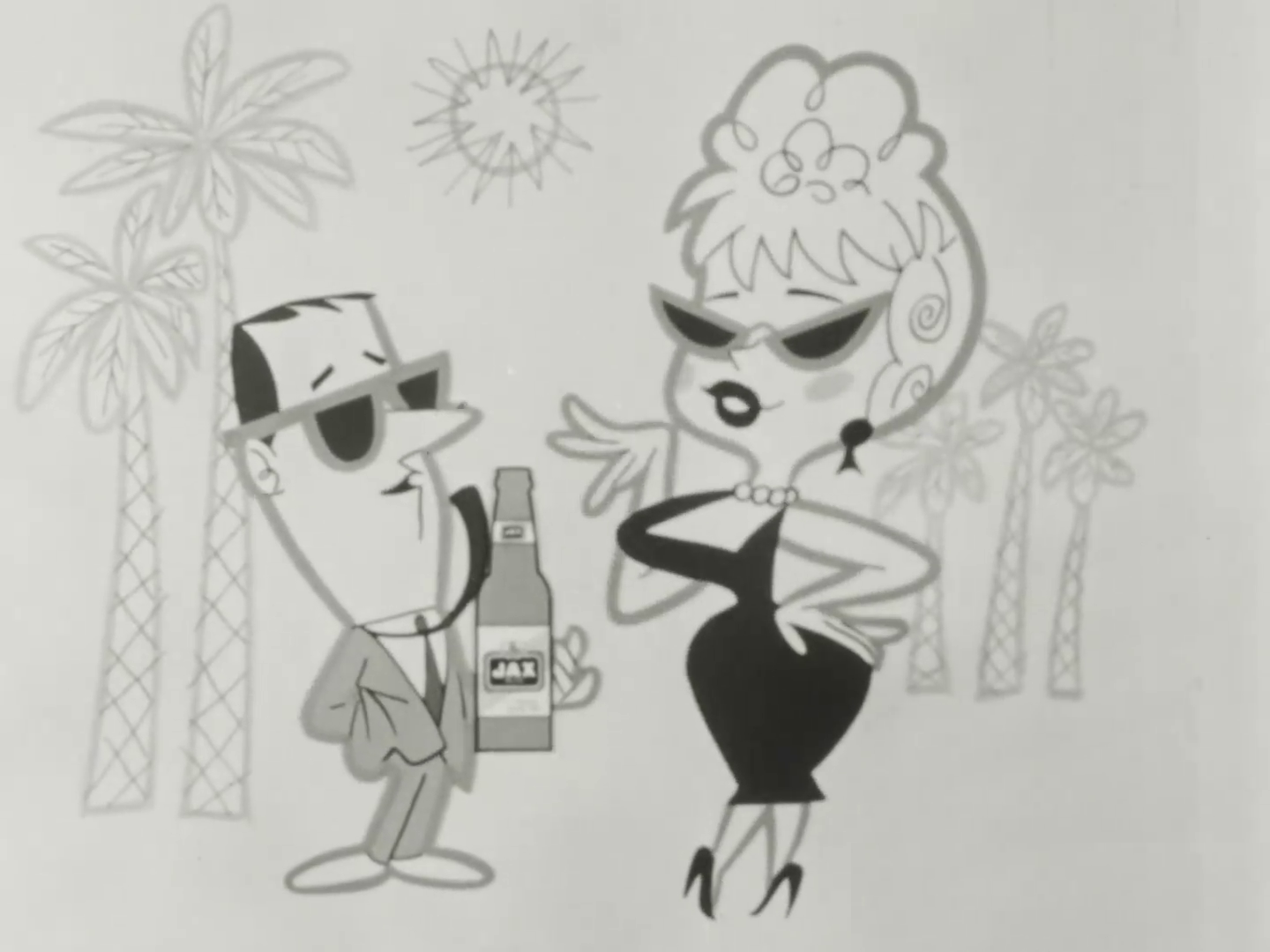
Though Jax was based in New Orleans, its New York City ad agency decided to have the TV spots animated in New York City, where there were a number of excellent commercial/industrial studios. According to the May 15, 1961 edition of Television Age, the agency hired Pelican Films, the firm owned by Jack Zander, who started with Romer Grey’s ill-fated studio in 1930, and later animated Tom and Jerry for Bill Hanna and Joe Barbera. He formed Pelican in 1954. One Nichols-May spot for Jax involving a kangaroo won honours at a commercial animation festival in New York in 1961; Chris Ishii co-directed with Armin Shaffer designing the characters.

Here are some frames from one 60-second commercial that spoofs The $64,000 Question. Nichols plays the quiz-master, with May as “Miss Mallory,” the contestant in the sound-proof both. Nichols confides in the audience that the contestant’s father, whom she hasn’t seen in 45 years, is next door. Miss Mallory blows the question (about Jax’s slogan, “premium brewed from 100% natural ingredients”) and a stage-hand grabs the father and hauls him away, killing any happy reunion. “Do I still get my freezer?” she asks hopefully as the camera fades out.


Here’s another one, with Nichols as an interviewer and May as “Boo Boo Gorman, popular Hollywood starlet,” who spends much of the interview being an airhead and blowing bubbles. You’ll see a logo for TVDays.com, a site owned by Ira Gallen, who rescued these, and countless other discarded reels of old television film.


The interviewer has trouble pouring the beer into a glass.


Boo Boo reveals her measurements are 76-22-64 1/2. The interviewers eyes make a path equalling the ridiculous measurements.


The spot comes to a halt when Boo Boo blows a bubble and then says she sinks in the ocean. No tag line for the beer, just a fade out.


1961 was the year the networks, encouraged by ratings for The Flintstones, started snapping up cartoon series for prime-time. All kinds of animation outfits tried to jump on board. Variety of September 20th that year reported Pelican and Total Television Productions joined together to concoct “Parrot Playhouse,” which never got on the air. Zander’s company carried on with commercials and, in 1966, debuted the 10-minute short A Nose at New York’s Trans-Lux Theatre.

Pelican remained busy, despite a bit of a downturn in the commercial animation industry in New York. An article in the February 28, 1966 edition of Broadcasting reported the company had 56 animated commercials in various stages of production and gave a prediction of gross income that year of around $3,500,000, up a half-million dollars from 1965. Some clients are below:


When the ‘70s rolled around, Zander put Pelican to rest after roughly a thousand commercials and opened Zander’s Animation Parlour. He retired in the mid-‘80s, and passed away, a respected figure in animation, at the age of 99 in 2007, leaving behind some stylish, enjoyable commercials. If only more of them were in circulation.