Tuesday, 22 March 2022

Cat Tail For Spring

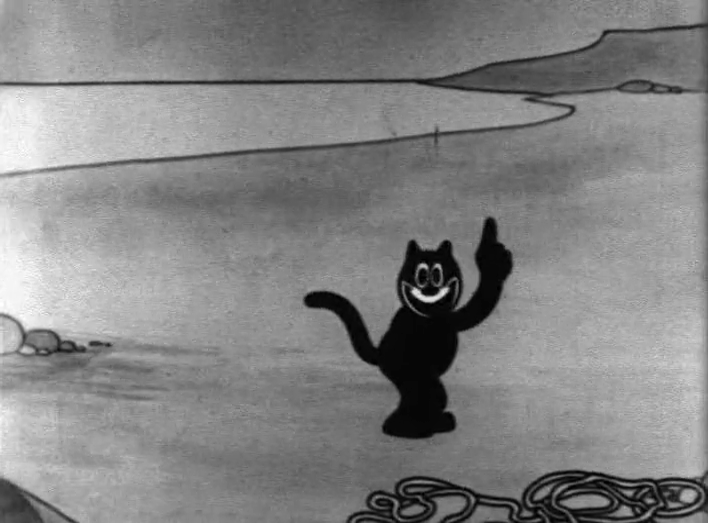
The only real puzzle in Alice Solves the Puzzle (1925) is why did the cartoon have a superfluous diving scene in the middle of it?

Bootleg Pete wants Alice’s half-completed crossword puzzle and chases her up a lighthouse. Julius comes up with a rescue idea. He’ll use his tail as a spring to vault himself to the top of the lighthouse.


There’s a fight for Alice’s honour. Or her crossword puzzle. Anyway, Henry, uh, Felix, uh, Julius, knocks the bear into the sky. Being a Disney cartoon, there is naturally a butt impaling gag.


Alice actually does solve the puzzle in a cute little ending that was switched a bit in The Major Lied ‘Til Dawn at Warners about a dozen years later.

Monday, 21 March 2022

Wolf, Stay Away From My Door

Viewers are behind Swing Shift Cinderella getting a view of the wolf feverishly running toward her. And the door slamming.


Cut to the wolf.


The credited animators are Ray Abrams, Preston Blair and Ed Love. Swing Shift Cinderella was released in 1945.

Sunday, 20 March 2022

Writing For Jack Benny, 1941

There’s a bit of there’s-more-to-this-story in an article about Jack Benny’s writers published by the Dayton Daily News on January 13, 1941.

The article mentions Jack Benny decided in 1936 he needed an assistant writer. It neglects to mention why and leaves the impression Jack was all alone writing his show for the first four years. That wasn’t the case at all, as Benny fans should know. Harry Conn was hired at a top salary to write the show but flamed out in a fit of ego.

Morrow and Beloin did some great things on the show, and some lousy things. To me, it seems like they were at it too long and ran out of ideas. Jack was saddled with animals—a polar bear, then an ostrich, then a camel, and then a horse. They added an insurance salesman character played by Mel Blanc who was uncomfortably wimpy (whereas over at Fibber McGee and Molly, Bill Thompson did a milquetoast guy who was funny). And Jack seemed to be yelling at everyone an awful lot.

On the plus side, they invented the Maxwell and, for that matter, invented Phil Harris; decided two dopes were one too many, so Mary became a sarcastic, insulting foil; developed the Fred Allen feud; modified the Kenny Baker character to fit Dennis Day (throwing in Verna Felton as a motherly bonus); and came up with some funny movie parodies (along with the Buck Benny Westerns). Oh, and Rochester. He arguably became the most popular person on the show next to Jack, and the writers (and Jack) eventually moved him away from a switchblade-chicken stealing stereotype. Fortunately, for the brief period he drawled he wasn't near Stepin Fetchit territory.

One other note about the article: the writers talk about up to 11 pages of changes for the repeat broadcast. Besides the spurious reasons (accommodating a couple of hundred people in a studio?), wouldn’t changes have to be run by the NBC censor? I can see a line or two, but more than five minutes of air time? I’ve never heard that extensive of a change in any of the east/west broadcasts available for listening on the internet.

Social Notes Of Interest For Gags Is Benny Woe
BY BETH TWIGGAR
NEW YORK, Jan. 13.— "Well you see," began Edward Beloin. "It's this way," continued William Morrow.
These two, Beloin and Morrow, have much to do with concocting Jack Benny's radio broadcasts on Sunday nights and they have worked together so much that they talk often as one man.
"It's a tough life," said Morrow. "As gentle as being the rear gunner on a bomber," Beloin added.
But it's hard to feel too sorry about their tough lives; they looked happy as they sat in the living room of their hotel suite, here, joking into the telephone, which jangled chronically, and finishing each other's sentences as they discussed their mutual job. Laughs were spaced about every two minutes, effortlessly. They were in the city from Hollywood for the opening of "Love Thy Neighbor," a large portion of which they wrote.
"Writing for the screen is a cinch," Beloin said, "compared to radio work. You can work the script over and revise." "Yeah, and when it's done you don't have to do it all over again for next Sunday," added Morrow.
For the radio programs the collaborators work on a flexible schedule. "But never in advance. Every once in a while Benny gets the idea it might be a good thing to have two or three programs piled up ahead, but like most of these things, it ends right there. We're last-minute men. We work under pressure."
Sometimes it gets to be Thursday, with the Sunday hour approaching like inevitable doom, and neither Beloin nor Morrow has an inspiration. "But one of us always snatches an idea out of the air from the window we open to jump out. So then we jump for the typewriter instead."
As a rule, even though the script is not written out in advance, one or the other, or both, have thoughts stored up for the future, Monday is supposed to be a day off. On Tuesday, Sunday is still a relaxingly long way off and they seldom do more than discuss the possibilities. Wednesday maybe they settle down to work, and maybe not until Thursday.
"Sometimes Benny will get ornery and wants to see what we've done before we've done anything. Then all three of us go through a little act. I'll insist Eddie has the first draft, and he claims he gave it to me. One of us says, 'Anyway, Jack, it goes like this,' and starts ad libbing. The other plays up. And Jack, having gotten us going, tiptoes away."
The Benny program is broadcast twice on Sunday nights. In New York, for instance, it goes on the air at 7 p. m. for the east and 11 p. m, for the west. In Hollywood, whence the program usually comes, the first broadcast is in the early afternoon, California time, and the second in the early evening. The double airing complicates the script-writers' chore, but not enough to feeze [sic] them.
Generally, by Friday, the first draft is ready. It'll be written four times before the two publics hear it. First Benny himself blue-pencils. After the second writing there's rehearsal and the lines are smoothed out. Sunday morning after the mike rehearsal, there is a third revision. Between the early broadcast and the late one the show is actually rewritten, with as many as 11 pages of changes put in.
"Why? Several reasons. New lines keep the cast up to scratch. If they repeated the same show verbatim, they might get lazy. Or it might throw them off, if the second studio audience didn't laugh where the first one had. Then it's a good thing for the audience to see the band enjoying the program, which they wouldn't do very obviously if it were all stale stuff. Occasionally, people want to listen to the first show at home, over their own radios, and see the second at the studio theater. They don't want to hear the same thing twice. So we write them a new program." Just like that.
Beloin and Morrow never put a gag in the script that they haven't laughed at first. "You see, we never write down to the audience. If we can't make each other smile even faintly, we know no one else will smile at all."
With one of the pair at the typewriter, they "talk" their creations, taking all the part and making up the lines are they go along. They're likely to start at it any time of the day or night, and keep on until the first draft is finished, regardless of food, sleep and social engagements. The "last-minute men" have found their tardiness advantageous more than once.
"If we had the show all rehearsed and set by Tuesday, and then one of the cast couldn't show up Sunday, we'd probably be in a devilish dither."
As it is, they can turn an emergency into fuel for comedy. Rochester's absence a few weeks ago is an example. Rochester is Jack Benny's famous butler, a mainstay of the program; Fred Allen says he's the star of the show. Anyway, Rochester was unavoidably detained, but the boys made a rousing asset out of what might have been a liability. The show centered around his whereabouts, with a telephone search through Harlem. When Jack Benny had a cold, Beloin and Morrow refused to ignore it. Instead of pretending he really wasn't sniffling at all, they made Benny's ailment the theme of the program. "Anything's funny, if you use it right," remarked Bill. "Even cliches." "Especially cliches," assented Eddie. "You [go with] a joke as long as it lasts, and drop it just before people get tired of it," said Bill. "That's the trick, knowing when to drop it," said Eddie. It's no trick at all, apparently, thinking them up.
It was five years ago that Benny decided he needed an assistant to help with the program. Individually Beloin and Morrow, who did not know each other, got in touch with him. Eddie had been writing pulp stories and finding that $12 a week was riot quite enough to live on. "Twelve-fifty is about the minimum," he observed, "to maintain our American ideals." Bill, among other things, had worked on the old "College Humor." "Fitted in just as though I'd gone to college, too," he remembered. They met by accident in a Chicago hotel, and started collaborating right off the bat.
"We’ve been doing it ever since," Bill said. "Both working together and living in hotels," finished Eddie.
Three weeks after the meeting, it was all settled. Benny found, somewhat to his surprise, that he had not one assistant, but two. And in the year since, their Sunday program has kept its popularity.

Saturday, 19 March 2022

Freddie Fudsie, Cartoon Star

They featured top animators including Emery Hawkins, designers including Tom Oreb and composers including Les Baxter. Some of them were released by MGM. But the cartoons from John Sutherland Productions may be among the most obscure ones in post-war animation history.

The theatrical release of a handful of the company’s films is only a sidelight. John Sutherland was not really in the entertainment business. He was in the propaganda business, willing to take on jobs from corporate America if the price was right. In exchange, he’d tell the tales corporate America wanted people to hear, that big industrial companies and banks weren’t ogres, but brought things that people needed, making life for everyone better, protecting The American Way.

I enjoy the Sutherland cartoons on an aesthetic level. The animation, designs and other artistry are very good, the voice work is excellent and the humour is well-placed. The message about capitalism and patriotism going hand-in-hand is a bit much, but this was the era of the Red Scare. (Ironically, John Brown who provided a voice in Make Mine Freedom was later blacklisted).

MGM released the following cartoons; basically the Sutherland shorts picked up some of the slack created when the Lah-Blair unit was disbanded to save money.

Make Mine Freedom (March 10, 1948)
Going Places (copyright Oct. 23, 1948)
Meet King Joe (May 28, 1949)
Why Play Leap Frog? (February 4, 1950)
Albert in Blunderland (August 26, 1950)
Fresh Laid Plans (January 27, 1951)
Inside Cackle Corners (November 10, 1951)

In none of the trade publications can I find a date when Going Places was released. Nor can I find an ad for a theatre screening it. But it must have appeared in theatres because the article below talks about it. The story appeared in papers September 25, 1949

'Freddie Fudsie's Animated Cartoons Are Selling American Free Enterprise
By HARLEY PERSHING

SEARCY, ARK. — (AP) — A blonde-haired moppet called "Freddie Fudsie" is seeking to sell Americans on the American economic system.
He was conceived by the president of a little Arkansas church college and brought to life on Hollywood drawing boards with the aid of Eastern capital. Freddie is an animated cartoon character.
He is the star of the second of four movie shorts designed to carry out the idea of Dr. George S. Benson, president of Harding College in Searcy. The idea is that Americans aren't doing so badly under the American free enterprise system.
The movies are geared to hold the attention of the average family through drama and humor while the message is being put over. "We're not trying to teach economics," explained Col. Nater, an associate of Dr. Benson. "All we want to do is remind Americans what a great country this is and remind them that freedom is everybody's job."
Dr. Benson is satisfied that Freddie is doing an able job of selling. He is an appealing little fellow who makes mistakes in his business operations but winds up on the right track. The story is a 10-minute fast-moving performance on the screen.
The films are the product of a four-way play — a bit of American business enterprise in itself. The credits run this way: Plots by Dr. Benson and his staff, financing by Alfred P. Sloan Foundation, artistry by John Sutherland, animated cartoon producer, and distribution by Metro-Goldwyn-Mayer out of Hollywood.
The general theme of the cartoons is that profits have helped develop American business and industry and therefore profits have helped develop the nation. But there is no profit connected with the movies.
"We didn't do it to make money," Nater explained, adding that to his knowledge M-G-M "just about breaks even" on distribution costs after charging movie theaters are rental fee. The shorts are available without cost to clubs, business firms and schools.
The first of the animated color films, "Make Mine Freedom," deals with a workman, capitalist, politician and a farmer with problems. A quack tries to give them a cure-all called isms in exchange for their freedom. Then John Q. Public pops into the picture, exposes the peddler, and all turn on him.
"Going Places," the second short, which features "Freddie Fudsie," traces him from a boy who by the sweat of his brow eventually becomes a successful soap maker. Then he gets big ideas and with a competitor forms a combine to corner the market. This brings down the wrath of Uncle Sam, and Freddie runs into more trouble when another soap is put on the market at a lower price. But the to Hollywood tradition everything turns out all right at the end for our sadder but wiser hero.
The third strip, "Meet King Joe," recently was released, and the fourth, "Why Play Leap ", is to be shown for the first time in December.
The story behind the story of this endeavor is Dr. Benson. The small-statured native Oklahoman (he'll be 51 Sept. 26) was a missionary in China when he was named president of his alma mater in this famed strawberry producing area in 1936. Harding College is supported by the Church of Christ.
When he took the job, Dr. Benson expressed dismay at the change he found upon his return to this country. He said his fellow-countrymen "had lost their old confidence; lacked faith in their destiny."
He launched a campaign to persuade Americans to appreciate what he considered the good things about free enterprise as practiced in the United States. He began speaking, writing a newspaper column, and delivering a radio commentary on the accomplishments of capitalism as he saw them.
Later Dr. Benson developed what he calls "freedom forums"—a series of seminars at the college on economics. He encouraged several of the nation's top-ranking industrialists to attend. Now these seminars attract hundreds of business and industrial executives.
He still wasn't satisfied with results. He wasn't reaching the average man—the worker who preferred something eke to forum discussions.
This brought on the idea of animated cartoons and problems of financing, producing and distributing them. Dr. Benson negotiated the first hurdle when the Sloan foundation, an organization devoted to granting money for advancement of economic education, agreed to finance the program. The amount wasn't disclosed. The educator headed for the film capital and completed his mission.


There are no credits on Going Places, but you don’t need it for the music. You heard the same peek-a-boo clarinets at Columbia and at Walter Lantz. The score is from Darrell Calker. As for voices, Bud Hiestand is the narrator, with Frank Nelson playing the good and bad mini-Fudsies and Billy Bletcher is Sam Sudso. Voice historian Keith Scott has mentioned a young man named Rolland Morris worked for Sutherland and I believe that is his voice as the young Freddie.

The cartoon features a great clenched-fist, leaning over trot cycle by one of the Fusdie’s workers, but I can only guess that either George Gordon or Carl Urbano directed this.

The Sutherland studio worked steadily in the ‘50s, producing films in animation, live action and a combination of both. A few have been fixed-up nicely and re-released by Thunderbean; it’s a shame Going Places isn’t among them. Some are profiled in trade papers; Sutherland took out full-page ads promoting a number of the cartoons now circulating on the internet. Some day, perhaps, a history of the studio will be written so we can learn more about this little corner of the animation world.

Friday, 18 March 2022

Familiar Poses

Even an air of familiarity can’t make Chuck Jones’ Tom and Jerry cartoons entertaining.

Here’s a Grinch grin.


The dog with the small hindquarters up in the air (Belvedere in Doggone South).


The Wile E. Coyote side look at the camera. Jones loved that one.


This is from The Cat's Me-Ouch from 1965. A good crew worked on it but there wasn’t much left for Tom and Jerry to do by then.

Thursday, 17 March 2022

Turnaround Cat

At Terrytoons and Hanna-Barbera, Carlo Vinci used to have an animation routine where a character would leap up, stretch out, churn his back legs while moving backward in mid air, then zoom out of a scene with a trail of dry brush strokes.

Here’s a good example of the same thing from another studio.

In Crazy Mixed Up Pup, an innocent kitty in a doorway suddenly notices Sam-as-a-dog running toward him (off camera). Here are some of the frames as the kitty zooms out the door.


Don Patterson, La Verne Harding and Ray Abrams are the animators for Tex Avery in this Walter Lantz short.

On the strength of this cartoon, Lantz decided to make it into a series. The problem was that Tex was gone. No one else can be Tex Avery.

Wednesday, 16 March 2022

Desi

His name will always be joined together with Lucy’s.

“The same old booze and broads” finally broke up Desi Arnaz’s marriage with Lucille Ball. Lucy pushed for I Love Lucy to get on the air because she thought it would save her marriage. It did for a while. And even though Lucy re-married, fans insist the two loved each other until the day she died.

Desi wasn’t an actor when he put I Love Lucy together. Nor was he a producer. He was a musician. His acting skills were passable for the show; he came across as a decent guy. His producing skills were brilliant. He insisted the show be shot on film, meaning the episodes could be re-run. That meant money, money, money, though I imagine CBS got a good chunk of it.

Here’s a syndicated newspaper story April 24, 1958 when he and Lucy were arguably TV’s number one couple.

TV Star-Tycoon Desi Arnaz Gets Lots of Riches But No Emmy for Recognition
By ERSKINE JOHNSON
HOLLYWOOD—(NEA)— Hollywood's biggest house cleaning job had been completed and it was moving day for Lucille Ball and Desi Arnaz.
Desi wanted to bring along his bongo drum for a fanfare of wild ecstatic beats because of the occasion's significance but Lucy had talked him out of it. With nothing to do, rare for him, Desi just stood and looked at the new Desilu Studio—the big, 14-stage one-time RKO motion picture studio which he and Lucy purchased last fall for $6,150,000.
Then he looked at me and grinned:
"It ain't an Emmy!"
After seven years of TV stardom and executive status as owner-boss with Lucy of a company which produces twice as much film for TV as any of the major movie studios produce for the world's theaters, Desi Arnaz has never won an Emmy or even been nominated for one.
Turned Prophet
He's been called Hollywood's TV tycoon.
He's been called a TV business genius.
He's been called a TV prophet for deciding film was best for "I Love Lucy" back in 1951.
He's been called to watch Lucy accept an Emmy.
But he's never been called to the stage for personal TV recognition.
"There never was an Emmy for my type of performance," he likes to laugh about it. "I even suggested a classification for Cuban fellows with an accent who played the drums, who were married to redheads but nothing happened."
Nothing happened, that is, except that the 41-year-old fellow Lucy calls "The Mad Cuban" became the first TV star to buy a motion picture studio. Or as Hollywood likes to tell it, "Lucy said, 'All I want for Christmas is RKO,' so Desi bought it for her."
Three Studios
What they really own is three studios — two in Hollywood, one in nearby Culver City. Total sound stages: 35. Total TV shows filmed under the Desilu hallmark—27. Along the way, as you may have heard, Lucy and Desi picked up a big home next door to Jack Benny in Beverly Hills and another in Palm Springs, where they also own a hotel and an 18-hole golf course. Not bad for a one-time bongo drummer and a long-time movie comedienne.
Now they hope to make movies, too. Or as Desi tells it: "If we get a good story that just won't fit on that small screen, then we'll do it as a movie feature." It was moving day for Desi¬lu. More room, more stages, bigger offices, Ginger Rogers' old dressing room for Lucy, their favorite foods in the studio cafe, an oak paneled kingdom for Desi, a built-in nursery for the new baby of one of their writers, Madelyn Pugh.
Met at RKO
It was sentimental day and homecoming day, too.
A Hollywood success story with a wallop.
Lucy and Desi met and fell in love on an RKO movie stage in 1940. But RKO studio, now Desilu Studio, fired Desi a few months later. Then RKO didn't agree with Lucy on her career, Desi returned to his old job as a bongo-beating orchestra leader and Lucille moved on to bigger and better roles at MGM.
They found memories of those days during their spring-housecleaning job at the studio. Photos of Lucy in the studio files captioned "screendom's most colorful young actress."
I can even tell you that Desi couldn't even find RKO studio on his first day in Hollywood, He'd been signed after clicking on Broadway in "Too Many Girls." He drove through the entrance to a cemetery ad joining the studio that first day and announced to the surprised gateman:
"I'm Desi Arnaz. I work here."
The gateman laughed and said, "Mister, if you're a live actor, you belong next door. Drive down the street a couple of blocks. That's RKO." And that's Hollywood, too. Today Desi owns RKO.


That all changed within two years. Lucy and Desi shot their final scene together on The Lucy-Desi Comedy Hour in 1960. Lucy filed for divorce days later.

What happened to Desi? Let’s jump ahead nine years. Here’s a wire service piece from August 23, 1967. There were two versions of this feature story. One started “On a clear day, Desi Arnaz can see the horizon line of the blue Pacific from the terrace of his beach home here and even on a foggy morning, he can spot neighbor Jimmy Durante studying a racing form sheet.” There’s no mention of Durante or “buying alfalfa and selling yearlings” in this longer version.

Back In Show Business, Desi Arnaz Is Surprised
By CYNTHIA LOWRY
AP Television-Radio Writer
DEL MAR, Calif. (AP) — Desi Arnaz, in the period following his divorce from Lucille Ball, sold his stock in Desilu, quit show business and retired to his horse farm, his boat, the track and golf course. He stood it for three years, but now he's back with both feet—and seems a little surprised.
"Things that got me where I was were the things I couldn't do when I got there," said the man who built a camera technique and a comedy series into a giant production company, Desilu, and a fortune.
Arnaz, now in his early fifties, has picked up some weight and his hair shows considerably more salt than pepper. After three years in retirement and two developing new shows he was lured back into television as producer and director of NBC's new comedy series, "The Mothers-in-Law," and has even been persuaded to act in one of the episodes.
After directing the first eight episodes, he is sidelined at his beach home at this Pacific Ocean resort recuperating from a freak accident which almost took his life. A veranda on which he was sitting collapsed and threw him against a metal stake, puncturing his side and requiring emergency surgery.
"I got where I didn't want to be because things began parlaying," said Arnaz, lighting a slim cigar and squinting at the ocean through dark glasses.
"We had a little studio and 'I Love Lucy' and then to compete we had to get a larger studio and from there on we had to get out or get bigger. We wound up with three big studios. But by 1962 I decided I didn't want to be Lew Wasserman (head of Universal Studios). I wanted to be Willie Wyler (a top film director)."
But for three years, Desi was neither. But his attention inevitably was caught by a book which he thought would make a good movie. Soon William Paley, chairman of the Columbia Broadcasting System, called him, Arnaz said, and asked if he really intended to return to work—outside television. "No more rat race," Desi told him. "No more wanting things day before yesterday."
"It takes three years to get even in television while losing $5,000 or $10,000 a year," he explained. "I was even then and I didn't know anything about comedy shows with gimmicks where the people take pills or live in bottles. . . Comedy is where you pile one joke on top of another joke and people laugh.
But the result was that Desi Arnaz returned to television, signed by CBS, his old network, to develop shows. And the first venture was based on an idea that had been kicking around Desilu since "I Love Lucy" days.
He first managed to get back Bob Carroll Jr. and Madelyn Davis who had written all 180 original Lucy shows. Eve Arden was added as the star comedienne, and although not Desi's first choice, Kaye Ballard joined her when Arnaz saw her performing in a night club.
The show was called "The Mothers-in-Law." Then CBS and a rich, important sponsor interested him in finding a situation comedy for Carol Channing. Everything seemed to be going swimmingly.
He planned to use the three-camera, live-on-film technique, made before a studio audience, which he developed for "I Love Lucy."
But then the come-back-story of Desi Arnaz took an unexpected turn. First "The Carol Channing Show" was dropped—then CBS turned thumbs down on "The Mothers-in-Law."
Later, "The Mothers-In Law," which had been developed with CBS money, was rescued—by NBC. Arnaz, naturally, feels that he has a good, funny show for the home folks, but he is hardly cocky since NBC has slotted it in a Sunday night half-hour that has proved to be a Death Valley for a succession of predecessors—opposite the second halves of both CBS' Ed Sullivan hour and ABC's "The FBI."
"I think it's honest comedy," he said with a shrug. "I guess somebody at CBS didn't like it. But I think you have to do something that you like, and then you have to find the right writers and actors who can play it. You start out to do something you think is fun. Then the public will judge. And if we are wrong, well, nuts, I'll go back to the horse ranch."
Arnaz, who handpicked Eve Arden to top-line the new show, says that effective, disciplined comedienne is the rarest bird in show business.
"In the past 30 years, how many really attractive women comediennes can you think of?" he asked. "Carole Lombard, Jean Arthur, Roz Russell, Kay Kendall, Lucy, of course, and Eve—that's just about the whole list.”
Arnaz, talking about women "who do things funny"—as opposed to doing funny things—observed that Jean Arthur can even "open a door funny" and that "Lucy can walk funny."
He is still convinced that the only way to achieve his ideal of television comedy is by using the technique of filming it while the cast is performing each show like a short play before a studio audience.
"You just can't fake those laughs we got," he said. "Hell, they are still using some of those old 'I Love Lucy' laughs as tracks for shows they are making today. Charlie Pomerantz—once the 'Lucy' press agent—and Dee-Dee—Desiree Ball, Lucy's mother—used to come to all the shows, and we all got to know the sound of their laughs. Just the other night I was watching a show and all of a sudden I heard Charlie and Dee Dee laughing."
Since Desi went back to television, Arnaz and his second wife, the former Edie Mark Hirch, have added a third home—an apartment in remodeled offices in one of the Desilu studios which Desi ruled when he was married to Lucille Ball. Now he’s just another of tie studio lessees.
"I like that," he said. "It's good when somebody in the studio comes up to tell me how much it's going to cost me to use something. And I can tell him, hell, he doesn't have to tell me because Fin the guy that set the price originally."


The Mothers in Law had casting problems and eked out two seasons. He made a few TV appearances and packaged some old shows for home video but, basically, it seems he pretty much concentrated on his horses. Arnaz died of lung cancer in late 1986.

People loved Lucy, and still do. I suspect they still like Ricky Ricardo and the man who played him.

Tuesday, 15 March 2022

Flypaper Kitten

Try as they might, the people making Van Beuren cartoons in 1933 couldn’t do Walt Disney. And they tried in Rough on Rats (1933).

There’s a female chorus, there are cute little kittens doing gag-less kitten stuff, there’s a threat vanquished when everyone gangs up on him. The designs are way, way too simple to compare to Disney, even 1933 Disney. The animation’s pretty stiff and odd in places (the kittens’ necks stretch out at times for some reason).

Here’s one of those atmospheric segments that’s going for likability. The black kitten lands on some flypaper and gets stuck. (This came out before Norm Ferguson animated Pluto battling with flypaper at Disney).


One of the other two kittens tries pulling him off by grabbing his tail. The black cat looks back at him. We can’t see an expression. A missed opportunity.


Cut to the kittens and flypaper on the floor. Note the little flick lines when the kittens wag their tails.


And some emotion lines.


Finally the kittens separate the flypaper and rescue the black one. On to the next scene.


I still like this short. It has no pretentions. And those kittens sure beat up on that rat.

Within about three years, Van Beuren had animators like Jack Zander and Bill Littlejohn who could compete with Disney-style animation. Mind you, within three years, the Van Beuren studio was closed because RKO decided to release real Disney cartoons.

Monday, 14 March 2022

Smearing Bogie

The pie scene with Bugs and Elmer in Slick Hare is one of my two favourite pieces of timing in a Friz Freleng cartoon (the other is Sam’s brick wall smash in Bugs Bunny Rides Again) but there’s a great smear drawing, too.

Bogie (played by Dave Barry) reveals the rabbit he wanted was for Lauren Bacall. When Bugs hears that, he dashes past Bogart and Fudd.


Friz’ animation crew of this period: Manny Perez, Ken Champin, Gerry Chiniquy and Virgil Ross.

Sunday, 13 March 2022

Staying Young Part 1

On Sundays, we generally have a Jack Benny-related post. This one is only tangentially involving him and it’s split into two parts because of its length.

This appeared in newspapers in August 1974, four months before Jack died. It talks about aging, society and attitude. Jack is briefly quoted in both parts. At the time, he had no idea cancer was killing his pancreas. The age-busting opinions in the story would not have done anything about it.

Ageless stars think young
This is the first of two articles on The Power of Egoceotric Thinking — How the Stars Stay Young
By MARILYN BECK
By Gannett News Service
HOLLYWOOD — They seem to stay younger than Springtime, as ageless as a painting by Gainsborough, or a Michelangelo sculpture.
It’s plastic surgery, you say?
Yes, frequently. But it’s more than that. And it’s that “more" which provides classic textbook examples of mind over matter — the power of egocentric thinking. That scores of filmland septuagenarians and octogenarians don’t look their age is one thing. That they don’t act or feel their age is quite another.
True, cosmetic surgery flourishes in Southern California. But surface appearances don’t count for much — not where it matters.
The awesome fact is that underneath the facelifts and beneath the hair transplants are minds and bodies that refuse to grow old.
The show business capital is alive with patriarchal and matriarchal figures whose vitality — and sensuality — belie their chronological years.
For some of them it's a childlike refusal to accept that the aging process which besets others will ever beset them. And how easy it is for them to feel that way: the aging comedians encouraged by audience approval to play onstage and on-camera Lotharios to ingenue co-stars; the faded actresses who begin to believe retouched 8x10 glossies are accurate mirror images, that newspaper articles and studio biographies describing them as "young" and "beautiful" are no more than honest.
"You say something often enough and you begin to believe it," says Jack Benny, who’s been saying he's 39 for the past 40 years. The record books list the ageless comedian as 80, but in his heart he stopped getting older when he reached what he considers the maximum time of youth. He walks a little slower now and uses a hearing aid. but his wit and his mind are as sharp as ever, and he continues to thrive under a heavy concert and television appearance schedule.
“I actually do feel I’m 29 years old — and that feeling is what’s kept me young," he says.

Gloria Swanson not only doesn't feel her age — she doesn’t believe it.
She describes her life: "The most active of anyone’s I know — a five-ring circus, with always something going on.” She still accepts acting assignments and speaking engagements, oversees a lucrative clothing business, and is constantly on the go from her Palm Springs home to her Manhattan apartment to her villa in Portugal.
"I feel young. In my heart I am young" she says.
Pat Collins, who bills herself as hypnotist to the stars, so firmly believes that filmland personalities have found the secret to continuing youth, she exhorts students to follow the star’s examples.
“Tell your body it is young," she instructs students under her hypnotic influence. “Concentrate on thinking young — as the stars do. Will your face to be wrinkle-free, your organs to be young again."
The walls of Ms. Collins' Sunset Strip Celebrity Club are lined with blown-up portraits of personalities who have taken part in her sessions. She tells the story of one middle-aged woman who took the youngagain instructions so literally that her monthly menstrual cycle began anew — several years after she had gone through the menopause.
Geriatricians don’t scoff at the mind-over-matter theory. Helen Hayes maintains a hectic pace.
After all, they’ve been telling us for years that we’re only as young as we feel. And nowhere more than in Hollywood are there more illustrious examples of how effectively the theory works.
Gloria Swanson was 74 years old when she undertook a demanding tango number last year for a guest shot on the Carol Burnett Show. According to choreographer Ernest Flatt: "She was absolutely incredible. She never let up during five long days of grueling rehearsals. Her strength and stamina never wavered.”
Cary Grant is 70. He not only doesn’t look it, he doesn’t act it. Just ask any of the young n’ lovely lasses he dates. Just ask Maureen Donaldson, the 20’s writer with whom Cary is currently involved. Just ask Grant himself his virility is a source of soaring pride.
Bob Hope turned 71 on May 29. He spent the day as he spends most of his days — rushing between airports for flights that would take him on a round of charity and concert appearances.
I’ve seen Hope put in a 16-18 hour work day and never show the strain, while those around him — a fraction of his age — were ready to collapse from the pace and the pressure.


The list goes on and on, those filmland famed ones in their twilight years who are advanced in age, but active as youngsters — and children at heart.
Mae West is 82, and still hands out invitations to "Come up and see me sometime." Marlene Dietrich is 69, and continues to show off her famed "gorgeous gams" to concert audiences. John Wayne is 67, and hops off his trusty steed just in time to plan pre-production for his next cinema adventure. Groucho Marx is 83, and though he looks it, he manages to keep up with the social-professional pace set for him by Erin Fleming, his in-her-30s secretary manager/girlfriend/companion.
James Stewart, at age 66, still pilots his own racy Supcrcub airplane. George Burns, at 78, recently completed a one-man show at Los Angeles' Shubert Theatre. Henry Fonda, 69, continues with the gruelling grind of his one-man "Clarence Darrow" stage engagements — in spite of a pacemaker implanted in his chest following a collapse this spring.
Lawrence Welk, at 71, looks like a man in his 50’s, and shows no signs of setting aside his baton — or giving up his popular syndicated variety show. show. And Helen' Hayes, 73, retired as First Lady of the American theatre only to set about a dazzling course in moviemaking, book authoring, starring in a television series, and making endless rounds of personal appearances. Last year, as a respite from the grind, she took time off for an adventure vacation which included hikes through the African jungle.
Miss Hayes has her own theory as to why she — and so many of her colleagues — have been able to thwart the passing of time.
"When you are on stage or screen portraying someone else," she analyses. "You can forget who you are — and how old you are. You're stepping out of your own skin for that period of time and I sincerely believe actors and actresses save themselves many years in that manner."
Perhaps it is as simple as that.
Perhaps that's why Cary Grant, at age 61, felt qualified to marry actress Dyan Cannon who was then 25 years old. At approximately the same time in his life, Grant was playing leading man to 26-year-old Samantha Eggar in Walk Don't Run. If he could run through such a portrayal why shouldn't he feel fit to walk into a real-life involvement with an in-her-20s beauty.
Certainly show business personalities abide in a society where the rules and order are unique. Where it's considered proper for men to romance — to marry — women young enough to be their granddaughters. Where it's considered chic for women to carry on affairs with men young enough to be their sons.
"I never think of age," Dinah Shore says. "I'm always surprised, in fact, to be reminded of it in print."
Dinah is going into her third year of a modern relationship with 37-year-old Burt Reynolds. Both insist their age difference has never been a factor between them.
"I'll read something about myself," says the youthful-acting, youthful-looking Dinah, "and think, 'Hey, can that be me?' I'm having more fun out of life than I did 10 years ago."
Indeed she is, as are scores of other Hollywood still-lovelies who believe age is a relative thing — and that they are only distantly related to the almanac figures listing their dates of birth.
Kaye Stevens commenced her love affair with Salinas, California, disk jockey, Sam "Johnny Kansas" Warner Hiatt, when he was 21 and she a decade older. Five years later, the romance — and Sam and Kaye — are still going strong.
June Allyson had stored up quite a few complaints against Glenn Maxwell by the time they divorced in 1964. But one" thing both agreed had never bothered them during their marriage was the fact Maxwell was eight years June's junior.
During the lengthy period June Lockhart was involved with pop singer Bob Corff, she taught him that, "My main thing is being a woman. That's all that matters." Ms. Lockhart was then 45 years old, Corff 23. She had convinced herself — and obviously her swain — that, "People are realizing older women who are active and involved can be interesting."
Interesting, certainly, is the relationship of 65-year-old Merle Oberon and 38-year-old Robert Wolders. The former film queen met the latest love of her life when she selected him as leading man for Interval (a film study of an older woman who falls for a young buck). Now, after a three-year period of nearly constant togetherness to test their compatibility, they are planning to become man and wife.
A May-September marriage has worked out handsomely for 78-year-old Ruth Gordon, and her distinguished 62-year-old playwright/husband, Garson Kanin. They'll be celebrating their 32nd anniversary this year and, according to "Garson, "Have never thought about the difference in our ages."
Age simply doesn't exist for many of them: for Polly Bergen, 43, who has recently become involved with a much younger man and who believes, "You're only as old as you feel — and I feel young;", for Bing Crosby, 70, who has been married for 17 years to the former Kathryn Brandstaff, 30 years his junior; for Dean Martin, now married to a woman the same age as his eldest daughter.
You watch them in action and you've got to believe there's something to the theory that one is only as old as one feels . . . when you see sexagenarian swains romancing young starlets at Filmland restaurants . . . when you watch people old enough for old folks' homes live it up at late-night parties, guzzle booze with the gusto of someone who's just turned legal age, whiz down ski slopes or race around tennis courts with the strength and stamina of college athletes.
George Burns says he doesn't know how it is with his cronies, but with him the secret's simple: "I'm rich," he drawls. "I've hired someone to wrinkle for me." George is kidding. It's actually not quite as simple as that. Marlene Dietrich, Jack Benny, Bob Hope and George Burns play the concert stage while others their age play checkers.
Robert Young, Buddy Ebsen and Jimmy Stewart have been playing television heroes (working 12-14 hour days) at a time of life when many men are playing shuffle board. Lucille Ball, Gale Sondergaard, Molly Picon and Helen Hayes happily enlist for gruelling work assignments while most women their age do nothing more strenuous than babysit with grandchildren, — or great-grandchildren.


See part two by clicking here.