Saturday, 16 April 2016

Cartoons of 1954, Part 2

Silly, short-sighted film studios.

When it came to television, they behaved like children threatening to hold their breath and turn blue. In the process, they lost the potential for hundreds of millions of dollars in profit.

The studios had reels upon reels of old films, most of them worth nothing in theatres. Television wanted them. What did the film studios do? Instead of getting into the television business—because they were still unofficially boycotting it—and selling their old films to stations or networks, they sold them to TV distribution companies. A keys-to-the-mint analogy wouldn’t be out of place.

The story of animated cartoons in the last half of 1954 is mainly one about television, and theatrical shorts finding their way onto the small screen. New York-based distributors had already put B-grade material into the hands of TV station operators—Bray silents, cartoons from the Van Beuren and Iwerks studios, the Fleischer Superman shorts (by far the classiest of the lot). Paul Terry was smart enough to work out a deal with CBS for his back catalogue.

Late 1954 marked the debut of some of Walter Lantz’s shorts from the 1930s on the small screen, thanks to Matty Fox’s Motion Pictures for Television. Columbia Pictures made a deal that included some of its cartoons being broadcast on cartoons, the long-forgotten Scrappy and other old black and white ones. Still, the North Central Allied Association of Exhibitors laid into the studio, saying “such deals make our tv competitor's job easier” (Variety, Nov. 19, 1954).

Walt Disney didn’t see television as a competitor. In fall of 1954, his “Disneyland” show debuted on ABC, which he used to promote his films and soon-to-be-opened theme park. As host, he showed a truncated version of Alice in Wonderland and linked together old animated shorts, among other things, and reaped the benefits.

It would be another two years before Eliot Hyman’s Associated Artist Productions landed two huge deals that gave the company the TV rights to certain Warner Bros. and Popeye cartoons.

Let’s run through some cartoon-related stories from Variety for the second half of 1954. John Hubley embarked on a failed attempt to make a Finian’s Rainbow feature with a tremendous musical cast. UPA was still hoping to make feature cartoons, Fred Quimby set-up a second unit under Mike Lah to animate cartoons. Interestingly, the trade paper mentions Paul Frees voicing Cellbound. It was the last MGM cartoon with Tex Avery’s name credited as director. But Avery had left the studio a year and a half earlier. Even though the voice track is recorded early in the animation process, evidently enough prep work had been done to give Avery (and writer Heck Allen) screen credit.


July 14, 1954
[RKO] will release 44 one-reel shorts and 26 two-reelers during 1954-55. These will include 18 Walt Disney cartoons in Technicolor.

July 15, 1954
'Droopy' and 'Barney' Back On M-G Sked
Metro cartoon department, functioning under producer Fred Quimby, will add two additional units following the mass annual vacation of department Aug. 27 to Sept. 20.
Units will resume production on the "Droopy" and "Barney Bear" series, both of which were temporarily dropped pending completion of studio's "Sinbad the Sailor" cartoon sequence for "Invitation To The Dance."
[Note: Weekly Variety of Aug. 4th added: “Perspecta Sound will be used for all 16 cartoon releases for the new year. Four are being made in CinemaScope.”]

July 15, 1954
Cartoon producer Walter Lantz and Mrs. Lantz sail from NY on Aug. 20 for a six-week trip abroad, during which time Lantz will visit UI exchanges and meet exhibs to stimulate sales of Lantz product in the European market.

August 2, 1954
Metro cartoon producer Fred Quimby has inked character actor Paul Freese for the voice assignment for "Cellbound," which goes on the drawing boards for 1954-55 release.

Cap to Slice Disney Score Sans Peggy Lee
Hollywood, Aug. 3.
Capitol Records will release an album based on the music from the Walt Disney feature "The Lady and the Tramp," although the cartoon film features the voice of Peggy Lee, under contract to Decca.
Instead of taking the soundtrack, Capitol re-recorded the entire score. An unbilled singer took Miss Lee's songs.

LOVEY ‘TOM AND JERRY’; AT LEAST TEMPORARILY
Metro's "Tom and Jerry" cartoon, marked for 15 years by mayhem and near murder, perhaps has taken a lesson from the current anti-violence protests from parents and teachers.
For the first time since the series started, all will be sweetness and light. Jerry will not smack Tom in the teeth with a well-driven golf ball or dump cantaloupe "grenades" on him from a kitchen table. In the upcoming "Tom, Jerry and the Kid," the cartoon characters will join forces in a careful, correct and tender treatment of a new-born baby.
Metro, however, hasn't indicated whether this is a permanent or temporary truce.

2 First Prizes, 3 Second Place Awards to Yanks At Prelim Venice Fete
... Other Yank kudos went to "Christopher Crumpet," first prize for cartoons while three second prizes were given "A Is for Atom," "[Hazrds of] Dental Radiography," and "How to Make a Mask," last-named in the children's film section. [Note: “A Is for Atom” is a John Sutherland industrial animated short. “How to Make a Mask” was by Ruby Niebauer, released by Bailey Films].

August 6, 1954
Lantz's 25th Anni
Tentative plans for UI's observance at year's end of cartoon producer Walter Lantz's 25th anni with company were discussed yesterday by Irving Sochin, short subjects sales chief, with the producer, who embarks soon on a two-month [remainder of story not published].

August 9, 1954
4 Metro Shorts Will Go Into Sept. Release
Metro will release four short subjects during September. Pete Smith's "The Camera Caught It" goes out early in the month; James A. FitzPatrick Traveltalk, "Yosemite the Magnificent," Sept. 11; and pair of cartoons, "Mice Follies" and "Farm of Tomorrow," Sept. 4 and 18, respectively.

August 11, 1954
2-Reelers, Four Serials On Col Sked
New York, Aug. 10—Columbia will launch its 1954-55 shorts subjects program in September with a schedule of 26 two-reelers, 84 single reels and four serials. The new program will be featured by the first Cinema Scope entry from United Productions of America, cartoonery which releases through Col. The C'Scope entry will be a "Mr. McGoo" short titled "When McGoo Flew."
Program is being bolstered by reissues. For example, out of the 26 two-reelers, 12 are reissues. Fifteen of the cartoons and 14 other one-reelers are reprints. UPA, however, will deliver 12 new cartoons, including a new "Gerald McBoing Boing" in addition to the C'Scope "McGoo."

August 16, 1954
Bird of Passage
New series of Woody Woodpecker cartoons for UI release, to have a European setting, was announced by producer Walter Lantz yesterday prior to leaving for a two-month tour abroad.
In addition to visiting UI exchanges on the Continent and in Britain, Lantz is taking 4,000 feet of film with him to lense backgrounds in France, Belgium, Holland, Sweden and England for use as locales in upcoming series. Initialer will be "Woody Woodpecker In Paris."

August 18, 1954
Chatter
Roy Rogers Enterprises has closed deal with Walter Lantz whereby Rogers' outfit will merchandise food, infants' wear and toys springboarding from w.k. Lantz cartoon characters like Woody Woodpecker, etc.

August 25, 1954
New York
Wilfred Jackson stopped over briefly on his return from Europe en route to the Coast, where he'll direct several cartoon subjects for ABC-TV's upcoming "Disneyland" series.

September 1, 1954
5 U. S. Gov't Pix Competing In Edinburgh Film Festival
Washington, Aug. 31. — Five U.S. Government motion pictures have been selected for showing at the current Eighth International Edinburgh Film Festival, the U.S. Information Agency reported today.
Two are the Agency's own productions, "Tom Schuler, Cobbler Statesman" and "Village and the School," both cartoons.

September 21, 1954
DISNEY MOVES AWAY FROM RKO
Ends 18-Year Association; Buena Vista,Own Distrib Co., To Handle Future Releases
Unable to get an adjustment in distribution terms from RKO, Walt Disney Productions henceforth will release all its product domestically through its own Buena Vista Film Distribution Co., formed a year ago to release Disney's first feature-length True Life Adventure, "The Living Desert," prexy Roy O. Disney announced yesterday. Only exception is a series of 18 shorts still to be distributed by RKO, which has handled all Disney features up to "Desert" since 1936. Abroad, Disney films will be distribbed in England by Walt Disney British Films, Ltd., which like Buena Vista is a wholly owned subsid of WDP; and in other areas of the world by nationals of all important countries, according to announcement.
All Buena Vista execs and sales personnel have been called to Burbank studio for meetings, starting today, for discussion and screening of all finished product. Buena Vista program for next two years will be initiated by "20,000 Leagues Under the Sea," skedded for a Christmas release. "Lady and the Tramp," first CinemaScope cartoon feature, follows next Easter, with "Sleeping Beauty," still shooting, next. Trio, which Disney describes as the most impressive array of features in the history of organization, reps an overall outlay of between $11,000,000 and $12,000,000, according to studio.

September 29, 1954
HY MAYER
Hy Mayer, 86, cartoonist, author, editor and vaude performer, died Sept. 27 at his home in South Norwalk, Conn. Born in Worms-on-Rhine, Germany, he came to the U.S. in the middle. '80s. He had been a cartoonist for numerous papers and magazines, including the New York Times, Life, Harper's and Collier's. He was editor-in-chief of Puck in 1914 and a contributing editor in 1915.
From 1909-1916, Mayer drew the cartoons for his "Animated Weekly," a film short. He also produced 50 film "Travelaughs," based on his worldwide jaunts. He appeared in vaude, demonstrating his cartoon handiwork and impersonating famous characters. He was a member of the Lambs. Wife and a stepson survive.

October 6, 1954
20th Dropping All 2-D Short Subjects
New York, Oct. 6.—Concentrating primarily on CinemaScope, 20th-Fox is streamlining its shorts subject releases by dropping all 2-D reelers with the exception of the Terrytoons. Latter are now so designed that they can be shown through the anamorphic lens with a full-screen effect.
Being dropped off the sked are 20th's six sports shorts and its "See It Happen" series which took in great events of the past. So far this year, 20th has released 17 CinemaScope shorts, with another four due out by the end of the year.

Seek Ella Logan, Wayne To Reprise B'way Roles In 'Rainbow' Cartoon
Ella Logan and David Wayne of the original cast are being dickered to join Barry Fitzgerald in a feature cartoon version of the 1947 Broadway smash, "Finian's Rainbow," which will be produced by the newly formed Distributors Corporation of America.
Fred Schwartz, DCA proxy, arrives here tomorrow with composer Burton Lane to huddle on cast and production affairs.
Fitzgerald has already been signed for the voice of Finian, played on Broadway by Albert Sharpe. Schwartz wants Miss Logan to voice her original role of Sharon and Wayne to do his Leprechaun part.
John Hubley, formerly with United Productions of America, will do the cartoon work on the celluloid version of the show, originally produced by Lee Sabinson and William R. Katzell. Set to roll with "Finian's" under the DCA banner is "The Viking," an adaptation of the Edison Marshall novel, which will be produced by Milo Frank.
First DCA entry, "Long John Silver," produced by Joseph Kaufman in Australia, is now being scored.

Army Archerd’s column
Gene Kelly danced with cartoons, Esther Williams swam with 'em and now Walter Pidgeon sings with 'em — in "Hit the Deck." The tune: "Hallelujah!"

October 8, 1954
DuPont Using Cartoon Short To Sell Gas
Three execs from E. I. DuPont de Nemours & Co. are here from Wilmington, Del., for confabs with producer John Sutherland on two all-animation subjects from company. They include E. F. DuPont, director of industrial relations; Virgil Simpson, advertising exec; and Glen Parry, public relations exec.
Films include a 13 ½ minute film about Freon gas, liquid spray, which will be distributed by company as an entertainment short and sponsored on a local tv basis. Second is a 20minute employe relations film.

October 12, 1954
Testimonial To Lantz On 20th Anni Nov. 1
Teatimonial party honoring Walter Lantz's 25th anni with UI was announced yesterday by a film cartoon industry committee. Lantz is currently in Europe and is expected back around Nov. 1.
Cartoon producer started producing cartoons for Uncle Carl Laemmle in 1929 and has been with the Arm since. His present trip is to collect stock shots for a series of Woody Woodpecker cartoons with European backgrounds.
Walt Disney, Fred Quimby, Edward Selzer, Steve Bosustow and George Pal head the committee which is tentatively planning a cocktail party for late next month to mark the anniversary.

October 20, 1954
Flamingo Exchange Deal Paves Way For Jap-Produced Pix for TV
First telefilm production deal with the Japanese, under which a Tokyo-based firm will supply a film series for American television, was worked out in New York last week by Television Corp. of Japan and Flamingo Films. Under a five-year deal which involves exchange of programs as well as new product, TCJ will supply a series of 52 quarter-hour fully animated cartoons to Flamingo for American tele distribution.
Deal not only marks the first time the Japanese will produce film for American television consumption, but also marks the first cartoon series produced directly for television to be offered for syndication. Under the terms of the production deal, TCJ's animators, who employ a Disney-type technique, will do the animation and filming in Tokyo, with Flamingo supplying story format and soundtrack in N. Y. Japanese, incidentally, will supply their own soundtracks for local consumption.
Total cost of the films, in which Flamingo and TCJ are partnered, comes to $1,500,000, all of which will be forwarded In dollars to Japan. Agreement, under which Flamingo has named TCJ its selling agent in Japan for its own product, runs five years with options to cancel at the end of three, and calls for an annual expenditure by Flamingo in subsequent years of at least $1,000,000. Films, incidentally, will have a central character and a continuity currently being worked out by Flamingo. They're being done in 35m Eastman color, with delivery of the first films slated for April 15 and a September release date assigned. Flamingo is working out details under which the cartoons would be distributed theatrically outside the U. S. and Japan.
Deal was negotiated by Flamingo's Sy Weintraub and TCJ's John Tanaka, who left for Japan last week to start production. TCJ is a production outfit whose board of directors Includes Japan's top industrialists, with the Mitsui banking interests also involved. Firm has been in production for some time for Japanese teleyision, and the deal was consummated on the basis of the animation work Tanaka brought over with him. Deal is looked upon with favor by both the U. S. and Japanese governments, since it brings American dollars into Japan and is regarded as a goodwill gesture.
Flamingo has already shown TCJ samples to a number of national sponsors and has reported favourable reaction. Series, episodes of which are self-contained, would be offered initially on a program basis, for full sponsorship and slanted toward early-evening family audiences. Later, in syndication and rerun, they'd be offered on a library basis to stations.
Deal calls for Flamingo to hand over to TCJ its "Superman," "Top Secret," "TV's Baseball Hall of Fame," "Flamingo Theatre" and "Tele-Comics" series for sale to Japanese television stations. Deal would be a joint one, where Flamingo and TCJ would participate in the revenues from Japanese sales. Future Flamingo product would be handled in Japan by TCJ, while there's the possibility that the latter would produce additional series for Flamingo. Latter's Jim Harris is exec producer of the cartoon series.

October 22, 1954
Metro CinemaScoping Tom & Jerry' Cartoons
New York, Oct. 21.—Four Fred Quimby "Tom and Jerry" cartoons will constitute the first Metro CinemaScope briefies.
Titles include "Pet Peeve," "Touche Pussycat," "Southbound Duckling" and "Pup On a Picnic." "Pet" will be released Nov. 20. Total Metro shorts for the new year will be 49, including five Musical Gems CinemaScopers.

October 27, 1954
COL SELLS OLDIE OATERS TO TV
New York, Oct. 26. — Columbia is unloading a sizable package of its oldie pix to television. Company disclosed an unspecified number of oaters and cartoons is going to Hygo Corp., pic distributor in the tv field. It's understood about 29 westerns, and 50 black-and-white single-reelers are involved.
Jack Cohn, v.p. and Col's eastern chief, stressed that disposition of these pix "in no way alters our company's policy of not releasing our features for television showing." He added that the westerns and animated product sold to Hygo have "long since outlived their theatrical value and have no further potential for reissue."
The westerns, it was said, date back 15 years or more and some of them star Bill Elliott and Russell Hayden.

European Backgrounds to Cartoons; Lantz Reminds Trade Animated As Costly Per Foot as Features
Impressed with the European response to his animated cartoons, shorts producer Walter Lantz is planning to provide some of his upcoming subjects with continental backgrounds to add to their foreign appeal.
Lantz, who's marking his 25th anniversary of releasing his reelers through Universal, told in N. Y. last week (22) of the enthusiastic reception accorded cartoons in Europe by both exhibs and audiences. He'd just returned from a survey trip through that market.
He also stressed the economic problems of the shorts producers in the face of apparent apathy on the part of U. S. theatremen and their unwillingness to up the ante for the one and two-reelers despite the sharp rise in production costs.
May Trim Footage
Planning a program of 13 new animated color items for the new year, Lantz emphasized that continued exhib resistance to higher rentals for his product might force him to cut the length of his reels from the current six to only five minutes. "If we can't get more money, and since we want to maintain the quality, we'll just have to trim the footage." he declared.
Lautz explained that his cartoons cost him anywhere between $30,000 and $50,000 and that, on a per foot basis, "they cost as much as our expensive features." Furthermore, he disclosed, it takes him four years to recoup his negative cost on anyone of his shorts.
The only independent cartoonist left in the field—he's been at it since 1916—Lantz disclosed that 30% of his income came from his licensee business (comic strips, etc.). "Without that and our reissues," said the man who's made the Woody Woodpecker characters a part of the American shorts scene, "we couldn't make ends meet."
Lantz and Irving Sochin, U shorts subjects sales manager, agreed that, were American exhibs to sell shorts more aggressively, "there would be more of an audience response." In Europe, Lantz reported, theatre ops play the cartoons big and exploit them along with the feature bill. "Why couldn't they do that here?" he asked.
Rentals Unbudged
Sochin, who earlier in the week had reported that U would have a lineup of 51 shorts in 1954-55, observed that the success of cartoons had to expand along with the success of the feature product. "However," he said, "exhibitors don't want to give us a fair shake. In all these years, cartoon rentals haven't increased a dime. They don't really want to give us a chance to expand."
Philip Gerard, U's eastern publicity topper, said U intended to back up the Lantz shorts in the coming year with a solid promotional campaign tying in with aggressive merchandising of the subjects.

In Paris
With Gene Moskowitz
Paris, Oct. 26. —Walter Lantz here getting background material for series of cartoons on the doings of Woody Woodpecker in Paris. U.S. cartoons are faves here for more discriminating picgoers, and leading are the UPA and Tom & Jerry Films.

November 3, 1954
KNXT Pays 250G To Air 149 Old Lantz Cartoons
Largest sale of a block of cartoons to television, involving nearly $250,000, has been closed by Donald Hine, program director of KNXT, with Motion Pictures for TV, for unlimited run of 149 Walter Lantz cartoons over a period four and a half years. Comedy shorts were made by Lantz for UI between 1927 and 1937. In the block are 92 "Oswald the Rabbit," 13 "Willie Mouse," 18 "Pooch the Pup," 11 "Meeny, Miney and Moe." They will be used on the station's "Space Funnies" airing five times a week from 5 to 5:30 p.m. None of the cartoons has been shown before on tv.
Deal calls for an unlimited run for 18 months with an option for additional three years.
[Note: the cartoons also aired on “Family Fun Time,” which ran weekdays from 9-930 a.m. and 3-3:30 p.m.]

Lantz Blames TV For Budget Uppance
Television is making serious inroads on theatrical cartoon production, with the result that a short which last year cost $30,000 now will run around $35,000, producer Walter Lantz reported yesterday.
Expanding market for animated tv spot commercials is responsible, according to Lantz, just returned from a 10-week tour of UI exchanges in Europe and talks with foreign exhibs. Cartoon industry is becoming particularly shy of good animators, who have swung over to tv work on the theory they can make higher weekly pay—"but not every week," Lantz points out— and top story men and directors.

BOTH COASTS INVOLVED
‘Finian's Rainbow’ Cartoon Feature To Work East and West
Recordings for "Finian's Rainbow," the all cartoon feature to be produced by DCA in association with Maurice Binder, will be done both in New York and on the Coast.
John Hubley, who will supervise the animating, and Binder returned to the Coast this week after huddling on the final script with Yip Harburg and Fred Saidy, authors of the original Broadway show. They're due back in N. Y. in December to oversee the voice recordings that will be done in Gotham.

November 10, 1954
CARTOONS TOO CRUEL FOR MAT KID TRADE?
Toronto.
Editor, VARIETY:
I notice in a recent VARIETY that Hollywood's cartoon makers are meeting to honor Walter Lantz. I should like to suggest to them (excluding Disney and Bosustow) that they discuss ways and means of making cartoons attractive and entertaining once again instead of vulgar displays of violence and viciousness. Their creations these days are made up of crude and unrelated incidents in which ugly animals inflict the most painful and cruel acts upon each other. In a recent Tom and Jerry the cat's whiskers were torn out and its claws cut off; it was frozen, battered into different shapes, squashed and stripped of its fur. "Bugs Bunny" are the same. This happens in cartoon-after-cartoon without relief; eyes are bloodshot, teeth fall out, ugly lumps rise on heads and dynamite is the climax to every scene. It's enough to make sensitive people ill, and those who go to see intelligent pictures must sit through this so-called entertainment.
And they are shown to children by the score on Saturday afternoons!
Do the makers of these cartoons not realize what harmful effects these horrors have on children and adults in their appreciation of films and attitude toward, and treatment of, animals? If it is not possible for them to use intelligent stories and artistic interpretation, as do the UPA and Disney studios, then the other producers should stop making cartoons, for they are debasing one of the most skillful and expressive forms of film making.
This much is certain: if producers do not cut out this violence there will soon be such as outcry from parent-teacher associations that they will bring stricter censorship upon themselves. All that is necessary is a little beauty, art and imagination. They cost no more than the ugliness we see at present.
Gerald Pratley, (CBC Film Commentator)

November 12, 1954
Fair Weather Role
KTLA weatherman Eugene Bollay has been signed by UPA to narrate cartoon, "The Jaywalker," a Columbia release.

November 14, 1954
'Voice' To Vocalize ‘Finian’s’ Sequences
Frank Sinatra joins Barry Fitzgerald in lending his voice to "Finian's Rainbow," all - cartoon version of the Broadway hit which Maurice Binder is co-producing with Distributors Corp. of America.
In lead role of Woody Mahoney, he will speak as well as sing several songs, including "How Are Things In Glocca Morra," "The Old Devil Moon" and "If This Isn't Love."

Sterling's Big Push
Sterling Television wrapped up sale of 41 different shows with 128 video outlets during Sept. and Oct. Included in the sales was initial buy of the Sigmund Spaeth series, "Music For Everybody," by WDAY, Fargo.
The package getting the biggest acceptance during the period was Sterling's cartoon series, with 16 stations making the buy.

November 19, 1954
Edens Doing ‘Dance’
Roger Edens, producer of "Deep In My Heart" at Metro, yesterday was assigned by studio to adapt music for the Tom & Jerry cartoon sequence in "Invitation to the Dance." Score will be taken from "Scheherazade."

November 24, 1954
Actress Back As Cleffer With Penguin Pic Theme
Hollywood, Nov. 23.
Mary Jo Matthews gave up a promising film career at Metro a few years ago when she married Art Rush, manager of Roy Rogers. Now, it looks like she's back in the industry in a new capacity—songwriter.
She gets started with "Chilly Willy," written for the Walter Lantz penguin cartoon character. Lantz liked the tune so well he will use it as theme music for all cartoons featuring the penguin.

November 26, 1954
Cap Gets Soundtrack On ‘Finian’; Changes Due
Hollywood, Nov. 23.
With two of its artists set for the cartoon feature, Capitol has acquired the soundtrack album rights to “Finian's Rainbow.” However, celluloid version of the Broadway musical smash will undergo some changes.
Ella Logan will recreate her role of Sharon in the cartoon feature to be produced by Maurice Binder for Distributors Corp. of America. Frank Sinatra has been set for what is nominally the role of Woody, but some of the material handled by Og (the leprechaun) in the stage version will be transferred to Sinatra. Binder also has signed Ella Fitzgerald for the voice track and she'll sing "Necessity" as well as a duet with Sinatra. Binder is attempting to get a clearance from Decca, for whom Miss Fitzgerald records, to permit her voice to be used in the soundtrack album. If no clearance is forthcoming, Capitol will excise her voice from the soundtrack for the disk package.

Peary 'Child' Narrator
Harold Peary to narrate UPA's newest cartoon, "Spare the Child," for release by Columbia.

December 1, 1954
Big Play for Cartoons
New York channels 13 and 2, on the top and bottom numbers of the tuner, have purchased cartoons from the Coast vaults in the amount of 335. WATV (Ch. 13 Newark, with Gotham transmitter) grabbed 156 of Columbia Pictures' one-reelers, with Hygo TV distributing. WCBS-TV, Ch. 2 flagship of CBS, has a two-year pact for 179 Walter Lantz cartoons out of Universal - International, for spreading on its various kidvids and as inserts on general stanzas. Each deal is the biggest local turnover of its kind in both coin involved and number of properties.

Terrytoons May C'Scope
Terrytoon shorts, which are turned out for 20th-Fox release by Paul Terry, may soon go Cinema-Scope. Subjects are currently shot in widescreen but with conventional lenses, with the figures drawn to conform to the requirements of C'Scope projection.
Terry is now experimenting with actual use of CinemaScope lenses to photograph his cartoons. Shorts of several other companies, notably Walt Disney, Metro and United Productions of America, have already been lensed via Cinema-Scope.

December 9, 1954
June Foray was inked yesterday to do the voice of "Chilly Willie," a character in the Walter Lantz cartoon series by same title.

December 13, 1954
RKO Releasing 6 Disney C’Scope Cartoons In '55
New York, Dec. 12.—Walt Disney will turn out six Technicolor cartoons in CinemaScope in 1955, Sidney Kramer, RKO shorts sales manager, announced Friday. First in series, "No Hunting," a Donald Duck episode, will be released Jan. 14.
All of series will be released eventually in standard prints, titles including "Beezy Bear," "Barely Asleep," "Chip Ahoy," "Hooked Bear" and "In the Bag." Kramer stresses that shorts will be made available to houses equipped with any anamorphic system, whether it is CinemaScope or not.

Robert Givens, formerly with United Productions of America, Burbank, Calif., to TV Spots, Hollywood. (Broadcasting magazine).

December 17, 1954
Cool Character
Metro cartoon producer Fred Quimby is jazzing it up in creating a character for studio's Tom and Jerry short series. Name of character" is "Bebop Bear."

December 22, 1954
Mull 'Disneyland' For London Airing
London, Dec. 21.
There have been top level discussions within the Disney organization to determine whether their ABC-TV series should be made available on British channels. This was revealed In London last week by Cyril Edgar, head of their British releasing organization, on his return from product conferences in New York. Edgar admitted that this item had been on the agenda but said they were some way from taking a firm decision. Expressing a personal viewpoint, he did not think there was much likelihood of the "Disneyland" programs being made available in the British market until such time as industry policy had been clarified. He emphasized that their policy in America was to harness television to exploit their own product, and, while meeting with some exhibitor resistance in the first instance, they had proved to be a valuable booster for their own product. What was currently happening in America was comparable to the results in Britain when excerpts from the Disney cartoon feature "Alice in Wonderland" was shown on BBC-TV last year. There was an immediate upswing on receipts throughout the country.

Jim Backus Adding New Facet to Career With Col Disk Deal
Hollywood, Dec. 21.
Triple and quadruple threat men are becoming almost commonplace in show business, but Jim Backus apparently is out for the decathlon record. Already established in seven different fields. Backus will invade a new branch of the entertainment industry in 1955 when he becomes a disk artist.
Deal has been set with Mitch Miller for Backus to record for Columbia Records, the terms to be finalized as soon as the suitable property is obtained.
Etching, either singles or an album, will probably be based on the "Mister Magoo" character which Backus created for the United Productions of America cartoon series.
In the last year and a half, Backus has appeared regularly on the "I Married Joan" tv series; had a featured spot in "Deep In My Heart" at MGM; broke in a new nitery act; continued guest shots on radio as "Hubert Updyke," the richest man in the world; starred as "Magoo" in the award-winning series; did "The Man Who Came to Dinner" in stock; sold a screenplay, "Big Talent," to MGM and another to UPA; and did the voice of the villain Judge Hawkins in the cartoon feature version of the Broadway hit "Finian's Rainbow."
Actually, Backus made his recording debut on "Finian's," since it was strictly a vocal stint. Capitol Records will release the soundtrack album, so Backus will be heard on disks via Capitol before his Columbia deal gets underway.

December 27, 1954
HL Will Bankroll 3 UPA Cartoon Features
First financing deal for Hecht-Lancaster Productions, under its plan announced several months ago of helping outside producers get backing for proposed Him projects, will be United Productions of America.
Pact involves three feature-length cartoons, with James Thurber's "The White Deer," to be the first, produced during 1955. Additionally, the deal calls for H-L to arrange distribution for the animated films. Stephen Bosustow will produce and Robert Cannon direct initialer.
H-L also is negotiating with several other indie outfits for financing-distribution, in a plan to expand its activities.

Friday, 15 April 2016

Whack a Dog

The dog thinks he’s taken care of a squirming fox in his sack in Tex Avery’s Out-Foxed, but it turns out to be another dog from his kennel.


Here’s the reaction shot and then the drawing that starts the next scene. Do you think Avery changed animators? (This is a rhetorical question).


Mike Lah, Walt Clinton, Grant Simmons and Bobe Cannon are the credited animators. My guess is Lah animated the first scene above.

Thursday, 14 April 2016

Mickey Mouse Helps the South Win

Mickey Mouse as a rebel? It’s not exactly the way you think of him, is it?

Ah, how things were different in the early days. Mickey joins the Confederate Army in The Barnyard Battle (1929) and leads the South to victory over some metal-helmeted cats who would look more at home in World War One.

There are some neat sight-gags as well as a scene with an expanded head take. Here are some poses when Mickey fires his rifle at a cat but discovers it’s a pop gun.


And, being a Disney cartoon, there are two butt-violation gags.


Carl Stalling’s score gives the cartoon most of its Southern flavour. “Dixie” and “The Battle Cry of Freedom” have places on the soundtrack, with “Tramp! Tramp! Tramp!” under the opening title.

Wednesday, 13 April 2016

Mr. Warmth

It’s hard to believe there was a time that Don Rickles wasn’t insulting someone while on stage in Las Vegas, on a late night talk show, or on one of those laugh-track-laden celebrity roasts. There was. It was in smaller venues. And it was an awful long time ago.

Rickles had already started making his name by 1957 when these newspaper stories were written. The first one is from the Brooklyn Daily Eagle of May 14, 1957. The column makes him out to be one of the things he’s known for—an equal-opportunity heckler of his audience.
Young Comedian Has Two Objectives in Life
By STAN WYMAN, Staff Writer

For Don Rickles, there are two objectives in life for him to achieve. First, there is the job of making people laugh. Don is a comedian of considerable talent as attested to by the many new fans he is winning daily. Second, there is the job of teaching people to respect people as exemplified by his act which is probably the best object lesson in reverse psychology available in easy doses.
Don is the type of comic who looks around at the people watching him, and then proceeds to cut them down or tear them apart. He leaves no stone unturned in making his victim uncomfortable. Yet, despite this there is a lesson in brotherhood to be learned.
Taking him at his very own words, Don says there are two types of people who don't like his type of comedy. Both the bigots and the anti-semites are hurt because, despite the heavy laughs which follow him throughout the act, the barbs strike home. "The good people • and thank God they're in the majority • laugh because they know I'm only kidding, or maybe because they think I'm sick in the head," Don said. "I never intend making a speech about brotherhood or preaching about it when I start the night's work, but I can't help it. There is always someone who just refuses to believe that other people are entitled to the same respect that they get."
Don, who is now appearing at the Eelegante, Ave. K and Ocean Parkway, is just 28 years of age, having celebrated his birthday this week. Many who see him will claim he is closer to 40, what with his hair falling out and his gruffled voice.
His idol, he says, is Milton Berle and nothing gave him a bigger charge than when Milton made the journey to Brooklyn to see Rickles at the Eelegante. A former resident of the boro, Rickles, who is unmarried, lives with his family in Queens. "Those days," he says, "are coming to an end. We just bought a nice home in Long Beach and we'll be moving out there shortly.
Once on the stage, Don commands all the attention. He has been described as noisy, loud and very funny. There is, as a matter of fact, very little time for anything once Rickles takes over the microphone. Off stage, he is quiet and pleasant with his favorite topic being, exactly what he preaches, brotherhood or some allied thought.
It is a theme that permeates his act. And it is surprising that so many people are taking the big doses of medicine being peddled by the man. Off course, on second thought, there is good reason for his vast following, one that is growing each day: The medicine is so pleasant and Rickles so funny.
As the Eagle column intimated, Rickles headed west. And he attracted a huge throng of fans among the show biz world because of the other thing he’s known for—making fun of celebrities to their faces. Maybe it was the audacity they were laughing at. If you read some of his material in the Associated Press column below, it’s pretty lame. This was published November 12th.
Don Rickles Is Sensation Of Hollywood Night Clubs
By JAMES BACON

Associated Press Writer
For BOB THOMAS
Hollywood—The biggest names in Hollywood are paying night club prices every night to get insulted—and loving every minute of it.
Sensation of the local night club beat is Don Rickles, who headlines the show at the new Slate Brothers night club. The Slates themselves once were show business headliners but bought out a small club here on La Cienega Boulevard and brought Rickles out from Miami and New York.
That was some weeks ago and the SRO sign has been out every night since. Most of the stars have come back five and six times as the show and the insults change every night with the crowd.
EVEN LOUELLA
Even such top columnists as Louella Parsons and Hedda Hopper get blasted—and they write up Rickles the next day.
To Hedda, Rickles said: "Get this idiot in the cheap hat" and to Louella: "I read your column, it's weak."
Frank Sinatra doubled up when Rickles said: "I saw you in 'The pride and the Passion,' Frank—the cannon was great."
When Groucho Marx heckled him, Rickles shot back: "How would you like a harpoon right in your nostril? Let's face it, Groucho, your brothers carried you for years and when you lose that duck, on your show, you're off the air."
And Dean Martin got this: "You're not relaxed on stage, Dean, you're boozed up."
Of Jerry Lewis: "A comic, maybe. A singer? Forget it."
Gary Cooper: "He's so old he can't climb on a horse."
Esther Williams: "Grease up your body and swim around the room."
Zsa Zsa Gabor: "There's a bus leaving in 10 minutes for Budapest. Get on it."
Harry James: "Your lip is gone. Why don't you hum for a change?"
Milton Berle: "Are you in show business, sir?"
As Laraine Day got convulsed in laughter, Rickles said: "Laugh it up now, Laraine. Leo's left you out of the will." And to her husband, Leo Durocher: "Hit a few fungos around the room, Leo, so the folks will know you haven't always been a bum."
Rickles offstage is a mild-mannered, shy fellow. He's a graduate of the Actor's Studio, the alma mater of Marlon Brando, the late James Dean and many another top star. During the daytime he emotes as a heavy in a movie with Clark Gable and Burt Lancaster called "Run Silent, Run Deep." Tonight he has a TV date as a guest on the Eddie Fisher show.
CLOSE OF ACT
His acting ability shines at the close of his act when he makes a speech that never fails to enthrall the audience. It goes something like this:
"Like Will Rogers, I can truthfully say I never picked on a little man. My humor is directed only at big people, and you are big people."
In about a minute, he has the audience believing that he is really serious and then he winds up:
"If you have any animosity toward anything I do on this stage, say to yourselves as you walk towards that door: 'This boy is sick!' And I am. I am sick of you and you and you. And in one minute, I will pull a cord out of my navel and blow this joint up like a Roman candle."
Looking through a bunch of newspaper stories about him in the late ‘50s, none of the columnists appears to have been offended by his material. Imagine if Don Rickles were starting out today. Would his act fly? And should it?

Tuesday, 12 April 2016

A Changing Elephant

Here’s something I’ve never understood from the start of Chuck Jones’ cartoon Punch Trunk (released Dec. 13, 1953). A shipment of bananas has arrived on the dock. A dark green elephant peers out from behind the stalk.


The elephant kind of withdraws back, but then he suddenly turns grey and develops long tusks. These are consecutive drawings.


Why did he change colour? Were the first drawings of a shadow? If so, why didn’t the elephant have tusks? What am I missing here?

This is much like a Tex Avery cartoon, except in reverse. Instead of huge eye-takes as people see the teeny elephant, we get Jones’ small-eyed poses into the camera. Ken Harris, Ben Washam and Lloyd Vaughan are the credited animators. Dick Thompson and Abe Levitow may have been split off to work on Feline Frameup at the same time.

Monday, 11 April 2016

Mucho Mouse

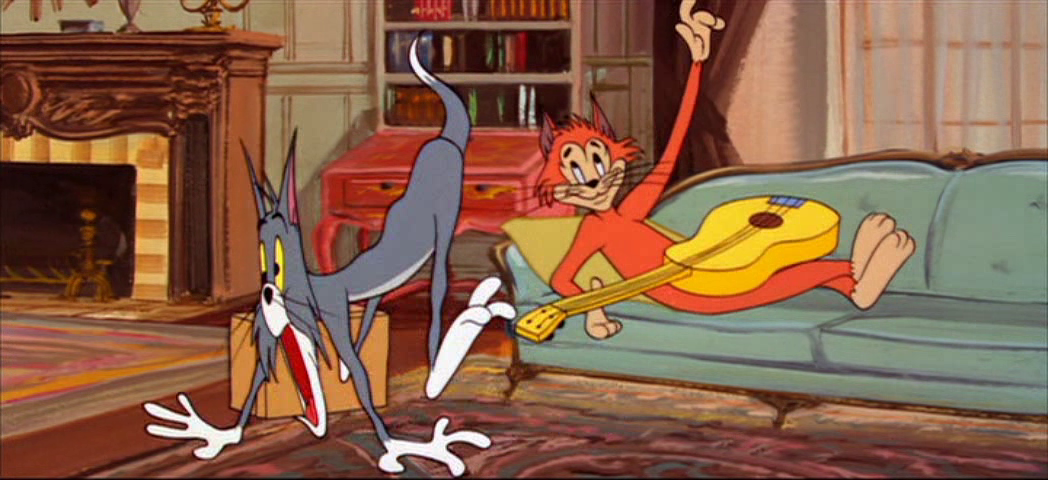
Mucho Mouse was a test cartoon for MGM. The studio wanted to see what would happen if it released an animated short in a foreign country before making it available to North American theatres. Mucho Mouse was the result. It was slated for release in Latin America around Christmas 1956 and then in the U.S. and Canada in late 1957.

Frankly, it’s a bore. And the animation’s odd in that you have classy, attractive versions of Tom and the orange cat (by Ken Muse in some spots) coupled with angular, thick-lined animation that looks like it belongs in a Hanna-Barbera TV cartoon.

Here’s an example when the orange cat thwaps Tom with his guitar strings.


Muse is one of the credited animators, along with Lew Marshall, Bill Schipek, Jack Carr, Ken Southworth and Herman Cohen. Daws Butler’s Tom sounds like Huckleberry Hound trying to read Spanish at one point of the cartoon.

Sunday, 10 April 2016

Tralfaz Sunday Theatre – What On Earth!

Here’s another neat cartoon from the National Film Board of Canada. It was released in 1966. The description from the Board's web site:

This animated short proposes what many earthlings have long feared – that the automobile has inherited the planet. When life on Earth is portrayed as one long, unending conga-line of cars, a crew of extra-terrestrial visitors understandably assume they are the dominant race. While humans, on the other hand, are merely parasites. An Oscar® nominee, this film serves as an entertaining case study.

You can adjust the definition of the video file.


Jack Benny, 1939

Almost all the pieces of the Jack Benny show were in place by 1939. The last of his major cast members joined the show. Dennis Day had done a bit of radio work under his real name of Eugene McNulty in New York City. But when Kenny Baker jumped at the prospect of more money, more airtime, and not having to play an at-times clueless character, Benny looked and looked for someone. Day was introduced to audiences through his domineering mother, played by the great Verna Felton, but the pages of Variety reveal that wasn’t Benny’s first idea.

Despite fears the audience would be upset, it turned out to a stroke of brilliance. After returning from the war, Dennis evolved into an apt impressionist and dialectician and proved to be a better foil than Baker, whose career peaked with the Benny show. Hooking up with Jack gave Day a career. A movie deal quickly followed and after the war he appeared on his own radio and TV shows. He landed a record deal with RCA. He appeared on the Vegas strip. None of it would have happened if Kenny Baker didn’t feel insulted by playing a cheerful silly man-boy.

The year started with Jack’s distraction with a smuggling trial in New York, where he continually had to fly for court appearances. Variety didn’t give it the coverage the wire services and New York papers did, as they revealed Benny’s chastisement by the judge sentencing him, word for word. In essence, he was conned by someone claiming to have diplomatic immunity to carry Benny’s newly-purchased jewellery into the U.S. so he would avoid paying duty. Benny pleaded no contest.

Professionally, Jack completed some movies and was working on another. In essence, Paramount Pictures decided Benny was only bankable if he played his radio character, so they plunked him in Buck Benny Rides Again, a title derived from a series of radio sketches (though the movie plot was dissimilar) and in a picture with Fred Allen, against whom he had been carrying on an audience-loving feud.

General Foods, for a second time, tried to wrest Jell-O away from his sponsorship table and give it to someone else in exchange for the rather drab Post Grape Nuts. The idea was thwarted. General Foods was not to be deterred and pulled it off during the war.

For all intents and purposes, Andy Devine ceased being a semi-regular on the show by the end of 1939.

Jack continued his charity work and, surprising as it may seem, was one of the people involved with the radio actors trade union, which was ready to call a strike—which would have included his own show.

Here’s Variety.

January 4, 1939
Screen Guild show for Gulf Oil will make a Quick bid for dialer preference by triple starring the initialer next Sunday (8). In the upper bracket will be Jack Benny, Joan Crawford and Judy Garland. Reginald Gardiner is also in the cast of a musical revue being whipped up by Morrie Ryskind. Oscar Bradley has the music assignment for the series. Mitchell Leisen directs the show and Tom Lewis of Young & Rubicam produces.
George Murphy was assigned by Screen Guild officers to emcee show. They took a vote.
On the second show Jan. 15 will be Fred Astaire. Herbert Marshall, Loretta Young and Franklin Pangborn in a comedy with music. Script being supervised by Dwight Taylor.

January 5, 1939
JACK BENNY will need a faster chauffeur than Rochester to get around Sunday . . . after finishing his eastern broadcast for Jello at 4:30 p.m., he'll have to dash from the NBC studio at Sunset and Vine to the El Capitan theatre, where he costars on the Screen Guild program, which takes off at that hour . . . he's allowing himself six minutes to make the jump.

January 10, 1939
Bill Morrow and Eddie Beloin have hied to Arrowhead to cook up next Sunday's script for Jack Benny, the first time in years they've concocted the Jello laugh situations without the comic at their elbow. Benny is in New York to testify before the federal grand jury in the smuggling case which recently involved George Burns. He's due back in time for Saturday's rehearsal.

January 11, 1939
Jack Benny was indicted today on charges of transportation, possession and smuggling of $2,100 worth of jewelry by a Federal Grand Jury. Actor pleaded not guilty. His bail was set at $1,000. Albert N. Chaperau, who has pleaded guilty to another indictment charging him with smuggling gowns into this country, was indicted with Benny. George Burns and Mrs. Edgar J. Lauer, wife of a State Supreme Court justice, have pleaded guilty to charges linking them with Chaperau. Jack Benny aired east Monday (9) to testify Tuesday in New York before a federal grand jury in connection with a smuggling case. He said he was willing to cooperate with the authorities, but figures he won't be much help. Myrt Blum, his agent, accompanied, as did Loyd Wright, his attorney, Col. Bill Donovan represents Benny on the N. Y. end.
Chester La Roche, president of Young & Rubicam yesterday said that Jack Benny's indictment on a smuggling charge would have no effect on his radio contract with General Foods.

SCREEN ACTORS GUILD
With Jack Benny, Joan Crawford, George Murphy, Judy Garland, Oscar Bradley, Reginald Gardiner, Ralph Morgan, J. Frank Drake, John Conte.
Revue
30 Mins.
GOOD GULF GASOLINE
Sunday, 7:30 p.m.
WABC-CBS, New York
(Young & Rubicam)
Of two Hollywood programs which debuted within an hour of each ether on CBS Sunday, Jan. 8, 1939, this one was the hit Item of a one hit, one error score. Program led off as a bright, brisk, professionally keen challenger for important attention and large circulation. If succeeding installments with changing personalities each week can even come near the entertainment quality of the first broadcast, the circulation quantity seems assured.
What the program offers and the way it goes about things may, of course, add up to 'just another revue with guests stars.' But the finesse of adroit production and the Screen Guild's roster of names make that mean something.
Each week the director and writers will be of 'guest' character. Which is anybody's guess as to what they actually contribute. Probably more from the writers than the directors. Mitchell Leisen, of Paramount, and Sam Perrine and Irving Brecher were the scriveners for this air-billed one. In the background was Young & Rubicam's Tom Lewis and Austin Peterson.
Incidentally, apportioning the numerous credits is no small task on such a program. They were skilfully woven in. several of them as gags. Gulf for and agreeable as personalized by its head man, J. Frank Drake, who spoke his piece clearly and with no slush.
Jack Benny was in fine form for Gulf, but ironically off-form for his own Jello show that was just ahead. Usual comedy approach to the meeting of Benny and Crawford (with an interruption routine by Judy Garland), piled up giggles by the usual device of pin-pricking Benny's fatuous self-importance. Miss Crawford played straight with beaucoup authority to Benny's demonstration of his sex appeal.
Reginald Gardiner did his now-familiar train bit, swell for first hearing and a work of artistry even to accustomed hearers. Miss Garland whammed a couple of special numbers that revealed her range as stylist and entertainer. George Murphy, while not fully seasoned at the m.c. stuff, still merited the assignment and was a cute kid. Ralph Morgan, as president of the Guild, saluted Jean Hersholt (absent in N. Y.) as president of the Motion Picture Fond and introduced Gulf’s man, Drake.
M. P. Fund gets $10,000 weekly from sponsor. With orchestra (good) and production incidentals, plus agency fees, etc., it's $15,000. A snappy show for the money. Land.

'Bogus Frankfurter Mystery' is title of skit Jack Benny and his Jello troupe will do on Sunday's broadcast. Comedian plays the editor who directs his news sleuths to track down the guilty culprit.

January 12, 1939
Albert N. Chaperau yesterday pleaded guilty in a federal court in New York to an indictment charging him and Jack Benny with smuggling $2,131 worth of jewelry into New York. Benny pleaded not guilty Tuesday.

January 13, 1939
It was reported in New York yesterday that Albert Chaperau, who pleaded guilty to a smuggling indictment in which he and Jack Benny were named, will testify against the radio comedian when latter comes to trial before a federal court in New York.

January 17, 1939
Gracie Allen, George Burns, Jack Pearl and Kenny Baker were subpenaed yesterday in New York to testify at trial of Jack Benny on smuggling charges. Trial date is (24).

January 18, 1939
In handling the Jack Benny smuggling charges story, the New York dailies described him as 'Americas No. 2 radio comedian,' but without indicating how this rating was arrived at or who was first.
Newsmen evidently trying to show an acquaintance with the CAB reports. Raised curiosity in the reader’s mind. [Chase & Sanborn show rates No. 1 on CAB].

San Francisco... Harris D. Connick, manager of the Golden Gate International Exposition, has signed contracts with Jack Benny, Eddie Cantor, Fred Allen, Fannie Brice and Sophie Tucker for appearances at the Fair. Each will appear twice daily for single week stretches in the open air pavilion.

'Umbrella Man,' current waltz hit which jumped from obscurity to the lead spot on the best seller lists in the space of several weeks, was written some seven months ago by Jimmy Cavanaugh, who did the lyrics, and Vincent Rose and Larry Stock. Kay Kyser introduced the tune for Harms, which first published it some time in September, and also recorded it. However, it was not until Kenny Baker did it on the Jack Benny program that it started to make any dent in the biz. Witmark admittedly had been sleeping on it until Kenny's vocal awakened interest. Following that event they got behind the tune and shoved it up to its current rating.

January 19, 1939
Plans to immediately pull film stars from air programs if strike against commercial network broadcasting is ordered this weekend were completed last night at meeting of Coast members of national executive board of American Federation Radio Artists. Eddie Cantor, AFRA national prexy, presided at session held at headquarters of Screen Actors Guild. Members of national board present in addition to Cantor included Edward Arnold, Norman Field, national vice president; Jean Hersholt, Jimmy Wellington, Warren Hull, Georgia Fifield and Carlton KaDell, president of Los Angeles chapter. Others attending were Kenneth Thomson, SAG executive secretary; I. B. Kornblum, AFRA attorney and acting business representative, George Arliss, Jack Benny and Dorothy Lamour, Laurence W. Beilenson, attorney for SAG and western counsel for AFRA.
In meantime attorneys for national sponsors were meeting with agency heads in New York in an effort to avert walkout of air performers. Strike ballots will be cast in New York today. Chicago and San Francisco chapters vote Friday and Los Angeles Saturday night. If walkout is approved it will then be up to national board when strike will be called.
Spokesmen for agencies producing network shows yesterday could see no alternative but to drop off the air in the event of a general walkout by AFRA.

January 20, 1939
Jack Benny, Mary Livingstone, Bob Hope and Bob Burns were names added to Hollywood's air gigantic that will touch off the March of Dimes continental parade Sunday on three nationwide networks for infantile paralysis funds. Show will go out from here between 8 and 9 p.m. on Mutual, Columbia and National Broadcasting chains.

January 25, 1939
Rep. L. E. Brophey, of Minnesota's lower house, has thrust himself into the limelight with a proposal that the Federal Communications Commission suspend radio stars who have been indicted on criminal charges carrying a minimum penalty of one year imprisonment. House's Public Welfare Committee yesterday (23) approved this proposal which Brophey, who comes from this city, had introduced in the form of a resolution.
Brophey declared that his measure was designed to prevail upon the FCC to bar those air celebs recently indicted on gem smuggling charges. What particularly burned him, said Brophey, was that at least one of the indicted names had belittled the criminal action.
Jack Benny and George Bums, of Burns and Allen, are the Minnesota legislator's obvious targets. Burns has pleaded guilty to the indictment, while Benny declares himself innocent and has elected to stand trial.

Radio strike... Los Angeles chapter okayed in advance any action taken by AFRA executive committee. Eddie Cantor, AFRA head, presided at Saturday night session at El Capitan theatre Emily Holt told attendees date for nation-wide strike against agencies would be fixed within 24 hours unless some agreement is reached, but expressed hope walkout would not be necessary.
Other speakers at meeting were Kenneth Thomson, Screen Actors' Guild executive secretary: Edward Arnold, J. W. Gillette, representing AFM; Ralph Morgan, SAG prexy; I. B. Kimblum, AFRA counsel.
Resolution to obey strike order was approved by unanimous rising vote. On stage with speakers were Jack Benny, Tyrone Power, James Wellington, Don Wilson, Dorothy Lamour, Boris Karloff, Conrad Nagel, Melvyn Douglas, Andy Devine and others.

February 1, 1939
Eddie Cantor and Kate Smith proved to be the top air favorites with 49,343 boys and girls between ages of six and 16 polled in the latest Children's Preference Study conducted by the Bays Athletic League of New York. The boys gave Cantor No. 1 place and the girls showed they like Miss Smith most. In last year's poll Joe Penner was No. 1 with the boys, while Cantor was the girls' ace choice. Four followups with the boys this year were Jack Benny. Penner, 'The Lone Ranger' and Edward G. Robinson. Charlie McCarthy was sixth.
In 1937 the poll gave the boys' next four preferences as Cantor, 'Ranger,' Benny and Bing Crosby. Four followups with the girls this year are Crosby, Cantor, Billy House and Penner. The 1937 poll showed the girls' next four best to be Benny. Crosby, Burns and Allen and Deanna Durbin, The poll this year made no mention of screen favorites.
Billy House's standing was deemed significant by radio trade. Also that only two programs picked by kids were daytimers, viz ‘The Shadow’ and ‘Let's Pretend.’

Federal Judge William Bondy imposed a fine of $8,000 and a suspended sentence of a year and a day on George (Nat) Burns yesterday (Tuesday) in Federal Court, N. Y. on the alleged smuggling indictment involving less than $5,030 worth of diamond studded jewelry into the United States. Burns had already paid civil penalties amounting to $9,770 in addition, it was disclosed. This brings his monetary penalties to $17,770 on items totaling less than $5,000 [$4,885].
Judge Bondy suspended the prison sentence on a promise of good behavior, and Burns was put on probation for the duration of the term. He got 10 days in which to pay the fine.
Burns' plea for leniency, made through his attorney, Carl Newton, was based on the fact that the actor had cooperated with the Government investigation since its inception. Assistant United States Attorney Joseph Delaney had originally recommended a fine of $12,000.
Comedian, it was announced, would be available as a witness in 'another' impending trial, growing out or the smuggling activities of Albert N. Chaperau, This was taken to mean the trial of Jack Benny, who comes up on like charges Feb. 14.
Burns arrived in New York yesterday (Tuesday) after the plane he boarded on the Coast was grounded in Chicago by snowstorms and forced his transfer to rails. He avoided interviews after the case was cleared.

February 2, 1939
Jack Benny-George Burns palship continues unchilled by fact latter will be government's principal witness in forthcoming trial of Benny on smuggling charges. Pair dined together yesterday in Paramount commissary, with friendly ribs interspersing food.

Threatened national radio strike appeared definitely staved off tonight, as American Federation Radio Artists and advertising agency committee representing sponsors started drafting an actual contract.
Committees came to enough common meeting ground at 7 a.m. today, to turn work over to legal representatives. Lawyers were closeted all day over legal entanglements and will continue sessions for several days.
Forthcoming contract involves so many twists that actual terms of settlement are vague until legal requirements can be cleared.
AFRA regards affair as victory, while sponsors are resigned to paying more for talent on commercial network broadcasting.
AFRA hopes for contract effective Friday (10), but all depends upon speed of lawyers. Mutual web is not sitting in on sessions.

February 15, 1939
Jack Pearl, comedian, has been appearing before the grand jury in New York during the past week in the Albert N. Chapereau smuggling case. Attorney Louts Nizer, representing Pearl, told the U. S. attorneys that although not, directly or indirectly involved in the smuggling action, Pearl did meet Chapereau in Europe and that he was ready to testify regarding the impression Chapereau disseminated concerning himself.
Government's case against Jack Benny was postponed by Federal Judge Knox in New York yesterday (Tues.) to March 6, on plea of Donovan, Leisure & Newton, counsel for the actor. Postponement will give him sufficient time in which to complete his current Par assignment and permit him to come to New York and stand trial.

Jack Benny yesterday spiked reports that he will change his plea to the government's smuggling charge and said that he will go to New York to contest the action when the case is called for trial.

February 23, 1939
Jack Benny will emcee banquet of Woman's Auxiliary of American Legion at Chicago annual convention Sept. 27.

February 24, 1939
Jack Benny guests on the Lum and Abner airer Friday (3) to accept an honorary degree as 'Dr. of Fisticuffs."

February 28, 1939
Mary Livingstone took her five-year-old daughter over to Paramount to see Jack Benny in action in ‘Man About Town.’ Seeing daddy in trapeze attire, youngster turned to mother in disgust. ‘He certainly looks awfully silly,’ she whispered, ‘but don't tell him I said so!’

March 6, 1939
‘Now we'll be able to get something done,’ quipped Jack Benny when his gag writer. Bill Morrow, broke down and admitted he was married Tuesday night to Margret Wilkins, New York model. Fellow workers on the Jello program now feel that Morrow is not one to be trusted with confidences if he can't keep his own secret.

March 21, 1939
Jack Benny has re-signed Sam Hearn to contract for appearance on his Jello broadcasts starting April 2. Hearn, now out on personal appearances, is cancelling further bookings to return here. Deal handled by Leo Morrison.

March 28, 1939
New York, March 27. — Jack Benny will plead nolo contendere— no defense—when he goes on trial here next Monday in Federal court on charges of smuggling $2,131 worth of jewelry into this country, according to the Daily News. Newspaper also reports that it has learned comedian will plead guilty if the plea is not accepted.
Jack Benny asserted yesterday that his New York attorneys are handling the case and that he wouldn't say anything regarding the case without their permission.

April 4, 1939
Trial of Jack Benny on smuggling charges was postponed 24 hours when plane failed to arrive in time for comedian to face court.

April 5, 1939
Changing his plea from ‘not guilty’ on the smuggling charge against him, Jack Benny yesterday (Tues) was fined $10,000 by Federal Judge Vincent L. Leibell in N. Y. and an additional sentence of a year and a day was suspended on condition the actor reports regularly to probation officers in Los Angeles. The comedian flies back to the Coast today (Wed.) to resume radio and picture commitments. His next for Paramount is ‘The New Yorker.’
Benny expressed regret at having become carelessly involved in the situation and said he had 'no guilty knowledge of crime.' Value of the gems purchased by Benny and smuggled into the U. S. was $2,131, on which approximately $700 in duty was payable.

April 6, 1939
Rosa Weber, house maid, will collect about $5,000 from Uncle Sam for turning over information which led to the indictment and conviction of several persons in the smuggling case in which Jack Benny drew a $10,000 fine.

April 8, 1939
Washington, April 7.—Louis B. Mayer today was revealed by Uncle Sam as America's No. 1 wage earner for year 1937, when he drew down total of $1,296,563, of which $1,161,753 was contributed by Loews, Inc., and $134,750 by Metro. No. 2 position went to J. Robert Rubin, another Loew's and Metro exec, who was paid $641,753 for his services for same period.
Paramount Pay List: Jack Benny, actor, $60,000. [By contrast, Paramount paid actress Franciska Gaal, who had been dropped from a proposed Benny film, $82,958. Herbert Marshall, who filled in one a Benny radio show, made $198,166 from RKO].

April 12, 1939
Jack Benny and his associates gave out a typical Jelloesque show Sunday, All of the standard tricks and the usual violent reflexes of the push-over Hollywood audience were noted. But it had little spontaneity. It would have been a good show for an ordinary comedian; it was an ordinary result for a good one.

Jack Benny has three more pictures to go with Paramount under his existing contract, at a reported $125,000 per feature.
Completed and awaiting release, no date as yet being set is 'Man About Town,' production on which was interrupted, on various occasions by the gem-smuggling difficulties involving Benny.

April 18, 1939
Jack Benny will emcee Masquers salute to radio Thursday night, which Columbia's Pacific network broadcasts. Benny's writers, Bill Morrow and Ed Beloin, are collabing with Willie Collier on the script.

April 19, 1939
Kenny Baker's 'Poem for My Mother' used on the Jack Benny program last Sunday night is the product of Robert Sutherland, 12-year-old Buffalo schoolboy.

Warner Bros.-produced sustainer, 'Grouch Club," sponsored for the first time coast-to-coast (General Mills' Kix breakfast load is the payer-offer), was importantly spotlighted as the newest comedy show on the air via WEAF-NBC, hitting the east at 6:30 p.m, Sunday night (10), but somehow it all didn't come off. Starring Grouchmaster Jack Lescoulie, with Arthur Bryan and Leon Leonardi's band, it was hit 'n' miss. Show has been sustaining for almost a year now out of KFWB, the Warners’ Hollywood station, from whence this commercial also emanates, and some of it has been condensed into WB shorts, but on its first commercial teeoff the effect was shy of the mark. Highlight was the sequence having to do with the 'free library" (which was one of the better WB shorts in this series), but in the main m.c. Jack Lescoulie sounded as if he'd been listening too assiduously to Jack Benny. Even his tone inflection tips that paid off, plus the style with the testy command, ‘Play, Lombardi!’, a la ‘Play, Phil Harris!’ The Grouchmaster also makes a crack about 'while you folks are timed in to this station waiting for Jack Benny to come on right after us.' [Lescoulie, who was later in the original cast of TV’s Today Show, played Benny on Benny’s own show on a 10th anniversary broadcast in 1941. He also did the Benny voice on several Warner Bros. cartoons].

April 21, 1939
AL MARTIN is compiling a collection of material written by the late Al Boasberg for screen and radio celebs under the title 'He Left Us Laughing.' Martin is authorized to collate the volume by Mrs. Roslyn Boasberg, writer's widow. Collection will include radio material scripted for Jack Benny, Burns and Allen, Eddie Cantor, Al Jolson, the Marx Brothers and a dozen other name personalities.

April 22, 1939
At Masquers radio party, Jack Benny proved master of the crowd's emotions by sobering them with a semi-serious reference to his recent run-in with the government after a convulsive quarter hour of quipping. He told of strolling out on the desert near Palm Springs when he accidently stepped on a rattler. The viper, curled to strike, fell back and slunk away after giving Benny a fast take, as if to say, ‘Fella, you've had enough trouble.’

April 24, 1939
Kate Smith's new contract with General Foods, which becomes effective this fall, is for three years, and is non-cancellable. Similar pact prevails between Jack Benny and tin food processor. It reflects the sponsor's pleasure in the show's C.A.B. showing.

May 10, 1939
Ruthrauff & Ryan is shooting the Lever Bros, bankroll to lure to its Tuesday Night Party the cream of town's guest talent. Set for May 16 is Jack Benny, with other top names to follow.
Hugh Wedlock and Howard Snyder, former scripters for Benny, are pounding out the gags for the Dick Powell soap show.

May 20, 1939
CLARENCE ELDRIDCE, vice prex of Young & Rubicam, has returned to New York with reactions of Coast agency execs to the proposed plan to shift radio sponsorship of various General Foods products. Tentative plan is to shift Jack Benny from Jello to Grapenuts and Kate Smith to take over Jello. Several other GF-backed programs are also involved but setup is stalled pending action of Al Pearce's option. Understood Benny is not so hot for the switch. Decision is expected to be reached in New York next week.

May 24, 1939
Texaco was reported yesterday dickering with Al Pearce to replace the current Texaco Star Theatre. Pearce airs his last for Grapenuts in July. Texaco runs out its string after June 28 broadcast. Understood that the petrol show will bid for the current Pearce Monday night spot on NBC, preferring the milder opposition of Dupont's Cavalcade of America to Fred Allen's Town Hall, now bucking the Texaco hour show. Although action on the Texaco option was due last weekend no word has officially come from the east one way or the other. Local officials of the Buchanan agency have been especially non-committal.
With Pearce dropping out of the General Foods lineup, Jack Benny goes under Grapenuts sponsorship in the fall and Kate Smith switches to Jello. Daytime strip show is being auditioned for Calumet-Swansdown.

Priming some strong product for mid-summer release, of which the Jack Benny picture, 'Man About Town,' is expected to be the forerunner. Paramount will send off that film exploitationally with a gala broadcast June 25, tied in with Benny's Jello show. This will be the final of the current series for the program, and will be piped from Waukegan, Ill., the comedian’s home town.
'Man About Town' will be pre released at the Broadway Par, but the film goes out in early July otherwise.

May 27, 1939
Jack Benny yesterday was set as emcee of Paramount sales convention banquet, which will be held June 10 at Ambassador.

Paramount has set the preem of 'Man About Town," Jack Benny starrer, at Waukegan,Ill., June 25, home town of the player. Special train will take members of the cast and the entire radio troupe to the Illinois town. On the stage of the Genesee theatre he will present his last airer prior to the summer layoff. Carl Krueger, Par studio advertising department, trains out tomorrow to meet Robert Gillham in Chicago to complete plans for the opening.

May 31, 1939
Proposal to switch products on various General Foods programs has been put on the ice for the time being.
Meanwhile Al Pearce, on whose continuance the general shuffle depends, has had his contract for Grapenuts extended to July 31. He's on the NBC red WEAF link Monday nights (8-8:30).
Under the suggested rearrangement the plugging of Grapenuts was to go the Jack Benny program, while Kate Smith, who now has Swansdown Flour and Calumet Baking Powder, would do the praising of Jell-O.

June 7, 1939
Paramount’s annual sales convention, convenes here tomorrow (Wed.) for four days at the Ambassador hotel, with upwards of 265 delegates in attendance. ...
Entire Cocoanut Grove has been taken over for the banquet Saturday night, with Jack Benny emceeing a floor show to be aired transcontinentally.

Man About Town
(Comedy with Music)
Paramount production. Stars Jack Benny. Dorothy Lamour and Edward Arnold. Supporting cast: Binnie Barnes, Monty Woolley, Isabel Jeans, Phil Harris, Betty Grable, E.E. Clive, Eddie Anderson, Merriel Abbott Dancers, Matty Malneck's orchestra and Pina Troupe. Directed by Mark Sandrich. Produced by Arthur Hornblow. Jr. Screen play by Morrie Ryskind, based on story by Morrie Ryskind, Allan Scott and Z. Myers. Photographed by Ted Tetzlaff. Art direction, Hans Dreier and Robert Usher. Edited by LeRoy Stone. Costumes, Edith Head. Musical director, Victor Young. Musical advisor, Troy Sanders. Musical numbers staged by LeRoy Prinz. Assistant director, Holly Morse. Songs by Matty Malneck, Frank Loesser and Frederick Hollander. Previewed June 7 at Paramount theatre. Running time: 82 mins.
Luscious entertainment for eye and ear and one of the brightest and most smartly turned out pieces of merchandise from the Paramount organization is this 'Man About Town.' It is the best and most natural Jack Benny vehicle in a long time, rich in production values, very funny in situation, dialog and amorous nonsense, and registering hit performances from Benny and his co-stars, Dorothy Lamour and Edward Arnold, and all down the line of support.
Screen play by Morrie Ryskind, with story collaboration by Allan Scott and Z. Myers, is sparkling and cleverly contrived, precisely tailored for Benny's radio and screen personality and ample enough to enlist the best talent of every principal. Benny is presented as an American theatrical impresario in England who crashes the aristocratic set with ludicrous and farcically dangerous results in his efforts to win Dorothy Lamour, his singing star, through jealousy stimulations. Involved in these cross maneuvers with the show girls and the wives of a pair of lord-lings are Edward Arnold and Monty Woolley, as the outraged husbands. Binnie Barnes and Isabel Jeans, the wives, Phil Harris, sweet on Miss Lamour, Betty Grable, a chorine, E. E. Clive, the sour-puss butler and Eddie Anderson (Rochester), who turns in two top flight comedy dances.
The fun is held to high pitch by the masterful direction of Mark Sandrich who keeps the romantic, musical and comic proceedings flowing with smooth precision and constant re-charging of interest in every phase. The Merriel Abbott Dancers, the Pina Troupe of acrobats, Matty Malneck's orchestra do their share in the lavish entertainment. The revue scenes, gorgeously staged, featuring the Petty girls, are beautifully decorative and alive with dance movement in novel routine. Musical embellishment is aptly supplied and of high order, the numbers staged by LeRoy Prinz. Songs by Matty Malneck and Frank Loesser, 'Fidgety Joe' and 'Strange Enchantment,' and 'Sentimental Sandwich' by Frederick Hollander and Loesser, are of hit calibre, sprightly and tunefully romantic.
Arthur Hornblow, Jr.'s, production guidance smartly combines surefire divertissement for the connoisseur and the mob — a glamorous, healthy, scintillating, humorous and decorative show.


June 12, 1939
Paramount sales convention delegates rubbed elbows with studio's rank and file Saturday night at Cocoanut Grove where 1,200 persons gathered about banquet tables marking close of distribution gathering. Stanton Griffis, Barney Balaban, Adolph Zukor, Y. Frank Freeman, William LeBaron, Neil Agnew, John Hicks Jr., and rest of company toppers attended.
CBS broadcast co-emceed by Jack Benny and Bob Hope and featuring lot's stellar personalities was among entertainment features. Later Anson Weeks presented his own show, including Veloz and Yolanda.
Party ended shortly before 2 a.m. when sales delegates boarded special train for San Francisco.

HOW affixing a title tag to program won Paramount free time over Columbia's coast-to-coast net as well as shortwave pickup for South America and Europe Saturday night is one of more interesting sides to Par's sales convention banquet at Ambassador Saturday night. As Par's radio contact, Bob Hussey had sought to land gratis chain broadcast of party tendered delegates and studio crowd at Cocoanut Grove. Given thumbs down by NBC, Mutual and CBS in view of recent purchases of ether time by film companies for picture plugs, Hussey mulled idea that current year marks 50th anniversary of Thomas A. Edison's invention of motion picture camera. Using that as springboard, he returned to CBS and sold execs on idea of network joining with Par in commemorating semi-centennial of Menlo Park Wizard's discovery, with Irving Feis, former CBS producer turned Par writer, at helm. Result was show that hit lanes from 9 to 9:30, covering 115 stations in this country and Canada as well as stretching to S.A. and other side of Atlantic. Bangup entertainment was supplied with talent including Cecil B. DeMille, Bob Hope, Dorothy Lamour, Tito Guizar and Linda Ware, with Jack Benny as emcee, and with Victor Young conducting Anson Weeks' ork. Hussey and Reis produced and directed bill.

June 19, 1939
Cliff Lewis, Paramount's exploitation chief, working on the world premiere of 'Man About Town' at Waukegan, Ill., has posted billboards in every L station from Chicago to Milwaukee, and has rated a deluxe parlor car train from North State [?] Railroad to bring Jack Benny and his troupe from Chicago for five day celebration accompanying preem.

June 21, 1939
'Buck Benny Rides Again' is the next Paramount starrer for Jack Benny, with Eddie (Rochester) Anderson in a featured role.
Mark Sandrich, producer-director of "Man About Town,' will handle 'Buck,' first job under his new contract.

The timely (and financial) intercession of General Foods made it possible for Paramount to go through with its plans to give the natives of Waukegan, Ill., a double ceremonial for its favorite son, Jack Benny, June 25. When it got around that stadio would double-bill the event—a Jello broadcast and premiere of ‘Man About Town’—in a theatre where paid admission was to be charged, Federal Communications Commission stepped in with a desist.
Just as Paramounters really started to worry, GF cleared their dilemma by announcing they would buy out the house for the night and give the Waukeganites a double bill, sans the usual tariff.

PARAMOUNT’S pre-preeming publicity in Waukegan, Ill., on 'Man About Town' (25), starring Jack Benny, has Illini town all het up. Anticipating 150,000 visitors for Celebrity Day celebration, Waukegan Police Chief he’s asked help of (1) U.S. soldiers at Fort Sheridan, (2) U.S. sailors at Great Lakes Naval Station (Benny trained there), (3) State motorcycle patrolmen, (4) State militiamen, (5) Boy Scouts.

June 22, 1939
Jack Benny yesterday arrived in Waukeegan, Ill., his home town, together with other members of troupe of Paramount's 'Man About Town' which is to be premiered there (25).
Demand for tickets has been so heavy by invading visitors that premiere showing will be held in three theatres simultaneously — the Genesee, Academy and Rialto.

June 24, 1939
JACK BENNY yesterday received his high school diploma at Waukegan, Ill., many, many years late . . . educators huddled and decided sheepskin should go to outstanding hometown boy despite fact he quit school in third year to take up fiddle . . . Benny is so elated with higher education accomplishment, he now proposes going after honors in fiddling Rimsky Korsakov's 'The Bee.' [Note: “The Bee” was by Franz Schubert. “The Flight of the Bumblebee” was by Korsakov].

June 26, 1939
Waukegan, Ill., June 25.—This town had its biggest day today when an estimated 150,000 visitors swelled normal 33,000 population to witness world premiere of Paramount's 'Man About Town.' Screening of the Jack Benny picture last night in three houses and broadcasting of Benny's Jello program from stage of the Genesee theatre brought a five-day celebration for the 'local boy who made good' to an end.
Celebs on from Hollywood for the event, gave most of gathering yokels their first glimpse of Hollywood on the hoof during main street parades both tonight and last night. Preem had all the trappings of a West Coast first night.
Cost of premiere, approximately $125,000 divided among General Foods, Paramount, National Broadcasting Co., and advertising concerns, was more than offset by benefits reaped by former companies in exploitation.
In addition to filmites gathered, nearly 250 newspaper men and women were brought on from around the country to record doings. Aiding Benny in person were Dorothy Lamour, Andy Devine and his wife, Mary Livingstone, Phil Harris and orchestra, Eddie 'Rochester' Anderson, Gertrude Niesen and Tony Martin. To issue order at the preem, Paramount solicited services of U.S. soldiers from Fort Sheridan, sailors from the Great Lakes Naval Training station, Illinois state police, national guardsmen, Chicago city police, in addition to local gendarmes and Boy Scouts. Total on duty today were 2,337 and crowd behaved perfectly.

Kenny Baker has been signed to an exclusive deal by Texaco for next season, for which he will reportedly be paid $2,000 a week. His contract with Jello, which prohibited him from using his voice for anything but singing on the oil show, netted him $500 weekly. His Texaco fee on the series closing Wednesday night was $1,000 weekly.
Understood that Frank Parker may return to the Jack Benny troupe in his old vocal spot.

June 28, 1939
Jack Benny's finale from Waukegan, Ill., his home town, was good dual showmanship for Paramount's 'Man About Town' film starring Benny and for Jello, his sponsor. Plus a good stopgap to break the jump from L. A. to N. Y. What's more, it was a brighter show than has been Benny's average in recent weeks. Getting the town's mayor to stooge that way for the Jello plug was just a shade overboard, so far as the dignity of that office is concerned. But considering the general hometown spirit it was acceptable, and probably won't get the Mayors Assn. of America too peeved.
Show ran nearly five minutes short, and the band interludes had to be stretched plenty.

June 29, 1939
New York, June 28. — Paramount's 'Man About Town' opened today at Paramount theatre to biggest day's business since Washington's birthday, garnering approximately $11,000. Jack Benny and Dorothy Lamour did two personals each, while Gene Krupa's band is fixed added attraction.

July 9, 1939
Montreal — With a large number of the clergy of all denominations openly admitting that the Jack Benny and Charlie McCarthy programs are having a serious effect on Sunday evening service attendance, matter of changing the hours of worship here is currently under consideration.
Inter-denominational group conference of clergy and church officials is being arranged to determine unification in the proposal to push back the hour of Sunday night church services from 7 p.m. to 9, at least during the summer months. Number of churches here have gone ahead with the proposal without waiting for the round-table decision. Jello program and Chase & Sanborn hour are carried in Canada over the government network.

August 3, 1939
Harry W. Conn, gag-writer, filed a $65,500 breach of contract suit against Jack Benny yesterday in superior court. Conn contends he entered into a contract with Benny to write comedian's gags for 39 weeks in exchange for five per cent of Benny's earnings during such time as Benny used the material, but has received no compensation.

August 11, 1939
Jack Benny will do m.c. chore at first annual dinner dance of the Beverly Hills lodge of B'nai Brith at Earl Carroll’s (20). Special floor show is also being lined up for event.

August 12, 1939
Auditions for tenor spot on Jack Benny Jello program having exhausted the home crop, understood several are coming on from New York to try out for the vocal turn, vacated by Kenny Baker, exclusive to Texaco next season.

August 18, 1939
Fall radio status of Kenny Baker is shrouded in uncertainty with reports making the rounds that he may be back with Jack Benny, additional to his Texaco chore. Understood that his Texaco contract, which calls for his exclusive tenoring and acting, is undergoing legal scrutiny, looking to the possibility that he may also be available for the Jello series.
Agency's auditioning of successor to Baker for the Benny program failed to uncover any talent acceptable to the comedian. With half of the Texaco show to originate in New York with dramatics it is held likely that oiler may relax its hold on Baker for his exclusive services. Baker's contract with Texaco, executed before the dramatic half of the program was decided on, is said to call for $2,000 a week. Under the new arrangement Baker would be confined to not more than two numbers as he shares the vocals with Frances Langford. Also to be crowded into the half hour would be the comedy antics of Ken Murray, and possibly Producer Ed Gardner's 'Archie,' with David Broekman, musical director, slated to do one production number each week.

August 19, 1939
Hollywood last night paid tribute to Gus Edwards, the Star Maker, on the 60th anniversary of his natal day at the Ambassador hotel. Turnout of around 500 toasted the discoverer of more than a score of stage stars, sang his songs and partook of his birthday cake, of such colossal size that it had to be wheeled in.
Eddie Cantor emceed the birthday party and called to the microphone for speeches eulogizing the evening's honor guest Governor Culbert Olson and Jack Benny. Weber and Fields were introduced as discovers of Edwards.
Benny's quips topped an evening of good natured raillery. He said he was the only one there who wasn't discovered by Edwards, that he wasn't unearthed by Rudy Vallee or Major Bowes and that Sol Lesser was out of the question. When Cantor introduced him through the courtesy of Rochester he countered with ‘Deanna Durbin didn't hurt you any, either.’ Benny cracked that since Edwards started Cantor he should try to find him a job now. Benny kidded the absent Bing Crosby with 'he's the only tout I know that has an annuity' and added the only safe bet with him is that the stork will visit his home again.'
CBS broadcast 15 minutes of the festivities, with Victor Young batoning Stan Meyer's orchestra in selections composed by Edwards. Vocals were sung community style. Edwards danced across the speakers stand to prove that he has recovered completely from his recent illness.

August 24, 1939
Don Wilson, the Joe E. Brown and Jello shows announcer, doing a pic trick in Paramount's '$1,000 a Touchdown,' has lost 30 pounds since acquiring San Fernando valley ranch and is having to lay in whole new wardrobe.

August 30, 1939
San Francisco... After months of dickering, deal has been finally set for Jack Benny, Mary Livingstone and Phil Harris' orch to play in Treasure Island's Temple Compound Labor Day weekend (2-4). Trio reported getting $9,000 for the date, second to Edgar Bergen-Charlie McCarthy's $10,000 booking recently for two days. Harris takes over Tuesday (5) for several weeks on his own. Shows are gratis.

September 6, 1939
There are some 750,000 front covers of Time mag, dated last week, with Jack Benny's photo, in color, thereon, that can be had for the asking. Instead, Time's editors played a very timely hunch and substituted Winston Churchill, also in color photo, as its No. 1 newsworthy feature, and wrote up the author-statesman in a manner that was a beautiful blend with events that followed fast and furiously over the weekend, when Neville Chamberlain appointed Churchill his First Lord of the Admiralty in Britain's newly created war cabinet.
When Time's editors the week before last saw Hitler going berserk, they knew. Churchill would fast become hot stuff all over and, while the periodical usually has a couple of months covers in advance, Churchill was on what they call the 'vague list' until the trend of world politics suddenly catapulted him to the fore.
Co-managing editor Frank Norris says that the bugaboo of Time are sports figures who more often than not don't come through as brilliantly as hoped. Either that, or they get injured, or don't even participate. Most memorable was a promising three-year-old called Red Rain, back in 1935, who got the front cover and was scratched, not even running in the big race pointed for.
The Benny story was to tie in with resumption of radio advertising. He may yet be used, but the printed covers, due to the date thereon, are so much dead stock right now. The fall radio resume story, which was hung on Benny, was also scrapped.
Currently Time's companion publication, Life, which also must anticipate topical news events because going to press many days in advance, is in a dither on how to cope with the shifting war scenes.

September 7, 1939
San Francisco, Sept. 6. Labor Day weekend brought a crowd of 284,659 to the Golden Gate Exposition, with Jack Benny playing to s.r.o. during his six free performances in the Temple Compound.
Jose Iturbi, Albert Coates and Leopold Stokowski are booked to conduct the San Francisco Symphony Orchestra in a series of three concerts in the California Coliseum starting Wednesday (13). Miliza Korjus will appear as vocal soloist with Coates.

September 11, 1939
Program preferences are determined by income, according to the report released by the Cooperative Analysis of Broadcast. The bulletin shows that such programs as Cities Service Concert and Information Please appeal to the higher income levels while those in the lower income bracket prefer listening to Lum and Abner and Major Bowes.
During the winter of 1938-39, CAB says, average rating of all evening shows increased from eight and eighttenths percent to nine and three tenths percent, with evening shows rating 10 percent or higher increased from 39 to 44 over the previous winter. Number of daytime programs rating over five percent was almost doubled.
Ten leading programs for the winter, CAB says, are Chase and Sanborn, Jack Benny, Lux Radio Theatre, Kraft Music Hall, Major Bowes Amateur Hour, Town Hall Tonight, Burns and Allen, Good News, Rudy Vallee and Big Town.

September 20, 1939
Finding a sub for Kenny Baker, who hopped to the Texaco show with Ken Murray, is providing Jack Benny with plenty of call for an aspirin. Comic is doing a load of sizzling at his sponsor, General Foods, for letting Baker get away.
Not the least of his troubles on the Baker exit will be the flock of protesting letters which are anticipated.
Following Frank Parker's leave-taking a few years ago, Benny was flooded with letters from irate listeners who said they'd never tune him in again for 'firing' Parker. Inasmuch as Baker was built up on the show even more than Parker, Benny doesn't relish the new kickbacks when he takes to broadcasting again. As a result, he will in the future accept no more contracts except on a package-show basis. He wants complete control over the people in this company. Andy Devine, Rochester, and of course, Mary Livingstone, are now under his contract, but the rest of the cast is signed separately by the agency.
Baker is said to be getting $2,000 a week on the Texaco show, a figure which Benny claims he would have matched from his own pocket had the singer been under a pact to him, or had he known full details of negotiations on the switch to the oil company show.
A twenty-one-year-old warbler has been tentatively accepted by Benny for the Baker spot. Current plan is not to announce his name until about the fourth week the Jell-o show is on the air, filling in the meantime with a variety of warblers who are definitely and comically bad. Public will be asked its opinion, with the radio audience finally 'discovering' the permanent replacement.
May Air From Honolulu
If proper steamer connections can be made, Benny hopes during the winter to do two broadcasts from Honolulu, taking his whole troupe with him. In the event transportation can't be arranged, the shows will shift from the Coast to Miami for part of the winter.
With the expiration of his present termer next June, Benny will lay off for six months or a year. Part of the time will be consumed in making a Paramount film with his air-enemy, Fred Allen, and he'll vacation after that. Following the filming of 'Buck Benny Rides Again,' which will get under way in November, Benny will make no more pictures during the broadcast season.
Jell-O funster was in New York for a week, training out yesterday (Tuesday) for Chicago, where he will appear at the American Legion convention for four days and visit with his family for three more before returning to the Coast.

Jack Benny and Fred Allen, the well-cultivated enemies of the airlanes, will get together in a film for Paramount next summer.
It was originally hoped to do the picture after Benny finishes his next film, "Buck Benny Rides Again.' Jello comic will make no more pix during the broadcasting season.

September 27, 1939
Chester LaRoche, Young & Rubicam prez, flew out to the Coast Saturday (23) to be on band for the opening of the Screen Guild show the next day and the Jack Benny stanza this Sunday (1).
The LaRoche stand will be just for a week. [Note: Benny didn’t broadcast on Oct. 1. The season debut was the 8th].

September 29, 1939
FOR reasons of accumulating publicity and ostensibly to sound out the public on the wisdom of his choice, successor to Kenny Baker on Jack Benny's new Jello series getting away Oct. 8 will go unnamed for the first four weeks. If he fills the niche satisfactorily he remains indefinitely in the stooge-warbler role. Lad around whom all the mystery will be veiled is Dennis Day, young NY law student, who has appeared with Leith Stevens orchestra on several CBS sustaining programs. Discovery of Day is credited to Mary Livingstone (Mrs. Benny) who made the recommendation after she heard him in the east. Four-week optional deal was then struck with Columbia Artists in NY and the mystery angle hit upon as a publicity cover-up for the loss of Baker, which is expected to bring a flood of uncomplimentary mail.

Harry Baldwin, who doubles between secretarying for Jack Benny and making all those interruptions on his programs when comes a knock on the door, heckles Phil Harris on the final Coast Fitch Bandwagon program Sunday. Baldwin is the only secretary who carries an AFRA card.

Offices at Paramount where Jack Benny and his writers, Bill Morrow and Eddie Beloin, discuss gags and situations are being soundproofed to tone down vocal assault on workers in neighboring cubicles.

October 4, 1939
Chicago ... Bill Morrow in with Jack Benny for the Legion convention show.

The Jack Bennys readying to adopt another child, this time a boy.

October 5, 1939
Superior Court Judge Clarence M. Hanson signed an order yesterday staying proceedings in Harry Conn's $65,500 suit against Jack Benny until arbitration, as called for in their contract. Conn is suing for money allegedly due him for writing services.

Jack Benny and his Jello crew take to the air Sunday for another 39-week stretch. Only change from last year is Dennis Day for Kenny Baker in the tenor-stooging role. Returners are Mary Livingstone, Rochester, Andy Devine, Phil Harris, Don Wilson and Harry Baldwin. Murray Bolen produces for Young & Rubicam, with Ted Hediger the NBC contact.
Script chores again fall to Bill Morrow and Ed Beloin. Program is heard on 86 NBC (red) stations, broadcasting for the east at 4 p.m. and slotted at 8:30 p.m. on the Coast repeat.

October 9, 1939
Jimmy McHugh and Frank Loesser will write the songs for the next untitled Jack Benny picture at Paramount. It will have six song numbers.

October 10, 1939
Eddie 'Rochester' Anderson signed a three-year exclusive radio contract with Jack Benny yesterday. MCA handled.
In his pre-broadcast audience warmup Sunday Jack Benny introduced Eddie Anderson (Rochester) as 'the guy who stole my last picture.'

October 11, 1939
JACK BENNY
with Mary Livingstone, Verna Felton, Rochester (Eddie Anderson), Phil Harris Orchestra, Don Wilson, Dennis Day
30 Mins.
JELL-O
Sunday, 7 p.m.
WEAF-NBC, New York)
(Young & Rubicam)
With every indication that he will continue to deserve and hold his top-of-the-pile rating, Jack Benny returned Sunday at the same time and for the same sponsor over 80 NBC stations. It was a bang-up, high-speed laugh-studded premiere, a tee-off to serve as a master-model for all radio comedians to study. What is notable about these Jello stanzas is the amount of advance study and preparation, editing, tightening and timing that goes on the average, into the finished result.
A cute novelty beginning opened the program without a commercial, as if the microphone was eavesdropping upon Benny and Mary Livingstone and later Don Wilson and Phil Harris on their way to the program. Later the continuity skipped into the usual musical theme and J-E-L-L-O fanfare, which is the program's trademark.
Kenny Baker having gone his way the new singer is an unknown tenor, Dennis Day (phoney name), who was introduced as guided by his mother, a triple-distilled blend of all the stage mamas of fact and fancy. The character, as played by Verna Felton, with timing as Benny's own, should shape up as a comedy gem. Day at the end slapped over 'Good Night, My Beautiful' in a classy way. Both as a singer and a comedy foil, the youngster should do okay for Benny.
Right name of singer is Eugene McNulty. He's reported well known to the song publishing fraternity around N. Y.
The situational cross-fire, gag comedy wrapped in characterization, remains as before the clue to how he does it. Each player is given a role and the recurring emphasis upon well-known idiosyncrasies underscores the laughs. After six years for Jello, the laugh pace is still terrific. Land.

October 18, 1939
Kay Kyser's program next Wednesday (25) will come from a broadcasting set in his picture, 'That's Right, You're Wrong,' at the RKO studio. Regular ducat holders will be admitted.
Kyser guests with Jack Benny on his program Sunday (22) to swap quips end get in a plug for his picture.

October 24, 1939
Jack Benny picture, 'Buck Benny Rides Again,' got the spurs at Paramount yesterday with star reporting work on two-month shooting schedule. Also working was Eddie (Rochester) Anderson, extras and bit players.

November 2, 1939
Producer-Director Mark Sandrich today moves Paramount's 'Buck Benny Rides Again' troupe to Placerita Canyon to start Western shots. Making location trip will be Jack Benny, Andy Devine and other principals.

November 12, 1939
Jack Benny's dream, while under gas in a dentist's chair was an interlude of fancy-tickling, imaginative nonsense Sunday night (12). In his opiate-inflamed stream-of-consciousness, the dentist crystallized as Dr. Fred Allen urging Benny to use Ipana toothpaste and then progressively going to ever-larger instruments. Another delightful Freudian touch had Benny hearing Don Wilson repeatedly announcing "This Is the Jello program starring Phil Harris.'

November 14, 1939
Producer-Director Mark Sandrich yesterday took Paramount's 'Buck Benny Rides Again' troupe to Victorville for chase sequences. Location unit, which includes Jack Benny and other principals, returns here Thursday morning.

November 24, 1939
ROCHESTER is going to have to work with a polar bear in Paramount's 'Buck Benny Rides Again,' and will closely watch tests to be made of the animal next week to assure troupe that if is a docile and sympathetic critter. Bear is being trained in from Clinton, Conn. zoo to impersonate Carmichael, which Jack Benny uses in his radio program.

November 29, 1939
C. E. Hooper survey of the week of Nov. 8-15 shows Jack Benny running ahead of the Chase & Sanborn coffee hour [Edgar Bergen-Charlie McCarthy] for the first time. Rating this checkup got Benny was 34.4%, whereas the C & S stanza drew 34.2%.

December 6, 1939
Two radioites set for Paramount pictures are Barry Wood (Lucky Strike 'Hit Parade') and Dennis Day, Jack Benny's new tenor.
Day is already in work with Benny on a film but a separate deal for him is virtually set.

December 9, 1939
Fred Allen-Jack Benny ether feud is to be brought to screen by Paramount, with Allen and Benny playing real life roles and Mark Sandrich handling producer-director chore. Camera work is skeded to start in July.
Allen yesterday gave nod after year of effort on Sandrich's part to induce him to be lensed with Benny. Sandrich recently made trip to New York in final effort to win him over. Walter Batchelor agency signed for Allen.
Feature will be Allen's third screen start, he previously having been seen in 'Thanks a Million' and 'Sally, Irene and Mary' for 20th-Fox. Sandrich starts preparations on yarn as soon as he completes 'Buck Benny Rides Again.'

December 12, 1939
EFFECTS of absence is not limited to heart, as old axiom might lead one to believe, but reaches out to touch the pay-check as well. At least, that's what Fred Allen believes as he gazes at that Paramount contract he signed last week, which is understood to call for stipend of $150,000 for co-starring with Jack Benny in one feature to be made next summer. Allen drew around $50,000 per picture back in 1935-36 when he appeared in 'Thanks a Million' and 'Sally, Irene and Mary' for 20th-Fox. Par tried to coax Allen back for more than a year before getting his signature on pact, and offered price mounted with each bid for his services.

December 13, 1939
Edgar Bergen's new option with J. Walter Thompson for the Chase & Sanborn program will net him around $6,000 a week even though the java show will have its running time cut in half starling Jan. 7. Understood another boost in 1941 will put him in the top coin bracket with Jack Benny. Bergen will do his customary two spots with Charlie McCarthy on the new half hour setup.

Jack Benny is planning to take his Jello troupe to Miami some time in February. If sponsor okays and picture commitments permit he will do two or three broadcasts from the Florida resort. Benny also is negotiating with Ezra Stone for a guest appearance before the Aldrich Family returns east.

December 14, 1939
Top names from radio and pictures will appear on the Salvation Army Christmas Fund six-hour broad-cast on KNX Saturday night. Players will volunteer specialties for dialers who make contributions by phone or wire to the fund. Lum and Abner emcee the program, which airs from 10 p.m. to 4 a.m.
Among those who have promised to drop in and do a turn for the fund are James Roosevelt, Gene Autry, Al Pearce, Burns and Allen, Frank Parker, Ray Noble, Jack Benny, Andy Devine, Eddie (Rochester) Anderson, Don Ameche, Bob Hope, Ken Murray, Frances Langford, Barbara Stanwyck, Robert Taylor, Jean Parker, Penny Singleton, Arthur Lake, Benny Rubin, Arthur Treacher, Edith Fellows, Billy House, Fred MacMurray, Mary Healy, Fibber McGee and Molly, Eddie Cantor, Dick Powell, Joan Blondell, Ben Alexander, Hedda Hopper, Dennis Day, Mischa Auer, Bobby Breen, Morton Downey, and Roy Rogers.
Orchestras will be conducted by Lud Gluskin, Carl Hoff, Leith Stevens, Eddie Dunstedter, Bobby Sherwood, Ivan Dittmar and Phil Harris.

December 21, 1939
Mary Martin gets the top femme spot in the untitled Jack Benny-Fred Allen comedy, scheduled for July production at Paramount.
Meanwhile, she is slated to star in ‘Kiss the Boys Goodbye’ if she completes her stage work in time.

December 27, 1939
Jack Benny put across a whacking good show last Sunday night (24) over NBC red (WEAF). As usual for his pre-Christmas stanza, he did it in the form of a party at his home, with all the regulars on the program as guests. As a result, almost the entire 30 minutes was devoted to straight gags, most of which were aimed at Benny. It all struck an unusually high comedy standard and ended on a note of hilarious distraction, with Benny on the phone explaining to the director why he refuses to make that scheduled picture with Fred Allen, while his polar bear and ostrich fought it out in the living room, with Rochester trying to untangle 'em and the guests apparently taking the joint apart piece by piece. Commercials were neatly worked in, too, and were cut, like the Christmas turkey, to the bone.

Jack Benny Xmas-gifted his writers, Bill Morrow and Ed Beloin, with all rights to the title, 'Buck Benny Rides Again,' Understood Paramount will have to make a deal with the scribes for use of the handle in the picture starring Benny.