Sunday, 23 December 2012

Jack Benny’s Christmas in Vaudeville

Ed Sullivan had what must have been one of the cushiest book deals with McGraw-Hill. He came out with a book he didn’t even write. Christmas With Ed Sullivan featured little holiday remembrances by Ed’s buddies. The book was published in 1959—just around the time that plugola on TV shows was being ix-nayed. So Ed couldn’t push the book on his show. However, it did get a nice three-page spread in Family Weekly, one of those magazine inserts in weekend newspapers.

Among Ed’s friends who wrote a short recollection was Jack Benny (J. Edgar Hoover was another). It’s legend that Ed gave Jack his first shot on the radio. That’s not true, but it apparently did lead to Canada Dry picking up Jack to emcee its musical comedy show with George Olsen’s orchestra. The story was published in Family Weekly, December 20, 1959.

Dear Ed,
When I think of Christmas, I remember Father O’Connell, a priest in Sioux City, Iowa. At his death a few years ago, one of my most treasured friendships suddenly vanished, but a Christmas will never come without my memory racing back over the years to Sioux City and the night we first met.
Christmas in a town where I didn’t have one friend wasn’t exactly my idea of a holiday. It was in the early 1920s, and I had been playing a vaudeville engagement there. To make things worse, the snow began to fall. It was a white Christmas all right, but I didn't share in any of the joy I saw around me.
On Christmas Eve, the rest of the troupe had started to leave the theater, but I sat in the dressing room, feeling a long, long way from my home and friends in Waukegan.
Of course, I had been on vaudeville tours at Christmas time before, but there were always a couple of friends on the bill, and we managed to talk ourselves into a good time and a celebration over Christmas dinner in some restaurant, even though we were far away from Mama’s apple strudel.
But that year, besides not knowing a soul in town, I didn't know anyone playing the engagement with me. As the theater grew silent, I dreaded the prospect of dinner all by myself the next day. I was growing more alone by the minute when suddenly there was a knock at the door.
“Come in,” I called, and looked up to see a priest standing in the doorway.
He was a smiling, ruddy-faced man who introduced himself as Father O’Connell. “Jack,” he began, adding uncertainly, “I hope you don't mind my calling you Jack.” Then at once he explained, “It’s just that I’ve seen you every time you’ve come to Sioux City, and I think your act is great.”
Mind him calling me Jack! We were friends before I had time to answer.
Hesitantly he suggested that in case I hadn’t already planned Christmas with someone, he would be very glad if I would have dinner with him.
I jumped at the chance.
Instead of a lonely little restaurant the next afternoon, I found myself at the rectory having a wonderful dinner with Father O'Connell and five other priests. I didn’t feel at all strange, though I am Jewish and it was the first time I had been inside a rectory. To this day, I can’t remember another Christmas so filled with laughter and real joy. Once dinner was over, the priests went to open presents under their tree, where I was dumbfounded and touched to find a small gift from every one of them for me.
Good will toward all men indeed!
In the years that followed, Father O’Connell and I became close friends. Whenever I played Sioux City, he was at the depot to meet my train and spend any time he could spare with me. I looked forward to bookings in the once-lonely town where I hadn't known a single person on Christmas Eve. With Father O’Connell’s sudden death, I lost a generous and dear friend, and I have often realized since then that Christmas away from home is not so very different for me than Christmas away from the warmth and unassuming kindness I had found in that distant rectory in Sioux City.
Jack Benny


Tomorrow: Hollywood’s Secret Santa.

Saturday, 22 December 2012

Christmas Wishes to a Red-Baiter

At the very least, Christmas-time is about peace on Earth and good will to others. And it’s a time that’s sorely needed, considering how people sometimes treat each other over the course of the rest of the year.

So it is that entertainers—perhaps holding their noses—sent holiday wishes to International News Service columnist Jack O’Brian. O’Brian, to many people, was not a nice man. In the ‘50s, he was, frankly, an unapologetic, red-baiting bully. Robert Metz’s book CBS: Reflections in a Bloodshot Eye speculated how insulting and goading columns by O’Brian helped push CBS newsman Don Hollenbeck to suicide for supporting Edward R. Murrow’s anti-McCarthy telecasts, then showed anything but remorse for what happened. O’Brian later displayed his homophobic side in an early ‘60s column about a radio broadcast about gays. But O’Brian has also been credited with help busting open the Quiz Show scandal of the late ‘50s, though cynics might suggest a print reporter would gleefully revel in television’s downfall.

Differences, however, are set aside at Yuletide, and O’Brian waxed pleasantly in his column about the Christmas cards he received from many people in show biz. This is from 1957.

Yule Cards of Stars Bright Modest, Gay
By JACK O'BRIAN

NEW YORK, Dec. 24 (INS)—Merry Christmas, dear readers, and all holiday good wishes . . . Despite our position as an official heckler and skeptic and critic of the TV universe, the citizens thereof bothered in the spirit of the holy season to wish us the same.
Their cards are many, varied, expensive, modest, gaudy, glorious, but we must state none was in bad taste, none was anything but nice to receive.
Bob Hope’s indicated he’s ready to fly out into space to entertain (“have space ship, will travel”), with Bob and family-caricatured in out-of-the-world haberdashery . . . Mildred and Bert Lahr’s card was simple; tasteful red and gold on white background sprinkled with holly.
Alice and George Gobel kept it pure and simple, too: A pair of does-in the snow, looking toward a church whose windows glowed in gold against a midnight blue, all bathed in the light of the Christmas star.
Perry and Roselle Como’s card had its customary religious motif (mother and child) illuminated in lovely colors, bearing the rich, red cross of the least publicized portion of Perry’s private life, of which he’s proudest: The Hallmark of his Knighthood in the Roman Catholic Church’s “Order of the Holy Sepulchre.”
Patti Page wished yule good cheer via a cardboard pseudo-re-cording . . . Mike Wallace’s beautifully engraved, deep-dark blue card carried wishes for “peace on earth” in gold against white as its cover motif . . . NBC exec Veep Bob Kintner’s card had oriental children on its cover inscribing the season’s greetings in a variety of exotic languages.
Polly Bergen’s—a pure white card with three golden Christmas trees . . . Mary and Jack Benny sent a “Merry Christmas” embossed in gold on deep red velour . . . Peter and Mary Healy Lind Hayes’ card was in cardinal red, the holy family painted in color and inside, a most properly, and reverently inscribed: “With Best Wishes for a Holy Christmas.”
Sophie Tucker came caricatured in yellow slacks singing a Merry Christmas “All of These Days.” . . . Occasional TV actress and more frequent strip teaser Sherry (Mrs. Buddy Boyland) Briton’s pale blue card was the simplest, most restrained and polite greeting of our bunch.
RCA’s Frank Folsom featured a riot of gay good, taste and cheer with ornaments, holly, bells and all the merriest . . . Jo Stafford and husband Paul Weston: a red candle in a lamp, hung in gold against green . . . One hundred thousand dollar quiz winner Anette Chen’s was a Chinese Christmas scene in many oriental colors. The Fontaine sisters, religious girls, had the altar decorated for Christmas mass in lovely, natural colours . . . Rosemary Clooney’s white card was hand-writ in dark green.


Tomorrow: a vaudevillean Christmas.

Christmas Cartoon Trade Ads

The Film Daily is giving cartoon fans an early Christmas gift. Real early. Like late ‘20s, early ‘30s early.

Here are some beautifully-drawn ads from the trade paper going back more than 80 years. You can click on any of them to enlarge them.

Before we get to them, let’s pass on a couple of promo cartoons for The Film Daily Christmas Fund from 1929. The first one stars Krazy Kat, produced by the Mintz studio in New York. There’s no signature on the drawing. The second one is really cool, as Bill Nolan has drawn a caricature of himself along with Oswald the Lucky Rabbit, whose career in 1929 had taken him to the Walter Lantz studio after employment stops with Walt Disney and Mintz. Nolan, by the way, had drawn the Krazy cartoons in the mid-20s.


Now, the great ads. The first is for a Harman-Ising cartoon from 1935 and next to it is a Disney ad from 1932.
Below it is a Columbia ad for a three-strip Technicolor cartoon, except the ad itself is mainly in two colours, red and green. It’s from 1935. Next to it is a 1932 ad that might as well be for a cartoon called “Marketing Mickey.” It’s not only pushing the mouse, but bragging about the stuff he sells.
Who doesn’t love a Van Beuren cartoon? “Silvery Moon”, on the bottom left, was released in 1933. And to the right is an ad for a Terry-Toon from 1932. If only Terry’s cartoons looked as good as the ad.


Want to see the Van Beuren short? It was released to television in the early ‘50s as “Candy Town” by Official Films, which sheared off the opening titles (and changed the name for some unknown reason). Van Beuren was certainly consistent. The two cats skip around like the studio’s Tom and Jerry.

Friday, 21 December 2012

Ho-Ho-Ho-Hollywood

This is the time of year they really put the tinsel in Tinseltown.

There’s been an accusation going around for years that nothing in Hollywood is real. Christmas-time is ample proof, though the reason is more meteorological than cinematographical. Thus the wintery weather in the movie capital is no Miracle on 34th Street. It’s as crafted as any big-budget blockbuster sequel.

United Press columnist Aline Mosby looked how some of the stars of 60 years ago got their neighbourhoods into the Christmas spirit—and appearance. This is from newspapers of December 24, 1952.

Even Hollywood Manages To Look Christmas-like
By ALINE MOSBY
(United Press Hollywood Correspondent)

HOLLYWOOD (UP)—The orange is on the tree and the blonde in the swimming pool, but this land of cactus and sunshine manages to look like the good old North come Christmas, anyway.
It snows about half an inch every 27 years around here. Yet the movie stars and other citizens load their streets and homes with plastic reindeer and snow just as though everybody knew what it was all about.
Comedian Danny Thomas each year puts up a $1000 nativity scene on his front lawn among the palm trees and rose bushes in Beverly Hills.
Fancy Santa.
The sun also beats down on a mammoth $5000 Santa who’s climbing down comic Bud Abbott's chimney in the San Fernando Valley. This Santa waves his arms and shouts “Merry Christmas” via a phonograph. Abbott’s thrifty neighbor across the street merely puts up a sign on his lawn saying, “See our display,” with an arrow pointing toward the Abbott abode.
Glamour girls like Peggy Lee hang sequin-sprinkled artificial snowballs on their Christmas trees. Other stars, including Ruth Hussey, sprinkle fake snow on the real trees out in front. Esther Williams strung lights on a sycamore tree that forms an arch over her front door. One studio art director deco-rated his Christmas tree with ermine tails.
The Boulevard.
The lamp posts on Hollywood Boulevard sag with three-ton, eight-foot metal Christmas trees. Each is ablaze with 150 colored lights. Overhead dangle 300 aluminum six-foot bells and four-foot stars. The total effect is $125,000 worth of colored spots before your eyes.
Every night Santa Claus, who the rest of the year wears yellow shirts and grows lemons, rides down the boulevard. Bleached snowflakes, known as snow out here, flies from the glittering sleigh.
When Hollywood’s Santa Claus lane parade was launched in 1927 Santa’s sleigh was pulled by a camel to match the climate. The beast got tired and sat down half way down the street.
Neighboring Beverly Hills hung red bells on the lamp posts. A huge Santa, sleigh and six of the world’s largest (this is California) reindeer ride overhead. Wilshire boulevard features metal trees that bleat Christmas carols.
Roy Rogers plays Santa in North Hollywood’s parade. Christmas day, though, many celebrities will head to even warmer Palm Springs, where decorations on the thorny Joshua trees light up the sand.
One nearby town has a huge neon “Merry Christmas” on the hillside.
Not even Hollywood thought of that.


Tomorrow: Christmas cards of the stars.

Santa is a Sucker

Leave it to Tex Avery to come up with a Christmas cartoon like no other. Tex combined radio references, the old tale of the Three Little Pigs (minus two) and a kid who can’t wait for his visit from St. Nick. “One Ham's Family” is about a little piggy jerk (inspired by Red Skelton’s Mean Widdle Kid) who sticks it to a wolf (inspired by the Great Gildersleeve).

Here’s the wolf-disguised-as-Santa’s take when he realises the pig isn’t in his bag like he thought. These are consecutive frames.


Appropriately for an Avery Christmas cartoon, it was released August 1, 1943.

Ray Abrams, Ed Love and Preston Blair are Avery’s animators. Kent Rogers plays the wolf and the pig (and he’s the narrator as well).

Thursday, 20 December 2012

Tintair For Stanwyck

Last Yuletide season, we brought you a daily edition of Christmas With the Stars, thanks to old newspaper columns by Bob Thomas of the Associated Press. This season, we’ll check in with the other major wire service.

Aline Mosby of the United Press was more than a Hollywood gossip. After working the show biz beat, she covered a polar opposite—the Cold War as the wire service’s bureau chief in Moscow. One of her interview subjects there was one Lee Harvey Oswald. In the early ‘80s, she reported from what we called Peking back then.

But times were fluffier for her in 1952, when she published one of those celebrity Christmas lists that fills newspapers (and, today, web sites). She didn’t compile it herself. She had it done by Arthur Blake.

Some of Blake’s references are as dated as Blake himself. To be honest, I’d never heard of him. When I think of impressionists of the 1950s, I think of Will Jordan. But while Ed Sullivan was Will’s most famous impersonation, Mrs. Ed Sullivan might have been more Blake’s style. Sure, he could go on stage and make off like Peter Lorre and Jimmy Stewart, but he was known more for Bette Davis, Tallulah Bankhead, Mae West and Carmen Miranda.

Blake provides Ms. Mosby with not one but two Christine Jorgensen jokes. Franchot Tone divorced Barbara Payton in 1952 after learning she was still fooling around with another actor with whom he lost a very violent fight. At the time of this column, Ginger Rogers was about to marry Jacques Bergerac, who was 16 years younger. The “skinny” Sinatra jokes of the ‘40s were pretty much passé by this time. And Scott Brady may have been happy to have been noticed a couple of decades later; his star fell so far he ended up in the cult favourite Satan’s Sadists (with another big Technicolor name of the ‘50s, Russ Tamblyn).

Blake’s cattiness here seems pretty lame (certainly by today’s standards) but he annoyed some of his victims way-back-when. His nightclub act featured a deadly Louella Parsons routine which insulted her so much, she wouldn’t appear on Eddie Cantor’s radio show with him.

The Caustic Arthur Blake Turns Soft for Christmas
By ALINE MOSBY
United Press Hollywood Correspondent

HOLLYWOOD (UP)—Mimic Arthur Blake, who tickles night club audiences with caustic imitations of movie stars, decided to soften the blow today with “Christmas presents” for them all.
These gifts, of course, never will reach Santa’s knapsack. But Blake hopes to slip each present into his night club act when the celebrities show up in person.
While examining a fingernail, Blake lists his gifts as follows:
“For Barbara Payton—A unlimited extension of her travel visa.
“Bette Davis—Ten thousand cartons of di-nicotined cigarettes.
“Gary Cooper—Pocket size digest of the art of conversation.
“Mickey Rooney—A safe and sane fourth (marriage).
“Marlon Brando—An un-torn T-shirt.
“Percy Kilbride—Scott Brady’s looks.
“Scott Brady—Percy Kilbride’s money.
“Ava Gardner— A diet for fattening up Frankie.
“Marilyn Monroe—A new lease on her 1953 calendar.
“Tallulah Bankhead— A box of soothing throat lozenges.
“Christine Jorgensen—A Christmas note beginning dear sir, or dear madam, as the case may be.
“Alan Ladd—Another expression.
“Tony Curtis and Rock Hudson—-Haircuts.
“Ritz Brothers—A trip to Denmark so they can come back the Andrews Sisters.
“Garbo — A comeback, gift wrapped.
“Barbara Stanwyck—Tintair, in the large economy size.
“Ginger Rogers—A boy friend her own age.
“Franchot Tone—Judo lessons.
“Bob Hope—Bing Crosby enterprises.
“Ingrid Bergman — An Italian cookbook.
“Marjorie Main— A date with Charles of the Ritz.
"Tyrone Power—A gold coffin for his play, ‘John Brown’s Body.’”
Blake has no fear what his celebrated customers will say at such “gifts.” “Oh, they never REALLY get mad,” he shrugged.

Tomorrow: How stars of the ‘50s decorate for Christmas.

Christmas Island!

The Woody Woodpecker cartoon “Bunco Busters” (1955) is known mainly for the line “If Woody had gone right to the police, this would never have happened.” But since we are in Christmas time of year, it’s fair to point out Santa Claus makes an appearance, too.

Buzz Buzzard pilots a tramp steamer and storyman Milt Schaffer gives us some corny sight gags. The boat passes some mine fields. Cut to miners going down a set of stairs into the mine-filled water. Buzz’s next port-of-call—Christmas Island.


Cut to, well, it’s not miners going down the stairs.


But Schaffer milks the gag too long. When Buzz shouts “Easter Island!” we know exactly what’s coming before we see it.


The animation’s by Herman Cohen, Bob Bentley and Gil Turner, with the backgrounds by Art Landy.

Wednesday, 19 December 2012

Not Too Silent Night

Christmas comes too early you say? Christmas music is pouring forth from radios before it should? It was different when you were a kid?

Funny, people were saying the same thing 60 years ago.

You can thank—or blame, depending on your point of view—two people for the reason you can’t seemingly escape from festive tunes of snowmen, candy canes, Santa, sleighs and the like. Associated Press movie reporter Bob Thomas explained it all in his column that began appearing in papers on December 3, 1952.

Annual Barrage of Christmas Ditties Hitting the Air Waves
By BOB THOMAS
HOLLYWOOD, Dec. 3 (AP)—Here it is only the beginning of December and already the jukes and jocks are dinning our ears with Christmas songs.
The juke boxes and the disc jockeys hare a full quota of Yuletide carols, some centuries old and some brand new. The new ones will be as abundant as ever this year, because members of the music industry are always hopeful that they will find another “White Christmas.”
I can remember when the only Christmas songs we sang were the ones we learned in Sunday school. I seem also to remember when Christmas was celebrated on or about Dec. 25.
Of course, there had been some modern Christmas songs, but practically all you heard were oldies like “Silent Night” and “Jingle Bells.” All that changed in 1942. That was the year Bing Crosby crooned Irving Berlin’s “White Christmas” in a film called “Holiday Inn.”
That was a sentimental year, with men going off to war. The song seemed to hit everybody’s heart and stay there. Sales records are hazy in the music business, but most experts agree that Bing’s “White Christmas” platter is the top seller of all time. Estimates range as high as eight million.
Two million copies of the sheet music were sold in the first year of “White Christmas,” and 800,000 are reportedly sold each year.
That is the reason that each year song writers rack their brains for new Christmas songs. And music publishers and record companies plug the daylights out of them, hoping for another “White Christmas.”
I found some research on this subject at Capitol Records, which this year is going all out for a tune called “Hang Your Wishes on a Tree.” It’s a new song written by Marian Boyle and Eddie Gale and recorded by Les Baxter.
“It’s a good song,” observed Capitol executive Dave Dexter, “That’s the only thing that worries me—it might be too good.”
He told me that the song was selected from an estimated 500 to 600 Christmas ditties submitted to the record company this year. That gives you an idea of the chances of getting a song recorded, much less have it become a hit.
“The song-writing business is the toughest in the world to crack,” Dexter explained. “I think it was Irving Berlin who said that three out of every five American adults write songs at some time during their lives.”
Another viewpoint on the Christmas song industry is offered by Herb Montel, whose firm published “Hang Tour Wishes on a Tree.”
“Every publisher would like a big Christmas song,” he commented. “It’s just like having an annuity policy. Yet every publisher tries to discourage writers from writing them because the competition is so great.”


There were some popular Christmas songs before Der Bingle’s seasonal serenade. But there weren’t many. One was called “Santa Claus’ Workshop” and was written in 1910 by William T. Phillips. You can hear it below.

Tuesday, 18 December 2012

Grampy Plays Santa

Max Fleischer’s Grampy can be a little creepy, but there’s a certain inventiveness in many of his cartoons that’s admirable. Take “Christmas Comes But Once a Year” (1936). Typical Depression yarn. Poor kids won’t have a real Christmas but Santa comes along to save the day. In this case, Santa is Grampy.

As the old man laughs uncontrollably, he comes up with toys for the kids made of stuff found around their orphanage. They’re pretty clever.


A train set is created by a coffee percolator (plugged in), with saucers for wheels and teacups for cars, with a tunnel made from a cheese grater suspended above the tracks by a pair of books.


Another cheese grater creates snowflakes as a fan blows a bar of soap over it. A shame this is a lousy public domain version. I’d love to see what the brush strokes on the wall actually look like.


Grampy puts some green umbrellas into each other to create a Christmas tree.

The opening and closing of the cartoon have those wonderful little Fleischer’s models that add a 3-D effect which is still effective after all these years. The opening the orphanage behind a fence. The scene turns from an angle, and as the setting faces the front of the building, the fence stands out in front. The ending’s even better, as Grampy’s Christmas turns in 3-D. The scene then darkens so just the Christmas tree lights are on, with Grampy being lit from an open side entrance. I’ll bet it looked terrific on the big screen.


Seymour Kneitel and William Henning are the credited animators and there’s even an original song.

Monday, 17 December 2012

Jerry Gets His Christmas Present

Many things went into making the Tom and Jerry series a real joy to watch but the foundation is the wonderfully expressive pantomime by the two characters.

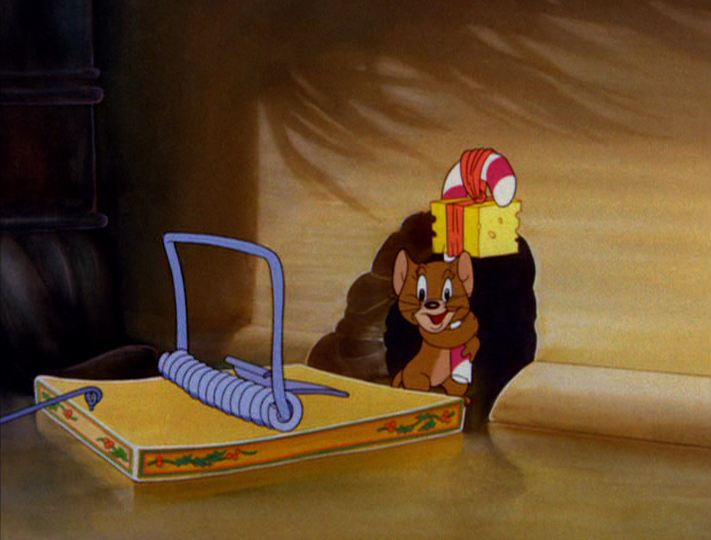
Here’s an example from “The Night Before Christmas” (1941). The cartoon begins and ends with Jerry in front of his mouse hole where Tom had placed a present of cheese on a mouse trap. At the outset, he ridicules it as an obvious attempt at capturing him. But at the end, he decides to extricate the cheese. Check out these poses as he discovers that Tom really has left him a present; the trap slowly springs back to play “Jingle Bells.”


The mouse shows a bunch of different emotions, raising the cartoon from the cutsey sentiment of a Rudy Ising MGM short to something far more satisfying.