Thursday, 9 November 2023

Bugs and Genie

Jim Backus played a character named Hubert Updyke III, the richest man in the world, on radio comedy shows. Backus got laughs aplenty; eventually this character formed the basis of Thurston Howell III on Gilligan’s Island.

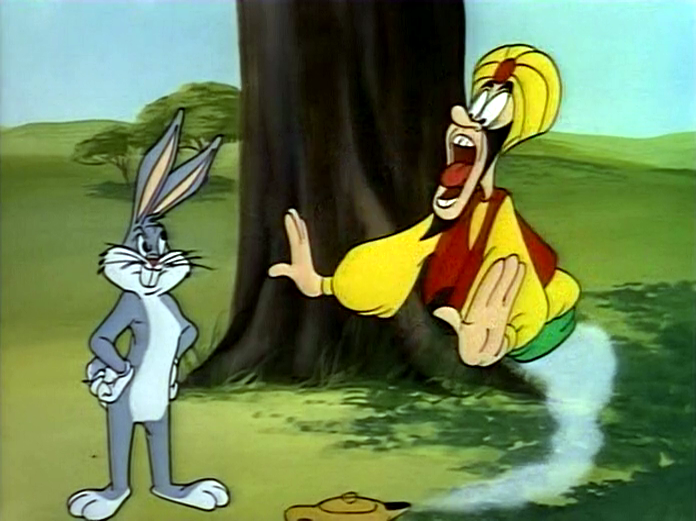
Writer Warren Foster and director Bob McKimson decided it would be funny to use Updyke’s attitude and catchphrases, and put them—and Backus’ voice—into a genie in the Bugs Bunny cartoon A-Lad-In His Lamp (released in 1948).

The early McKimson cartoons are filled with arm-waving and varied expressions. This cartoon doesn’t disappoint. Bugs is debating to himself about what wish he wants the genie to grant him. The genie keeps interrupting him before even revealing what he wants. Finally, Bugs has made a decision, which is stopped in mid-sentence by the genie saying “Heavens to Gimbels, no!” (This was an Updyke catchphrase). Here are some random frames to show how appealing McKimson’s shorts could be.


“Now cut it out!” yells Bugs. Multiples and floppy tongue.


Whether this is a Manny Gould scene, I don’t know, but Gould loved floppy tongues and he animated on this cartoon. Gould may not have loved Bob McKimson; he was gone by the time this cartoon was released, working for Jerry Fairbanks on “Speaking of Animals” shorts.

The other credited animators are Chuck McKimson, Phil De Lara and John Carey.

This cartoon deserves to be restored for home video.

Wednesday, 8 November 2023

Art Gilmore

He wanted to be the next Don Wilson. Instead, he became the first Art Gilmore.

Gilmore was one of the West Coast’s great announcers, and not just on radio. He narrated industrial films, especially for Dudley Pictures, was the voice-over on top of live-action shorts for Warner Bros., memorably in the Joe McDoakes series, and was the first King of the Movie Trailers, including those plugging science fiction films of various grades.

One thing he wanted to do was exchange comedy banter, like Wilson or Harry Von Zell or Ken Carpenter. Instead, he did something Wilson wanted to do—act. Gilmore was on camera on the original version of Dragnet. And he puts in an urgent performance as a uniformed police officer in the Jerry Fairbanks car safety/scare film Why Take a Chance? (1953).

Many of us will recognise him as the announcer who introed and extroed “The World Tomorrow” religious programme. And he was heard on one of the top syndicated shows of the 1950s—Highway Patrol.

As you see on the right, he also endorsed Vaseline (a 1938 ad).

The list goes on and on, so we’ll end it there.

Like many announcers, Gilmore left radio for service during World War Two. Here’s a post-war article from that fine publication, Radio Life, dated Feb. 3, 1946.

Art Gilmore Has Returned to His Radio Assignments, Relates for Radio Life His Experiences Aboard Pacific Carrier
Wednesday, 8:30 p.m., CBS-KNX. Tuesday, Saturday, 7:30 p.m., KHJ-Mutual
TALL (6’, 2”), lean (190 lbs.), good-looking Art Gilmore greeted us at the door of his attractive
Valley home. He was looking comfortably casual in civvies ("I'm lucky. The moths left 'em alone! ").
Peering shyly from behind Art's long legs was a little blonde moppet of about two years.
"That's Barbara," smiled the mike-man, and as he ushered us into a living room bathed in the glow of a cheery wood fire, we noted another little blonde moppet (aged five and a half) peeking with curiosity around the door.
"That's Marilyn," grinned Gilmore. "I have 'em all over the place." The roll call ceased there, however, save for the charming Mrs. Gilmore who made her appearance several minutes later, chiding Art with a choice bit of reminiscing: "Tell how you were always at the microphone with your shoes off!"
"That was during our college days," her husband elaborated. "I was tired."
"He waited tables and did all sorts of odd jobs," Mrs. Gilmore interpolated.
"What wore me out was watching all those pretty girls," was Art's explanation, which won him a scorching look from his missus. Mr. and Mrs. Gilmore were high-school sweethearts. "Another girl turned me down, so I took Grace instead, and never went with anybody else afterward," Art summed up.
"Personality Announcer" Aim
At the time of our visit with the Gilmores, Art had been a civilian for just a few short weeks, but was already busy testing for prospective screen assignments (film acting is one of his chief aspirations), and preparing for his return to the microphone on CBS' "Dr. Christian" and "Stars Over Hollywood," KFI's "Bullock's Show" and Mutual's "Red Ryder" series. His radio goal is to be a "personality announcer"—one who delivers dialogue as well as commercials (a la Bill Goodwin, Harry von Zell and the like).
"It's a funny thing," Art laughed. "Even in the Navy, I didn't get away from the microphone.” The announcer served as a fighter director aboard a carrier in the Pacific, and participated in the landings on Luzon, Okinawa, Iwo Jima and Leyte.
Before every big maneuver, the rumor would circulate that ‘after this one, we're heading home!’" Gilmore smilingly reminisced. "But there always seemed to be one more job to do.
"We were expecting to go into the northern seas to join forces with the Russians, when the word of the war's end came through," he went on to relate. "Were we glad! We didn't relish the thought of swimming around in those icy waters if our ships should be hit."
The carrier on which Art was stationed was struck just once, by a Jap kamikaze. No one was killed or critically injured, but Art grimly recalled that one man, a gunner, had a very narrow escape. A part of the fallen plane flew toward him, missed his face by mere inches, knocked the sights off his gun and landed over the side of the ship into the ocean.
During far more quiet moments on board ship, Art told us then, he and his shipmates gathered together "for what we laughingly termed 'our happy hours' ". Gilmore emceed the "home talent" shows, played his guitar and sang.
Started in Seattle
Born in Tacoma, Washington, thirty-three-year-old Gilmore started his career as a singer, studied opera, doubled as a vocalist and dishwasher to pay his way through college. After his second year in college, he quit school to join the Seattle CBS station as an announcer, came to Hollywood in 1936, worked first on KFWB, then KNX.
Gilmore's first microphone assignment following his recent release from the Navy was an acting chore on NBC's "Pacific Story." He was absent from the Hollywood scene for over two years.
Another pastime the mikeman acquired during the long months aboard ship was wood-carving. He still enjoys doing it, and modestly displayed some finished samples of his work—a totem pole he made for his children, and two tiny figures of a Kentucky hillbilly and a pompous maestro.
Art's other interests include home movies (particularly ones of his children), gardening (he has done all the planting on the grounds of his home), and carpentry (he has added several novel and attractive touches to the furnishings in his home).
"I guess," Gilmore smilingly summed up, "you'd call me a ‘putterer’."


The Red Skelton Show and Shower of Stars were among his television announcing gigs as Gilmore slid from radio into the new medium. Radio must have been his first love, as Gilmore was a founder of the Pacific Pioneer Broadcasters in 1966, when comedy/variety, drama and adventure had pretty been replaced on radio networks by newscasts and news feeds. He was active in the organisation for years and several people I’ve spoken with who met him at conventions remarked about how friendly he was.

Gilmore’s marriage to Grace lasted 72 years until his death in 2010.

Oh, Gilmore had a brief, unintentional, cartoon career. He was among many people—Don Wilson included—who cut children’s records for Capitol. They were turned into the soundtrack for “Mel-O-Toons,” with drawings (you can’t call much of it “animation”) showing the action. You can listen to one of his Capitol records below.

Tuesday, 7 November 2023

Pied Piper Pan

Playful Pan starts out like any Disney cartoon of 1930—there are animals dancing and music played from makeshift instruments.

Who can watch that for seven minutes? Even in 1930?

The cartoon gets a plot about half-way through. Clouds dancing to the tunes smash their butts together to create lightning that begins burning down the forest.

A fox with a squeak-toy voice runs to Playful Pan to get his help to put out the fire. After all, his music started the whole thing.


He gets an idea. He plays a tune that gets the flames (with little legs) to dance their way into a lake and commit suicide.


We cut to a little flame bringing up the rear; Friz Freleng used the same concept for gags in later cartoons at Warners. Pan’s music still can’t get the flame to jump in the lake, so the little goat-boy smashes him into pieces and uses his flute as a fire extinguisher to put out each piece.


A lot of good it does. The forest has been burned down. Pan fades out to end the cartoon.

Disney appears to be trying for something a little more elaborate by filling the screen with characters. The action is animated on ones.

Monday, 6 November 2023

Operatic Turnabout

Poochini the opera singer gets his revenge on the magician at the end of Magical Maestro by turning the phoney conductor into all the transformation guises he went through during the cartoons. The last one is the Hawaiian war dance (with accompanying magicians rabbits) with the goofy head twists, no doubt animated by Grant Simmons.


There’s nothing else director Tex Avery can do so, logically, this happens.


Rich Hogan helped with the gags and the other credited animators are Mike Lah and Walt Clinton. The cartoon was released in 1952.

Sunday, 5 November 2023

Benny's Bomb Was Not at Midnight

The Horn Blows at Midnight got mixed reviews from movie critics when it came out in 1945, but Jack Benny and his writers decided it would be funny to deem it a failure, and joke about it whenever they needed a gag about his acting or his successes.

Jack didn’t joke about the real bomb in his career, one few of his fans likely know about.

Rochester used to answer the phone on the Benny radio show, and proclaim Jack “star of stage, screen,” etc. He was referring to the vaudeville stage. But Jack had a shot on the legitimate stage, one that was very short-lived.

In September 1934, Jack Benny was on the air for General Tire and was about to switch to General Foods. He had just filmed Transatlantic Merry-Go-Round, another fluffy musical-comedy. He was then signed to star, in between episodes of his New York-based radio show, in impresario Sam Harris’ production of the George S. Kaufman/Morrie Ryskind satire on Roosevelt’s New Deal, “Bring on the Girls.” They hoped to take it to Broadway.

It started at 1321 Pennsylvania Avenue NW in Washington, D.C. The play opened on Monday, October 22, 1934. The day before, the Washington Star’s theatre critic gave a fine capsule biography of Jack Benny to that time.

This Season of Theater Has Plenty of Surprises
Fred Stone's Debut as a Dramatic Player Was One of Them, and Now Comes Jack Benny of Radio Fame in New Play.
BY E. de S. MELCHER.
THE current theater season is fraught with surprises. No sooner do we get acquainted with Fred Stone as a straight actor (we wonder if the late Mr. Montgomery would have done the same) than a flood of announcements comes to the effect that other music men are going serious, that serious men are going musical, that comedians are turning tragedians and that Hamlets are turning into the Four Marx Brothers.
Beyond that we find Miss Ethel Barrymore, once the brightest star in the theater, playing second Addle to Eva La Gallienne in “L’Aiglon,” we find a young screen player like Douglas Fairbanks, coming back with a former musical comedy performer, Gertrude Lawrence, to play in a very serious play, “Moonlight Is Silver,” which has been written by the increasingly popular Clemence Dane—we hear that the former “Autumn Crocus” star, now the screen star of “Pursuit of Happiness,” Francis Lederer, is coming to Broadway to produce some kind of a show of his own. Such varieties help the now of the theater. Surprises behind footlights are always welcome. If you have seen “Merrily We Roll Along,” in New York, you know that even controversy breeds success, and that the much-mutilated Elmer Rice play, “Judgment Day,” is holding its own.
So when we hear that a radio wag, Jack Benny, is coming here in theater disguise, minus music, minus songs, and presumably minus impromptu gags, then we must take that as part of this year's matter of course, putting this event in the files along with Mr Stone, Miss Barrymore, Mr. Fairbanks, Miss Lawrence and Mr. Lederer.
JOHN PETER TOOHEY, sage henchman of Sam Harris, knowing more about Mr. Benny than we do, we herewith give you his own words of the somewhat great man:
Benny, who was declared the most popular comedian on the air by more than three hundred radio editors in a census taken early this year, is coming to Washington this week ‘in the flesh.’ He is to be the bright particular featured player in the new George Kaufman-Morrie Ryskind farce 'Bring on the Girls,’ which is to be unveiled tomorrow night at the National Theater and which is to be offered to metropolitan theatergoers three weeks hence as a successor to the same authors' triumphant ‘Of Thee I Sing,’
Benny makes his living, and a right handsome one, with his voice at the present time, but it took the World War to start him talking. Before joining the Navy he played a violin in vaudeville and said nothing. After one attempt to raise funds with a musical appeal at a benefit, Benny dropped the violin and started talking. Since then he has talked his way through several Shubert musical revues, two editions of Earl Carroll's ‘Vanities,’ half a dozen feature motion pictures and into radio over broadcasting networks as a laugh-getting master of ceremonies.
“He is noted as a wit, monologist, comedian. His quips and stories have enlivened stage, screen and air. But is a hard master. For years after he deserted music for speech, Benny carried the old violin on and off the stage at each appearance. He never played it, just carried it along and looked at it wistfully now and then. Some day, he says, he’s going to use it again, providing he can stop talking long enough.
“Mr. Benny always had ambitions. His family lived in Waukegan, Ill., but he was born in Chicago. Then they carried him back to Waukegan, and he stayed there for 17 years. He was not idle, by any means, during those years. “ 'My father gave me a violin and a monkey wrench,’ explains Benny. 'He told me not to take chances, that plumbing wasn’t a bad business.’
“Young Benny didn’t get far with the monkey wrench, but he was practicing on the violin before he was 6 years old. When his 13th birthday arrived he was still at it, and by the time he was 14 he had determined to make it his profession. He started with an orchestra, playing for dances in and around Waukegan. He was 16 then, and after one year with the orchestra he decided he had sufficient professional standing to go on the stage. With a partner who played the piano while he played the violin, Benny launched his first vaudeville act.
"For six years he toured back and forth across the United States, playing his violin and saying nothing. Then the United States entered the war and Benny joined the Navy. As a musician he was soon drafted for sailor shows for the Seamen's Benefit Fund. His violin playing brought applause, but no contributions. After all, reasoned Benny, if you want money, you have to ask for it. He put the instrument down and broke a six-year silence.
"He got contributions. But what surprised him more, he got laughs. Gingerly he tried a few more gags. A wave of laughter swept through the audience. At the next show, Benny played less and wise-cracked more. When the war was over he returned to vaudeville as a monologist.
"In the years that followed, Jack Benny, a glib young man carrying a violin he never played, became a celebrated comedian. He was a headliner in vaudeville and one of the first and most successful masters of ceremonies in Broadway revues. He was a popular night club entertainer.
"Apparently, he was permanently attached to the theater when the end of a transcontinental vaudeville tour brought him to the Orpheum Theater, in Los Angeles, the port of Hollywood. Benny stayed at the Orpheum for eight straight weeks, establishing a new house record for a single artist. Meanwhile talking pictures and the first wave of screech revues came to Hollywood.
"To keep the talking Jack Benny out of talking pictures would have been a real problem. Nobody tried to. Metro-Goldwyn-Mayer promptly offered him a contract and he made his screen debut as a master of ceremonies in the “Hollywood Revue.” Other feature pictures and comedy shorts followed in rapid succession. Benny might have been in Hollywood yet, if he hadn’t met a Los Angeles girl—and continued to talk. The young lady just nodded her head and said they would go East for their honeymoon. (Now she is doing some talking for herself and you frequently hear her on the air with Benny. Her radio name is Mary Livingstone.)
"The Bennys arrived in New York just as Earl Carroll was casting the annual edition of his vanities. At Carroll's request Benny dropped into witness a rehearsal. When the curtain went up on the opening night Benny was still there. He was, in fact, the star of the show.
"For two years he was the leading comedian and master of ceremonies in the Carroll revue. Then came radio, and now the comedian is making his debut in the first straight play in which he has ever appeared. His weekly broadcasts are now being made every Sunday night so that they will in no ways interfere with his playing on the stage.”


A person acquainted with Benny at Great Lakes responded to the column. You can read it in this post.

Melcher was present opening night. He proclaimed Benny “played his first straight comedy role with an agreeable ease,” but incisively explained what the problem with the play was. “For the first half hour the play’s lines are sure fire. For the second, they are warm. After that you begin to wonder why the actors even bothered.”

In other words, Kaufman and Ryskind had a great first act but there was nothing left by the third. After the week-long tryout in Washington, Variety reported on Oct. 30th the production was shut down while the last act was entirely re-written, and stated on Nov. 6th it would play three days at New Haven, and then in Boston before heading to the Great White Way.

The trade paper reviewed opening night in New Haven and you can read that review in this Tralfaz post. The play had the same problem; it fizzled out after the first act. You can see the Boston Globe review of opening night on Nov. 26 to the right. The Harvard Crimson loved it and the paper’s review is on this website.

The aforementioned post also gives Variety’s coverage of the satire’s demise. After two weeks in Boston—with a meagre box office take in the second week—and another week in Springfield and Hartford, Harris pulled the show in mid-December with the idea of mounting it again during the next theatrical season. It never happened.

This dud didn’t hurt Jack Benny in the slightest. He carried on with his radio show for General Foods (Jell-O) and now had spare time for personal appearances, which always seemed to get good reviews and, of course, added to the Benny bank account. “Bring on the Girls” didn’t warrant a line on Jack’s radio show after it died. Perhaps it’s easier getting laughs from a phoney flop instead of a real one.

Saturday, 4 November 2023

She Saved Tom and Jerry

Joe Barbera’s book mentions that Tom and Jerry were saved from being one-shot characters because of a letter from Besa Short to MGM asking when more cat and mouse cartoons would be released. He told this story a number of times, including some years ago in a short interview with Jerry Beck.

Nobody today knows who Besa Short is. But in hunting around researching some other stuff, I found a feature article mentioning her. She certainly loved short films and promoted the crap out of them. I’m going to post the article because it’s an interesting footnote in the promotion of, and attitude toward, cartoons at the time. This is from ‘Every Week Magazine’, one of those syndicated weekend newspaper magazines that were popular at one time. The date is August 9, 1942.

Hollywood Hails Return of Shorts
By DEE LOWRANCE
HOLLYWOOD
The biggest news story in films since the war began is just now starting to leak out. Prepare for a shock—shorts are staging a comeback.
It’s been over 10 years since one- and two-reelers (with the exception of cartoons and newsreels) first took a back seat. Their forced retirement came at the depths of the Depression when movie men, desperate at the way audiences were staying away from theaters in droves, decided to hypo the box office. Taking a tip from the one-cent sales in drug stores, they hit on the idea of offering two films for the price of one.
The double feature was born. Triple, quadruple, quintuple features, all in one theater, appeared. “Bring a box lunch and stay all day,” advertised one movie house.
The competition became too tough. It soon dropped—two features were all any normal audience could take. Vaudeville acts fell by the wayside. Shorts were doomed.
Since then, no matter what happened—floods, drouth [sic], pestilence, or financial crashes, anything and everything to harass movie producers—all have been blamed on the double feature. Editorials have been penned, laws made, speeches ranted—but the double feature stayed put.
Shorts, the oldest film form, favorite son for so long, became the films’ stepchild. Short subjects producers were pushed into out-of-the-way parts of the studio, when they worked at all. Nary a line about then appeared in the papers—they were the Forgotten Men of Hollywood.
A FEW names did break through the great silence about shorts. There was Pete Smith, who started to kid serious subjects, giving his brief pictures a comedy smasheroo that put his name on the map. And long before Uncle Sam mixed into picture making at all, the Warner Brothers, with Gordon Hollingshead producing, began to make patriotic shorts in Technicolor to sell America to the Americans.
Newsreels, at the rate of two issues a week from five film companies, went along with every double-feature program and, hot on their heels, came the March of Time two-reel news coverage which rapidly forced itself into theater acceptance.
By and large, though, the double feature held a death grip on movie theaters. The return of shorts has been a long time coming. A straw in the wind was the rise of the news-reel theaters in the nation’s largest cities, with their added use of briefies. Super-duper length pictures like “Gone With the Wind,” which were too much in themselves to carry a B-picture, too, allowed a few shorts to be squeezed into a program.
Little by little, theater men have put out their own feelers. Wasn’t one really fine feature-length film, framed with excellent shorts, better than shoving two poor features down an audience’s throat? Some have tried, and the results have been on the whole most successful.
Down in Texas a real crusader, with a white banner lettered “Down With the Double Bill,” appeared. It might have seemed as if her name had ordained her crusade.
Miss Besa Short is responsible for all programs booked into 175 southwest movie houses. If you want to make her see red, hit the ceiling and lambaste the lot of you, just say “also selected short subjects” to her. That line is a battle cry to Besa Short. With the idea that dismissing shorts in those four words was entertainment murder, Besa Short started out some time ago on her campaign to make exhibitors, and through them the public, properly short-conscious.
Choosing her shorts with as much care as that given to full-length features, Besa Short booked them with an eye to balancing the programs evenly. A long comedy was surrounded by serious shorts; a heavy drama was relieved by bright featurettes.
Then she started a minor revolution in her part of the world. She went after publicity for shorts—newspaper notices, critical reviews. Next she saw that each theater had special lobby displays about the shorts they were playing; also advertised coming shorts in advance.
Naturally, Besa Short is a big name among Hollywood’s shorts producers, a heroine. Her work has been watched carefully by other theater bookers. The trend away from double features is beginning to gather momentum.
The war itself is having much to do with it. The defence shorts now being made at all Hollywood studios in co-operation with the United States government are being released all over the country. More are on their way. Made with the double-edged intention of entertaining while instructing the public, these shorts are playing a tremendously important role in keeping the public aware of all branches of the nation’s effort to halt Hitler and nip the Nips.
Experts on shorts are doing even more, which will not be seen by the public. Working with all branches of the service, they are making training films to be used to help whip our armed forces into shape.
The government-inspired shorts, made to entertain, too, will probably become the final blow against double features. For with each of them shown on a program, other shorts will be needed and the second, weaker features can be dropped. Few tears will be shed, for Hollywood and the film public alike are tiring of the two-for-the-price-of-one idea, especially as it often means two weak pictures instead of one good and an assortment of shorts.
With this in mind, let’s look at the present shorts picture. The production of shorts is divided between New York and Hollywood with the latter becoming more important all the time. Almost one-third of all cartoon shorts now being made are cartoons. Disney, with his Donald Duck and Mickey Mouse, still holds the top spot in cartoons. Those that he is making for the government are blazing new trails in educational jungles. But, since Disney’s attention has been on feature-length cartoons and defense and training pictures, other cartoon producers have grabbed their chance to push ahead.
Right now Disney has been getting some stiff competition in comic cartoons from two particular talents. Leon Schlesinger has two series, making some 39 to 42 of them a year, that are giving Donald Duck a run for his money. These are his “Looney Tunes,” with that mad Bugs Bunny (did you see his “Any Bonds Today?” or “The Wabbit Who Came to Supper”?) and “Merrie Melodies” which often feature Porky the schoolboy piglet. The Tom and Jerry series at MGM, with that fearsome pair, the cat and mouse cavorting, also should make Disney watch out for his laurels.
Popeye the Sailor continues to have a fine, flourishing following among cartoon addicts and George Paal [sic], who takes puppets and makes pictures in the cartoon tradition, is striding along in a field all to himself. Two-reelers, shorts which run for up to 20 minutes, make up a third of the remaining shorts, with twice as many one-reelers being made. Outstanding in the two-reel class are the patriotic shorts mentioned before. Gordon Hollingshead, who has always produced them, worked with films overseas in the first World War. After the war he came to Hollywood where he got into film production first as assistant director on every film John Barrymore made. From there, he went higher in production.
While doing research for the Errol Flynn starrer, “Captain Blood,” Hollingshead got the idea for the first of the color patriotic two-reelers, which told the story of the way our national anthem was written. Since then these shorts of his have covered all aspects of American history, beautifully dramatized, superbly photographed. His latest had audiences cheering. Called “March On, America,” it summarizes the United States’ growth since the Pilgrims, bringing us right up to date in a stirring, heart-warming manner.
Another important branch of Hollingshead’s worth concerns a series of shorts designed to make the public better acquainted with various branches of the armed services. They have also been a great aid to swelling enlistment.
No story on shorts could be written without due credit to Pete Smith. His office bristles with medals and awards he has won for the excellence of his shorts and he has been elected by the other shorts producers as their spokesman. At a time when double features blanketed all shorts, word-of-mouth publicity boomed for this maker of unusual shorts, interlarded with high wit, amusing situations, fascinating subjects and a commentary spoken in his dry, arresting voice.
Perhaps one of the best proofs of the way his shorts are gobbled up is the fact that every other studio has, at one time or another, tried to copy them. But the real thing is marked by Pete’s own very gifted touch, probably because he is a one-man production company, writing, directing, producing each of his shorts with little if any help.
There is no end to the subjects covered in one and two-reelers. Sports, pie-in-the-eye comedies, musicals, travelogues, musicals, dances, all and many more appear. High on the honor role are several different stories that are made and released consistently and will give you an idea of the scope of shorts.
There is, for instance, the dramatic series—like “Crime Doesn’t Pay” and “Stranger Than Fiction:; the question-answering kind, topped by “Information Please” and “The Quiz Kids”; Robert Benchley’s self-acted monologues; old-time comics at work—“The Three Stooges,” Leon Erroll [sic], Edgar Kennedy, Buster Keaton, Charlie [sic] Chase and “Our Gang.”
For music lovers, all sorts of orchestras and bands are photographed in south while the dance made can have jitterbug or unusual dancing spectacles like the series now starring the Ballet Russe de Monte Carlo.
Now, more than ever, shorts are used as a proving ground for new talent. Until Dorothy Morris appeared in Pete Smith’s “What About Daddy?” no one paid much attention to her. Now she’s having a star build-up at MGM. Other stars who came through shorts are Deanna Durbin, Judy Garland, Robert Taylor, George Murphy, Ann Rutherford, Alexis Smith and countless others who met their first audiences in shorts.
Established stars, too, often work in shorts. And, as they continue to gain in popularity as they are now, bigger and bigger names will be seen in what was for so long Hollywood’s downtrodden stepchild.


Besa Short left Interstate Theatres in 1946 to work for MGM to handle short subjects promotion. She died in Dallas on August 19, 1974, age 79.

Friday, 3 November 2023

Encounter With a Street Lamp

Hallucinating Felix is fun.

There are some great scenes Felix Dines and Pines (1927) of morphing monsters. We get a bit more of the same in Felix Woos Whoopee (1930) where the cat gets drunk on speakeasy hootch.

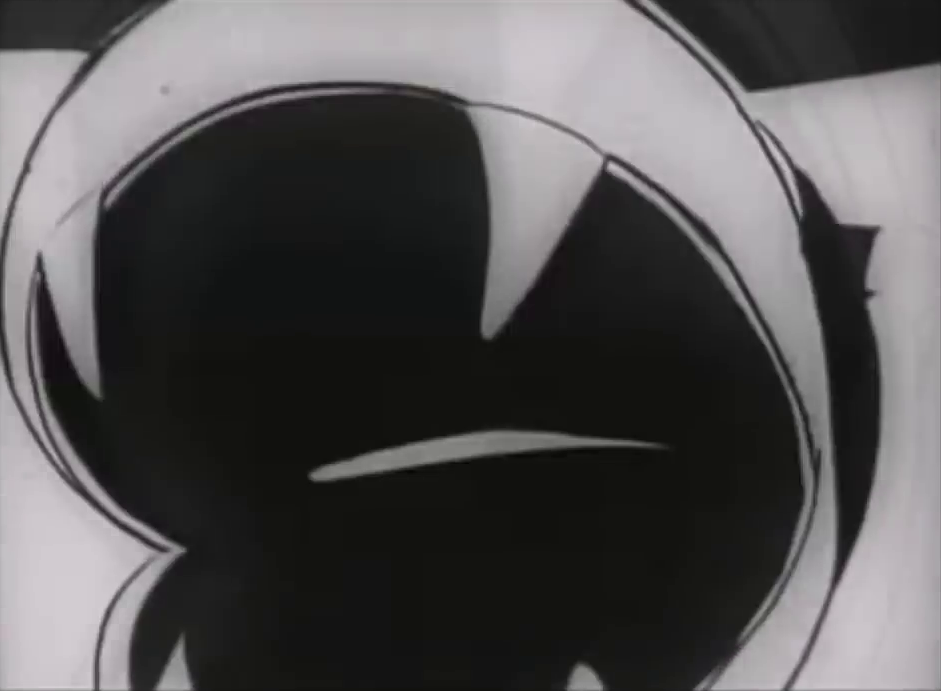
In this one, Felix greets a street lamp, which does a little dance, then jumps on it. The lamp turns into a smoke-spewing dragon that chases after him in perspective. The creature opens its mouth and “swallows” the camera.


Poor Felix had fallen from greatness by this point. Producer Pat Sullivan was interested in the sound of hootch falling into his own glass instead of sound in his cartoons. Educational Pictures dropped Felix. He was picked up for release by Copley Pictures on a state’s rights basis with music and vocal effects added after the cartoons were made to increase their saleability. Felix didn’t really make a comeback (despite starring in some shorts for Van Beuren) until the TV cartoons produced by Trans-Lux in the 1950s.