Monday, 23 October 2023

The Nine Lives of Tom the Cat

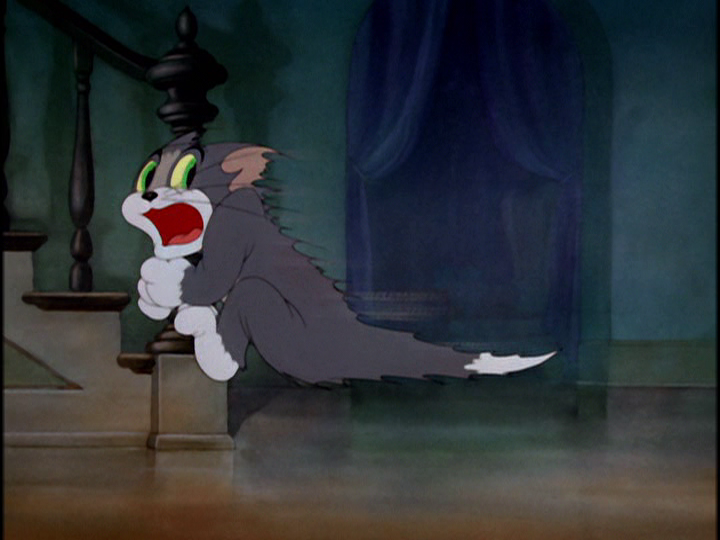
Tom’s owner has the world’s most powerful vacuum in Fraidy Cat (MGM, 1942). As he grabs onto a bannister, his nine lives are sucked right out of him.


Life Number Nine, fearing the end, does something about it.


Tom races out of the room, pulling his lives out of the vacuum, including the hammy Life Number One, who's the only one not pertified by the whole thing.


Tom slams into a door. His lives go back into his body, but not before Mr. One congratulates himself for surviving.


Bill Hanna, Joe Barbera and Fred "I think I'll have a nap in my office" Quimby are the only people to get screen credit. The Hanna-Barbera unit was in the early days, so people like Jack Zander and Pete Burness likely animated on this cartoon.

Sunday, 22 October 2023

Jack Doesn't Do Dallas

It was the show Jack Benny never gave.

Jack had signed to perform in Dallas on October 19, 1974 to raise money for the Southwestern Medical School at the University of Texas. Instead, his only appearance was in a hospital.

Nostalgia and fun memories always seemed to be stirred up in the press whenever Benny was coming to town. The Dallas show was no different. The Star-Telegram of Fort “We’re Not Dallas” Worth had this reminiscence in Elston Brooks’ column of August 30, 1974.

JACK BENNY'S RETURN TRIGGERS OLD TALES
Jack Benny has been signed to return to Dallas Oct. 19 as the star of Neiman-Marcus’ Japanese Fortnight in the Fairmont Hotel.
And since Gisele MacKenzie, his co-star on a celebrated 1954 show over there, is currently in town, and so is Charlie Meeker, who produced that Dallas show 20 years ago, this seems like a good time to relate a funny story that concerned all three of them.
Meeker, who now runs Fort Worth's Charlie's Place, recalls he was producing the State Fair Musicals more than 20 years ago when he suddenly got the idea to star Benny in "The Seven Year Itch" over there.
"I phoned Jack and almost sold him on the idea of the role being a departure from the Benny image," Meeker said, "but Jack had misgivings about playing a show like that in the cavernous Music Hall.
"I'd phone him continually, thinking I was about to convince him but then he'd back away again. Finally, his agent phoned me one day and said, ‘Jack wants you to quit calling him. He just doesn't know how to tell you no.’ "
FERRER'S AID DOESN'T HELP
Meeker had one more inspiration. He phoned Benny again, saying, "Look, I know Jose Ferrer lives a couple of doors from you. Jose just finished playing the Hall. Phone him, and get his opinion."
Charlie phoned Ferrer and asked what he had told Benny. Ferrer reported he told Jack that the first time you step on that sprawling stage you're scared to death, really frightened. But, after 24 hours, you get used to it and things are fine.
It didn't work. Benny didn't sign. But, flashing forward, Meeker was able to entice Benny to the same hall in 1954 to do the show with Gisele and the Will Mastin Trio, which was Sammy Davis, Jr., his father and his uncle.
"I flew out to Jack's home to sign the contract," Meeker continued. "We were having breakfast in his Beverly Hills house, and I was prompted to ask him why he hadn't signed for that first show."
Meeker went into his Jack Benny voice to give Benny's reply:
"WELL it's this way, Charlie. I called Joe Ferrer and he said it was a frightening place, but you got used to it after 24 hours. But the more I thought about it, Charlie. I figured, why, with my money and at MY AGE, why should I be FRIGHTened for 24 hours?"
AND NOW ONE FROM THE 'BENNY-FIT'
Gisele laughed when she heard the story. "It's so like him," she said. "He's such a wonderful man."
"I've got a story that goes along with it," I volunteered.
Mine occurred in 1966 when Benny had come to Fort Worth as guest violinist with the Fort Worth Symphony. It was called a "Benny-Fit," and the $100 tickets were marked down to $99.95 The $3 seats were going for $2.99. Riding in with him from the airport, we talked about that 1954 show he had done in Dallas with Gisele and Sammy Davis Jr.
"You know what?” Benny asked me. "As big as he is now, Sam said he'd play the show again with me for the same dough."
"What did you tell him?" I asked.
"I said it wasn't quite fair. The last time I got his father and uncle, too!"


This column is about all the comedy from Benny the locals got. The Associated Press sent out a story on Oct. 19 saying “Benny was in his dressing room at the Fairmont Hotel when a hotel employe found him ‘in extreme pain.’ Three doctors from the audience advised him not to perform.” Because he was at a benefit for a medical school, the audience was filled with doctors.

A later dispatch from the wire service reported Jack was in his stateroom off the main stage at the hotel “complaining of numbness in his arms and hands,” and that an employee “gave him some ice and took him to his room. Thirty minutes later he was rushed to the hospital.”

The AP quoted someone at the hospital saying Jack was supposed to remain for a few days to determine what was wrong, but was instead flown to Los Angeles and admitted to Cedars of Lebanon Hospital that day.

United Press International noted conflicting opinions in one of its stories. “Benny was examined by two doctors at his hotel room and ordered hospitalized over his protests,” it reported. “They said he had suffered a mild stroke. However, doctors at Presbyterian Hospital in Dallas, where Benny was taken in a private car, said Benny was suffering from an unconfirmed illness, ‘definitely not a stroke.’”

Hundreds of newspapers in the U.S. picked up the story, some putting it on their front page. It wasn’t relegated to the entertainment section.

Jack walked out hospital on Thursday, and was greeted by reporters. He said he had spent Saturday in Dallas walking and felt fine, then had “a terrible stomach ache” before the show. He went on that he told doctors he “could talk and play the fiddle,” but they insisted he go to the emergency ward. He joked he hadn’t seen the hospital bill “but when I do, I’ll then ache.”

The AP quoted him that doctors kept examining him and couldn’t find anything wrong. He wrote it off as stomach trouble.

But it wasn’t. He had cancer of the pancreas. Doctors couldn’t find it. The pains came back. Almost two months later, Jack Benny was dead.

Saturday, 21 October 2023

Plugging Cartoons

The best newspaper ads for cartoons in theatres way-back-when are the ones featuring drawings of the characters in them. Some of the artwork was supplied by the studios, in familiar poses in some cases. Others seem to have been traced (sometimes very poorly) by an artist working for the paper.

To the right you see an ad for a kids show with a number of cartoons; I’ve seen some ads promising 20 of them (Capitol Theatre, Hazelton, Pa., Dec. 1952). The “Lion and Mouse” cartoon was a 1943 Terrytoon. And the ad copy butchers the Woody Woodpecker short The Barber of Seville. (Note: It didn't dawn on me this was the 1944 Terry cartoon called The Butcher of Seville because I don't remember seeing it before. Thanks, S.P. for the info).

Here are a few more random ads. One theatre seems to be warning children it will be showing Good Night Elmer.


Here’s a neat piece of artwork from the December 6, 1941 edition of the “Showmen’s Trade Review.” It tried to help theatres along with suggested promotional gimmicks, things like displays, ad slogans and, in this case, newspaper ad layouts. They’re pretty attractive but I don’t believe I’ve seen these used in any newspapers. Andy Panda looks more like his dad in the drawing below. “Old Doc Layout,” writer of the article, is a pseudonym for Hank Harold.
Play Up the Fun-makers Who Star in Cartoons
These Layouts Prove It’s Practical and Profitable to Headline Short Subjects
For that "kid" appeal which should be an important consideration of every showman's show building as well as exploitation, there's no surer way to inject the necessary element in the newspaper ads than to give a "play" to cartoon characters you may be presenting in a short. Consequently, Old Doc is back with some more suggestions for layouts you will find practical from a standpoint of utilizing all your available space without handicapping the "punch" selling of your ad — which, of course, must always be your top feature's title, stars and catchlines.
You will note that the layouts below concentrate on the cartoon characters. You will also recall that every survey of reader-interest shows that cartoons have the ace pulling power of all elements editors can put into their newspaper pages. The comic strips top all in reader interest. If they can do that — you are hitching your wagon to a real star when you inject the likeness of some cartoon character in your ads. So try some of these suggestions.


Someone at MGM finally realised there was money to be made in Saturday matinee showings of cartoons, so it cobbled together a bunch of used shorts, connected them together and sent The Tom and Jerry Cartoon Festival to exchanges to be booked as one complete show.

There’s something different about seeing a cartoon on a theatre screen than on a computer or TV at home. The first time I saw Tex Avery’s Magical Maestro was in a theatre. The perspective of the magician’s rabbits jumping from the sides of the frame into the middle isn’t the same as watching it on home video; in the theatre, it caught me completely by surprise. And I think people laugh at cartoons more when they’re in a theatre with a group of people.

The days of a theatre programme with a feature, cartoon and newsreel are long gone. But there are still animation festivals here and there, screening cartoons old and new. So long as there’s an audience, and people interested in putting together a programme, cartoons will appear on the big screen.

Friday, 20 October 2023

Car Bites Car

Hugh Harman’s writers were no doubt sitting around, pondering. They had put Bosko in an auto race cartoon against a Pegleg Pete-style, cheating villain. It’s the climax scene. Bosko’s little car can’t get past the Champion’s. What to do? How is Bosko going to win the race?

The solution? Bosko’s putt-putt model develops a face and bites the villain’s car, which also develops a face, in the trunk.


The villain’s car leaps into the air in pain. Bosko’s car scoots under it for the win and Bosko is crowned Speed King.


Hmm. If this is a Bosko cartoon, there must be a piano somewhere, right?


Why, yes there is!

I can’t believe the only versions available on-line of some of these Bosko (and Buddy) cartoons are overly-pixilated ones that come from a poorly-tracked VHS recording of a TV cable channel. Granted, this isn’t a great cartoon, but Bosko deserves a lot better.

Frank Marsales’ soundtrack include Warren-Dubin’s “Young and Healthy,” the old Billy Murray favourite “In My Merry Oldsmobile,” and Mel Kaufman’s cat-drowning song “Me-Ow” that Carl Stalling was putting in Warners’ cartoon scores into the 1950s. Listen to a pie-anny version below.


Friz Freleng and Paul J. Smith are the credited animators.

Thursday, 19 October 2023

I Can't Bear Those Eyes

One of the things Tex Avery seems to have wanted to accomplish with All This and Rabbit Stew was to pick up the pace from the Bugs Bunny-Elmer Fudd short A Wild Hare the earlier in the year. There’s a lot more running and chasing in this cartoon, though the short starts with the hunter shuffling and ends with Bugs wearing his clothes and imitating him.

Shuffle runs after Bugs into a darkened cave and, eventually, all you can see is eyes. He thinks he’s caught the rabbit and, judging by the eyes, starts shaking him. A third set of eyes appears and we hear the familiar “What’s cookin,’ Doc?”

\

Shuffle’s eyes look back and forth between the two other sets. A match is lit.


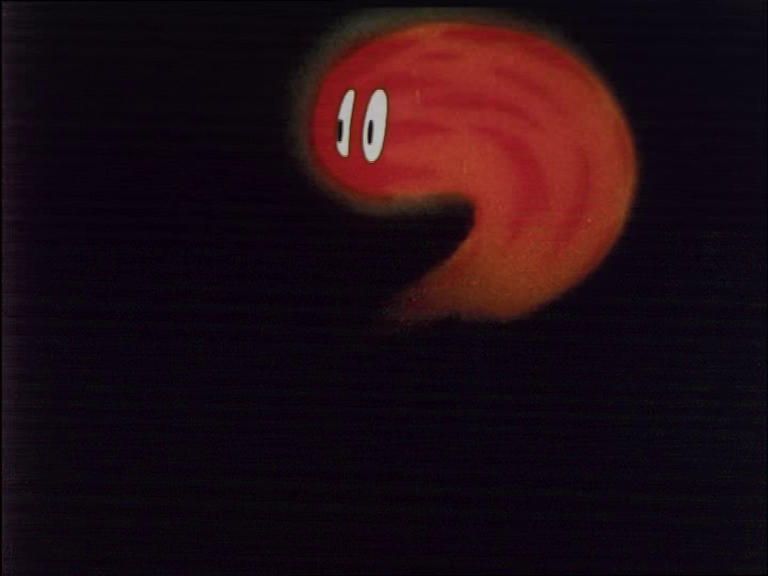
Now he can see what’s in the cave. A bear. Here’s the take.


The hunter turns into a red ball of flame and zooms out of the cave and into a hole.


One of the stations around here which aired the AAP Warners cartoon package in the morning and afternoon over and over for years used to air this one. I found the hunter dull and his voice annoying. I preferred Elmer Fudd. In fact, Bob Clampett re-used the log/cliff gag from this short (and re-worked the drawings) with Fudd a few years later in The Big Snooze.

Virgil Ross gets the rotating animation credit, while Dave Monahan’s name appears on screen next to “story.”

Wednesday, 18 October 2023

It's the Metaphors

Fibber McGee and Molly had a wonderful run on radio for over 20 years, though the show was slowly dismantled as the 1950s wore on and the big money of sponsorships moved into television. NBC turned it from a half-hour weekly sitcom into a 15-minute daily semi-serial, with no studio audience, no orchestra, no Harlow Wilcox (he was replaced with John Wald) and a limited number of secondary players. Eventually, it was turned into a short and pretty lifeless dialogue segment on Monitor.

Writer Don Quinn was long gone by this point. Quinn was praised in the press through the 1940s (and the following decade for his work on Ronald and Benita Colman’s radio series, The Halls of Ivy). Critic John Crosby felt the writing was the reason for the success of Fibber, though in the column below from December 11, 1946, he doesn’t find room to mention Quinn.

RADIO IN REVIEW
by JOHN CROSBY
79 Wistful Vista
The task of saying anything coherent about Fibber McGee and Molly is made extremely difficult by the fact that millions of people know them even more intimately than their own relatives and are as familiar with the goings-on at 79 Wistful Vista as they are with the gossip at the local cake sale. In fact. Fibber and Molly's great contribution to the listener is another set of neighbors to add to the ones they already have.
About the only things different in the Fibber and Molly show this year are the metaphors, which are as weird and unlikely as ever, and Fibber's own brand of home-grown insult. "You smell like a fracture ward and you have the manners of a Zulu," he says to Doc Gamble. Fibber has been insulting the Doc for a great many years and this is only the 1946 variant.
He has lots of other variants including "bandage bandit," "medical misfit" and "witch doctor," and the good doctor refers to him variously as "bean brain," "droop snoop," "limber lip" and "parrot face."
"A curt nod of dim recognition to you, you low bucket," the Doc is likely to greet him.
"Listen, you bandage bandit," Fibber will reply, "you're just a human telephone extension with a bag of benzedrine attached. As a psychoanalyst you'd make a good cottontail moccasin."
He doesn't reserve this patter entirely for Doc Gamble. His other old friend, Mayor La Trivia, gets his share, too, and gives as good as he gets. "How are things down at City Hall, La Trivia?" Fibber will inquire. "You stealing much? You're as well groomed as an alley cat and smell like a livery stable and have the manners of an underprivileged water buffalo. Yow family tree is such a slippery elm you couldn't hang a horsethief on it."
All those metaphors sound a little strained in print The McGees get away with it on the air only because they take a lusty delight in kidding themselves. Even Molly, a much cooler head than her husband, delights in the far-fetched metaphor.
"You get in more jams than an ant at a picnic," she says. She refers to her own dear friends as "that little group of public enemies I play bridge with."
The McGees can also get by with, in fact, go out of their way to indulge in, some of the corniest jokes on the air. "The fellow who tried to sell me a Doberman turned out to be a Pinscher himself," cracks Fibber.
" ‘Taint funny, McGee," says Molly, and laughs at it anyhow. That's the secret of it all. It may not be funny but it's extraordinarily human.
“Aren't you Fibber and Mrs. McGee?” asks a floorwalker at the Bon Ton Department Store.
“No, I'm Mr. Molotov and this is Catherine of Russia. We're shopping for an iron curtain,” replies Fibber.
People still pop in and out of 79 Wistful Vista like fleas at a dog show (now he's got me doing it) and some of the faces are reasonably new. There's a beauty parlor operator who speaks pure Brooklynese:
“When she came in she was the spittin' image of General Grant but we took years off her age. When she left she looked just like General Eisenhower.”
And, of course, there's always Mr. Wimple, a sort of Cal Coolidge with a dash of Titus Moody. "How's your wife?" Fibber inquired of him the other day.
"I've never seen her in better shape. She's been in bed for a month."
"Touch of flu?"
"No, touch of a truck."
Then there's Marian (Molly) Jordan's characterization of an extremely literal little girl whose humor is extremely hard to put into print. Her father, she said, won a turkey in a wrassle, and it turns out that's just how he won it.
Don't bother your heads about the plot. There isn't much. Currently, most of the jokes revolve around Mayor La Trivia and Doc Gamble's pursuit of a toothsome babe named Fifi Tremaine, who never appears. This can go on indefinitely and probably will just as Fibber will forever be remarking:
"Where's that muffler? Oh yes, right here in the hall closet."
"No, no, McGee! I haven't had a chance to" . . . . . . . .
But I guess everyone knows what happens then.


The other Crosby columns for the week:
December 9, 1946: Bill Paley at CBS waves the flag as he responds to radio’s critics.
December 10, 1946: “The Falcon” and “Big Town.”
December 12, 1946: Mutual’s “Exploring the Unknown” and “Crimes of Carelessness.”
December 13, 1946: Moss Hart takes on the New York Daily News’ John Chapman on “Broadway Talks Back,” a local New York radio show.
Click on each column below to read them. (The artwork in this post accompanied the Crosby columns in the Los Angeles Daily News).

Tuesday, 17 October 2023

You've Been Canned

Porky Pig has no hair, but that doesn’t stop a wimpy Indian from trying to scalp him in Nothing But the Tooth (1948).

The two are in a river. Director Art Davis cuts twice to a predictable gag.


Cut to a waterfall (background by Phil De Guard).


Over they go.


Now Davis cuts to the oddest gag in the whole picture. Salmon are swimming up the falls on their way back to the spawning grounds. Porky and the Indian copy them. Why? It’s a cartoon, don’t ask.


The Indian is caught along with some salmon. Off to the cannery. Carl Stalling, surprisingly, writes his own music as the machinery chugs away; Raymond Scott’s “Powerhouse” is not to be heard.


The cartoon, unfortunately, has a weak ending, like something from an early ‘60s Hanna-Barbera cartoon. Porky chases the Indian into the distance. That’s it? The cartoon has been pretty much one long chase to begin with.

Dave Monahan gets a story credit. Davis had Bill Melendez, Don Williams, John Carey and Basil Davidovich as his animators.