Tuesday, 18 October 2022

Beaky Takes His Turns

Why does Bob Clampett have a flying dragon in a cartoon? Well, why not?

Clampett gets some interesting visuals out of it in The Bashful Buzzard (1945), as it chases after Beaky.

After a twisting pan of the curled-up dragon’s body, Clampett cuts to a close-up roar. He quickly cuts to Beaky zooming away from the creature, and cuts again to a long scene where the dragon zooms after Beaky in mid-air, turning in two circles before the pair jump into a cloud that appears on the scene. The animator goes for perspective.


The cloud starts changing shape with fight sound effects in the background. We now reach to the finale with Beaky returning home.


“You never, never, bring-a home one teensy-weensy piece of-a meat!” Mama Buzzard shouts at Beaky. Cut to the final scene where the camera pans down the side of a cliff, with Beaky holding on to the dragon, who says “Well, now, I wouldn’t say that.”

Radio references? What were you expecting in a Clampett cartoon? The dragon’s doing the catchphrase of Peavy the druggist in The Great Gildersleeve. Beaky (voiced by Kent Rogers) is an imitation of Edgar Bergen’s dullard dummy, Mortimer Snerd.

And for years I’ve wondered why Mama speaks in Italian dialect. Nobody else does in the cartoon. I have now concluded it’s yet another Los Angeles radio reference. Minerva Urecal appeared on variety shows on stations in the 1930s as “Mrs. Pasquale,” shouting in an Italian accent in the exact same way Sara Berner does as Mama Buzzard. I’m not saying this is the origin of the voice in the cartoon, but I can’t think of any other explanation. (As a side note, Mrs. Pasquale appeared on the syndicated “The Mirth Parade.” Another actor on the show was Bob Burns, known as “The Arkansas Traveller,” the name of a song that appears in this cartoon with some new, bumblebee lyrics).

As for animators, Bob McKimson and Rod Scribner’s work can be seen in this cartoon and Bill Melendez and Manny Gould must be here, too.

Monday, 17 October 2022

Periscopasaurus

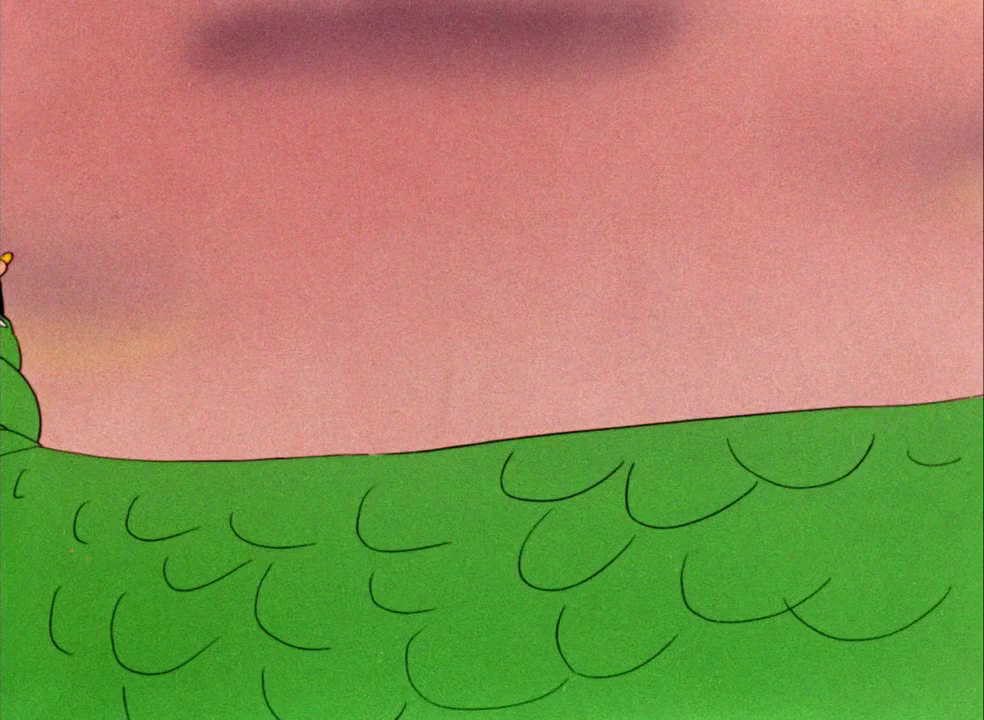
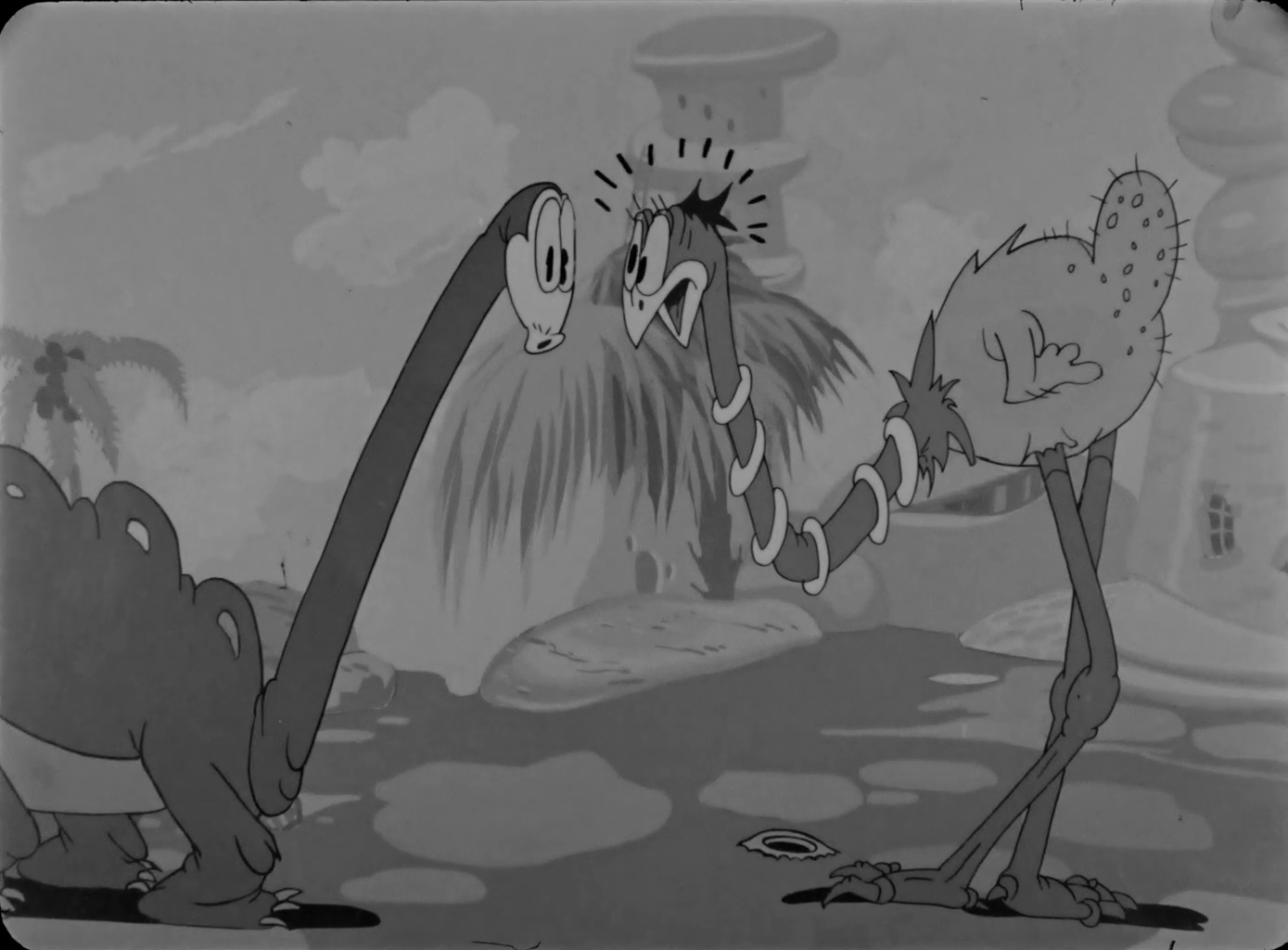
A brontosaurus hunts for a meal in The Cave Man, a 1934 Willie Whopper cartoon.


He’s looking. Aha! Let’s turn him into a periscope.


It turns out the grassy snack is some kind of prehistoric chicken, who stares the bronto in the eye and flies away.


What’s a bronto to do? He rolls his eyes and it’s on to the next scene.


The cartoon isn’t especially funny but there are some odd gags, solid backgrounds and a nice jazzy score. Berny Wolf and Grim Natwick are the credited animators.

Sunday, 16 October 2022

Getting Into the Mood to Laugh

You’d think people would already be in the mood for laughing when they seat themselves down in front of a stage to watch a comedy.

In radio and television, producers take no chances.

There’s always a warm-up period after a studio audience seats itself to get it in the mood to enjoy the show—and be told when to applaud and react.

Here’s a piece that I suspect came out of the CBS publicity department and was sent (along with photos, I imagine) to newspapers on its mailing list. This appeared in November 1960. Inidentally, Moore had been using the “feathers” line for years, judging by old clippings.

Benny, Skelton Featured In Audience Warm-up Roles
The curtain parts and Jack Benny steps before the audience to relate how he talked former President Harry S. Truman into appearing on one of his shows . . .
"I was terribly nervous about calling such an important person, and a little afraid, too. When I got Mr. Truman on the line, I said, 'Mr. Truman, this is Jack Benny. Would you appear on my show?' Well, he said, 'yes.' And I was so nervous I said, Why not?'
Then Benny switches the subject . . .
“There has been a lot of talk about my age. Actually, I'm not 39. I'll be 66 on my next birthday . . . I don't mind telling you this because you'll all say, 'No, he can’t be.'”
This is Jack Benny during the audience warm-up period that is held before every broadcast of "The Jack Benny Show, presented on the CBS Television Network on alternate Sundays from 10 to 10:30 p.m.
The purpose of a warm-up is obvious: to get the audience into the mood to laugh and enjoy themselves. Benny and other top CBS Television Network comedians—such as Red Skelton and Garry Moore—accomplish this result by doing what comes naturally: telling jokes.
Even Ed Sullivan, who is not a comedian, has a warm-up period for "The Ed Sullivan Show" presented on the CBS Television Network Sundays, 8-9 p.m. Sullivan doesn't tell jokes, but he makes his audience feel at home by introducing various members of the show. For instance: "I'd like you to meet my handsome co-producer, the Scarsdale Flash, Mario Lewis. We've been working together since the show first started 12 years ago and we're still speaking to each other.” Sullivan will go along in this vein introducing all show staffers who happen to be on hand.
Most warm-ups—but not all start—with an announcer greeting the audience and introducing the stars.
Don Wilson handles these warm-up openings for "The Jack Benny Program," Harry Von Zell for “The George Gobel Show” (CBS Television Network, alternate Sundays, 10-10:30 p.m.), and Durward Kirby for 'The Garry Moore Show,” CBS Television Network, Tuesdays, 10-11 p.m.
Red Skelton, star of "The Red Skelton Show," CBS Television Network, Tuesdays, 9:30-10 p.m. handles the warm-ups himself.
What kind of routines do the stars employ?
Jack Benny is the same during the warm-up and during the show itself. Only his jokes are different.
Garry Moore starts his routine by running his hand through his crew cut, staring at the audience and demanding:
"What did you expect, feathers?"
Moore then seats himself on a stool to answer questions thrown at him from the audience. He manages to turn many answers into jokes.
If he's asked, for instance, how tall he is, he might compliment the questioner for his diplomacy, "because what you really mean to ask is how short am I."
And Moore has a regular quip that closes each warm-up. "Don't worry," he tells the audience, "you'll get through this just fine."
Red Skelton varies his routine from week to week, telling whatever jokes come to mind.
Here's a recent Skelton warm- up joke:
“Gee, what a nice surprise I had when I walked into the studio. There was a crowd outside and some guy hollers: 'Hey, there's Red Skelton. It really made me feel good, you know, with everybody turning to look at me."
There is a pause. Then Skelton adds:
"Heck, I may as well admit it. I'm the guy who hollered."


And speaking of warm-ups, here’s a revelation from the “Between You and Me” column of the Port Huron Times-Herald of March 12, 1950. Jack obviously didn’t tell this one in vaudeville, but it wasn’t exactly a new joke.

THE TALKING DOG—We are all still laughing. Jack Benny and his radio entertainers, at last Sunday's broadcast, laid us in the aisles, as the saying goes. Jack Benny is tops, in my opinion. The fact that he holds the ace position in about every radio survey, year after year, leaves me with plenty of company, too. Sunday afternoon, along with Blanche and the Andreaes, we attended his broadcast out here in Hollywood and we are still holding our sides. Because of the differences in time the starting hour out here is four o'clock in the afternoon (seven in the evening at home) and there is always a long line-up. Only a ticket holder has any chance of getting in and, as one stands in line, he is besieged with requests from both men and women who go from one to the other asking for "an extra ticket." Those who heard Benny last Sunday, when he had that brilliant and attractive daughter of Winston Churchill as his guest star will know what I mean. But I really like Benny, Phil Harris, Rochester (who does a grand job in his modest way and is mighty popular out here), orchestra and, in fact, all of them, in the horseplay which goes on before the broadcast, more than I did in the show itself. It is one of those things which go absolutely flat when one tries to tell about it or write about it, but I can repeat a story which Jack told just before the real show started. A fellow and his dog walked into a bar and the man asked the bartender for a drink. "I've got a talking dog here," he said, "and if you'll give me a drink I'll make him talk." The bartender looked a bit suspicious, but finally agreed. "Now let's hear the dog talk," he growled, after he gave the fellow a shot. "What's that up there?" said the dog's owner, pointing to the ceiling overhead. "Ruth, Ruth!" barked the dog. The bartender looked black. "That's no talk!" he exclaimed "I have a notion to throw you out." The dog’s owner was undisturbed. "Just give me another drink and I'll prove it again," he said. The bartender weakened. "All right," he said "but no more fooling, you understand." The man got his second drink. He pointed with his finger to the roof of his mouth. "What's this Fido?" he asked. "Ruth, Ruth," barked the dog, again. The bartender was at the boiling point. "Out you go," he exclaimed, threateningly, pointing to the door. The man was unperturbed. “Give me another chance and another drink and I'll show you this time," he pleaded. Once again the bartender fell for it, but this time with the threatening promise that he would be tossed out if he did not make good. So he poured the drink, the man took it and again turned to his dog. "Fido," he cried, "who was the greatest ball player in the world?" The little dog never batted an eye. "Ruth, Ruth," he barked once more. Both he and his dog were promptly tossed out the door by the outraged bartender. As they picked themselves up the dog turned to his master and exclaimed: "He must be a DiMaggio fan!"

Saturday, 15 October 2022

Romeo in Rhythm

Think about it for a minute. How many cartoons take place on a low-budget theatre stage inside a scarecrow? I can think of a grand total of one—MGM’s Romeo in Rhythm (1940).

As you might expect in a Metro cartoon of this year, there is plenty of animation on ones, but because it’s a musical with singing and dancing, it doesn’t seem over-animated with movement for the sake of movement.

There’s a good story-line woven through the cartoon. Romeo woos Juliet in swing-time, but is constantly interrupted. That’s worked into the music, when Romeo kicks away his mandolin (a guitar is heard on the soundtrack) and sings “You’ve Got to Be Alone to Woo.” The song doesn’t come from an MGM musical. It was written by, of all people, Bill Hanna and Joe Barbera, with music by Scott Bradley. Hanna and Barbera’s lyrics are clever and a far cry from “Pixie Dixie, deedly dum, are the best of friends.”

In one scene, theatre backdrops roll down from the rafters, each painting suiting the verse of the song. Romeo and Juliet stick their heads through holes where heads should be on the painting, like a painted board on Coney Island. The stylised humans are certainly different for an animated cartoon of 1940.


This dissolve looks awkward when viewed frame-by-frame but when watching it on the screen, I suspect audiences weren’t put off by it because it happens at the end of a bar of music.


“At last you’re alone, just you two,” sings Romeo. At that moment, lights come up to reveal rows of heads. The camera pulls back to show a blinking sign. Romeo carries on with the lyrics: “You parked in that hole called the Hollywood Bowl.”


Another good sequence is earlier in the short where Romeo falls into a pile of metallic junk and emerges like the Tin Man from The Wizard of Oz. Bradley scores “We’re Off to See the Wizard” on the soundtrack as Romeo stumbles around and tries to remove all the junk. (The DVNR on the home video version of this is just disgraceful).


“Metro-Goldwyn-Mayer Shorts Story” magazine of July-August 1940 gives a summary of the cartoon (crediting the direction to Hugh Harman instead of Rudy Ising, though there’s no screen credit for anyone). Boxoffice magazine of July 27, 1940 reported Bradley was scoring the short, while the Hollywood Reporter of August 5 announced the cartoon was finished (mentioning the score included songs from Broadway Melody). The release date was August 10 (“Woo” was copyrighted Sept. 3). No animators were credited but I would bet Mark Kausler knows if we are seeing the work of Jack Zander, Bill Littlejohn, George Gordon and Carl Urbano.

The cartoon got mixed reviews when it was released. Uncle Walt was still the gold standard (no doubt to the annoyance of Harman). Boxoffice called the cartoon “An acceptable cartoon, but not beyond...The cartoon work is standard, which reminds that it is not Disney. With emphasis on that score.” “Fair,” declared The Exhibitor in one word. Motion Picture Daily was more enthusiastic. “This is a travesty in cartoon on ‘Romeo and Juliet,’ produced skillfully by Hugh Harmon [sic]. It should add a bright touch to any problem. The characters are crows which sing a few snappy tunes in Harlem jive fashion.”

Showman’s Trade Review felt “There’s a good idea in this cartoon but it misses fire somewhere. A couple of birds (ravens) play Romeo and Juliet (colored version). There are a lot of gags some of which are funny, but the subject bogs down in the middle and doesn’t get anywhere. It results in just a fair cartoon.”

Motion Picture Herald liked it a little better, calling it “an amusing cartoon.” Exhibitor Walter Pyle of the newly-opened Dreamland Theatre in Rockglen, Saskatchewan pronounced to that publication “Just another cartoon. A few kiddies snickered a little.” A “Harlem” short seems like an odd choice for a Canadian prairie farm town of maybe a couple of hundred people. But it was screened as well in Bengough, Sask., where the manager told the Herald it was “very entertaining.” The paper was told by the operator of a theatre in Dewey, Oklahoma is was a “good cartoon” but “the kids did not understand or appreciate it.”

To be honest, it’s tough feeling sympathetic for Romeo at the end when Juliet leaves him and runs off to work. It’s because they’re not real characters and the situation isn’t real. They’re actors performing a play on stage.

Mel Blanc provides a couple of voices on this short but the star is Billy Mitchell, who puts in a fine singing performance as Romeo. Juliet is Lillian Randolph (right), who found more work in MGM cartoons as the maid in the Tom and Jerry series. They both lent voices to the MGM musical short Swing Social (also 1940), a cartoon featuring Amos ‘n’ Andy accents, Uncle Tom, fish with thick minstrel-show lips, a razor and irresistible fried chicken.

Mitchell was a veteran at the time, billed in The Billboard in 1922 as “the boy with the insane feet.” The same year these two cartoons were released, he appeared as the Lord High Executioner in “The Swing Mikado,” with an all-black cast. By the late ‘40s, Mitchell was a pioneer of the parade of party-record comedians, with one release called “The Bumble Bee Invaded the Nudist Colony,” and appeared year after year at the Club DeLisa in Chicago. He was dead by the late ‘50s. Judging by newspapers of the day, Romeo in Rhythm vanished from screens long before that. It was never re-issued.

Friday, 14 October 2022

Two in One Animals

Tex Avery and gagman Heck Allen try out an impossible gag in Half-Pint Pygmy (1948). During a seemingly endless chase, George and Junior run after the aforementioned African, who tries to escape up a giraffe’s neck.


The gag is the giraffe has two ends and no heads.


Tex evidently liked the gag so much, he pulled a variation in the next sequence. The three run on top of a camel (to the music of “The Campbells Are Coming”). The scene reveals the camel has two heads but no ends.


A camel-y take.


Louie Schmitt, Bill Shull, Grant Simmons and Walt Clinton are the credited animators.

Thursday, 13 October 2022

And the Mystery Animal Is...

A few early Disney sound cartoons had characters back away from the camera to reveal themselves. Plane Crazy (1928) is one. Uncle Walt liked it so much, he repeated it in the opening of The Barn Dance (1929).

It’s a cow in both of them. Here’s the Barn Dance version.


Both shorts have "Ruben, Ruben" on the soundtrack.

Ub Iwerks gets the animation credit.

Mickey Mouse loses at the end. Minnie runs off with a cat. The early Terry cartoons had mice-loving cats, too. Someone will have to explain the interspecies fixation of the era.

Wednesday, 12 October 2022

The Dashing Joker

The main villains on the Batman TV show were all quite different from each other, and I think the variety helped the series.

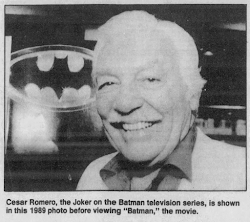
Burgess Meredith’s Penguin was snarky. Frank Gorshin’s Riddler was unhinged. Cesar Romero’s was happy, even gleeful, in committing crime.

Of the three, Romero was the biggest name at the time, having appeared in all kinds of movies in the Golden Age of Hollywood. Over the years, Romero was interviewed many, many times, especially by local entertainment columnists whenever he appeared in dinner theatre in a city.

For a good summary of Romero’s career, here’s a wire service story published on June 23, 1984 (depending on the newspaper). You’d never know he worked in television or on a Batman movie (1966) reading this.

Romero celebrates 50 years in film
By BOB THOMAS
Associated Press
LOS ANGELES — Fifty years ago, a young Broadway dancer came to Hollywood to appear with William Powell and Myrna Loy in "The Thin Man." Unlike most of his contemporaries, Cesar Romero is still here. Not only is he here but he's working, as he has done since 1934, minus service in the Coast Guard during World War II.
He recently was feted on his 50th anniversary in show business with a party on the Santa Fe, N.M., location of "Lust in the Dust," his 134th movie. Or is it 152nd? He's lost count.
"The New Mexico Film Commission presented me with a trophy for my 50 years in films," Romero said in an interview. "I said I was happy to get it — considering the alternative."
He has played almost every kind of role, but “Lust in the Dust” is a first. “I play a priest who used to be a rabbi. No explanation is given. I think it's going to be a very funny picture — not campy but funny.
"The cast is great: Tab Hunter, Lanie Kazan, Henry Silva and Divine, who happens to be a female impersonator. The director, Paul Bartel ('Eating Raoul’) is a charming guy. I had a great time."
Through great films and duds, Romero has brought the same brand of enthusiasm to his work. Still classically handsome at 77, he'll get another award for his career achievement this month from Nosotros, the organization that has sought more work for Latino actors.
"I guess I was lucky; I was never typecast in films," he remarked. "I played a wide variety in most of my career. It has only been in later years that I seemed to be thought of as an Hispanic. That surprised me. I was born in New York City, my mother was born in Brooklyn. I never considered myself a part of the Latin group."
Still, he is proud of his Latin heritage:
"My grandfather, Jose Marti, was the liberator of Cuba," Romero said. "The Cuban war of independence was planned in my grandmother's house. In 1965, I attended the ceremonies when a statue of my grandfather was unveiled at 69th and Avenue of the Americas in New York. It was quite a day. The pro-Castro Cubans lined up on one side of the statue, and the anti-Castro Cubans on the other, and it ended in a riot.”
Romero's yen to act started in boarding school when he played four roles in "The Merchant of Venice." His father, who lost his fortune when the sugar market collapsed, found his son a job in a Wall Street bank. He spent his evenings at debutante dances and met an ink heiress, Elizabeth Higgins, who suggested they form a dance team.
After a career in nightclubs and in musicals, Romero won a contract at MGM. Summarily dropped, he landed at Universal, then caught the eye of Darryl Zanuck. When Zanuck's 20th Century merged with Fox, Romero was added to the contract list. He stayed 18 years.
He said his best three movies were "Show Them No Mercy," "Captain From Castille" and "any one of the musicals — 'Weekend in Havana,' 'Springtime in the Rockies,' 'The Great American Broadcast,' etc." The three worst? "A couple I did at Universal: ‘Armored Car' and 'She's Dangerous,' with Tala Birell," he said, "also one for Sam Katzman at Columbia, 'Prisoners of the Casbah' with Gloria Grahame and Turhan Bey."
For 37 years Romero lived in a Brentwood, Calif., house he originally bought for $15,000 and sold for $400,000.
He's on the road much of the year playing dinner theaters, returning to the apartment he shares with his sister, Maria. He has never married.
"How could I, when I had so many family responsibilities?" he said. "I was living with my parents, two sisters, a niece and a nephew. Could I tell a girl, 'Let's get married and you can come and live with my mother, my father, two sisters, a niece and a nephew'?
"I have no regrets, no regrets. Right now I'm seeing a lady quite a bit younger, and we have a good relationship. It'll stay that way."
Romero said he would never retire. "What the hell would I do if I quit? I can take time off when I want, and work when I want," he said. "It's an ideal situation."


What did Romero think of working on Batman? Interviews he gave over the years are consistent. He thought of it as fun. Here’s the Associated Press again; the story was published starting May 8, 1966.

Long a Lover, Now ‘The Joker’
By GENE HANDSAKER
HOLLYWOOD (AP)— For years Cesar Romero played suave leading men. Handsome lovers in white tie and tails. And, as he puts it, "playboys, heavies, gigolos and lounge lizards."
Now he was hardly recognizable in pasty white makeup, a clown's painted grin and a wild thatch of green wig.
This was romantic Romero as, zounds, The Joker of "Batman!"
MOVIE VERSION—Cast and crew of that television hit are making a movie version. Over lunch the smooth Latin from Manhattan said of his new career as comic villain.
"I love it. It’s a kooky, way-out character, the easiest I ever played. I can be as hammy as I like and do all the things we were told not to do: mug, overact, accentuate. It's fun because you're not tied down, inhibited."
As Batman's fiendish but never quite successful adversary In the film, Romero has a grand time staging a kidnapping, flying by umbrella like Mary Poppins and wielding a disintegrator that turns humans to powder.
NEW YORK BORN—"And I don't have to worry about circles under the eyes or whether my hair is combed," he noted.
Romero, 59, a towering 6-foot-3 and 200 pounds, has been in pictures 32 years. “This town,” he said, “has been very good to me.”
He was born in New York City to a Cuban mother and Spanish father. As a boy vaudeville fan, hanging around stage doors, he knew that show business was for him. After a turn as a $17.30-a-week bank clerk he teamed up with a girl dancer and appeared in supper clubs.
STAGE DANCER — He became a stage dancer in musicals along with a youth named George Murphy, now U.S. senator from California, who later in Hollywood gave Romero his nickname—Butch.
Dancing led to stage acting—"Strictly Dishonorable," "Dinner at Eight," etc. M-G-M brought him to Hollywood in 1934 for a role in “The Thin Man.”
Romero became one of the town's most attractive bachelors, escorting Joan Crawford, Virginia Bruce, Loretta Young, Ann Sothern, Barbara Stanwyck. He still occasionally takes Jane Wyman to dinner parties at friends' homes.
NOT ELIGIBLE—In 1940 he built a house in Brentwood where he lives with a spinster sister. Marriage? "It just never happened," he said. "There's nothing very eligible about me now, and I have no intention of changing my status.
"In many ways I regret not marrying. I would have liked to have children."


I’ve gone through more than a dozen interviews made over the decades with Romero and in all of them, he’s asked why he’s single. He pulled his punches, but that’s not surprising given the era (and, perhaps, it probably hasn’t changed for really big names in Hollywood).

The stories also crow about his great physical condition. Unfortunately, that wasn’t the situation at the end. He was hospitalised with severe bronchitis and pneumonia and died from complications related to a blood clot on New Year’s Day 1994 at age 86.

Tuesday, 11 October 2022

Auntie Angela

Mention Angela Lansbury’s name and many will think of Murder, She Wrote. Some will think of her warbling in Disney films such as Beauty and the Beast.

But fans of show tunes the world over will talk about her performance in the title role in “Mame,” even if they’ve never seen it. She performed it on the Great White Way for almost two years then went on the road with it.

Lansbury was an unusual choice, judging by this wire service story of March 27, 1966.

Angela Exercises For Musical 'Mame'
By WILLIAM GLOVER
Associated Press Drama Writer
NEW YORK — Angela Lansbury is limbering up like an athlete for another and, she hopes, more durable go at Broadway musical comedy.
"I just can't tell yet how much energy I'm going to need," she explains, "so I want to have plenty."
Miss Lansbury, who has romped quite a dramatic gamut over the years, reaches Broadway's Winter Garden May 24 in a show derived from the adventures of that incredible book-play-film heroine, "Auntie Mame."
To avoid confusion with all earlier incarnations, the new exhibit is titled plain "Mame." And, the star vows, the portrayal is going to be "completely different"—if she survives.
"The whole thing is being plotted very carefully so I don't have to keep running around out of breath," she says, ticking off an awesome assortment of chores. Besides taking part in 11 songs—a rare number for even an Ethel Merman or Mary Martin—Miss Lansbury's assignment includes dance variety from tango to Charleston and "about costume changes."
ONLY ONCE BEFORE HAS she essayed musical performance, in a fast flop two seasons back, "Anyone Can Whistle." Although she emerged from the debacle with good reports, a lot of testing was done before she got this new role.
"They first called me in last August," recalls Miss Lansbury, "and I think I was competing against every leading lady in the theater. The thing went on until the end of November."
Oddly, Miss Lansbury never saw any of her famous predecessors in the straight stage comedy. Rosalind Russell did it first on Broadway just 10 years ago, and the following parade there and in multiple touring troupes included .Constance Bennett, Bea Lillie, Sylvia Sidney and Eve Arden.
"That's all to the good—I'm going in like a clean sheet of paper. No one can say it's a carbon."
Jerry Lawrence, who along with Robert E. Lee wrote both the original play and the musical adaptation, figured Miss Lansbury could do it.
Another early supporter was Jerry Herman, “Mame’s” composer (who three years ago penned another little opus called “Hello, Dolly!”).
“Both of them wanted an actress — not a dancing cutie — so that Mame would come out a whole person,” continues Miss Lansbury.
Miss Lansbury, as a matter of record, did sing briefly in two films prior to “Anyone Can Whistle”—namely “The Picture of Dorian Gray” and “Till the Clouds Roll By.”
After “Whistle,” the energetic star “did a lot of big, fat movies—four or five” so that she could clear her calendar for this stage excursion. The Lansbury screen career began at age 18 (“Gaslight,” 1944) and she didn't do her first Broadway show until 15 years later. She confesses one mild reservation.
“I'm an early person except when I'm in a stage role,” says the lady who likes to rise by 7 A.M.
“The one thing I object to about being in a show is having to miss half a day. You can get so much more done in the morning.”


Lansbury received almost universal praise for her opening night performance. The Daily News’ Douglas Watt was a hold-out, basically saying Lansbury didn’t have the depth or ability to pull off a lead for the entirety of musical, and Bea Arthur stole scene after scene from her.

Earl Wilson’s column addressed some whispering at a New York City theatrical night spot.

As the tall, willowy, 41-year-old British-born blonde Angela Lansbury was being standing-ovationed as the greatest new star for her spectacular success in "Mame," there were a few dirty dogs around today who were muttering that her last show, "Anyone Can Whistle," was a fast flop.
And she was Carroll Baker's mother in the film "Harlow," another loser.
So maybe she was an accident altogether?
"Not at all," said Jerry Herman, composer of "Hello, Dolly!" as well as "Mame." He remembered her singing—and acting—from "Anyone Can Whistle."
"I suggested to Jerry Lawrence and Bob Lee that we get this lady, who was an actress who could sing," he said. There were those who thought that Lucille Ball should play it. But Herman preferred somebody less comedic. "I got together with this lady and taught her one song, 'It's Today,' And—she got the part."
AND THEY WERE asking in Sardi's this morning, whether any show had ever received a standing ovation before.
"Oh, I'm sure there have been some!" Miss Lansbury was saying to her husband, son, dtr. and mother, as she cavorted about in a blue Norwegian fox wrap and silver-and-gold lame gown.
"I'm not so sure," some oldsters were answering.
It was the biggest, maddest, wildest evening at the refurbished Winter Garden . . . in the crazy celebration party at the Rainbow Room they even “bravoed” the reading of a review . . . This is not to overlook occasional opinions that the show was not the greatest of all time. (I say this as a compleat reporter.)


As for Lucy getting the part, well, it happened. Further comment is best left unsaid.

Considering her monster success, she should have become another Carol Channing on the Great White Way. It didn’t quite happen. A $720,000 loss over 132 performances for her musical “Dear World” in 1969 didn’t help. Soon, she was filming “Bedknobs and Broomsticks” for Disney before heading alone to Germany for a film and then to Ireland to try to get her head together.

Judging by the rest of her career, she was able to do just that.