Tuesday, 11 October 2022

Expressive Pooch


So I’m watching this scene in Squirrel Crazy, a 1951 Terrytoon, and wondering if Jim Tyer animated it. Suddenly...


To borrow from another cartoon studio, "Mmmm...could be!"

It seems the writers also borrowed from a cartoon studio.


I don’t know what’s worse—Lillian Randolph’s Amos-n-Andy style dialect in the Tom and Jerry cartoons or the ridiculous suburban WASP-tinged-with-a-bit-of-the-South voice the unnamed maid has in this one.

This cartoon stars “Nutsy” who, let’s face it, isn’t very nuts compared with a certain MGM squirrel. Tyer animated a pile of scenes with the dog.

The cartoon was part of the “Terrytoon Toppers” re-release series, and returned to the big screen in October 1957.

Monday, 10 October 2022

Surprising the Weasel

Bob Clampett got a chance to direct a couple of colour cartoons with his original unit in 1941 before taking over Tex Avery’s crew later in the year and leaving black-and-white shorts behind.

Both featured familiar routines. Goofy Groceries was another stuff-in-a-store-comes-to-life shorts, with Farm Frolics was a spot gagger.

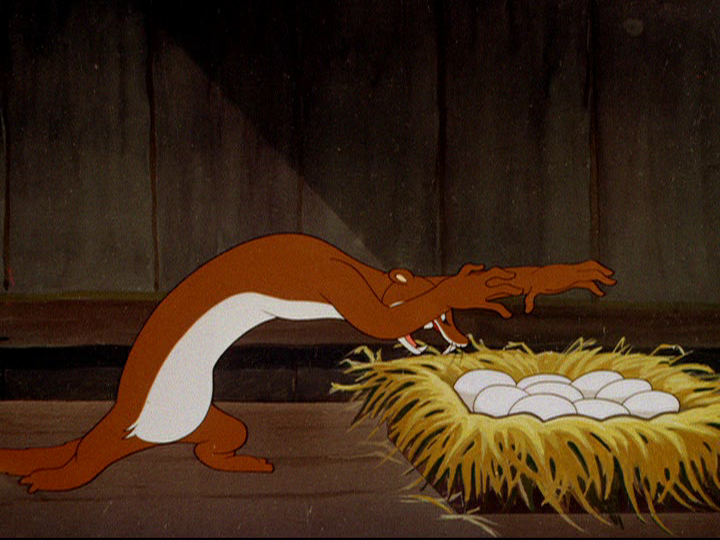
Clampett goes for a weasel gag that starts off the like the bobcat gag that Tex Avery planted in Cross Country Detours (1940). Avery had the weasel stalk an innocent young quail, as narrator Lou Marcelle and composer Carl Stalling set up the suspense. Suddenly, the weasel breaks down and says “I can’t do it,” pounding the ground in footage inspired by Avery acting before a studio camera.

Here, Clampett and writer Warren Foster start off the same way as narrator Bob Bruce’s trembling voice matches Carl Stalling’s trembling strings. The weasel creeps closer and closer.


But Clampett goes a different route than Avery. Suddenly, the eggs hatch and the chicks yell “Boo!”


The surprise almost kills the weasel. “Don’t ever do that!” he says. It may be Joe Penner’s catchphrase, but Mel Blanc treats the line with a fairly straight voice.


Whoever animated the scene did a nice job with the weasel’s fingers and hand expressions. John Carey and Izzy Ellis are the credited animators. Dick Thomas is the uncredited background artist. Foster gets in some good gags and the opening is creative where the scene is sketched by a “moving” hand and then there’s a wipe to turn it into a coloured background.

Sunday, 9 October 2022

Tralfaz Sunday Theatre: Match Your Mood

The ‘60s were, well, the ‘60s.

The times, they are a-changin,’ sang some fellow through his nose. Certainly no one would mistake the pop culture clichés of 1969 with those of 1959. And certainly, ad agency execs who, at one time, liked Ike suddenly had to switch gears and be With It.

It meant advertising reflected kind of an ersatz, watered-down version of the late ‘60s. After all, ad agency salesmen were never really With It.

But that isn’t necessarily a bummer.

Here’s a fun example of something made in the late ‘60s that borrows chunks of the culture to try to appeal to the Flower Power generation.

Match Your Mood is a plotless industrial film made for Westinghouse by Jam Handy out of Detroit. It opens with a model in a mod outfit making her through the woods, flouncing her hair, on her way to feed some Canada geese in a placid lake.

But what does it all mean? What are the geese? Are they geese? Are they representative of America’s neighbours to the north, a placid nation while America is ripped in two by the turmoil of assassinations, student unrest and the Vietnam War?

Yes, reading something profound into nothing was the ‘60s.

Anyway, the film switches to still photos of furniture and decorations around the kitchen and living room. Anyone growing up back then will recognise walnut panelling and rattan furniture.

But around half-way through, we see a pair of scissors. We hear guitars and a Hammond organ. People are groovin’ to cut-out, hip panels that seem to be pasted on refrigerators, cupboards and FAR OUT! There are fireworks and a fold-out Hallowe’en pumpkin and FAR OUT AGAIN! There’s a really bad cut in the soundtrack and it’s New Years’ Eve. Some guy in a green jacket is dancing like Jerry Lewis. Psychedelic!

The camera closes in on a logo. The music ends. A woman’s voice says “Westinghouse. The complete refrigerator. Compare.”

What? This is a refrigerator commercial? What about the teapot? And the Sherlock Holmes hat? And those geese?

And, again, we’re left to ask “What does it all mean?”

Actually, there’s only one reason I’m posting it, and it’s not to make fun of the ‘60s. I was listening to the soundtrack of this short and kept thinking “I know this music.” Then it dawned on me. Spiderman!!

Jam Handy leased Johnny Hawksworth cues from the KPM library that were heard on the last, weird season of the Spiderman cartoons on ABC (1969). There are huge fans of the cartoons and the library that will be able to name every single cue. I can’t, but I know the last one is “The Eyelash.”

Mel and Jack

No, not everyone who works together in radio hangs out with their boss, though it sounds like they’re close buddies on the air. Take Jack Benny for example. Don Wilson and Dennis Day don’t seem to have been part of his social set. He hung out with Barbara Stanwyck and Paulette Goddard as well as vaudeville cohorts like George Burns.

There was at least one exception.

Mel Blanc.

Mel’s autobiography and Jack’s book written partly by his daughter mention the relationship the two had. And while I imagine Mel wasn’t at the Bennys’ big, fancy Hollywood parties, they did see each other at the Blancs’ cottage at Big Bear Lake, and Mel could come over and entertain Joan Benny with his array of cartoon voices.

And Jack certainly was close enough to Mel to call on him in hospital after the horrific car accident in 1961 that came close to killing Blanc. Eventually, Mel was well enough to return to Jack’s TV show in a very touching portion of a Christmas season episode.

Here’s a feature story from the Hartford Courant of December 24, 1961. Nowhere does it say Jack visited Mel “every day” in hospital as some stories say. Nor does it tell the story of a comtose Mel being woken after repeated attempts when a doctor talked to him as Bugs Bunny (Mel alternately confirmed and denied that one). But it does give you an idea of the friendship between the two and what a thoughtful man Benny was.

You Just Can't Keep Mel Blanc Down
Man of 300 Voices Fights Back from Near Tragedy

By H. VIGGO ANDERSEN
Television Editor
A man with 300 different voices telephoned me from Hollywood the other day. That could be a bit confusing, you know. Even disturbing. Happily, he was using only one voice that day. The one he was born with and a very pleasant one it is.
You would never dream, as we sat there chatting over the transcontinental phone, that Mel Blanc, out there in California, was confined to a wheel chair, still convalescing from extremely painful, near-fatal injuries suffered in a grim automobile accident about 11 months ago. He was cheerful, uncomplaining, eager to talk about his work which he still carries on busily, undaunted by his handicap.
"I'm a very lucky guy," he said, and meant it. "Lucky to be here at all. Know what the doctor told me when I asked him how many bones I had broken? He said if any friends of mine ever told me about breaking a bone, any bone except the left arm, I could tell them I had broken the same ones! That covers quite a bit of territory, including my head, which was pretty well smashed up, too."
Mel was driving to work that fearful evening and was in the curb lane on Sunset Boulevard near UCLA. Suddenly a youngster, driving a car at a fast clip, crossed the double lines from the other side of the boulevard, veered across the inside lane and then plowed head on into Mel's car. It took rescuers more than a half hour to saw him out of the wreckage and then they hurried him to the hospital of the nearby university more dead than alive.
Fortunate Coincidence
"Just by coincidence I had entertained the faculty at UCLA a few days earlier, and when I was brought in one of the doctors recognized me. Man, did he go into action. He's a bone specialist. Well, he and a head specialist and 14 other doctors worked on me all that night. I was on the critical list for three days. Since then I've been wearing all sorts of casts and bandages, but, by gosh, I'm still here and doing fine," said the indomitable man of many voices.
"Just the other day," he went on cheerfully, "they took the cast off my right leg and it is in a brace now. With the help of crutches I am beginning to get around a bit. In two or three months I should be pretty much myself again."
One thing that has kept Mel Blanc's spirits up during the dark, painful months since the accident has been his work. Almost as soon as he got out of the hospital and returned to his home in Pacific Palisades he resumed making hilarious magic with that wonderful, flexible voice of his. He does the voices of 97 per cent of the characters in all the Warner Bros. cartoons, you know, including such prime favorites as Bugs Bunny (his top favorite and one he has been doing for 25 years), Speedy Gonzales, Daffy Duck, Porky Pig, Yosemite Sam and many others.
How did he manage to carry on, lying in bed all swathed up like a mummy. Let him tell it.
Son Built Him A Studio
"My son, Noel, is a pretty clever boy," he said proudly. "He's a lieutenant in the Army. Well, he built me a studio right here in my own home that is as complete and well equipped as any you'll find in Hollywood. I lay here in bed and made sound tracks so that the boys down at Warner Bros. could keep going with the cartoons, including that new and highly successful one, 'The Flintstones.' "
You probably heard one track he made like this for Jack Benny, in which a small squirrel hid in a bunker hole and watched Benny whiff the breeze futily several times without connecting with the golf ball. At last the squirrel burst out sarcastically: "It's cool now. Hit it."
And once the conversation had touched Jack Benny, Blanc was off on his favorite subject. "I've worked with just about all of them and he's the best. I'm not just talking about his superb talents as a comedian, but Jack Benny as a man. He is one of the kindest, most considerate men walking the earth today. Do you know that in all the time I've been laid up he has found time to visit me in the hospital and here at home at least once in every 10 days. He has been a source of tremendous inspiration and encouragement to me. What a great guy he is!"
Together Again Tonight
Blanc and Benny, who have been working together since 1940, back in radio days, will be seen together again tonight on Benny's Christmas show, but not in the familiar roles of annoying Christmas shopper (Jack) and utterly frustrated clerk (Mel). In tonight's show Benny visits the house-bound Blanc and they do a scene sitting beside each other. "Jack has seen the tape, and he tells me it's very funny. I hope you and everyone else will think so." (I'm sure we will.)
I asked Blanc how early in life he had learned that he had an outstanding gift for mimicry.
"Back in grammar school days. I guess," he said. "I used to do a lot of silly imitations for the other kids. I got started by talking to foreign born people in my native Portland, Oregon. For instance, a Japanese fruit pedlar. I'd point to the various fruits and vegetables he was selling and ask him what they were. Get him talking. Then I'd listen and when I left him I could do a pretty fair Jap dialect. I've been doing that sort of thing ever since I can remember picking up accents, dialects and odd sounds everywhere I've been."
"Is it true that you actually have 300 different, so-called voices?" I asked him.
"Oh, I guess it's really more than that," he said in all modesty.
Blanc had his first radio show on station KGW in Portland in 1927, just after he had been graduated from high school and he has been in show business ever since, and his is a voice (or voices) known and beloved to millions of listeners.
From Portland, Blanc drifted down to Hollywood where he began his career as a voice specialist for Warners, a job he still holds. Then came radio and his signing with Jack Benny in 1940. His first appearance with Benny was for the role of "Carmichael the Bear," and he was such a success Jack made him a permanent member of the cast. He became famous in his own right as the station master (remember him? Anaheim, Azusa and Cuca-monga) the clerk in the annual Christmas show and as the sound of the famous old Maxwell.
Feared TV
When Benny went to television, Blanc had some serious doubts about his ability to make the switch. For so many years he had been cloaked in anonymity, just a voice. He didn't believe he could perform as effectively as a visual entertainer. He couldn't have been more wrong for he turned out to be the perfect image of all his radio voices and characters. The public loved and still loves him. In addition to his cartoon work, and his career on the Benny program, Blanc also owns his own commercial company, known as Mel Blanc Associates. The concern produces humorous commercials for many of the top accounts in the country and Blanc admits he "loves those residuals."
A mighty busy and contented man, this courageous Mel Blanc. Happy in his work, still very much in love with his wife of many years, Estelle, and so proud of son, Noel, he has every right to describe himself as "a lucky guy." And he's a mighty nice one, too.
Why don't you look in on him on the Benny show tonight? He'd love to have you. And you are guaranteed some laughs from a man who not so long ago had very little to feel funny about.

Saturday, 8 October 2022

The Impatient Patient

This blog has neglected Norm McCabe’s career as a director at Warner Bros. It hasn’t been totally deliberate. For one thing, decent quality versions of a number of his cartoons haven’t been available. And for another, some of them just don’t do anything for me. I can’t get into his one-shot characters.

Here’s the list of McCabe’s directorial efforts for Leon Schlesinger, in order of release. There were only 13 in all.

The Timid Toreador (with Bob Clampett), Production 9638, released December 21, 1940
Porky’s Snooze Reel (with Bob Clampett), Production 9772, released January 11, 1941
Robinson Crusoe Jr., Production 172, released October 25, 1941
Who’s Who in the Zoo, Production 224, released February 14, 1942
Daffy’s Southern Exposure, Production 442, released May 2, 1942
Hobby Horse-Laffs, Production 768, released June 6, 1942
Gopher Goofy, Production 440, released June 27, 1942
The Ducktators, Production 770, released August 1, 1942
The Impatient Patient, Production 774, released September 5, 1942
The Daffy Duckaroo, Production 802, released October 24, 1942
Confusions of a Nutzy Spy, Production 804, released January 21, 1943
Hop and Go, Production 1054, released March 27, 1943
Tokio Jokio, Production 1058, released May 15, 1943

Why did McCabe co-direct a pair with Clampett? Clampett needed to take sick leave, so McCabe finished the cartoons for him. When Clampett moved to take over to Tex Avery’s unit in fall 1941, McCabe was given the Clampett unit. There was shortly a change. Clampett had worked in a separate building as Ray Katz Productions, which was considered a different studio for union bargaining purposes. When McCabe took charge, his unit was soon moved in with the rest of Leon Schlesinger's operations at Fernwood and Van Ness. Ray Katz Productions quietly disppeared. Soon Warners wanted half the Looney Tunes in colour. McCabe was assigned all the black and white ones.

His story crew was Tubby Millar with ex-Disneyite Don Christensen added later (they rotated credits).

I enjoyed Daffy’s Southern Exposure, so I thought I’d take a look at another of McCabe’s Daffy cartoons—The Impatient Patient. It’s been at least 50 years since I’ve seen it.

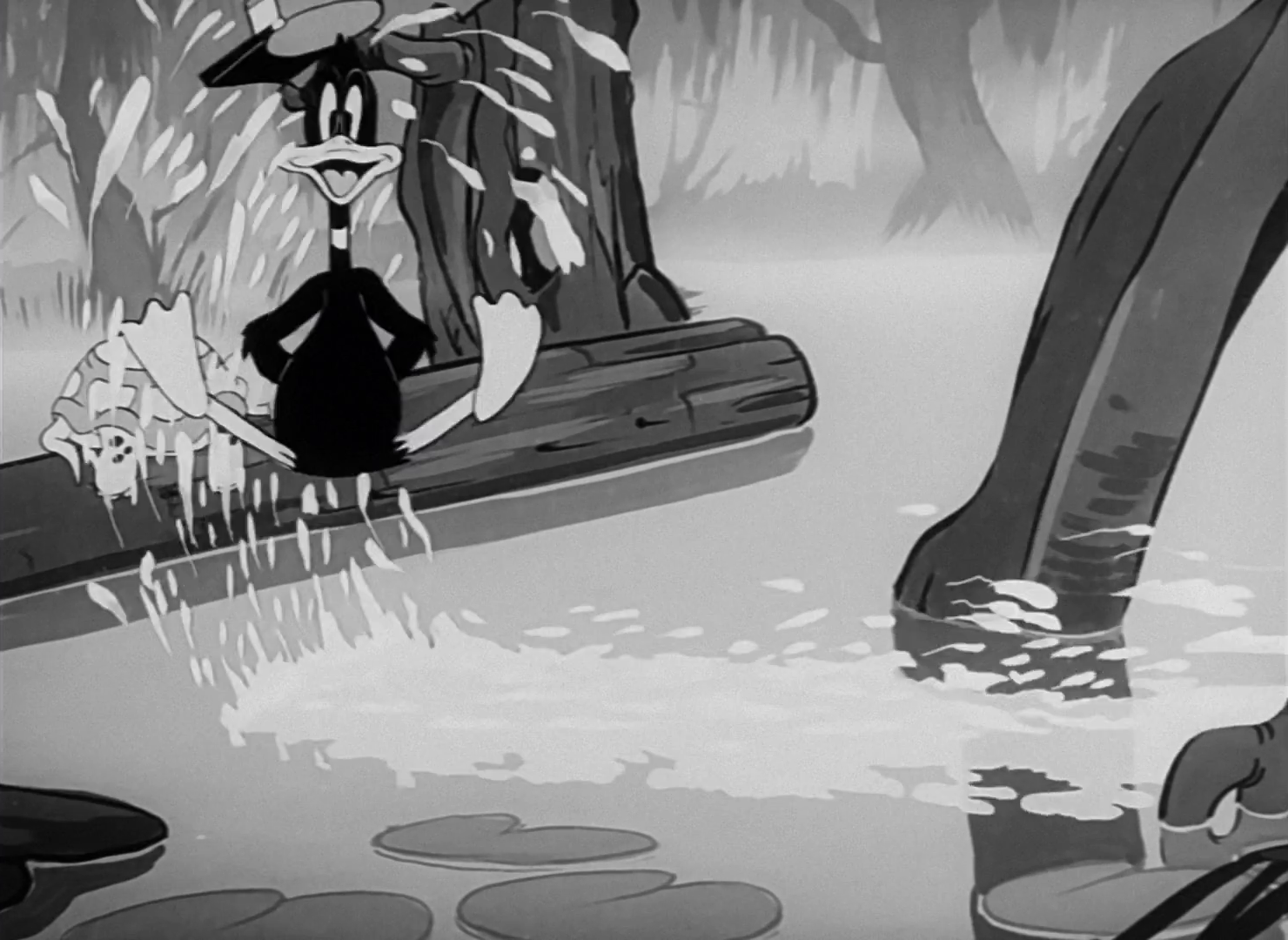
McCabe doesn’t do a bad job here. There’s an opening pan with overlays of a swamp. Daffy’s doing a parody of the old song “Chloe” that Spike Jones revived a few years later. Chloe turns out to be the persona Dr. Jerkyl takes on when he drinks some potion. The cartoon ends with a Red Skelton radio show reference after a Baby Snooks reference.

Daffy still is a bit of the crazy, woo-hoo Daffy and a bit of the later smart Daffy, while Chloe is just too much of a dullard to really be threatening, try as Carl Stalling might to set an atmosphere of drama with his score. For example, Christensen’s story has Chloe break into a dance. A better director-writer team could have seized on that and turned it into a running gag (imagine what Avery might have done with it). In fact, it took me some time to figure out the first dance music was coming from a radio Daffy accidentally turned on.

There’s a throwaway wartime gag, too. The camera pans across some boiling liquid in a chemistry set’s glass tubing. There’s dark metal piping in the foreground panned at a different speed to create depth.


The camera moves in as the liquid makes its way into a glass bowl.


The camera pulls back to reveal it’s coffee. Note the sugar bowl is chained. Sugar began to be rationed in the U.S. about four months before this cartoon appeared in theatres.


And a bit of the woo-hoo Daffy.


McCabe started out as an in-betweener in 1932. In November 1942, he was inducted into First Motion Picture Unit of Army Air Force. By law, he was supposed to be offered his former job when the war ended. Instead, in 1946, he was hired as a director by Meridian Pictures, which intended to make industrial and educational cartoons (Harry Love was his art director). One of his cartoons for Meridian’s subsidiary, Oscar Productions, can be found here. In August 1952, he replaced Howard Swift as animation director of Five Star Productions. He made stops at other commercial studios. McCabe went to work for old Warners colleague Friz Freleng at DePatie-Freleng and ended up back at Warners itself working on its TV cartoons beloved by ‘90s kids until retirement in 1996. You can find a filmography elsewhere on-line.

McCabe died in 2006, well into a time period where fans could check out some of his work (even if it had been ruined years earlier by cheap colourised tracings, and a whole new generation of animators could learn from one of the real pioneers of sound cartoons and the last of the Schlesinger directors.

P.S.: I should have remembered Dexon Baxter profiled McCabe. Learn much more about Warner Bros.’ most famous Geordie in this article.

Friday, 7 October 2022

The Kill the Wabbit Cartoon

This blog has not touched What’s Opera, Doc? during its 11 years on the internet because the cartoon has been written about to death and there really isn’t anything new to say.

But it’s such a famous cartoon, I can’t really skip it. I’ll just post a few poses (and probably some in-betweens) showing Bugs gesticulating as he sings to Elmer Fudd, accompanied by a solo French horn.

O, Mighty Hunter, ‘twill be quite a task.
How will you do it, might I enquire to osk?


(The broad ‘a’ in “ask” satirises the pretentiousness of opera).


Since Bugs is singing on stage, he takes a deep breath before his next line.


It would not be a Chuck Jones cartoon without a coy side-glance in profile.


Bugs finishes his line and balls up his hands. I don’t get the weird deformed foot Bugs develops.


People watching the cartoon probably didn’t notice, but in the previous two lines of the song, Bugs is standing in front of a completely different background.


To give you an idea how long the cartoon was in the system, here are the other Jones shorts around this time.

Bugs’ Bonnets, Production 1387, released Jan. 14, 1956.
Animators: Abe Levitow, Dick Thompson, Ken Harris, Ben Washam. Layout: Bob Gribbroek.

Barbary-Coast Bunny, Production 1389, released July 21, 1956.
Animators: Abe Levitow, Dick Thompson, Ken Harris. Layout: Bob Gribbroek.

Rocket-Bye Baby, Production 1395, released August 4, 1956.
Animators: Abe Levitow, Dick Thompson, Ken Harris. Layout: Ernie Nordli.

What’s Opera, Doc?, Production 1397, released July 6, 1957.
Animators: Abe Levitow, Dick Thompson, Ken Harris. Layout: Maurice Noble.

Gee Whiz-z-z-z, Production 1399, released May 5, 1956.
Animators: Abe Levitow, Dick Thompson, Ken Harris, Ben Washam. Layout: Ernie Nordli.

Maurice Noble’s name falls between two cartoons with Ernie Nordli. Nordli had drawn layouts for What’s Opera, Doc? but when Noble returned to the studio, he chucked them all and started afresh. (Get it? “Chucked.” As in “Jones?” Okay, so I need a new writer).

The cartoon was also made during one of Ben Washam’s absences; at least, he wasn’t credited on the short.

The short benefits from the Warner Bros. studio orchestra. Can you imagine what it would sound like a few years later with a chintzy, dissonant score that Bill Lava wrote for the cartoons (to be fair to Lava, he was a capable composer but his cartoon work reeks of low budget). Certainly, Milt Franklyn’s ability to snip from Wagner to come up with this effective score is an admirable achievement (30 years earlier, Franklyn was fronting a regional dance band).

Yes, the cartoon has probably been over-seen and over-analysed to the point that some may not want to watch it any more. There are a number of Bugs Bunny cartoons I like far, far better than this, but I’ll take it over Bugs’ Bonnets any day.

Thursday, 6 October 2022

Stop! Go! Stop!

There are animation fans who chant a mantra of “Cartoony!” In other words, if animation isn’t over the top, it’s not a real cartoon.

Nonsense.

You won’t find wild takes in a Friz Freleng-directed short, but you’ll find a lot of laughs and incredible timing in his best cartoons. He had a good run of them toward the end of the ‘40s.

One of my favourite Bugs Bunny cartoons is Bugs Bunny Rides Again (1948), where Freleng and writers Tedd Pierce and Mike Maltese take the rabbit and Yosemite Sam through a string of Western clichés. There are at least two perfect bits of timing in the short—one when Sam and his horse smash into a brick wall to the strains of the William Tell Overture, and then when Sam high-steps to his right and drops into a mine shaft. Sam’s expression changes in consecutive frames and he’s held at the edge by Freleng just long enough before the fall.

There’s a twist on a Tex Avery-style joke at the opening of the cartoon. It’s the old “traffic” gag, where a traffic signal controls some non-traffic objects; in this case, bullets.

Below are select frames that give you an idea. The bullets obey the traffic signs—except for one little straggler bullet at the end (several of Freleng’s cartoons have a gag that involves a little character following a group of larger characters).


The Freleng unit's animators are Ken Champin, Manny Perez, Virgil Ross and Gerry Chiniquy.

Wednesday, 5 October 2022

Radio's Mrs. Terwilleger and a Cartoon Parrot's Mother

There’s an undeniable link between the Golden Ages of Animation and Radio. The big stars of radio were the subject of caricature and parody in cartoons from a number of studios, from Disney to Mintz. And the lesser stars of radio found employment providing voices for cartoon characters.

Mel Blanc was front-and-centre on the list. In 1934, he was appearing at a store opening in Salem, Oregon. A year later, he found work on KFWB on Johnny Murray’s Variety show. KFWB was owned by Warner Bros. which, as we all know, housed the Leon Schlesinger cartoon studio.

But there were many, many others who came up from the ranks of radio (including quite a number from KFWB) to voice cartoons—Arthur Q. Bryan, Sara Berner, Bea Benaderet, Frank Graham, Marvin Miller and, of course, June Foray, are just a few.

There was another cartoon actress who was a big star on radio—that is, until vaudevillians came west to make movies and started taking over the airwaves in the early ‘30s. Radio on the West Coast bloomed in 1922, with more stations in Los Angeles than New York, and created its own star system and chains of stations from Seattle to Hollywood.

One of those stars was Elvia Allman.

She, too, was on KFWB’s Johnny Murray show. But she was big enough to have her own show, Elvia Allman’s Surprise Package on KHJ in 1929. She got a shot at the big time in 1933—a 13-week contract for a 15-minute show of satiric songs broadcast on NBC Red from New York. At the end of it, she came back to Los Angeles. When the big stars settled in California and filled the network programme slots, Allman became a supporting actress, one in great demand. She even made some films. One was Melody For Hire (1941) that also included Irene Ryan. The two would work together in the 1960s as frenemies on The Beverly Hillbillies.

The Los Angeles Times profiled her in the “Ether Etchings” column of December 16, 1934.

Sent to get a story about Elvia Allman, this scribble arrived on the Merrymaker stage at KHJ yesterday, hoping to find the elongated comedienne at rehearsal . . . the Stage was deserted except for one old gal who was busy rocking in a chair . . . “Hey, lady,” we heyyed, “do you know anything about Elvia Allman?”
“Do I know anything about Elvia Allman? Does Mrs. Terwilleger know anything about Elvia Allman? Young man, I know everything worth knowing about her—and a lot that's not worth knowing either, but I wouldn't want you to mention that.”
FROM CAROLINA
So Mrs. Terwilleger said she'd tell everything, but for me not to tell, but If I did tell, to tell whomever I tell not to tell—so, maybe, I better not tell . . .
That Elvia was born in Spencer, N. C., but moved to Texas before she found out what the Governor of North Carolina said to the Governor of South Carolina—or vice versa.
“In fact," said Mrs. Terwilliger, “she moved to Texas just in time to help Davy Crockett at the Alamo. Not that I am one to talk about another girl . . . Texas steered her to Chicago at the age of 18.
FIRST STAGE JOB
“Her first stage job was with the ‘Merchant of Venice,’ though I’m not the one to say she was in the original production! . . . also played in ‘Smilin’ Through’ . . . bet she got the job because she had such a big grin . . . went to New York and they say (not that I'd believe gossipers) that the dern near starved to death—that's why she's so skinny . . . she was too tall for an ingenue, too young for second business roles and too light for heavies . . . just seemed to be misfit, if you know what I mean, young man.
“She came to California with the gold rush, or maybe it was only eight years ago, got a job with KHJ . . . knowing nothing about radio she was made a program director . . . she also read children's poems (with gestures) . . . then Don Lee bought the station--and the same gestures . . . she was a staff artist for six years, doubling as off stage screamer and tragedienne.
IN TIME FOR BANK-CLOSING
“In 1932 she went to New York to join N.B.C. for a thirteen-week series . . . missed earthquake out here but got there in time for the bank closing, which probably meant nothing to her anyway . . . she sings a pretty fair tune, too, though I have watch her very closely . . .”
You've probably guessed that Mrs. Terwilleger is Elvia’s favorite person (seeing as they're the same person) so we’ll continue without quotation marks . . . Elvia likes to go to the beach--as long as she doesn’t get wet . . . likes a kayak (a boat—not an animal) . . . her favorite performers are Fanny Brice and Beatrice Lillie . . . her favorite radio folk are John Charles Thomas, Mary Eastman, Gladys Swarthout and a singer named B. Crosby.


There’s a little sidebar, of sorts, courtesy of the Los Angeles Evening Post of August 11, 1934.

Elvia Allman received a phone call the other morning.
“Hello Mrs. Terwilliger,” said a masculine voice, “this is Mr. Dinwiddie. I’ll be glad to come over on your porch any time you say.”
Elvia for once was speechless. The name “Mr. Dinwiddie,” had been applied to one of her characters without any knowledge that there was such a name in real life.
Elvia’s caller was quite nice about it. He admitted that he got a terrible ribbing from the boys in the office on Monday morning following Elvia’s act on the KHJ Merrymakers Sunday night, but said that he didn't mind because he enjoys the skit himself.


Allman was given another chance at stardom. She was the m.c. for a syndicated series called “Komedy Kingdom.” You know how funny it’s going to be when comedy is spelled with a “k.” It did have a few good acts, including Bob Burns, Morey Amsterdam and Allman herself doing comic monologues in character. The show seems to have debuted in late 1936 and was broadcast on stations in the U.S., Canada and Australia.

For the most part, after enough discs were cut to make the series profitable, Allman supported big-name comedy acts. Here’s a short piece from Noel Corbett’s “Valley Voices” column in the North Hollywood Valley Times, May 11, 1943.

Elvia Allman is not the kind of actress who needs mood music or five minutes of silent home thought to get herself into character. Not Elvia. The tall, slender red head, who is considered one of radio’s top actresses, is more likely to be found engrossed in a game of gin rummy till time to say her lines.
“Tootsie Sagwell” on Burns and Allen, Mrs. Niles, on “Comedy Caravan,” Cobina, of the famous “Brenda and Cobina”—all Elvia. Most of her theatrical career has been confined to radio with occasional flings in the movies; Elvia doesn’t know where she got the inclination for a stage career, since none of her family has ever been remotely connected with things of the theatre.
“Started out with elocution lessons,” grins the actress, “when I was attending a convent school in Wichita Falls, Texas.” (And here might be a logical place to point out that the girl with the variable voice was born in a town in North Carolina—the name of which she cannot recall! “Couldn’t have been very important,” she frowned, “or I'm sure I’d remember it.”)
After graduation from school, Elvia moved to California where she soon found radio work as mistress of ceremonies on a show called “Surprise Package.” This led to a stint in New York on a show where, she confesses wryly, I was known as the California Cocktail Girl—why I don’t know.”
After the New York session, California Cocktail Girl returned to the West Coast to pick up her radio career and become one of Hollywood’s top radio comediennes.
Actress Allman likes to play gin rummy (and that’s an understatement), wears slacks and reads all types of books. She is always willing to oblige autograph seekers, but confesses that after all these years, she never knows what to write!


By this time, Allman had given up her cartoon work. She was never credited on screen. I first noticed her when, close to 60 years ago, I was watching I Wanna Be a Sailor (1937) for the umpteenth time when Petey Parrot’s mother started talking and I suddenly realised “That’s Elverna Bradshaw!” Allman played the character on The Beverly Hillbillies.

The cartoon was directed by Tex Avery, who cast her as Kate Hepburn-sounding characters in I Only Have Eyes For You and Little Red Walking Hood (both 1937).

Jerry Beck’s “Cartoon Research” site says Columbia/Mintz hired her for The Foolish Bunny (directed by Art Davis, 1938), Window Shopping (Sid Marcus, 1938) and Lucky Pigs (Ben Harrison, 1939), but I don’t hear her in the first two and doubt she’s in the third. On the other hand, it sounds like her as Miss Cud in I Haven’t Got a Hat (Friz Freleng, 1935), especially the way she says “Porky Pig.”

Allman’s Hepburn voice shouldn’t be mistaken for Sara Berner’s Hepburn, which is lighter and higher pitched than Allman’s.

This is not a list or a filmography, but I should point out one of Allman’s most famous TV roles was the bossy chocolate factory manager on I Love Lucy.

After retiring, she devoted herself to community service. She volunteered with Meals on Wheels and taught English to underprivileged children. A little sadder is when broadcaster Chuck Schaden interviewed her about her career, she couldn’t recollect all that much.

Allman was 88 when she died in Los Angeles in 1992.

Note: this post was written months ago before the release of Keith Scott’s book on voice actors. He says Allman is not the “Cobina” voice in Goofy Groceries (1941) or Eatin’ on the Cuff (1942). It’s Sara Berner doing her best Allman imitation.