Friday, 19 August 2022

Goat, Goat, Gone

Two goats, each with a wooden leg, are pitching horseshoes in front of a blacksmith’s shop (in the shot below, one is concealed by the swaying tree).


Uh oh. One goat disappears for two frames. This is cycle animation and the goat vanishes every time.


The short is Ub Iwerks’The Village Smitty where Flip and his girl-friend (why is a frog dating a cat?). They’re at their Mickey and Minnie Mouse-iest in this 1931 short. Flip does an aw-shucks giggle. There’s even a piano in the livery stable. Too bad there’s not much humour in the cartoon.

Theatres had problems with the name of the cartoon, as you can see in the newspaper ad to the right.

Thursday, 18 August 2022

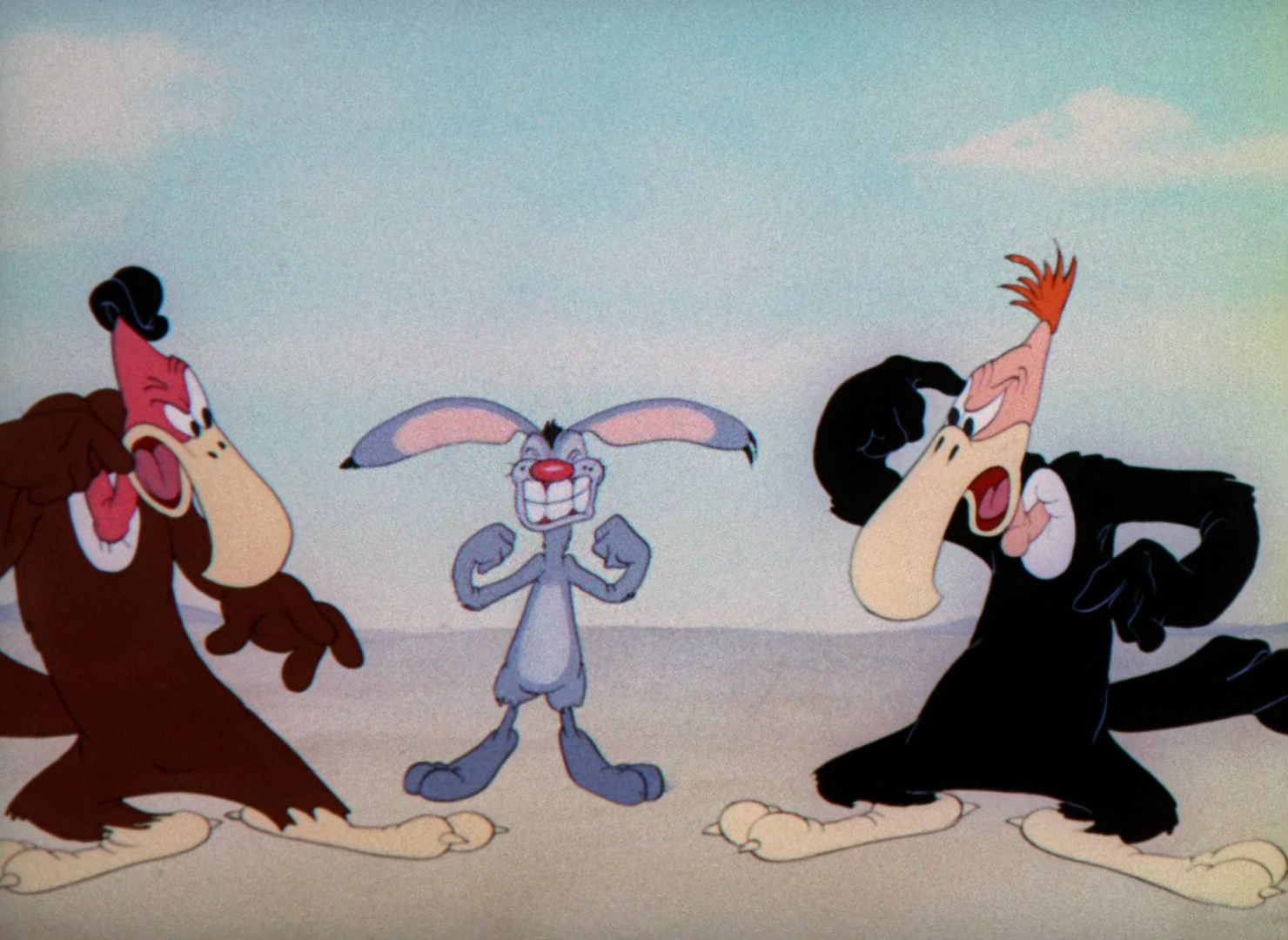
Tex's Other Rabbit

Two buzzards are arguing over which one has caught a rabbit to eat when the rabbit gets between them and mimics their argument.

There’s great animation of the rabbit with fun expressions.


The buzzards kick the heckler out of the scene. These are consecutive frames.


What's Buzzin' Buzzard is a 1943 Tex Avery cartoon with lots of signs and wartime rationing references. Kent Rogers plays one buzzard. I don't know who the Durante buzzard is. John Wald announces the surprise ending. Ed Love, Ray Abrams and Preston Blair are the credited animators with Johnny Johnsen providing backgrounds.

Wednesday, 17 August 2022

You Kids Killed The Time Tunnel

How could a TV show with Whit Bissell, John Zaremba and a set made of concentric metal ovals fail?

Pretty easily, as it turned out.

Your correspondent, age 9, loved the Time Tunnel. Actually, I loved the set more than the show, though Bissell and Zaremba fit the parts. Bissell’s general and Zaremba’s scientist were alternately contemplative and urgent, by my recollection.

The Time Tunnel was a product of Irwin Allen Productions, which also brought viewers Lost in Space. I’m not a science fiction fan, but both shows—at their best—had an element of suspense, until Lost in Space turned into the Dr. Smith and the Robot (and Some Other People) Show. If Jonathan Harris had been any more camp, he could have been on RuPaul’s Drag Race.

Scripps-Howard entertainment writer Richard Shull looked at the rise and fall of The Time Tunnel in a pair of columns. As a side note, there’s one reason to like Shull. He was hired by the New York World-Telegram to replace the retiring Harriet Van Horne—who once dissed a Christmas special starring Helen Hayes. Van Horne then changed her mind and wanted her job back, so the World-Telegram fired Shull. You have to pull for a guy that gets shoved around by management like that.

Let’s start with Shull’s column of November 12, 1966, about a month and a half after the Tunnel debuted. Irwin Allen must have put out news release bait that his show was deadly serious because I’ve read a number of columns that snapped at it.

Time Tunnel: Has Interesting Twists
By RICHARD K. SHULL

NEW YORK—Neglected and almost lost in the corridors of TV time scheduling this season is a good, honest adventure show titled "The Time Tunnel."
Unfortunately, it's sandwiched between the sub-moronic Green Hornet and Uncle Miltie Berle's moribund variety show on ABC on Friday. Also, it's directly opposite the gallow's humor of Hogan's Heroes on CBS and the snickering sadism of The Man From U.N.C.L.E. on NBC.
The odds against its success, anyone on Madison Avenue will tell you, are monumental.
And a sure kiss of death for the show would be for a TV columnist to say it's good. So, no more along that line.
But Time Tunnel is good science-fiction well done with some interesting twists. Ex-rock singer James Darren, now 30 and a father of two makes a strong, youth-oriented hero.
The basic idea of a machine capable of transporting humans in time and space is incredibly credible.
• • •
MOST OF ALL, however, the show is dedicated in its honesty to history. You won't find Daniel Boone fighting the South American Incas as in the Daniel Boone show. Nor will ever see Asian tigers battling African lions while South American toucans fly overhead as in Daktari.
Time Tunnel is doing a first rate job of making history palatable to the small fry, perhaps a true reflection of the modern child's mind in which history, space research, and futuristic fantasy all commingle in one welter of events and places past and future.
"The show won't change history, but we can affect the people involved within an event," Darren, an intense fellow, explained.
"And sometimes we'll take credit for the inexplicable of history. For instance, during the Black Plague in Europe, there was one group of people who were untouched while everyone around them died. Who is to say that someone from a time tunnel hadn't played a hand? History never explained," Darren said.
• • •
THE SHOW is produced by Irwin Allen, who also does Voyage to the Bottom of the Sea and Lost in Space. He has the facilities of 20th Century-Fox Studio behind him so he can incorporate expensive scenes from old movies into his shows to give them the illusion of grandeur and bigness.
Although the original intent of the show was to travel Darren and his pal, Robert Colbert, both backward and forward in space, so far the show has spent most of its time going back.
The initial episode, a flossy $1,000,000 production, has Darren and Colbert aboard the Titanic. They and the viewers knew what was to happen, but, in keeping with the show's policy, they were powerless to change history. The ship sank.
The following week they were in 1978 and the first U. S.-manned flight to Mars.
Since then, they've been to New Orleans for the 1815 battle in which the misdirected British were sacrificed before Gen. Andrew Jackson's lines; to the East Indian island of Krakatoa for its violent volcanic eruption in 1883, in ancient Troy to see Ulysses's Trojan Horse scheme; in the American West in 1876 to see arrogant Gen. George Custer lead his men to slaughter, and at Pearl Harbor on Dec. 6 and 7, 1941.
• • •
IN EVERY STORY, they become deeply involved with the prime characters, yet never change history.
In most of the episodes, the production values have been outstanding, although in the Custer episode the Indians were a rather potbellied, motley group.
In the context of what is being offered to youngsters as TV entertainment, Time Tunnel is an outstanding show.


Shull changed his mind before the season was over, almost as if he had been betrayed. The Time Tunnel, he decided, stopped being an “outstanding” show and the writers dumbed it down, narrowing the audience in the process. Smaller audiences mean hesitant potential sponsors, and no sponsors mean no show. There was no tunnel within a few months. This appeared in papers May 13, 1967.

“The System” Breeds Silliness
By RICHARD K. SHULL

NEW YORK — Why does a TV series, which shows promise of good escape entertainment in its early episodes, rapidly deteriorate into silliness? Many adult viewers have asked this question.
Blame it on the system. And for a clear example of how it works, look at Irwin Allen, producer of Voyage to the Bottom of the Sea, Lost in Space and Time Tunnel. The first two of those shows will continue next fall.
Allen is a modern Janus, with a faculty for presenting one face to the networks and advertisers and another to the TV audience. He is the ultimate product of television's system of buying and selling shows.
Take a look at his three series and see what happened.
In the beginning, Allen had Voyage to the Bottom of the Sea, a tale of a futuristic research submarine and espionage by foreign agents bent on learning its secrets.
That was the story idea Allen sold to ABC network, and which appealed to the sponsors. But once the show got on the air, Allen began to modify.
To be successful with an early show, Allen knew he had to appeal to that 14 per cent of the audience between the ages of 6 and 11 years.
Youngsters don't especially dig spy stories and romantic sub-plots. Kids do like monsters, almost any kind of monsters.
• • •
SO Voyage to the Bottom of the Sea got rid of the spies and girls, and settled down to the serious business of hairy globs and chrome-plated galaxy men. The kiddies watch, the ratings are sustained, and the network keeps renewing it.
As the star of the series, Richard Basehart, once was given to comment, "It ain't Hamlet, but . . ." And recently David Hedison, the co-star has asked for more money, since he rarely gets to perform opposite a human anymore.
Lost in Space went much the same way. The original idea concerned futuristic space travel with a foundation in existing fact. This appealed to the adult program buyers.
But on the air, Allen discovered the 6-to-11-year-old TV thought leaders were smitten with the cowardly, deceitful nature of the program's villain-in-residence, Jonathan Harris.
The story ideas were overhauled and now the show comes across weekly with a tale in which two children, who ooze with honesty and integrity, must rescue the sniveling, cavilling adult villain.
The kids love the show because it confirms their suspicions about all adults.
It's almost superfluous to point out that Time Tunnel commenced as a painless history lesson in which two travelers in time, weekly would step into some historical event. This idea appealed to the adults who purchased the show for TV.
But again, there was the kiddie element. The little people who make the big ratings took over. When last seen, Time Tunnel had British General Chinese Gordon fighting for his life at Khartoum while futuristic alien beings with their brains outside their skulls were preparing to take over the earth.
So it goes in the world of Irwin Allen, who has mastered the art of selling two shows under the title—one to the networks and sponsors and another to his audience.


Sandwiched in between these columns was one by UPI Hollywood Reporter Vernon Scott. We’ve republished a number of his columns here; Scott used to do a minute-long feature on the UPI radio network, too. Generally, he seemed fairly upbeat and friendly, but he just loathed The Time Tunnel. It became a symbol for him.

This is from January 29, 1967.

Sorry Plight of Time Tunnel
By VERNON SCOTT

UP-International Writer
HOLLYWOOD — Anyone measuring the worth of a television show should first weigh its merits, if any, on the basis of the audience it is attempting to reach.
Thereafter, it should either entertain, inform, stimulate or evoke a combination of these reactions.
Clearly, most television shows this season have failed on all counts. But again, who are the producers trying to reach? The question is not easily answered.
Captain Kangaroo is perfect for his audience. Batman is fine for his. And presumably Bonanza has stolen into the maudlin hearts of viewers from 16 to infinity.
But what of a series such as The Time Tunnel which airs on Channel 34 every Fri-day evening? Who in the world is ABC trying to reach with this nugget? What does producer Irwin Allen have in mind? Tots are in bed by that time. Teenagers are too hep or out on dates. And any adult who watches it has got to be suspect.
• • •
IN THE BEGINNING the show might have been based on a good idea—perhaps H.G. Wells’ “Time Machine.” The premise was to have two handsome young scientists flown backwards and forwards into time from week to week involved in historic events over which they have no control.
But the idea is too costly for execution, for one thing. If you are going to put a couple of guys back in early Rome or in the War of the Roses you'd better have the money to make it look authentic. On this show it never does.
The concept is handled clumsily, the acting poor, the scripts unbelievably bad.
Recently it wasn't enough that the heroes (James Darren and Robert Colbert) found themselves in an Italian' nobleman's villa during World War 1 where they are badgered by the Kaiser's troops and — get this — the ghost of Nero. A spoof you ask? No. A bit of satire perhaps? No. It was pure tedium.
• • •
A MATURE MIND must ask itself why on earth this particular hour-long episode was filmed and aired, and for whom it was intended.
At best it was comic book nonsense for adolescents. But it cannot be written off so lightly. In reality it is typical of the affrontery of television executives determining what the public is offered for viewing.
But this isn’t to single out the Time Tunnel. It is no better nor much worse than the common fare American viewers have been slapped in the face with for too many years to come.
The great misfortune is that good television, not to say great television, is so rare that one is forced to leave the set turned off most nights of the week. There are Time Tunnels of one kind or another on the air almost every hour of prime time.
It is pitiful that a great and powerful medium, indeed America's mass medium, cannot or will not do better.


Irwin Allen went on to greater, big screen achievements, like The Poseidon Adventure and The Towering Inferno (the latter lovingly spoofed on SCTV). Bissell won a lifetime achievement award from the Academy of Science Fiction, Fantasy and Horror Films. Zaremba and his serious mien made a good living in TV CommerciaLand, hunting for beans to put in Hills Brothers coffee. The Time Tunnel became scrap metal.

ABC went on next season to bring viewers a series about General George Armstrong Custer without a visit from time travellers. At least Bissell, Zaremba, Colbert, Darren and Lee Meriwether never dealt with that kind of ratings massacre.

Tuesday, 16 August 2022

There's Something Familiar About That Dog

There are many people who are quite expert at watching animation and recognising the artist. I am not one of them. But even Mr. Magoo could see that Chuck Jones is written all over these frames.


Jones wouldn’t have drawn these, not at this point of his career, but I imagine he did the character layouts. Someone can accurately tell you if this is by Ken Harris or Abe Levitow or someone else.

This is from a commercial for Gaines Multi-Menu, a product of General Foods, likely from late 1964. A nice bit of animation is a swirl before the dog lands in a position that reminds me of Charlie Dog. It's animated on twos.


You can download the spot by clicking here. All the voices are done by Paul Frees.

Monday, 15 August 2022

Tongue in Hand

Here’s Boxoffice’s review The Framed Cat (1950)

Good. Another excellent Technicolor cartoon in the popular Tom and Jerry series. Jerry, the tiny mouse, tries to frame Tom, the cat, by planting a bone stolen from Spike, the bulldog, on him. This leads to the usual complications in Tom’s life as the ferocious dog pursues him. In the end, the cat has to bow to the superior chicanery of the tiny creature.

One sight gag I like is when Spike is licking the bone as Jerry takes it. He realises something is wrong. Then the dog’s tongue turns into a human hand, feeling around for the bone.


The usual crew animates this: Irv Spence, Ray Patterson, Ken Muse and Ed Barge.

The cartoon was reissued in 1965.

Sunday, 14 August 2022

Honking, Hats and Home life

“When he hits a low...he is impossible to talk to.”

One wouldn’t think that is a description of Jack Benny, but that’s how his business manager Myrt Blum described him to the man who later managed Benny’s career, Irving Fein.

Understandably, newspaper and magazine articles about Benny didn’t talk this all that often. It’s not good publicity, you know. But besides Fein’s book, there’s a reference to it in an article in the June 30, 1939 edition of Radio Guide. In it, we see a not-so-perfect Benny, as well as a candid revelation that his wife was quite enthralled with the finer things in life. “High strung” is an interesting way to refer to her.

It starts off by looking at some of the silly restrictions placed on what he could say on his radio show (with a bit of a side journey about a moose). And there’s plenty of trivia, too.

I don’t believe I’ve either read or posted the previous chapters of this series, unless one of them involves his oft-told tale of growing up, vaudeville, meeting Mary, going into radio, and such.

THE MELANCHOLY CLOWN
This concluding chapter in the story of Brother Benny tells you how serious he is —and how funny!
By James Street
BENNY is a serious man. Tom Harrington, his radio boss, says he's the most serious man in show business, possibly excepting Fred Allen. He talks shop all the time. Mary buzzes around, but Jack is apt to get you in a corner and pound your ear with his woes and talk ideas.
“It’s impossible for Jack to relax,” Harrington said.
He’ll talk for hours about censorship. He believes the public should be protected from obscene shows, but he thinks too much censorship is dangerous and that it can wreck comedy. Rules regarding controversial subjects are rather silly at times and Benny is penalized particularly because so much of his humor is based on today's happenings.
After the Orson Welles' Mars program, Jack was going to use some cracks about Mars, but he was blocked. A week later he was allowed to do so, but the punch was gone. Maybe Mars is controversial. Unquestionably, radio is childish about "controversies" and in straining at a gnat often swallows a camel.
Along that line, this little recent incident may tickle even Mr. Benny, who is not the only radio man with woes. Phil Stong's "Honk the Moose" was broadcast recently, and Phil was asked to take the part of the moose he made famous. His job was to honk. The moose story is for children and thousands of them have read it. But some minute-man of radio came up with the startling information that mooses honk only during mating-season, therefore Phil's honk would be out of order. There was quite a to-do about it. Maybe the FCC and some of the bigwigs would be offended if there were a nasty old honk on the air. Phil Stong was too amused to be offended, even at such ignorance. He simply pointed out that a moose honks as a cow moos, a duck quacks, a sheep bleats and a dog barks. He went on and honked for his moose. America's morals were not soiled.
Benny is a cooperative soul and he's willing to cut his show to conform to good taste. Recently he had a school room scene in his tentative show. A day or so before broadcast date, a school bus was wrecked, and Benny cut the scene rather than remind America of the tragedy.
HE IS not allowed to get by with gags that Allen can use. Jack is prohibited from saying anything about a bad appetite, and he can't kid about taste. His agency handles many food accounts, and they fear that if Jack kids about foods somebody might not buy some of General Foods products. We hazard the suggestion that is very funny. Brother Benny can work miracles but we do not believe he can wreck America's appetite.
Benny is never temperamental, but he gets irked. He was in Boston one day and it had been arranged that he call on the Governor of Massachusetts. He went to the executive's reception room and waited. The Governor was busy. Jack waited a long time, then got up to leave. A stooge of the Governor's said, "Don't go, his excellency will see you in a minute."
JACK said, "I've got to go. My option comes up in thirteen weeks. The Governor is good for four years."
Benny has had trouble only once with his program, and that was when he hired Michael Bartlett as his tenor. Bartlett's voice didn't fit the tone of the program. The contract was canceled in friendly fashion and Benny hired Kenny Baker, who now ranks next to Bing Crosby in popularity. Don Wilson also rose to fame after joining Benny. However, Benny's hired hands are "typed," and in years to come that may cause trouble for them.
Burns and Allen are the Bennys' best friends and have been socially associated with them for at least twelve years, ever since Jack and Mary married.
They play Friars "Around the Corner" and rummy together. Jack and George play pocket billiards while Mary and Gracie concentrate on backgammon. The two women favor the same shops but avoid duplicating clothes because they are together so much.
Jack thinks George Burns, Eddie Anderson—the Rochester of the show—and Andy Devine are the funniest men alive.
Although Benny is moody. he'll laugh himself sick if he's really amused.
"He'd laugh at a red hat." Burns said. "His friends enjoy punching in his presence because Jack is such a good audience. He'll literally roll on the floor when highly amused.
Once he fell down and crawled on the sidewalks of New York because he got tickled at Burns. The two were waiting along and Burns said something unimportant. Benny doubled up.
"What's so funny?" Burns asked.
"It's not what you said," Jack replied, “but I know what you are planning.”
Burns didn't.
The two clowns used to have a telephone game that was very funny to them. Burns would call Jack and say he had some important information. Then right in the middle of a sentence he would hang up. Benny would roar. Once Jack wired George to meet him on the nine-thirty train that would arrive at a certain station. George wired back. "What time will you arrive?" Benny then wired friends all over the country and they wired Burns "Benny will arrive at nine-thirty."
George didn't meet the train. He posted the telegrams all over the walls of his room, and when Jack asked why he didn't meet him, Bums said, "I didn't know what time you would arrive."
Jack rolled on the floor. Gracie and Mary put a stop to such doings.
When Benny and his writers are working on a script, he will act the whole thing. If the script calls for him to climb a ladder, he'll climb one. He gets peeved at Beloin and Morrow, the ace gag-men, at times, but never bawls them out. Instead, he scolds Baldwin, his secretary for eight years, for not "reminding the boys to do such and such."
He loses his temper with his radio cast if they don't put their whole heart in rehearsals. But after bawling them out he'll say, "I'm sorry I was a bit harsh."
Benny has been accused of being absent minded and reserved. Morrow says his brain is preoccupied, that he's always thinking about his work, and that many persons mistake his preoccupation for snootiness. He's a generous and fair boss and gets his hands extra jobs when ha can. He even pays his cast and writers when they do benefits, although Benny is not paid for such work.
His feud with Fred Allen, of course, is just a gag. They really are good friends.


Benny reads detective stories and other frothy stuff. He likes to think of himself as a gourmet, but actually his appetite is very easy to please. He does know good coffee, and makes his own. He also enjoys malted milks and likes to cat at drive-in restaurants—those places where you park and eat in your car. He eats anything, but is apt to sample your food. He eats when he gets hungry and eats what he wants.
His favorite exercise is walking, and he takes long jaunts with his trainer, Harvey Cooper. He plays golf, too. And terribly! He makes fun of the game while he plays it, and usually knocks off about the tenth hole.
He enjoys driving his own car, and owns three. On his recent trip to Europe, he left his Buick in Chicago, and all during his European jaunt he kept talking about how much fun he would have driving from Chicago to California.
Benny can sleep anywhere and in anything. If he's tired after a party, he'll sleep a few winks on the divan in his clothes before he heeds Mary's order to undress and relax. He never uses a pillow. Mary buys a new hat every week and each is more radical than the other. Those gags of Benny's about his wife's hats are from his heart.
Mary is a very vital person and interested in everything, particularly hats. She smokes moderately and is generous to a fault. She loves movies and attends every preview possible.
She loves fine nightgowns and negligees and is afraid of the dark. She won't be alone for five minutes if she can help it. They have some half a dozen servants, but when Jack is away, her sister or Gracie must stay with her.
Mary is essentially high-strung. Jack pays her a salary and she spends half of it on clothes. She loves tailored underthings and silken doodads. She buys a new dress for each weekly show and her wardrobe is filled with fine clothes and furs.
She sometimes bobbles a line in the show, but the audience never knows it, and the bobbles give Benny some swell ad-lib material. Recently she said, "Can't I be boat's Don" instead of "Don's boat." Jack squeezed five extra laughs out of the mistake and the audience thought the line was planted.
Jack is allergic to roses. They make him sneeze. A fan sent him a basket of roses at a recent broadcast and Benny was on a spot. He didn't want to seem ungrateful and he knew the sender was in the audience. So he smelled the flowers, and sneezed so often that his show almost was late.
As a dresser he's inconsistent. He has been voted the second-best-dressed man in America, but he's apt to be mussy at times, with cigar ashes on his front. Robert Taylor asked Benny the name and address of his tailor, and now Taylor goes to Jack's tailor. Phil Harris also is a smooth dresser and goes for hand-embroidered robes.
The Jack Benny Club of Perry, Iowa, voted him the only star who can look handsome in his shirt-sleeves. It’s well enough that his fans can't see him at Saturday rehearsals. The cast meets at Benny's house and sits around a long table. Jack is at the head of the table, dressed in a pair of gabardine slacks, a tan camel's-hair sweater and a tweed coat. Morrow and Beloin wear rumpled sports clothes. Mary probably will be dressed in a navy blue blouse and slacks, with a bandana on her head. Andy Devine will be in blue dungarees and Don Wilson will wear flannel golf slacks and a polo shirt. Phil Harris probably will be the best-dressed of the pack, with a bright sweater and glen-plaid trousers.
When Benny began his gags about his Maxwell automobile, he had no idea so many of the cars still are in operation. Bui owners of the orphan cars have sent him more than a hundred hub-caps from old Maxwells.
Every room in the Benny home, except the dining-room, has a fireplace.
A Benny joke seldom fails, but Jack tells of the time he flopped.
"I was at the Academy of Music," he said. "I walked onto the stage and said, 'Hello, everybody." I got the raspberry. So I said, ‘Good-by, everybody,’ and walked off and kept right on walking until I got home."
Jack poses as a tightwad in his show, but he's really a soft touch. He gave away $1,500 in two days to not-so-lucky friends during a recent visit to New York.
Several years ago he and Mary adopted a daughter, Joan Naomi, who now is about five. Jack's funniest act is seen only by her and Mary. He romps and yells with her and converts his home into a madhouse. She went to one of his rehearsals and saw him do a line several times. Finally she said, "Why didn't you do it right the first time?"
Benny is not a joiner. He belongs to the American Legion, however. He was slated to fiddle while Rome burned at the Los Angeles American Legion convention. He had his fiddle and was ready. Rome was to be a pyrotechnic display. But something went haywire and the fireworks went off too soon. Jack barely escaped injury.
His radio income is approximately $15,000 a week for thirty-nine weeks. He gels $170,000 a picture and has two slated for this year.
His net income, therefore, is one of the highest in the United States. His income tax runs eighty-five percent.
"I don't give a hang how much money Uncle Sam takes in income taxes," Benny said, "as long as he leaves me enough to live on comfortably, as I do now. Uncle Sam can have the rest, and more, if I am able to make it."
Noble sentiments, Brother Benny. He has proved that if a man speaks a better gag the world will beat a pathway lo his door. But he knows something else that's far more important—that the same path leads away from the door, and the world will retrace its steps if a man is not worthy.
Jack Benny may be heard Sunday night on NBC at:
7:00 p.m. EDT – 6:00 p.m. EST
6:00 p.m. CDT – 5:00 p.m. CST
8:30 p.m. MST – 7:30 p.m. PST

Saturday, 13 August 2022

Exhibit A: Binko the Cub

Binko the Cub got caught in a numbers game. Two of them, actually.

It’s 1930. Binko was the star character of the Romer Grey cartoon studio. Binko had a problem. There was only a small number of distributors that could release cartoons. Ub Iwerks worked out something with MGM. Hugh Harman and Rudy Ising did the same with Warner Bros. (via Leon Schlesinger). Charlie Mintz connected with RKO for his Toby the Pup series. Universal already had Walter Lantz and United Artists wasn’t interested yet. That was it. There was no one left for Romer Grey.

The other numbers problem involved dollars. Grey didn’t have any, certainly not enough to bankroll an animation studio, try as he might. It was a problem that boiled up several years after Grey closed his studio. We’ll get there in a moment.

More than 20 years ago, Mike Mallory researched and wrote an excellent capsule history of Grey’s cartoon operation. You can read it HERE. To sum up, Grey’s father was Zane Grey, who very comfortably made a living writing western novels, enabling him to build a spacious estate in Altadena. His mother Lina got her socialite friends together to toss in some capital so her 20-year-old son could set up a cartoon studio in the family garage.

Grey assembled an animation staff with loads of potential; many would go on to better things. A story has been told about how Ken Harris, later a fine animator in Chuck Jones’ unit at Warners, was willing to pay Grey to work there. Jack Zander (later at MGM), Preston Blair (same) and Pete Burness (UPA) were on the staff. Lina Grey’s bankroll convinced two barely-experienced assistant animators to leave Disney and come over—Bob and Tom McKimson. And young Romer hired Volney White to supervise things.

White was a Coloradan; he and his brother Ray grew up in Greeley, attending College High School and the Colorado State College of Education, moving to Los Angeles in 1923. The 1924 Pasadena directory doesn’t say where, but gives his occupation as “cartoonist.” In 1929, he was a director at Liberty Pictures on South Myrtle Street opposite the Santa Fe station in Monrovia; the local paper reported on a break-in at the sound movie studio that year. Somehow he connected with Romer Grey.

With no distribution deal in place, there was no one to pay Grey to make Binko cartoons. That meant no money to pay cartoonists, or anything else. When Romer’s mother was told $50,000 was needed to keep things operating—some of the staff had been charging lunch to her in lieu of their non-appearing salary—the studio shut down.

Mallory’s story ends in 1990 with the surprise discovery of the studio’s records—including artwork—in boxes stored in the basement of the Grey mansion. “Unfortunately, no trace of film was found,” he says. But there was film. Binko’s Hot-Toe Mollie turned up in the Library of Congress collection and was released on DVD/Blu-ray in 2014 in Tommy Stathes’ Cartoon Roots series (along with other excellent and interesting cartoons).

And the story doesn’t end with the demise of the cartoon studio. Volney White wanted his money. So he sued.

Here’s how the Pasadena Post put it in a front-page story on May 21, 1932.

Son of Author Named in Film Cartoon Suit
$356,280 Damage Action Against Romer Grey Is Filed in Court

Damages of $356,280 were asked of Romer Grey, son of Zane Grey, noted Pasadena author, in a suit filed in Superior Court late yesterday by Volney White, artist, 1461 Woodbury road.
Cartoon at Issue
The artist charged that Mr. Grey defrauded him of rights to a motion picture cartoon, known as Binko-the-Bear Cub.
Two years ago, the complaint stated, Mr. White showed the writer a cartoon drawing of Binko and that later an agreement was made to produce animated cartoons for motion picture houses.
Company Projected
Mr. Grey, according to Mr. White, was to form a company, called Romer Grey Pictures, Inc., to manufacture and distribute the films. The artist, he declared, was promised 35 per cent of the profits, guaranteed to be in excess of $75,000 a year, $5000 worth of stock, $2000 in cash and a salary of $150 a week for drawing the cartoons.
The complaint stated no company was formed although Mr. White signed over rights to the cartoon and two pictures were made. At various showings of the picture, the complaint continued, the creator received no screen credit for his work.
Waits for Pay
At no time was he paid, although he worked forty-one weeks drawing cartoons, and he received no cash or stock, it was asserted.
In detail, Mr. White asked $350,000 damages, $6250 in salary and $30 compensation for the claim of a workman which he purchased.
According to Walter S. McEachern, attorney, several laborers who worked on the pictures, have laid demands for wages before the Labor Commission.


The wheels of justice turn ever... well, let’s skip the cliché and tell you it took 13 months for the case to get to court. The Los Angeles Times’ report on June 22, 1933 informs us two cartoons were finished, though I’d be interested in how White arrived at his dollar-figure.

ZANE GREY SON IN COURT FRAY
Artist Asks $756,250 Animated Cartoons
Contract Action Opens Today in Pasadena Court
False Representation Charge Made by Plaintiff

PASADENA, June 21.—Romer Grey, son of Zane Grey, famous novelist, is the defendant and Volney L. White, artist, the plaintiff in a $756,250 breach-of-contract damage suit scheduled to be tried here tomorrow in superior Judge Wood's court.
White charges in the complaint that young Grey made false representations in obtaining the rights to the motion-picture production of "Binko the Bear Cub," "Hot Toe Mollie," and "Arabian Knight Mare," animated cartoons which the plaintiff asserts are his original creations.
The complaint recites that Grey said he had formed a $50,000 corporation to produce motion-picture adaptations of White's drawings. The artist, it is asserted, was promised 35 per cent of the profits which Grey is said to have estimated should net White $75,000 the first year, and more later. The plaintiff also contends that he was promised $1000 cash in advance and that Grey had agreed to employ him at a salary of $150 a week.
"All of these representations were false and fraudulent," continues the complaint, "and were made solely for the purpose of inducing the plaintiff to assign to the defendant all rights to the films."
Two of the animated cartoons, according to White, were exhibited in Southern California theaters, but Grey refused to show any more. As a result, it is contended that the the cartoons, valued at $750,000, became worthless. White also asks $6250 he charges Grey owes him for services.


The court case took a day. White didn’t get anywhere what he wanted. This is what the Pasadena Post reported on June 24th.

CARTOONIST WINS $900
Volney L. White Compensated For Nine Weeks Spent Sketching For Romer Grey Comedy

Judge Walton J. Wood in the Pasadena Superior Court late yesterday awarded Volney L. White, cartoonist, a judgment of $900 against Romer Grey, son of Zane Grey, author, as the result of the lawsuit instituted by the artist. The judgment came after Judge Wood and attaches of his court had gone to the Tower Theater and had there viewed one of the cartoons based on drawings made by Mr. White as produced and animated by Mr. Grey and his associates. The animated cartoon showed Binko the Bear Cub straying from the path of good judgment and coming in contact with Hot Toe Mollie, a young woman of parts.
The plaintiff had asked for $750,000 for breach of contract plus $6250 for actual work done in producing the cartoons and drawings, some 15,000 of which were made for one picture. It was held by the court that all the plaintiff is entitled to is pay at the rate of $150 a week for the nine weeks spent in producing thousands of drawings for the feature. The other deal was held to be a partnership and as it was not shown the partnership had been profitable to either party in the way of producing revenue, nothing was awarded in the main issue.


In a story on June 23rd, the Times reported the judge hearing the case “preferring fishing to watching animated cartoons” but the paper had this to say the following day:

After viewing “Hot Toe Mollie,” first sequence in the “Binko” series, at a special showing this afternoon at the Tower Theater, Judge Wood announced from the bench he “enjoyed the picture and can’t see why it didn’t sell as it seems as good as any of the other animated cartoons.” During the testimony, Grey revealed that he finally sold the only two film productions of his company to his mother, Mrs. Zane Grey, for $9500. His mother and father, he explained, had footed the bills for his picture enterprises.

Grey carried on being the son of Zane Grey and died in 1976. White continued his animation career. Bobe Cannon was the usher at his wedding in 1934. A Greeley newspaper report of September 3, 1938 stated Volney and brother Ray had been at Warner Bros. for five years (Volney eventually received screen credit as an animator in the Frank Tashlin unit) before they headed to Miami to work on Gulliver’s Travels. The 1940 Census shows Volney living in New Rochelle, New York; he directed several cartoons for Terrytoons. He returned to California by 1943. The North Hollywood directory the following year gives his occupation as “aeroworker” but the Voter Registration List states he was an “artist.” He might have been both. Military documents show he was a private who served six months from the start of June 1943 and record him as unassigned to an “aircraft casual detail” and with the First Motion Picture unit on the Hal Roach lot in Culver City.

After his discharge, it’s not clear where he worked but he remained in the Los Angeles area, where he died on December 23, 1966.

As a side-note, a song called “Binko the Bear” was copyrighted on Dec. 26, 1930 by Gene Quaw and James Mayfield of Los Angeles. I can’t confirm if this had anything to do with the cartoon.

Fans of early sound cartoons can be happy this footnote in animation history has been restored for viewing, if nothing more than a curiosity. In some ways, it’s atypical of a 1930 cartoon. It’s mainly musical with animals playing makeshift instruments. There are some overlays (that move when they shouldn’t), which must have been daring for that year. Some of the characters look like something from a Disney or Harman-Ising cartoon of that era, and a few of the backgrounds are reminiscent of something in an Ub Iwerks cartoon. Binko is a non-personality (and a silent one) who, in Mickey Mouse fashion, gets the senorita in the end. We wonder after coming away with only $900, Volney White didn’t think he got it in the end, too.