Thursday, 21 July 2022

That Egg's a Skunk

Humpty Dumpty, Jr. uses matches as a weapon as he battles the Bad Egg in the 1935 Ub Iwerks ComiColor short Humpty Dumpty.


The famous Iwerks radiating lines.


Junior tosses the whole box of matches at him. They explode. Why? Um, let’s ignore that one for now.


Junior jumps on a spoon, sending Bad through the air. He lands, cracks open, and little skunks jump out.


Iwerks and musical director Carl Stalling are the only ones who get credit on screen. Stalling, presumably, came up with the song “Spooning in a Spoon,” which won’t make people forget Disney’s “Who’s Afraid of the Big Bad Wolf?” Maybe he should have written “Who’s Afraid of the Big Bad Egg?” The parody would have brought some humour to this kiddies-only dull-fest.

Wednesday, 20 July 2022

Not Being Ed Norton

He was more than just Ed Norton, and Art Carney set out to prove it after The Honeymooners went off the air in 1956.

Carney had little choice. Jackie Gleason continued with Honeymooners sketches in his 1956-57 variety show but when he came back in 1958, Carney wasn’t on the show. He had to do something, so he managed to sell NBC on the idea of airing occasional specials where he could finally star.

Not everything went smoothly for the Emmy-winner. In 1961, new material had to be quickly inserted into a special in January after the NBC ordered the deletion of an eight-minute sketch where he and Lee Remick portrayed Jack and Jacqueline Kennedy. NBC said it was “improper” and in bad taste to have people playing the president and his wife. (In March, another Kennedys sketch was censored in a Mort Sahl special where Carney was to play the president. Sahl then refused to do the show).

The Saturday Evening Post profiled Carney that year and he appeared in a gag photo spread in Seventeen magazine. Here’s another profile from one of the newspaper syndication services. It glosses over his radio career, considered ancient history in the 1960s, and his work on the Morey Amsterdam show on Du Mont which led him to Gleason’s Cavalcade of Stars (and the first Honeymooners sketches) on the same network.

Carney Modest About Acting
By ROBERT NETHERCOTT

NEW YORK, Oct. 2 – Art Carney won't believe it when told he's one of the finest performers TV has ever nurtured. He smiles and says, "Cut it out."
Tall, spare and graying, Art Carney has been about as important to television during the past six or seven years as the image orthicon tube.
He started out with the burdensome task of creating three wonderfully dissimilar characters on Jackie Gleason's show – sewer man Ed Norton, inoffensive Clem Finch and the starchy Sedwick Van Gleason, father of Reggie.
To live up to and at the same time live down such popular Frankensteins was considered one of the neatest twists out of being "typed" ever pulled off by an actor.
But Carney went on to straight dramatic roles like a graduate of Old Vic. Parts he played on Studio One, Playhouse 90, and other major shows ran the gamut of human expression.
In 1957 he took on his own program a series of eight specials. No two were alike. Many of them were hailed as "blockbusters." They showed that Art could do pretty nearly anything.
"It annoyed me a little," Carney said, “when people who had watched me on the Gleason show would come up to me after a Kraft Theater performance and say, 'I never knew you were an actor!' What did they think I was doing up there on the Gleason show – bowling?"
Bill McCaffrey, Carney's agent and close friend, has defined Art's seemingly effortless perfection in any role he takes on as a sign that he's a "primitive in acting." Art, who hardly ever disagrees with McCaffrey, grins a knowing grin.
On October 9 Carney will be among a glittering cast on the Westinghouse program's "Sound of the Sixties" (NBC). Written and produced by Dore Schary and to be narrated by John Daly, the show will feature Art in a sketch about a "do-it-yourselfer."
Carney thinks it's one of the funniest things he's ever done.
"They got the right guy for the job," he says. "You see this character is a very ignorant somebody when it comes to doing handy little things around the house. That's me. I can screw in a light bulb and put out the garbage. Very little else."
Asked about whether he's more at home in comedy or dramatic parts, he replies that he feels good doing both and wants to continue mixing them up.
"In the 'Sound of the Sixties," for instance," he says, "I might be considered a comic doing a funny bit. But I think of myself as an actor in a comedy situation. I always think of myself as an actor. That's why I feel comfortable."
Art plans to do some other TV this coming season but his main project is a Broadway play, "Age of Consent" which opens in December. Unlike his first Broadway role some seasons back, "The Rope Dancers," this play is a light hearted comedy.
"I enjoy my work," Art concludes.
Maybe that is as good an explanation as any of what makes this gifted, original and somewhat solitary man tick – and click.


Newspapers continued to publish little blurbs about the inability of Carney and Gleason to get together on television again. Earl Wilson used up most of his column of February 24-25, 1962 on the subject.

NEW YORK—Art Carney stirred some vanilla yogurt with a spoon, ate it and said, "Jackie Gleason and I never had a cross word. . ."
He was lounging in his dressing room at the Biltmore Theater where, with the help of his reputation as Ed Norton the sewer worker, is doing good business as the stage star of the B'way show "Take Her She's Mine."
"Lots of people don't believe it, but it's true," he said. "We just hit it off."
It was a timely discussion because Gleason's agents have tried to get them together again for one more "Honeymooners" effort as a special or even as a new series.
They failed to make the merger.
"Bill McCaffrey, speaking for me, wanted certain things just as Jackie would want certain things." Art sipped some coffee out of an enormous cup. "After all, what else are we working for?
"But I know Jackie'd do anything for me and I hope he knows he's got the same kind of friend in me."
Carney and Gleason, by coincidence, each have the same problem now — that of being too funny.
"Gleason just doesn't want to stick to doing the funny stuff — he's an actor," Carney said.
"In this show here" — about a father seeing his daughter growing up and away from him — "I could get a laugh with an Ed Norton gesture but I'd be out of character.
"Still I got to say I love the Norton character. I was in California before the show opened. . ."
An elevator operator mentioned seeing Ed Norton every day.
"Every day! You're kidding!" Carney said.
"Yeah they run it out here every day," the elevator operator said.
So next day who was in the great unseen audience watching "Honeymooners" rerun"? Ed Norton.
"Gleason never called me a stooge. I was the second banana, sometimes I was straight man for him, sometimes he was straight man for me. The fact he didn't like to rehearse much didn't hurt — the spontaneity was there. If anybody fluffed or ad-libbed it was in."
Carney yearns to do a musical. He loves music.
"I play the piano by ear," he mentioned. "I was a dope as a kid. I took a few lessons — but gave it up. I wanted to do all the things fellows wanted to do — girls . . . sports . . . girls . . . girls . . . girls.
"I remember the day Gleason played me the acetape [acetate] of his album ‘Music for Lovers Only.’ He said ‘Art, that's my first pair of long pants.’
Carney has had just the reaction you'd expect to his serious attempts at times to be serious.
"I get letters from people saying ‘Dear Mr Carney: Why do you waste your time doing comedy when you're such a fine dramatic actor?’
"And it's very nice until I read the next letter which says, ‘I saw your dramatic show. Why the hell don't you stick to comedy?’”


Carney went on another honeymoon with Gleason from 1966 to 1970. His career was doing just fine but his personal life was a mess because of addiction. He cleaned up, won an Oscar and lived to the age of 85.

He may have shone in his forgotten TV specials but the world still knows him for bringing to life one of the most beloved characters of the 20th century.

Tuesday, 19 July 2022

Red Dances

Preston Blair’s master-work at the MGM cartoon studio has to be the dance sequence in Red Hot Riding Hood (1943). Much has been written about it, so there’s little for me to say other than enjoy some of these drawings from one scene.


Tex Avery cuts to a shot of the wolf, then widens the shot to show the applause and whistle machine.


Did Blair have an assistant on this? If he did, who?

For all of Blair’s fine work, he and the other animators received no on-screen credit. Ed Love and Ray Abrams also animated this cartoon, the third of Avery’s put into production at MGM.

Monday, 18 July 2022

360 Bugs

Bugs Bunny divests a South Seas island of all the enemy soldiers, and rhapsodises that it’s so peaceful and quiet.


Bugs’ mood changes. He’s angry because he can’t stand peace and quiet. Animator Virgil Ross (I think) has him do a 360 degree turn, then follows up with some smear drawings.


Gerry Chiniquy got the screen credit for animation in Bugs Bunny Nips the Nips (1944). By the 1960s, it wasn’t on TV screens, certainly not where I lived. We could still boo the Nazis, though.

Sunday, 17 July 2022

Buck Benny and the Buck Private

Stars, big and little, toured military camps stateside, appeared at bond and war stamp drives in Canada and the U.S., and performed in sometimes horrible conditions to boost the morale of troops overseas during World War Two.

One was Jack Benny.

Jack went beyond all of what you’ve read. He wrote and even called families of service members once he got home to tell them their boy was okay. This was revealed in his autobiography (co-written with his daughter). But it was a story told at the time as well, as you can see by the newspaper column below published November 28, 1943.

This Story Concerns 2 Swell Guys
By DOROTHY MANNERS
Special to THE DETROIT TIMES
HOLLYWOOD, Nov. 27.
THIS is about two swell guys—Jack Benny and Pvt. Billy Van Grove Jr.
Jack, you already know and perhaps it is as well if you accept this as an introduction to Pvt. Van Grove, before we start reading his mail.
He is 22 years old and the son of the William Van Groves of Los Angeles. Billy has been in the service about a year and is based in Central Africa with the air forces. Lately, Billy has been writing letters home, most of them about Jack Benny, and here is what he has to say:
‘What Excitement!’
“Sunday, July 27.
“The story that’s going around is that Jack Benny arrives soon to put on a show for us. What excitement! I doubt if I’ll get close enough to him to ask a favor—but if I do, ma, I’m going to give him a note to you.’
“I feel almost like I know Jack Benny, because both of us are from Los Angeles and when you are miles and miles from home that makes you feel close to a guy.”
“Tuesday, July 29.
“First, let me tell you that if some one calls you and says he is Jack Benny, don’t act too surprised because it will really be—Jack Benny. I did get close to him and we got talking long enough for him to take down your number and to promise to call you.
“Of course, I feel pretty good about that, but I noticed he took down quite a few numbers. That was yesterday, the day, Jack, Winnie Shaw, Larry Adler (who is just about the best harmonica player in the world) and Anna Lee put on their show for us. It lasted two hours and Benny really outdid himself. How the GIs loved it. We talked all through the night about it and this morning the fellows can talk about nothing else.
“Today Jack ate dinner with us in the enlisted men’s mess hall and he was even funnier, being himself, than he was in the show. He used the regulation mess kit to eat out of, and afterward, he went outside to wash his equipment in the trough provided for that purpose.
“He made quite a ceremony out of getting all the food out of the cracks and crevices of the kit and kept kidding: ‘I’d never eat if I had to do this every day.’
“Guess you don't think this is funny but then you and dad have never eaten out of a GI mess kit.
“If you see any of the neighbors and folks I know I wish you would tell them about Benny and how much his visit here meant. And there are thousands and thousands of guys who feel just the way I do—and right now, thanks to Jack, I’m feeling mighty good.”

Saturday, 16 July 2022

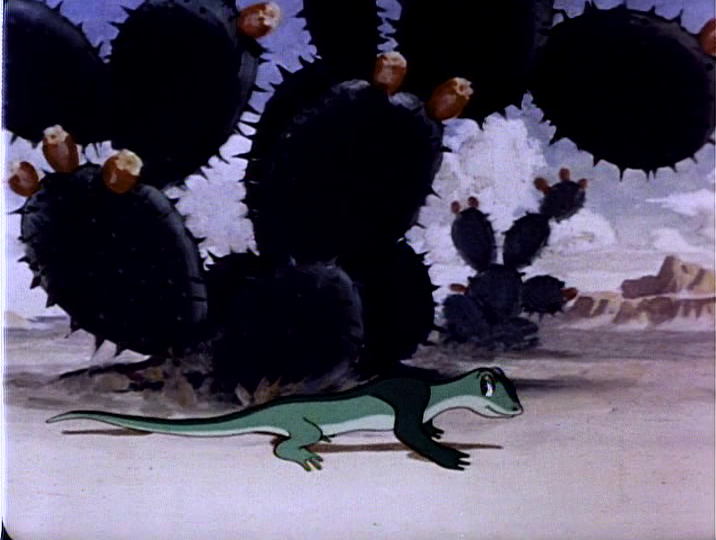
The Detouring Lizard

Director Tex Avery, writer Rich Hogan, animator Paul J. Smith and composer Carl Stalling all get credits on the 1940 Warner Bros. cartoon Cross Country Detours, but there are several whose names don’t get mentioned at all.

Background artist Johnny Johnsen and actors Mel Blanc and Sara Berner may be the most prominent, but there is one person who appeared in this cartoon who got a blurb in the popular press.

Well, sort of appeared.

The Los Angeles Times of August 27, 1939 reports:
Casting of the week: Marcia Eloise, a strip-teaseuse from the downtown Follies, answered a call to model for animators drawing a “Looney Tune” cartoon at the Leon Schlesinger studio.
First, we see a “shy little deer” with a sexy walk strolling away from the camera. I suspect Miss Eloise posed for that. Note: I suspect incorrectly. Thad Komorowski has a negative of the reference footage and says it's someone else.


Later, the narrator (identified by Keith Scott as Lou Marcelle) says “Here’s a lizard which, as you all probably know, sheds its skin once a year. Let’s watch this interesting procedure.”


Avery tops the gag.


Avery spoke about the gag to author Joe Adamson in his tremendous book Tex Avery King of Cartoons. Avery said “We Rotoscoped her action to fit the lizard. Shaped the lizard like a girl, too, took off her skin and she was just a lighter green. It got a great laugh, too.” Avery then admitted he didn’t think lizards shed their skin at all, but they “planted the gag” when, during the story meeting, they didn’t figure a snake would work.

The Los Angeles Daily News story about the casting leaves one questioned unanswered. The August 16, 1939 piece read, in part: “In a recent visit to the downtown theatre, one of the studio officials was intrigued by the talent of Marcia, and when the studio decided to put in a call for a dancer, he called the Follies management and made the arrangements.

Which “studio official” is not revealed.

You can see a picture of her from the August 16, 1939 edition of the Daily News, giving her full name (and lying about her age). A little hunting gives us a bit of information about her. The Times of July 1, 1939 states:
Another “name” artist joins the roster of performers at the Follies Theater today, when Marcia Eloise, who won nation-wide fame as the “girl in cellophane,” begins an engagement.
In 1937, Miss Eloise was signed to a seven-year Hollywood contract. She appeared in a featured role in the Allan Jones-Fannie Brice M.G.M. film, “Everybody Sing,” and also in Paramount’s “College Swing.”
The Follies had a good press agent. Several stories about their girlie shows were planted in the Los Angeles press about this time. The Times of July 10 reveals she was in the musical production “Scandals of 1939.” It tells us “Marcia Eloise, youthful, auburn-haired danseuse who begins her second week, has scheduled an unusual number that also involves intricate tap and toe steps.” Her next production, reported the Times on the 25th, was “Naughty Babies.” The Daily News of August 5 tells of “Grin and Bare It,” a “smartly paced midsummer musical revue.”

You get the idea.

November 1940 saw her perform “her novel and charming act” at the Globe Theatre in Boston, with comedian Joe DeRita on the bill.

She was born October 6, 1922 to Frank Griffin and Marguerite Gibson in Denver. An entry at Geni.com reveals she also used the stage names “Teala Loring” and “Judith Gibson.” It additionally tells the world she was the sister of actress Debra Paget. She appeared in ten films for Monogram from 1945-46.

Griffin married Eugene Bennett Pickler in Los Angeles on June 21, 1950. Her marriage certificate doesn’t give an occupation for her but that was the year of her last movie, Arizona Cowboy with Rex Allen. They lived in Norwalk, California before moving to Houston. She died in a car accident in Spring, Texas, on January 30, 2007 at the age of 84.

Friday, 15 July 2022

Zoot Take

Jerry performs a lovely little solo jive dance in The Zoot Cat (1944). The camera pans along with him as he meets up with Tom, dressed as hipster (1940s version). Tom looks ready to slip him some skin when the two realise who each other are.

Tom does a take. Jerry does a take. Then he zooms out of the picture. This is animated on ones. Jerry appears to be looking at the camera but that’s just an in-between as he turns his head.


Ray Patterson, Ken Muse, Irv Spence and Pete Burness got screen credits. Someone will tell you if this is Spence’s work.

If you’re wondering why the girl cat keeps calling Tom “Jackson,” that’s what hep cat musicians used to call each other back then. Sara Berner as the love interest lets out with a lot of ‘40s jive talk in this short. There’s more chatter in this cartoon than the average Tom and Jerry outing, much of it supplied by Jerry Mann.