Tuesday, 28 June 2022

The Rooster, I SAY, the Rooster is Crowin'

The ink and paint department at the Warner Bros. studio gets plenty of work to do in this scene in The Foghorn Leghorn (1948).

Foggy pretends the sun has risen in an attempt to fool Henery Hawk. Look at the dry brush and multiples (the drawings are animated on twos).


Manny Gould does some good work in this short, including this scene. John Carey, Phil De Lara, Chuck McKimson and Pete Burness also animated this cartoon for director Bob McKimson.

Monday, 27 June 2022

We Interrupt This Blacksmith

The Village Smithy must have been a real unexpected treat for cartoon-lovers of 1936. Instead of the cartoon tootling along on its own, an off-screen narrator interferes with, and reacts to, what’s happening on the screen. It’s something that, to the best of my knowledge, hadn’t been done before.

The narrator recites the familiar Wordsworth poem (with a few of his own touches) focusing on the blacksmith at work. But then he completely changes direction. “Now,” he says, “our hero, Porky Pig.” The camera pans to the left, where we find Porky, shaking his hands as if he was a newly-victorious champ.


The narrator carries on with a non-poetic explanation. “Let’s see. We have the blacksmith.” The camera pans back to the smithy, who gives his opinion of the situation to the audience.


“Now, boys,” he says the two-some on screen, “we need a horse.” They lamely search for one in the scene.


Carl Stalling plays von SuppĂ©’s Light Cavalry Overture. “Listen boys! Here comes one, now!” says the narrator. A camel wanders into view. The narrator apologises for the wrong animal and an off-screen hook yanks him out of the cartoon.


This sort of humour is light-years away from any Buddy or Beans cartoon, let alone the cutesy-ootsy world of Disney and Harman-Ising. Only Tex Avery would try to make something like this.

If I recall, story units hadn’t been set up so the whole story department—Bugs Hardaway, Cal Howard, Tedd Pierce (who plays the blacksmith) and whoever else was around then—pitched in with ideas, though this has Avery written all over it. Cecil Surry and Sid Sutherland receive the animation credits, though it’s fairly certain Bob Clampett, Chuck Jones and Virgil Ross animated on it as well.

Among the approriate tunes Stalling employs are “Horsey Keep Your Tail Up” (Bert Kaplan and Walter Hirsch) and “My Pony Boy” (Bobby Heath and Charley O’Donnell).

Sunday, 26 June 2022

Jack Benny Goes to a 7-11

What was it like hanging around Jack Benny?

Let’s find out in this column from the Orlando Sentinel of February 4, 1966. Jack was in town for another one of his concert stops. I wonder if Jack went inside the grocery store or stayed in the car.

My Weekend With Jack Benny
By HOCKER DOENGES

Why do I think Jack Benny is a good guy?
I guess because he's one of us—he's a gentleman and a scholar and a story teller.
He arrived on Sunday at 10 p.m. Beth and George Johnson and Ann and Bob Crane and Bob Doenges and I met him—also more important, Mayor Robert Carr and Helen Ryan.
We took him to the Cherry Plaza, and all of a sudden Jack Benny said, "I need something to eat before I go to bed." He had flown from Los Angeles and we never thought of food. Have you ever tried to find food at 10:30 on a Sunday night? For a celebrity? No food.
We found a 7-11 open and bought a baloney Poor Boy and a regular quart of milk. We went to the Johnsons, doctored up the Poor Boy with cheese and toasted it. He loved it. The milk was wrong—he only drinks skim milk.
FINALLY WE got through all of this and Jack put up his feet and said, "I would like to have a cigar and I'm out of them."
No husband could produce a cigar. He couldn't have been nicer—said he'd smoked his quota on the way out so really shouldn't have one. Who else would have acted like this to save our feelings?
HE MUST use a pen a day, he never turns any one down. After the concert he signed at least 250 autographs. I thought we would never get him to the party.
He called his Mary every day in Palm Springs, where she was with friends playing golf and gin rummy. He doesn't own a Maxwell and never has. He doesn't have a Rochester, but he has Irving.
IRVING IS his manager and although he scared me at first he does a terrific job and I miss him, too. Jack looks much younger than 39 and asks no quarter from any one. He calls his wife every day and finds out her golf score or whether she has won or lost at gin rummy. He even sang "Happy Birthday" to a 20th birthday gal at the Skyline when they brought in her birthday cake. She almost fainted!
HIS STORIES and conversation are terrific. He was in Berlin four days after the armistice of World War II. He was doing a show over there and after the armistice he couldn't find any of our boys to play for, so he followed them into Berlin.
He has an orange grove and a ranch in California. We gave him some lousy weather, but he didn't complain, didn't even make a snide remark about the weather here or California. I would have.
HELEN RYAN started working to get Jack Benny here 21 years ago, and finally we had him and he LIKES us. His audience at the benefit he liked—he liked the party afterwards—it was not the cost plush party, but it didn't cost $5,000 or $10,000—every penny HE made for us went directly to the Symphony deficit and Jack Benny likes that. He doesn't want to donate his time and have a lot spent on the party afterwards.
Jack remarked several times that our conductor, Henry Mazer, was one of the easiest to work with. He liked us and we loved him.
I still think Jack Benny is a great guy!
Signed His Den Mother for Three Days, Harriet (Hocker) Doenges


The paper ran a full page about Jack after his death in 1974. There were a number of wire service stories, one dealing with pancreatic cancer, another with reaction from Jack's many celebrity friends, including future president Ronald Reagan. The Sentinel reporter who covered the concert looked back.

Jack's Quips Remembered By Reporter
By SUMNER RAND

Sentinel Star Staff
When Jack Benny visited Orlando just under nine years ago to take part in a benefit concert for the Florida Symphony Orchestra (FSO), he hit some of the coldest weather that winter.
"I just came from six nights in Canada," he joked. "It was almost as cold as Miami."
THE COMEDIAN, who over the years raised more than $5 million for symphony orchestras throughout the country, impressed the Orlandoans he met, including this reporter who met him briefly at a press conference, with his informality, lack of pretense and free and easy manner.
He appeared at a press conference held in what was then called the Cherry Plaza Hotel in a dark gray sports jacket, flannel slacks, black loafers, blue ascot and scarlet handkerchief with a huge cigar.
Asked if the cold weather might affect his violin playing, he joked, "I play exactly the same whether it's hot or cold. In fact, that's how I play, hot and cold."
He said the idea of coming to Orlando to help the Florida symphony reduce its deficit came from conductor Alfred Wallenstein who had been a guest conductor of the local symphony a couple of seasons before Benny's appearance.
"He conducted my first four concerts. The other conductors weren't afraid to have me after that," Benny quipped.
He described the act he put on for orchestra benefits as follows: "I play the world's greatest violinist. Actually, I have no business to be within eight blocks of a concert hall."
His playing and his quips before a capacity audience in Orlando Municipal Auditorium that night Jan. 27, 1966, though, helped raise $23,200 net profit for the Florida Symphony.


Hocker Doenges was right. Jack Benny was a great guy.

Saturday, 25 June 2022

Not Bert and Harry

Want to sell beer? In the 1950s and early 1960s, the combination that seemed to work was cartoons and comedy.

Hamm’s featured an animated bear in its TV ads. Mr. Magoo sold two different brands of brew. Perhaps the most famous cartoon beer hawkers were Bob Elliott and Ray Goulding as Bert and Harry Piel. Word is their Piel’s beer spots were so popular, they were included in New York television listings in newspapers.

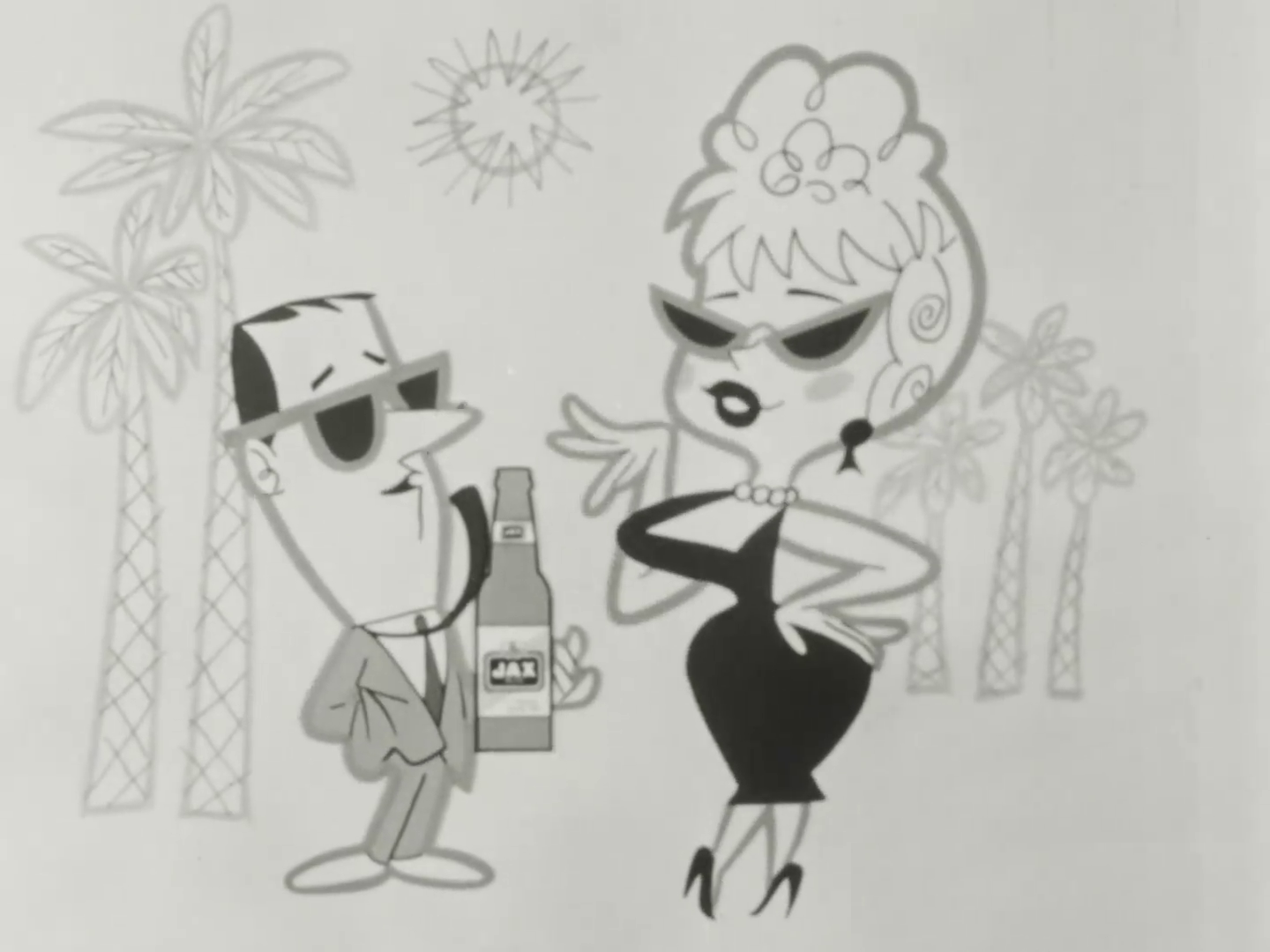
There was another famous comedy couple employed to sell beer to a regional audience, appealing to the smart set in their own way as much as Bob and Ray. Mike Nichols and Elaine May were seen on Ed Sullivan and other variety shows, breaking up audiences with their nightclub routines. In 1960 they were hired to lend their voices to ads, both radio and TV, for a regional beer.

In the May 1961 edition of Television magazine, an article entitled “Keeping Up With the New Generation” states:
Last year the Jackson Brewing Company, New Orleans, marketing its Jax beer in nine southern and southwestern states, left off live-action film commercials on an “adventure in taste” theme to go with fun, animation and the voices of Nichols & May.
The commercials—full animation, no break for the usual “live” product shot —center on humorous situations: a cowboy who brings his horse into a bar, is saddened when the animal is refused service; a talking dog, also refused service; a woman who uses Jax to wash her hair; a man who breaks his teeth taking off a Jax bottle top.
Jackson, advertising via Doherty, Clifford, Steers & Shenfield, New York, works its key themes into the humor (“real beer taste,” “premium brewed from 100% natural ingredients”), has had its share of success as measured by a sales increase last year, a flood of complimentary viewer mail, and even a request from a TV station for permission to run the commercials in its local programming.
The article adds that a survey of best-liked TV commercials conducted in January 1961 by the American Research Bureau found five beer companies ranked in the top 31, with Jax at number 11 with 2% of mentions (Hamm’s was no. 1 for the eighth year in a row).

Though Jax was based in New Orleans, its New York City ad agency decided to have the TV spots animated in New York City, where there were a number of excellent commercial/industrial studios. According to the May 15, 1961 edition of Television Age, the agency hired Pelican Films, the firm owned by Jack Zander, who started with Romer Grey’s ill-fated studio in 1930, and later animated Tom and Jerry for Bill Hanna and Joe Barbera. He formed Pelican in 1954. One Nichols-May spot for Jax involving a kangaroo won honours at a commercial animation festival in New York in 1961; Chris Ishii co-directed with Armin Shaffer designing the characters.

Here are some frames from one 60-second commercial that spoofs The $64,000 Question. Nichols plays the quiz-master, with May as “Miss Mallory,” the contestant in the sound-proof both. Nichols confides in the audience that the contestant’s father, whom she hasn’t seen in 45 years, is next door. Miss Mallory blows the question (about Jax’s slogan, “premium brewed from 100% natural ingredients”) and a stage-hand grabs the father and hauls him away, killing any happy reunion. “Do I still get my freezer?” she asks hopefully as the camera fades out.


Here’s another one, with Nichols as an interviewer and May as “Boo Boo Gorman, popular Hollywood starlet,” who spends much of the interview being an airhead and blowing bubbles. You’ll see a logo for TVDays.com, a site owned by Ira Gallen, who rescued these, and countless other discarded reels of old television film.


The interviewer has trouble pouring the beer into a glass.


Boo Boo reveals her measurements are 76-22-64 1/2. The interviewers eyes make a path equalling the ridiculous measurements.


The spot comes to a halt when Boo Boo blows a bubble and then says she sinks in the ocean. No tag line for the beer, just a fade out.


1961 was the year the networks, encouraged by ratings for The Flintstones, started snapping up cartoon series for prime-time. All kinds of animation outfits tried to jump on board. Variety of September 20th that year reported Pelican and Total Television Productions joined together to concoct “Parrot Playhouse,” which never got on the air. Zander’s company carried on with commercials and, in 1966, debuted the 10-minute short A Nose at New York’s Trans-Lux Theatre.

Pelican remained busy, despite a bit of a downturn in the commercial animation industry in New York. An article in the February 28, 1966 edition of Broadcasting reported the company had 56 animated commercials in various stages of production and gave a prediction of gross income that year of around $3,500,000, up a half-million dollars from 1965. Some clients are below:


When the ‘70s rolled around, Zander put Pelican to rest after roughly a thousand commercials and opened Zander’s Animation Parlour. He retired in the mid-‘80s, and passed away, a respected figure in animation, at the age of 99 in 2007, leaving behind some stylish, enjoyable commercials. If only more of them were in circulation.

Friday, 24 June 2022

A Streetcar He Didn't Desire

In the climax scene of Canary Row (1950), Sylvester tries to reach Tweety’s apartment building from his building across the street by walking gingerly across the power line connecting the two.


Uh, oh. Sylvester’s plan is about to be spoiled by the electric trolley running along the road. Note the motorman.


As Carl Stalling plays Shuffle Off To Buffalo, the streetcar catches up with Sylvester and ZAP!!!


Cut to the end. The motorman has been replaced by Tweety and Granny. How? Why? Oh, well. It’s a cartoon. Granny sure is enjoying trying to electrocute Sylvester.

You can see some of Paul Julian’s background work in this short, including some pasted together frames, on this blog.

Tedd Pierce came up with the story for director Friz Freleng. Virgil Ross, Arthur Davis, Emery Hawkins, Gerry Chiniquy and Ken Champin are the animators.

Thursday, 23 June 2022

Piano Slang

The guy at the piano played by ear.


Yes, this is yet one of I-don't-know-how-many visual puns in Tex Avery's Symphony in Slang (released in 1951). In this scene, only the ear and the piano keys are animated. The piano player remains on one cel.

Boxoffice magazine of May 26, 1951 gave it a good rating and reviewed it thusly: "A hep-cat goes to Heaven and tells about his life in every-day slang. Webster is called from his dictionary editing to interpret, but he doesn't seem to grasp what the man is driving at. A more advanced type of drawing adds to the humor of this clever short."

Fans know this was Tom Oreb's great moment at MGM after being punted from Disney, providing designs. There's plenty of non-animation in this short, an interesting experiment by Avery, who seems to have loved showing off puns on the screen.

Rich Hogan is the credited writer. John Brown is uncredited as providing the voices.

Wednesday, 22 June 2022

Time To Stump the Experts

Information Please was, in a way, the Jeopardy! of the network radio era. It was a question-and-answer programme that aspired to be not low-brow. There was no Bert Parks screeching “STOP THE MUSIC!” There were no screaming studio audience members yelling at a wheel being spun.

The main difference between the two is, instead of three ordinary-folk contestants, Information Please relied on four erudite intellectuals to respond correctly, with dry wit if at all possible.

Frankly, I find the programme dull, despite the presence of a usually-amusing Oscar Levant. Evidently, I’m in the minority as the quiz lasted 13 years on radio and got a brief run on television.

The Herald Tribune syndicate’s John Crosby analysed the show in his column of October 8, 1946. He gets in a shot at a stupid contestant on another quizzer as he explained the problems attracting an audience for radio guessing games.

Interestingly, the New York Herald Tribune version of the story talked about Mobiloil sponsoring the show. The Ottawa Journal’s copy says Texaco. I thought this might be because Canada never had Mobil stations but I see papers in Greenfield, Mass. and Dayton, Ohio also say “Texaco.” The Oakland Tribune reads “an oil company.” I’ve used “Texaco” here.


RADIO IN REVIEW
Information, Please Returns
By JOHN CROSBY

NEW YORK, Oct 8.— "Information, Please" is back on the air again after a summer recess and the opening program demonstrated it's still the most intelligent quiz show on the air and its badinage the most literate on the air (C.B.S., 10:30 p. m., Wednesdays). Clifton Fadiman, who possesses possibly the most cultivated voice in radio, is still in there pitching them and Franklin P. Adams and John Kieran, assisted by a couple of guests, are still in there catching them, or most of them. Guest stars on the opening program were Fred Allen and Oscar Levant, a couple of sharpies from other branches of the amusement industry.
The great problem on a quiz show is to select questions which are hard enough to stimulate the average listener and not so difficult that they simply bewilder him. "The Quiz Kids", who throw around square roots of six-figure numbers like tennis balls, are so far ahead of most listeners that their program is less a quiz contest than a stunt like a dancing bear act. It's fun to watch but impossible to take much part in. The questions on most quiz programs are ridiculously easy, as is exemplified by the following sample—taken verbatim from "Allan Prescott’s Party (A.B.C., 5 p.m., Sundays).
"What author said the report of his death was greatly exaggerated?"
"It wasn't William Shakespeare, was it?"
"No, it wasn't.”
● ● ●
"Information, Please" steers a sharp course between extremely difficult and too easy questions. Its puzzles are literate, thought-provoking, and fun to guess at even when you guess wrong. Here are a few of them from the opening program, the answers to which you’ll find at the end of the column:
1. Why would the following persons be of value to the Dodgers? , (The pennant race hadn't been decided then.) (a) Two Headed Grogan. (b) Dick Merriwell. 2. You lift an object with your left hand while the index finger of the right hand performs seven arc-like motions. What are you doing?
3. Name the poems in which three successive lines begin with the word "she".
4. Identify the member of the partnership who (a) did the painting in the Currier and Ives team, (b) is the Senator in the Smith-Connally team, (c) was the straight man in the Moran and Mack team.
5. Name three lines of poetry which suggest horse racing.
6. Name two fictional characters whose lives were considerably altered by reading.
While you’re mulling over those, here is a conundrum which came close to sinking the "Information, Please" experts this Summer. During the war "Information Please" parted company with the American Tobacco Company. The Texaco Company took over the sponsorship at the old hour on N.B.C. (9:30 p.m. Mondays).
At the end of last season, Texaco dropped its sponsorship and this season came up with a new program, the Victor Borge show. "Information, Please" had little trouble finding a new sponsor but suddenly discovered that its old spot was now owned by Texaco. As a matter of fact, the program had great difficulty finding any evening time on the air. Its switch from N.B.C. to C.B.S. will do it little harm but the new time, 10.30 p.m., is too late for many school children who used to listen to the program as part of their homework and also, at least in the East, for many adults who prefer music to quizzes at that hour.
Many other media, notably this newspaper, are supported by advertising, but no other media, with the possible exception of sky-writing, is so completely controlled by advertising. Suppose a newspaper were run on the same basis, as broadcasting. Let us say Walter Lippmann, who usually occupies either the split or editorial pages of the many newspapers he appears in, were sponsored by Proctor & Gamble. Suddenly the sponsor decided that a comic strip, say "Superman," would sell more soap than a political columnist and dropped Mr. Lippmann. The sponsor could then insist that "Superman" occupy the same coveted spot in the paper formerly occupied by Mr. Lippmann's column. No newspaper publisher would put up with it, but the broadcasters accept such a pushing around as a matter of course.
● ● ●
The answers to those questions:
1. (a) He was the two-headed pitcher of "Duffy's Tavern" who could watch both first and third at the same time. (b) He was the mythical pitcher whose curve broke both ways in the same pitch.
2. Dialing a telephone. (The experts missed it).
3. Thomas Gray's "Elegy Written In a Country Churchyard." ("The curfew tolls the knell of parting day. The lowing herd winds slowly o'er the lea. The plowman homeward plods his weary way.") (b) “Only a bird in a Gilded Cage.”
4. (a) Ives, (b) Connally, (c) Moran.
5. The experts got a little kittenish on this one. Fred Allen suggested two of them: "I pass by your window." (The two-dollar window) and "Mademoiselle From Armentieres, Parley-vous?" Mr. Fadiman suggested "Life is full of Epsom Downs."
6. (a) Don Quixote, whose reading about chivalry set him to tilting windmills. (b) The heroine in the play "Born Yesterday" who read "The New Republic" and became a new woman.


As for the other Crosby columns of the week, on October 7th he looked at Paul Whiteman’s live music show on ABC. Before the end of the ‘40s, the band disappeared and Whiteman played records. Crosby also complains about the repetitiveness of Jack Benny’s show.

On October 9th, he runs through the highlights of a live-to-tape broadcast of a union meeting aired on the Mutual flagship, WOR. It’s actually not “tape.” It’s from a wire recorder, a portable pack that vanished when tape machines became practical to use on the beat. He also takes about the precursor of a clap on/clap off machine that works (based on guesswork) on radios, as well as a new programme in Britain.

The October 10th column gives some Hot-cha-cha! cheers for the Durante-Moore season premiere. We transcribed that review in this post.

Finally, CBS shows starring Dinah Shore and Hildegarde are reviewed on October 11th. Dinah has Peter Lind Hayes as her comic assistant this season and is sponsored by your Ford-Mercury dealers. Crosby gets a little shot in about the Confederacy. He also looks at Hildegarde’s new show for Campbell Soup and wonders when someone will give Tallulah Bankhead her own show. All in good time, Mr. Crosby. She didn’t just get her own show. She got the Big Show. Click on them to enlarge them.

Tuesday, 21 June 2022

Annie Round the World

Chuck Jones very capably uses a variety of limited animation techniques in the Private Snafu short It's Murder She Says... (1945).

Here are four static drawings of malaria-carrying Anopheles Annie that appear in the cartoon. They’re used several times. The first time, lettering zooms into place on each of them. The second and third times, the camera cuts into them closer and closer as Carl Stalling’s music gets more and more dramatic.


As you can see, Jones is using the short to try out stylisation, much like he did in The Point Rationing of Foods (1943).

Just don’t call it “Illustrated Radio.”