Sunday, 13 March 2022

Staying Young, Part 2

Walking tall is how stars stay young
(This is the second of two articles on "The Power of Egocentric Thinking — How the Stars Stay Young.")
By MARILYN BECK
Gannett News Service
HOLLYWOOD – Plastic surgeons can take credit for the way many of the senior citizen stars look. But no surface restorative can explain the miraculous stamina enjoyed by show business personalities in their 60s, 70s and 80s — or the fact that such elders remain as sharp of mind as "kids" of 40.
Mae West credits her mental and physical vitality to good living and good food — and daily high colonics. A food faddist who neither smokes nor drinks, at age 82 she still works out each morning on an exercise bicycle and a walking machine. Bob Hope, 71, says his system keeps on constant because he doesn't smoke, drinks only in moderation, "and I watch what I eat."
He also makes sure he never misses his daily massage (even when a masseur has had to be flown to his side during entertainment tours in remote comers of the world). He also plays golf regularly. And he walks tall.
"Walking tall might be the most important lesson I've learned," says the man who still has the stride and the carriage of a man of 30. "People start to look old because they let their posture go — so that their bodies actually do shrink and start to bow. You’ve got to stretch your frame each day, walk with your belly tucked in and your head reaching the sky.”
Gale Sondergaard reaches for the mountaintops when she's not busy on stage. The 75-year-old, Oscar-winning character actress claims mountain climbing as her favorite relaxation.
James Stewart, at 66, continues to head for Africa when he wants to relax "When you're doing something like a safari, and camping out in the wilds, you don’t have time to worry much about anything except survival. It keeps you feeling young."
Will Geer ("Grampa” on CBS' "The Waltons" series) is 72, and is the despair of his grown children because he refuses to grow up. He insists on sleeping outdoors each night, rain or starry skies. He also rides his bicycle around the heavy-trafficked areas of Hollywood each day, though he admits he’s sometimes finding it hard to "push them peddles."
“You should pay as little attention as possible to old age," reasons Geer.
Jack Benny keeps up with all the best-selling sex manuals, though he enjoys boasting that he hasn't learned much from the texts that he didn’t already know. "All you need is common sense," says the 80-year-old comedic great.
Whatever it is that's needed to make one a for-real sex symbol, Cary Grant most definitely has it — if one is to listen to the endorsements of the women in his life.
Greta Thyssen was a recent-Miss Denmark in the Miss Universe contest when she was first swept off her feet by the screen idol, who was then 56 years old. "He was older than my father," recalls Greta "But he was as romantic and virile as any younger man I ever dated. Cary never acted or did anything to make you aware of his age.”
Aging — and the loss of virility — are simply a matter of mental attitude, Lorne Greene is convinced. The 58-year-old, silverhaired Pa Cartwright of "Bonanza" fame has two grown children and a daughter of six, and has been married for the last 13 years to a woman 18 years his junior. Lorne is a fearless skier, an expert tennis player. And he’s a student of the study of geriatrics.
"There are sections in Russia (Abkhazia) where people live to be 130, 140 years old — and where men of 120 still father children!" he says.
It all has to do with a psychological attitude and continued physical activity, according to Greene.
Sen. Charles Percy received first-hand evidence of the validity of some of Greene’s theories when he journeyed to the region of Hunza in Pakistan to observe individuals approaching the century mark who still enjoy active, fulfilling lives.
Percy, a member of the Senate Special Committee on Aging, met farmers in their 90s who put in a full day's work at their fields, women of close to 100 involved in community activities and household chores.
His conclusion: active physical lives and the use of organic foods and mineral-rich glacier waters have much to do with the longevity of the residents of Hunza.
Carol Channing, 50, takes along her personal cook when she’s working on the road — to make certain that nothing but properly prepared organic meals are served her. Carol analyses, "You have to keep in training like a boxer to remain active on the stage." She says that such esteemed theatrical greats as the Lunts and Sir Lawrence Olivier also believe, "The most important quality in theatre is not as much talent as health. It's the survival of the fittest."
Miss Channing, Miss Swanson, Miss Helen Hayes — at age 73, all exercise regularly and strenuously. So does in-his-70s James Cagney. who retired from the screen in 1961 to undertake an active life as a serious painter and operator of his 500-acre farm in New York State.
Cagney, who broke into show business 54 years ago as a hoofer, stays in shape by tap dancing daily, and offers this stay-young advice: "You should work out enough to get out of breath two or three times a day."
George Burns makes it a daily ritual to do Canadian Air Force exercises — followed by the downing of a few cold martinis.
Buddy Ebsen, who, like James Cagney, started out as a dancer, practises tap routines during lunch breaks of his Barnaby Jones series. At age 65, Ebsen is still an active skier, races his 35-foot catamaran, works his 35-acre, Malibu Canyon ranch — and gives the impression he works to live for the next party. On more than one occasion he's served as a source of awe — and inspiration — to younger members of his series company by putting in a 12-to-14 hour work day, then organizing an on-the-set wingding that lasted 'till the liquor supply ran dry.
Some of the stars stay young in spite of on-going love affairs with the bottle, others with the aid of spartan food and drink regimes and diligent dedication to exercises.
But for all of them there's more to their secret of youth than diet and/or physical workouts. There's a stay-young attitude they share that seems to have miraculously translated itself into stay-young bodies and minds. They don't accept themselves as old, and neither does an industry that continues to employ them, and a public that continues to support their work.
"I'm a workaholic," is the way Buddy Ebsen describes himself. "To me retirement represents the pinnacle of boredom. I'm hooked on that intoxicated feeling one gets trying to do something — and having it turn out right. There's no better feeling than that — or anything more capable of making a man feel like he's still a kid."
Buddy Ebsen is lucky. He's part of a privileged tribe of "kids" who are still allowed the luxury of work — at an age when others their age are considered fit for nothing more stimulating than retirement. To be old is a stigma in most modern day societies. To be 50 is usually to be over the hill — if you're not fortunate enough to be an entertainer.
The enormous increase in population after the Second World War brought about the practice of the mandatory retirement system — shoving old people out to pasture to make way for the young. However, what started out as an economic base has long ago become a psychological base.
In corporate quarters, your stability, wisdom and experience count for nil if you're 65 or over. At age 65, you're washed up, through.
At age 55, you can begin growing insecure over the fact you've only got a decade left to merit a paycheque. At age 45, you better face the sad fact that it will be next to impossible to switch jobs, because few firms want to take a chance on someone of "advancing" years.
Society constantly reminds us in subtle — and not-so-subtle ways — that life's opportunities are mainly for the young. That's the way it usually is — unless you're lucky enough to be in show business.
As far as Robert Young is concerned, there's no business like show business — in spite of its pressures and demands. "How many other fields are there like acting," he asks, "in which you can keep working when you're 90?"
To the 67-year-old Young, "real fulfilment is knowing what you want to do — and being allowed to do it."
Young says. "I want to work 'till I die." He says this after having tested retirment for six years in the senior citizens' community of Rancho Santa Fe, near San Diego.
He looks back on those years as a time when, "I tried to live the life of a country squire — and filled my days with pseudo activities. I was marking time on a treadmill."
His retirement experience ended when he signed as star of ABC's Marcus Welby M.D. series in 1969, yet he can still vividly recall the vacuum that represented life in Rancho Santa Fe.
"There were some of the unhappiest men in that retirement community," he reveals. "Former chairmen of the board — some who had ruled business empires. I'll never forget day one of them complained, 'I woke up this morning and thought, what in the hell do I do today?'"
Robert Young is fortunate. He's an actor, not a former chairman of a business board. There was an active career for him to return to — when he chose to and even he can't get over how much he's changed as a result of it.
"I astound myself," he says. "I zing around the soundstage or jump on a plane to do a benefit, or handle activities as national chairman of the Easter seal campaign, or settle down to work at my Universal studio offices where I'm producing some movies for ABC. I've never had such vitality before."
Robert Young is just one member of an impressive league of Filmland elders who serve as living proof of doctors' claims that a vital life helps insure a longer life.


Molly Picon, the 76-year-old star of American and Yiddish theatre, has been spending the summer working on the boards in A Majority of One. You can witness the spring of her step, the sparkle of her personality yourself in the For Pete's Sake motion picture currently in release.
David Niven is 64, but has the bearing and manner of a man of 40. He still makes a picture a year, has just completed a television special, is writing a follow-up to his best-selling autobiography, The Moon's a Balloon. And somehow still finds time to conquer the most challenging ski slopes near his Gstaad, Switzerland home.
At age 69, Joseph Cotton isn't able to land the top-flight American movie roles that once made him an idol of the silver screen. However, he's still fortunate to manage to keep constantly on the run with occasional European film assignments and steady work as the star of U.S. straw hat plays.
Fortunate, too, is Walter Pidgeon.
still witty and spritely at 76, to have found a series of movie and television assignments in recent years . . . and Red Skelton, 61, who was able to return from a short-lived retirement he hated to find his services still in demand as a nightclub and country fair-circuit star . . . And Fred Astaire, 74, who tried retirement once, found himself bored to tears, and now has more performing offers than he cares to handle. He just completed one he cared about: a feature role in The Towering Inferno for 20th Century Fox.
Well-known science fiction author Isaac Asimov turned to tv writing earlier this year for the NBC News Presents: The Pursuit of Youth. And after researching the tragic waste of retiring individuals at a mandatory age, he found he could easily identify with the show business personalities who are relieved of such pressure. At age 54, Dr. Asimov doesn't feel he's getting old, because "My job is no retirement. I am working harder now than I ever did."
If Lucille Ball isn't working as hard as ever since retiring her TV series this year, she is certainly maintaining a pace that could tax the strength of a youngster. It's been a constant round of Mame promotional trips for the 63-year-old Lucy, who's now charting her upcoming specials for CBS, and planning another movie. If she finds time for a break this winter, she'll take off for a "take-it-easy" cross-country skiing vacation.
Lucy, like her buddies Bob Hope and Jack Benny, believes in being more than "star." All three of them retain control of the projects in which they appear, sitting in with the writers, serving as final editor of material, keeping a close finger on production.
If Lucy has the reputation among some in the industry as a hard women to work for, it's because she demands the same perfection of co-workers as she demands of herself — and work without let-up.
If Bob Hope's TV specials invariably land in the top 10 of the Neilsen ratings, it's because he leaves no promotion ploy to chance — and will spend weeks on the phone and on the road, personally plugging the show to newspaper men, television hosts and live audiences.
"Work keeps me young," says 80-year-young Jack Benny.
"I can't imagine what I'd do without work, says Jimmy Stewart.
"I regard the dawn of each new day as a new day in which I can discover new interests and new insights," observes 70-year-old Gary Grant, who now applies the energies he once devoted to acting to activities as board memberspokesman for Faberge Products.
"The longer you work and try to get the most out of life, the longer you live," is the philosophy of Lorne Greene. The Griff series has failed, which served as his Bonanza follow-up, but he's just completed a role in Universal's Earthquake, is planning to produce and star in a film early next year — and is urging his agent to find him another tv series starring assignment.
Some personalities have been able to keep working because of sentimental value attached to their names during the current, nostalgia craze. However, most remain in. demand, not because of their age — but because they're regarded as ageless by industry and audience alike. They are citizens of a Never-Never Land where some idols never, never grow old . . . where Zsa Zsa Gabor at 51 is still playing at belftg "The Dollink" . . . where men in their sixties and seventies romance younger-than-springtime starlets both on and off the screen.
If geriatricians need additional proof that mental and physical stimulation can keep one vigorous and virile, they need look no further than the movie colony, where such men as Dean Martin, Bing Crosby and Henry Fonda keep wives 20 and 30 years their junior content . . . where Crosby, Anthony Quinn and Lorne Green became fathers in their 50s, "and Cary Grant a first-time father at the age of 62.
The rules that apply elsewhere don't touch the lives of the stars. The very society that has set 65 as mandatory washed-up age encourages show business personalities to retain-idol status as long as they can make it up the steps of a stage.
"That's what makes show business so great," analyses George Burns, who has spent months cutting a new recording and preparing for a one man show at the Los Angeles Shubert Theatre.
"There's something to look forward to all the time — and your age has nothing to do with it."
It's a mental attitude that has a lot to do with it — a refusal to accept that they are growing old. It's the power of egocentric thinking.
Charmed lives also have a lot to do with it — the opportunity to escape the retirement rules imposed on everyday society.
"When I stop hearing the audience's laughter, that's when I'll know it's all over," says Bob Hope.
Others in other walks of life should be so lucky, — of being accorded the opportunity to remain young until the day they die.


Read part one by clicking here.

Saturday, 12 March 2022

More Studio, Less Money

Walter Lantz always complained about money. But he had enough to expand his studio and continue upgrading where he and wife Gracie lived (he bought Kay Kyser’s house in one of his transactions).

Lantz had shut down production in 1949 for what appears to have been over a year. His deal with United Artists for two seasons of cartoons was chopped down to one. He decided to go back to Universal-International. He inked a contract with U-I for six cartoons, which was boosted to 13 for the 1952-53 movie season (Lantz had also taken on a project involving Woody and the Red Cross). That meant expansion.

Here’s a story from the Los Angeles Evening News Citizen of June 19, 1952 about the enlarged digs.

LANTZ IN NEW QUARTERS
Luxury Studio Pleases Woody

By DOROTHY WATSON
"Wotta birdcage!" commented Woody Woodpecker today as he eyed the handsome wood panelling in his newly-completed quarters at 861 N. Seward St.
Woody, of course, is that animated cartoon character created by Walter Lantz, who has been in the business since 1916.
Five years ago Lantz moved his studio from the Universal-International lot in Universal City, where he had been since 1926, to the Seward St. location.
For three years he rented the old Spanish-type stucco building. Then two years ago he bought it and started making plans for its reconstruction into an up-to-date studio.
Actual work began in January 1951 under supervision of sound engineer William Garity, vice president and production manager of Lantz Productions.
Now the building is completed and the rascally Woody, is making himself at home in the midst of luxury.
The studio' occupies about 12,000 feet of space on the ground floor of the two-story building. The exterior is stucco covered fireproof brick, and all windows are equipped with heat-resisting copper screens. To keep down noises there are cork floors end acoustic lined ceilings. The building is air-conditioned throughout.
Although the exterior is strikingly attractive, the interior is luxurious. The walnut-panelled reception room with its glass-enclosed switchboard is highlighted with colored “cells” of Woody, Andy Panda, Buzz Buzzard, Wally Walrus, Miranda Panda and other creatures of Lantz's imagination.
The offices of Lantz and his secretary, Gladys Matthes, are walled in burlap paper in soft beige tones with Japanese ash panelling and Heinley shutters. Those shutters are worrying Lantz. He says he never knows when Woody may go on a tear and tear into them.
Other rooms house the cameras, one for black and white and one for Technicolor, story conferences, music and consultations.
But the “piece de resistance” is the animation room, 50x40 feet and completely insulated against outside sounds. In fact, it is so completely soundproof that conversation from desks 10 feet away cannot be heard. There La Verne Herding, animator with Lantz since 1939 and reportedly the only women animator in town, holds forth. She’s the boss of that room and everybody knows it.
Also enjoying the new building are about 35 other employes who help turn out six Woody Woodpecker films yearly, commercial films, a monthly comic magazine and several licensed products such as children’s records, costumes, toys, balloons and puzzles.


Lantz collected cast-off animation people—Bill Garity, Tex Avery, Fred Moore and Ed Love among them—and collected a cast-off animation building. The Seward street location had once been home to Harman-Ising, then Walt Disney, then Columbia/Screen Gems. When Lantz signed with United Artists, he was pretty much forced to leave the Universal lot, so he ended up at the spot at Seward and Willoughby (as in Inspector Willoughby, his human take on Droopy in the early ‘60s.

Lantz’ concerns about theatres paying for short subjects were valid. I doubt the money he got increased at the same rate as the expense of making a cartoon. Here’s one of his many entreaties for more money. It’s from the Valley Times of North Hollywood of Sept. 11, 1962.

No More Cartoons? I Blame The Exhibitor
“Do you want to know WHY the theatrical cartoon business is dying?” animator Walter Lantz asked.
“It’s really quite simple: It’s a cost problem, the old money factor.
“Over the past ten years,” the Woody Woodpecker creator said, “production costs have gone up 180 per cent but the revenue has remained the same.
“AND I’LL be quite honest with you,” he added. “If something isn’t done, Woody and I may not last more than another year or two.”
Lantz, the only remaining independent animator of theatrical cartoons releasing through a major (Universal), said that while the majors don’t make them anymore, he still produces some 19 brand new Woody Woodpeckers a year for the theaters.
“But we can't keep it up under the present circumstances,” he said.
“HOWEVER, there IS something that can be done and it might not only keep me in business but enable the majors to go back to their ink pots, too.
“As I said, production costs have zoomed skyward but I’m not criticizing the unions. People—good, talented people—deserve whatever they can get.
“But it’s the lack of the dollar at the box office that’s killing us. I lay the whole problem right in the lap of the exhibitors, the guys who book what shows YOU see in YOUR theater.
“THEY STILL pay the same price for cartoons they did 10 years ago because they don’t consider the cartoons that important to their program. Despite the fact that you hear oohs and ahhs in ANY theater whenever ANY cartoon comes on, the exhibitors still consider them fillers like a newsreel or a travelogue.
“If we say ‘You have to pay us more or you won’t get a cartoon,’ they say ‘Fine. Who needs it?’
“But if the exhibitors don’t start paying more on their rentals,” Lantz said, “the cartoon business for movie houses will truly be a thing of the past.”
“OUR RETURNS are not comparable to our investment,” he said. “You see, each cartoon costs a minimum of $35,000 to do or rather, to do CORRECTLY. And, it takes you four years to get any part of your investment back.
“That’s why no new outfit can get in. Even at only 10 cartoons a year, a firm would have to invest $1,400,000 before it got anything back. That’s a lot of capital, brother.
“But,” he reiterated, “if the exhibitors would just realize how much people like the cartoons and would pay just a little more, it would do the trick.
“In three or four years, a cartoon has approximately 17,000 domestic play dates, so by just paying $6 rental instead of $5 for the cartoon, the exhibitors could save the day.”


I can’t help but feel Lantz is being a little disingenuous here, as he avoids any mention of the money he raked in selling his cartoons for television distribution. His deals, one for his old black-and-white shorts, and then another with Kellogg’s in 1957 to create a half hour show out of mainly old cartoons combined with ancient silent stock footage, must have brought in a pretty penny or two. In 1955, KNXT paid a quarter million dollars for 149 of his aging cartoons (such as Oswalds and other titles of the late ‘30s).

There were also commercial contracts with Coca-Cola and A.C. Delco. His trips overseas for weeks at a time with Gracie had to be write-offs, as he visited Universal film exchanges. There were comic books and other commercial tie-ins. Lantz was no dummy. He owned his studio’s characters meaning he kept the cash. Lantz wasn’t standing at Seward and Willoughby with his hand out.

The increasing costs of theatrical animation killed the MGM cartoon studio in 1957, the Warners studio in 1963 and turned UPA into a TV factory in 1960. Even the two East Coast studios, Paramount and Terrytoons, faded away. Lantz stayed open. And even when he finally ceased operation in 1972, he never retired. He promoted his characters and helped children’s charities until the day he died.

Friday, 11 March 2022

Noble's Surburbia

Maurice Noble was the art director for John Sutherland Productions in between stints with Chuck Jones at Warner Bros. He was responsible for a large array of designs for It's Everybody's Business, a 1954 capitalism propaganda cartoon for Du Pont. He needed settings for the 18th, 19th and mid-20th century. Boats, maps, cars, hats, trains, cityscapes. And because it’s 1954, it has to be in a modern art style. He succeeded magnificently.

Here’s a little sequence. The Average Worker gets his pay.


Into his car he jumps to head home to suburbia.


He screeches to a stop (note the flat tires caused by excess braking) now that’s he back in his ultra-modern home. Note the trees with greenery made with friskets (and a sponge, I presume).


Mrs. Average Worker’s in the 1954 kitchen. She picks her husband’s pocket. He’s in so much in Dreamland over his pay that he doesn’t even notice. In the future, Jane Jetson just grabs her husband’s wallet.


I suspect the background artist is Joe Montell. The animators are Bill Melendez, Emery Hawkins, Abe Levitow and Bill Higgins, with Bill Scott and George Gordon punching up Sutherland’s story. Carl Urbano directed and Gene Poddany provided the music. All top-rate people. Unfortunately, I don’t know who did effects at Sutherland, but the effects animation is very good in the two-reeler, too.

While Macdonald Carey is credited with narration, Herb Vigran and Joe Kearns don’t warrant being mentioned on screen. Sutherland even went to the expense of hiring a male chorus.

Thursday, 10 March 2022

First Tooth

Car/baby analogies are what drives Tex Avery’s One Cab's Family (1952).

“Junior has his first tooth,” Daddy Sedan (Daws Butler) to Mommy (June Foray). Cut to the “tooth.” It’s a spark plug. The most creative thing isn’t the gag, it’s the dissolve into the next scene.


There are parts I like in the second half of the cartoon, which owes a lot to Friz Freleng’s Streamlined Greta Green of a dozen or so years earlier. The ending is better than Freleng’s Warners cartoon; the boy cab continues to be a ‘50s rebel.

Grant Simmons, Mike Lah and Walt Clinton are the credited animators.

Wednesday, 9 March 2022

Qomeback For Q

It’s hard to say where I saw Robert Q. Lewis first. I suspect it was as the host of Play Your Hunch after Merv Griffin left, but he seemed to be a panelist on all kinds of game shows. He tried to be amusing and urbane. That went over better at New York cocktail parties than on television so he never became a star on the level of Griffin. Still, he was pleasant enough, though off-camera he apparently could get pretty petulant. Arthur Godfrey, who changes “friends” like you and I change socks, employed him as his regular fill-in. He had a variety of network radio shows in the ‘40s and ‘50s, and ended up back in radio in the early ‘60s before a TV comeback.

Then, like many people in television, Lewis disappeared again. It’s jarring seeing him in colour; he belongs to the black-and-white ‘60s in my memory. In the early ‘70s, he was on radio again at KFI Los Angeles (long after its days as an NBC Red network affiliate) talking to celebrities of various stripes (“I am NOT a disc jockey,” he once snarked to the Los Angeles Times in an interview). Before the end of the decade, his radio career dried up and he was acting on stage, which is what he was doing in the latter half of the ‘60s.

Here’s Robert Q. in an Associated Press interview published January 13, 1963. His record-spinning days at KHJ Los Angeles (long after its days as an NBC Blue network affiliate) had ended.

Robert Q. Lewis Likes Familiar Surroundings
By Cynthia Lowry

AP Television-Radio Writer
NEW YORK (AP) — A funny thing happened to Robert Q. Lewis in the middle of a long and successful television career. Only it wasn't really funny: Suddenly, he couldn't get a job.
"I think it was a kind of over exposure," he reflected. "I don't think that audiences had gotten tired of seeing me around. But I do think I was overexposed to advertising agencies and network executives. Anyway, nobody would hire me."
Lewis, a native New Yorker who had entered show business at the age of 11 as a boy soprano on a radio kiddie's show, shrugged his shoulders philosophically and turned from broadcasting to the theater.
"Stock," he explained. "Most people think that stock companies today consist of summer stock in summer theatres. That's nonsense."
"There's fall stock, winter stock and spring stock, all over the country," Lewis said. "And if you've had television exposure, you can make good money playing in every contemporary American comedy written in the last 20 years and playing in them all over the country."
Three years ago, tall, slim, bespectacled Lewis did just that, appearing in such shows as "The Tender Trap," "The Gazebo," "Tunnel of Love," and "Seven Year Itch" in companies from Long Island to the Pacific Coast.
"It was great for me as a performer getting out all over the country, meeting people and getting the feel of an audience," he continued. "But the one drawback is that I'm a guy who likes his own home and to be in the middle of his own things. Hotel rooms are barren and dreadful."
Lewis, a dedicated bachelor, is a passionate art collector. He began as a child, when an uncle who was an art dealer took him to visit Pablo Picasso in the great painter's Paris studio. As they left, Picasso, who had taken a fancy to the boy, scribbled on a piece of paper, rolled it up and tucked it under his arm. It was a drawing, inscribed personally to Lewis. Today, worth many thousands of dollars, it is the keystone of a collection that includes paintings at well as sculpture.
"Obviously, you can't carry around paintings with you from hotel to hotel," Lewis said, "and, to be truthful, I get lonely without them."
Finally, he was fed up and asked his agent to find him a job in which he could settle down in one place.
"I'd spent years as a disc jockey," he said, "and decided to go back to it. There were many advantages. I decided I'd like to be in a place with a good, warm climate — either Florida or California."
His agent, fortunately for Lewis, found him an early morning spot on a local Los Angeles radio station where, in 1961, he resumed an earlier occupation, billing himself as "the world's worst disc jockey."
He promptly bought himself a house, complete with pool, took his collection out of packing boxes and within a few months became a rabid California booster. "It was a great life," he said, almost sadly. "I was up every morning at 4:45 to get to my show — it started at 6:30. I was finished by 10 and had the rest of the day to myself. That kind of a schedule meant I could accept television guest shots, wander through galleries and museums or just sit around the pool."
Lewis first entered broadcasting as an announcer on a Troy, N.Y., station in 1941 — and was the only announcer at the station on that Sunday in December when the first bulletin on the attack on Pearl Harbor hit the news wires. It was a busy day.
After an Army hitch, he became an announcer on a New York City station, with a morning program, a daily hillbilly sing and still a third daily comedy show. He joined CBS radio in 1947 and first came to major public notice substituting for Arthur Godfrey. He was a hit.
In the earlier television days he had a number of shows of his own — "The Name's the Same," "The Show Goes On," and "The Robert Q. Lewis Little Show" among them.
Then, when host Merv Griffin wanted to quit "Play Your Hunch" for a daytime variety show of his own, Goodson and Todman asked Lewis to come East for a two week on-the-air audition for the permanent job. Lewis won the job.
Now — paintings and sculpture along with him — Lewis is back in his home town again. But has he cut his ties with beloved California?
"No," he said firmly. "And I won't sell my home. It's just leased to my agent. Even if it's only on vacations, I'll be going back from time to time."
The initial Q. in his name? It doesn't stand for anything — just in there to make his name different from all the other Robert Lewises.

Tuesday, 8 March 2022

The Dirty What?

Popular culture is popular for only a while. Then new generations come along and have their own ways of doing things. They don’t know about things that were commonplace at one time. I’ve had to explain to younger people who Al Jolson was (and he was before my time), and not only how a rotary dial phone works, but why phone numbers had letters and numbers.

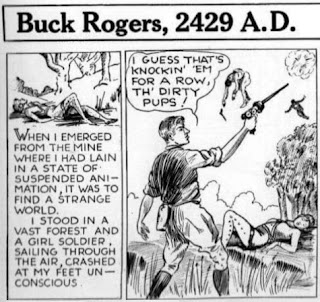
So it is with many old terms and sayings, too. People today may never have heard of them, though they were known 100 years ago. To your right is a frame from a Buck Rogers comic strip. Even though Buck is in the future, he uses an obsolete “oath” as they called it then. I’ve heard “You dirty dog!” before. No one says it today; people are less genteel and think nothing of using foul language our forefathers wouldn’t have dreamed of. But “The dirty pup!” is an old one that’s a new one on me.

It was common. Here it is in a Salt Lake City newspaper, 1908.


Portland, Oregon paper, 1916.


1915. Los Angeles Times.


This is from 1910.


St. Paul, Minnesota, 1892.


Here’s Bosko in Bosko’s Picture Show (1933).


Yeah, it’s possible he didn’t say “The dirty pup!” at the “cur” on the screen. But, to me, it’s more likely he did than fanciful tales of shouting a four-letter word that is far too common today but never used in polite society in an earlier day. Regardless, some people will believe it anyway because “slipping something past a censor” makes a much better story. Today, it seems, there are those who are quite prepared to accept and cling to fanciful tales as fact and reject everything else.

Monday, 7 March 2022

Hay and Hey

“I Heard” (1933) is full of great little gags tied to a fine song by Don Redman and his orchestra.

One scene cuts to a table and two donkeys bouncing in time to the music. “How’m I doin’?” sings the vocalist. A bucket drops down a chute. It and the donkeys turn to the camera and shout “Hey, hey!” The bucket is full of hay.


And the donkeys chow down for the next couple of bars of the song.


Willard Bowsky and Myron Waldman are the credited animators in this fun Betty Boop cartoon.

Sunday, 6 March 2022

Stuntman Benny

“Inert” is a good way of describing Jack Benny on stage.

Anyone who saw him on television knows his standard expressions. Basically, he stood there and stared. He moved his hands into a few different positions and that was about it. But only some of the time.

Benny was hardly a physical comedian, and certainly not a slapstick one, but there were times he had to rise to the occasion.

Faye Emerson was a columnist in addition to a TV personality, and here she is talking about Jack in newspapers starting around April 11, 1957.

RADIO AND TELEVISION
Bouncing Benny Beats 'Age' Battle

By FAYE EMERSON

Jack Benny, the perennial "39-year-old" dean of comedians, could well be a living testimonial for a health club, what with his strenuous schedule and his amazing physical agility.
Those who know Benny — and realize he fudges a year or two on his birth date — are constantly amazed at some of the physical contortions he puts himself through in presenting his show for CBS Television.
Recently Benny was rehearsing a show in which he and Ginger Rogers do an extremely athletic dance routine. Benny confessed to the cast and crew, with a rueful grin, that he had trouble putting on his overcoat, but a few minutes later he disproved this when he lifted Ginger clear off the floor at the end of a swirling turn.
"I did that?" Benny asked. "George Burns will never believe it for that matter, even I don't believe it!"
But actually Benny, despite his admitted 39 years, is in excellent shape. In a "Shower of Stars" show, for example, he did a 10-minute skit in which he played football in his living room, he jumped over chairs and couches and tumbled about the floor like a two-month-old kitten.
In a more recent show, he did a fencing scene in the Tower of London that actually had touches of such dashing hero-types as Errol Flynn and Douglas Fairbanks Jr.
The amazing thing is that Benny has to learn each of these feats of physical legerdemain as they are written into the script. He had never even held a fencing foil before he was called upon to learn the art well enough to make his fencing scene in the London show believable.
This, at anyone who has ever fenced knows, means countless hours of hard work.
But apparently Benny thrives on it and anything he can do himself he never relegates to a stunt man. In his Venice show, for example, broadcast in March, he falls into a canal. Jack said, not without a touch of pride, that he really did the fall, but added with his famous dead-pan expression. "After all, how much talent does it take to fall into the water?"
Whether or not it takes talent to fall in the water is a matter of some conjecture, but it does take a man in excellent shape to maintain Benny's schedule.
He does his own "Jack Benny Show" every other week; a once-a-month "Shower of Stars," plays, benefits and violin concerts, and still finds time to make records. He recently made a children's record for Isaac Stern.
In addition to all this, he takes an active part in writing his scripts, he helps direct the activities of his own company, J and M Productions, which produces the "Marge and Gower Champion Show" for CBS Televison. and still manages to cet in a few rounds of golf from time to time.
A busy schedule — even for a man who is "only 39."

Saturday, 5 March 2022

Why Are Cartoons For Kids?

There was a reason the big screen was populated with fairy tales and stories of little animals. That’s what the people wanted.

Walt Disney had won an Oscar for a cartoon starring flowers, trees, a fire. Mickey Mouse was a sensation when he debuted. Humans like Van Beuren’s Tom and Jerry and Ub Iwerks’ Willie Whopper were pretty much failures by comparison.

But one critic in England decided the screen needed didn’t need barnyard characters, it needed people. And he felt putting that on the big screen would create a whole, and necessary, British film industry.

The English had a movie industry over the years, and periodically jumped into animation. There were the Bonzo cartoons of the pre-sound era, the Rank Organisation hired ex-Disney director David Hand to run a studio in the ‘40s, and Halas and Batchelor came along with an interesting potpourri of designs over the course of several decades.

This thoughtful column appeared in Kinematogrpahy Weekly of January 24, 1935. I’m at a loss when it comes to the M-G-M series mentioned in it.

Give Us Adult Cartoons
says R.H. CRICKS

THE modern cartoon film has reached a high state of perfection, earlier problems of synchronisation have been entirely overcome, and the illusion of reality is lent to such incongruities as animals, and even furniture, talking. The cartoon provides an excellent vehicle for the demonstration of colour systems, and Walt Disney obtains a beautiful range of colours.
Some of Max Fleischer’s cartoons go further in obtaining a remarkable illusion of third dimension. One film in particular, “Little Dutch Mill,” appears to have been produced with the aid of models with superimposed cartoon characters; by movement of the camera position—the oldest known method of attaining stereoscopy—in conjunction with suitable construction of the sets, the background actually appears to be far behind the foreground.
Yet for all this perfection of technique, the majority of the cartoons are designed to appeal chiefly to the child mind rather than the adult. Is this a sound policy?
THE cartoon film takes the place in the kinema programme of the comic strip in our daily newspaper, or of “Our Usherette” in the KINE. itself; it provides a little light relief from the more serious part of the programme, and justifies the old couplet “A little nonsense now and then is relished by the wisest men.” But there is the one point of difference between the newspapers’ comic strips and the majority of film cartoons. If the said strips, instead of basing their appeal upon showing people like ourselves doing things that we should never dream of doing, were suddenly to become all whimsy, showing us fairy princesses and fantastic animals, would they be as well appreciated by adult readers?
There is only one answer: such strips would be relegated to the children’s section. Yet our kinema patrons have so far been offered little in advance of fairy tales and fables.
CARTOONS have admittedly obtained an immense popularity by the use of such characters. Mickey and Minnie Mouse have won for themselves an unassailable place in the hearts of the world’s picture-goers. But it is no everybody who can create a Mickey and a Minnie, and there is no earthly reason why other producers should slavishly attempt such an imitation.
It has been argued that such cartoons appeal to the child mind, and the children can be relied upon to bring their parents along to see the rest of the programme. This may be a sound argument when children are home from school and out to enjoy themselves with their parents; but at normal times it is doubtful whether an appeal to the child mind is likely to bring much additional business. An attraction which merely succeeds in selling half-price tickets is not the most profitable of films.
PARAMOUNT has undoubtedly the right idea in taking for its characters the subjects of popular American newspaper strips. The doings of Betty Boop and of Pop-eye the Sailor are read by millions of Americans every day; they are syndicated to more than 250 American newspapers.
Is there not an excellent opportunity for British producers to effect a similar tie-up with the characters of some of our own daily comic strips? Characters which occur to one are The Nipper and his fatuous father in the Daily Mail, Colonel Up and Mr. Down of the Express, Jane of the Mirror, Dot and Carrie of the Star, Jiggs of the Sketch, Alec of the Herald.
THESE are characters designed to appeal to the love of nonsense in the adult mine. Jane in particular, like Betty Boop, has the valuable quality of sex appeal; the fault even of inimitable Minnie is that such sex appeal as she shows appeals rather to the schoolboy mind than the average adult.
F. Watts, of Pathé, recently deplored the fact that there appeared to be nobody in this country capable of making sound cartoons.
May one suggest, rather, that the difficulty has been that no British film has hitherto been willing to see a British cartoonist through his teething troubles, and, consequently, no British cartoonist has had an opportunity of mastering the technique of the coloured sound cartoon?
As mentioned elsewhere, a British-made series of cartoons in Dufaycolor is now in preparation for M-G-M, which is a step in the right direction. One necessary feature of these cartoons is that specially composed music is to be provided by a composer whose work may reasonably be expected to attain a certain popularity of its own, just as have the Walt Disney tunes.
The enormous popularity of the cartoon provides just the opportunity for not one, but several British films to seek out the few competent cartoon workers, link them up with known humorists, and get them busy on making adult cartoons, preferably of well-known newspaper characters, thus cashing in on the continuous publicity so assured.

Friday, 4 March 2022

But It Works For Bugs Bunny

Dressing in drag works for every Warner Bros. cartoon character, right?

Not Wile E. Coyote in Going! Going! Gosh! (1952).

The Roadrunner simply races past him, then returns to explain why before turning around and resuming his running.


Lloyd Vaughn, Ben Washam and Ken Harris are the credited animators, with Bob Gribbroek laying out the short and Phil De Guard working on the backgrounds. Both Carl Stalling and Milt Franklyn get credits.