Tuesday, 17 August 2021

Widdy Widdy Widdy Widdy Da Wah

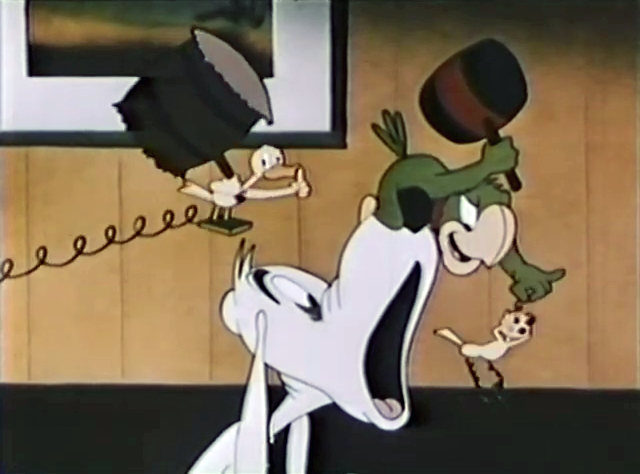
I have no idea what the title of this post means. They’re lyrics in Willie Whopper’s Robin Hood, Jr., made by Ub Iwerks and released in 1934.

Willie/Robin shoots an arrow at a target on a tree. Bull’s eye! And like those strength test things at the circus, the cylinder shoots up the wire and rings the bell. The tree grows a face. A bird in a house attached to the tree hands the tree a cigar, who gives it to Robin.


Grim Natwick is the credited animator, and is responsible for the Betty Boopish girl character.

Monday, 16 August 2021

Wise Quackers Take

The basic principles of animation are at work in these consecutive frames from Wise Quackers, a 1949 cartoon from the Friz Freleng unit at Warners.

Here’s a Daffy take. Anticipation and then the extreme.


There’s a great scene of Elmer’s two pet dogs jumping over, and banging into, each other. Afraid the references to slavery (and joke about blindness) will keep this short on the shelf.

Pete Burness joins Friz’ regulars: Manny Perez, Ken Champin, Gerry Chiniquy and Virgil Ross. There’s an inside reference to layout man Hawley Pratt in Paul Julian’s background at the end.

Sunday, 15 August 2021

Next Stop, Kokomo

Phil Harris may have been born in Indiana and sponsored charity work there until his death, but his old boss Jackson helped benefit the state, too.

In 1966, Jack Benny appeared at Starlight Musicals in Kokomo, when he broke the theatre's existing attendance records by drawing 28,863 people for seven performances. His benefit concert with the Indianapolis Symphony Orchestra in November, 1960 helped launch the symphony's endowment fund program, earning for it $35,000 in one concert.

The local paper in Kokomo put up two stories on its Sunday page on July 31st after the Benny (and entourage) performance. His featured singer was Wayne Newton, who was no unknown. He had a couple of hits on the charts that radio stations played for years. Still, Newton was almost reverential in his appreciation for Benny’s boost to his career; see Joan Benny’s book “Sunday Nights at Seven” for more.

There’s a happy coincidence in the second story as the writer and Jack share some things in common. I have been unable to determine when Benny played the town in vaudeville. And it’s a shame we’ll never know the story about his visit that he couldn’t print.

Benny Does Expected; Starlighter's Happy
By MARSHALL PITLER

Sunday Show Writer
Everyone knew what to expect. He's done the same thing for the past 40 years. But still Jack Benny had the largest opening night audience of this Starlight Musicals' season in the palm of his hand.
And he could not have let go, even if he wanted to. The Jack Benny Special was a guaranteed success.
There is a magic quality about Jack Benny which rivals nothing in the history of show business. This ageless wonder could recite the Gettysburg Address to 100,000 people, and the result would be hilarious.
Yes, everyone knew what to expect. The Benny Stroll, stance, stare, the gags about his money and age. Nothing was new, except the material, which was timely and in good taste.
Benny coordinated the entire show. He introduced the acts, was the brunt of his own routines with several well-timed interruptions, and actually hypnotized the audience with a very well-paced, fast running two and a half hour show.
One of his interruptions he did not plan. A light plane flew overhead, so Benny took advantage: "Darn! I hate it when they see the show for nothing."
Certainly, everyone knew what to expect. Benny had to play the violin. After threatening to play for almost his entire act, he finally did—and it wasn't "Love In Bloom." He caught us off guard by playing "The Bee" by Beethoven, [sic] and he did it quite well.
Benny delighted his audience by mixing among them collecting money in a tambourine in exchange for kisses from the gals. One gentleman even gave him green stamps, and by golly, he kept them.
Further attesting to his showmanship was Benny's selection of his co-star, Wayne Newton.
This humble, explosively talented young man added a clever balance to the show as he delighted his -fans with such numbers as "Rock-A-Bye," "Bill Bailey," and two of his hits, "Red Roses," and "Danke Schoen."
Although firmly established in the record industry, night clubs, and television, there is no end in sight for this six foot, two inch talent machine with the choir boy voice.
It was his stroke of fortune that his voice never changed; for it gave him the "gimmick" which is so important in the wildly competitive show business. This young man never stops working. Even when singing a ballad, his entire body seems to be keeping time with the music. He plays the trumpet and banjo with great zest, and much to the planned objection of Benny, he handles the fiddle pretty well, too.
Newton borrowed a page from Judy Garland's book of success by doing one of his numbers in the audience while grabbing the hands of his excited fans.
A delightful surprise was the first stage appearance of Doris Dodge, a very attractive little 10-year-old blonde from California. Under the pretense of asking Benny for his autograph, she then goes into a comedy routine with him. They also play several duets together.
A perfect show opener was the amazing juggling of the Rudenko Brothers. They performed some extremely difficult routines with ease.


Jack Benny Has Magical Touch With Audiences
Editor's Note: Sunday Show writer Marshall Pitler squeezed his way backstage at Starlight Musicals last week to gather impromptu interviews with Jack Benny and Wayne Newton, stars of the Jack Benny Special. He jotted down these impressions of the stars.
By MARSHALL PITLER
With the exception of pretty, 10-year-old Doris Dodge, her teacher, and her family, no one was waiting outside Jack Benny's dressing room at Starlight on opening night.
Of course, there was a reason. Guards weren't letting anyone backstage. But the power of the press was evident, because my wife and I passed through the guards. When Benny emerged from his dressing room, I introduced myself as representing The Kokomo Tribune. He smiled broadly and said, "Kokomo, Indiana. Why I worked a theater in Kokomo 40 years ago when I first started in this business."
I jokingly told Benny that I was returning a visit to his opening night in Indianapolis, since he was in my opening night audience in Heidelberg, Germany, when our 84th Infantry Division opened our Army show, "It's All Yours."
I was shocked when Benny remembered the show. "Why sure, it was 1945. I was doing a show with Ingrid Bergman, Shep Fields, Larry Adler, and Martha Tilton," the comedian said.
By this time, everyone was relaxed, and we all behaved like old friends. Jack Benny was working his magic again. Just as he does with his audiences, he made us feel perfectly at ease.
Benny was thrilled with the Starlight audience. He beamed as he said, "I can tell by that long applause, at the end of the show. They really like it." When I told Benny that the Kokomo Civic Theater presented “George Washington Slept Here,” he was highly amused. Benny played Newton Fuller in the film version of the play—the same role which I portrayed last spring.
As he left, Benny said, "Say hello to everyone in Kokomo for me, and remind me to tell you a very funny story about your town the next time I see you. You won't be able to print it though." I hope it won't take another 21 years to hear that story.
Wayne Newton's manager Tommy Amato told us that several years ago, he worked several Indiana cities, including Kokomo. He was playing in a night club trio.
Of course, this was before his association with Wayne Newton. He said he would like to bring Wayne to Kokomo for a concert sometime next year, if possible.
Newton, who earned his first $5 bill at the age of 6, is a country boy with good "up-bringin." He is polite, gracious, and very humble. He told us of his initial success in Phoenix, Ariz., which led to his own television show.
Las Vegas bookings followed, and then came his big break—his debut at the Crescendo, in Hollywood.
He and his brother Jerry have always worked together. Jerry is slightly older than 24-year-old Wayne. He is an excellent guitarist and adds a great deal of good-natured ribbing during the show.
Jerry told us that he and Wayne are building their bachelor "dream house" in Las Vegas.

Saturday, 14 August 2021

Death to Terrytoons

Terrytoons died because the dollar signs didn’t add up.

The Saturday morning cartoon business was huge. In the late 1960s, CBS was buying shows from Hanna-Barbera and Filmation. That’s even though CBS had its own cartoon studio. And the company let it die.

It made no sense. CBS should have easily created its own Saturday morning shows, maybe even selling them to other networks. But, instead, it let its Terrytoons studio wither away. Reader Andrew Lederer points out the studio was sold in 1971 to CBS' former Viacom division.

The studio had been creating TV cartoons in the early ‘60s. It invented Deputy Dawg as well as the insufferable Luno, the flying horse. But soon everything was shut down.

The Daily News in Tarrytown, New York looked back at the studio in a two-part feature story that ran on January 4th and 5th of 1973. Here it is below. We presume the author used a pseudonym.

Terrytoons' departure ends an era
First of two articles
By DICK TRACY
It was 63 years ago that Gertie the Dinosaur first flickered across the American consciousness.
Since then innumerable one-dimensional lions and cats and insects and dogs and nonsense creatures, as well as people, have entertained and influenced generations of movie goers and television watchers.
Millions of drawings on paper and celluloid have gone into building an art form and an industry which is now a vital part of the 20th century imagination.
LAST MONTH, in New Rochelle, what was an important chapter in the development of animated cartoons was brought to a close.
Terrytoons, which had operated there since 1934, closed down its Centre Avenue studio and moved its headquarters to offices in Manhattan.
The move out of Westchester County comes following a fall-off since 1969 on production by the company, which over the years created such one-dimensional stars as Mighty Mouse. Heckle and Jeckle and Deputy Dawg. It also marks the end of the only remaining complete animation studio on the East Coast.
"If our production of cartoons were to resume again, and it might someday," said William Weiss, the retired president of Terrytoons, "we'd probably have to open on the West coast."
Weiss, who has been retained as a consultant by Terrytoons' parent company, Viacom International Inc., blamed the wind-down in production over the past few years on a combination of factors, including changing forces in the animation industry and the nation's economy as well as in television program syndication.
The television market has been an integral part of Terrytoon operations since the company was sold in 1956 to CBS by the late Paul Terry, founder and guiding force behind the growth of the Westchester-based cartoon company.
IT WAS IN the years following 1956 that the tempo of operations at the New Rochelle headquarters began to speed up as the staff of artists, directors and technicians bore down to meet the deadline pressures of a weekly Saturday morning show on CBS.
Before the changeover to television, a staff of slightly more than 100 people working on the three floors of the company's operations had turned out 26 shorts each year for screening in movie theaters in the U.S. and overseas.
During the late '50s and into the 1960s, a smaller staff was producing about 100 shorts each year for both movie theaters and the network.
This pace of mid-century activities would most likely have been unrecognizable to early animators such as Winsor McKay [sic]. whose "Gertie the Dinosaur" in 1909 was one of the earliest touchstones of animated magic.
IT WAS THE work of McKay and other early cartoonists that gave Paul Terry the idea of trying his hand at animation in 1915.
An illustrator with the New York Globe at the time, Terry worked in his living room for six months to produce his first scratchy short, "Little Herman," a character based on a magician whose vaudeville stage name was "Herman the Great."
He had trouble selling the work until he came up to New Rochelle and approached officials of the Thanhouser studios, a long defunct motion picture company. The company bought the work after youngsters invited off the street by Terry broke up in laughter at the moving cartoon.
"Those children sold my picture for me," he said later. "They laughed and everybody laughed but I wasn't sure whether Mr. Thanhouser and his crew were laughing at the picture or at the children, they laughed so hard."
There followed a steady growth in the fortunes of Paul Terry and his moving cartoons as he produced first a series based on Aesop's fables and later a stream of characters ranging from mosquitoes that sang jazz, to villainous spiders and peg-legged pirates.
IN THE MIDDLE '30s, when he moved his studios out of New York up to the city where he had sold his first short, the animation industry was poised on the threshold of what was to become a period of growth which still he hasn't ended.
Techniques and technology were improving, and the public was demanding quality in their cartoons People had grown used to moving cartoons, and so were no longer beguiled by the mere novelty of drawings that moved.
At the same time that Terrytoons was beginning to move, a man by the name of Disney, who had a studio on the West Coast, was beginning to get a very good reputation among animators.
Weiss tells the story of a secret meeting held in a movie theater in New Rochelle at which some of Terry's top animators were lured out to work on projected full-length animated movies — notably Snow White.
"Some of Disney's key men received their training in our studio." adds Weiss, who didn't learn about the meeting until some time after it had occurred.
CORPORATE PIRACY wasn't the only bad news plagued the Terry operation in the late '30s. One news story which hit the front pages was the report of a law suit filed against the famous illustrator by Frank H. Moser, who had been Terry's partner until 1936 when he sold his 50 per cent share of the company for $24,200.
Moser charged that fraud and deceit had been used to paint a bad financial picture of the operation when in fact the company was in the pink financially and about to expand. The courts found in favor of Terry. This ended what had been an early triumvirate of Terry, Moser and Philip Scheib, the music director who remained with the company longer even than Terry.
As the country entered the forties, the Terry characters went to war along with everybody else. Shorts such as "All Out For V" stressed "preparation and the importance of individual work" and swing shifts of war factories were treated to the midnight spectacle of helmeted screen animals marching to victory.
IN 1942. a birth took place at the Terrytoons studio which was destined to lift the firm to its highest pinnacle of public recognition. The new creation was called Mighty Mouse.
Thirty years ago this year this screen hero, who was the product of the combined efforts of several people, has fulfilled Paul Terry's original predictions that he would be the most popular Terry character ever. His shorts, along with other Terry Creations, are still released by the company at the rate of 12 each year.
After the war years, the forties blended into the fifties and television became king of the media mountain. The impact of the electronic media on the art and industry of animation would generate forces which
would eventually bring abort a severe cutback in Terry operations.
NEXT • the machinery behind the ghost.

A look back on the 'golden days'
Second of two articles
By DICK TRACY
Tommy Morrison, who once supplied the voice of Mighty Mouse, is a thin, ruddy-faced man whose light blue eyes and quick movements might fit your image of a cartoon animator.
The other day, he and Bill Weiss, who retired this fall as president of Terrytoons, sat in their New Rochelle office, amidst cartons and furniture labled for shipment to New York, and talked about the end of an era.
THE ERA BEGAN 38 years ago when the late Paul Terry moved his animated cartoon studio up to the southern Westchester city.
Over the years such celluloid celebrities as Mighty Mouse, Heckle and Jeckle, Dinky Duck, Deputy Dawg, Tom Terrific, Koolcat [?] and a host of other quick-witted rascals and kind-hearted dimwits danced their seven minute stories upon the animation camera stage and then were gone back to the story room.
Now, the story room, like the rest of the Centre Avenue studio, is empty. The few remaining pieces of furniture—a couch, a table, the fiberboard where artists pinned up their rough drawings—have been sold, given away or junked, gone the route of the special photographic equipment and the metal shelves where films were stored and the special desks where once animators and background men, inkers and opaquers toiled to supply a public hungry for funny cartoons.
All gone.
TERRYTOONS will operate out of the Manhattan offices of Viacom International Inc., formerly a division CBS and now the cartoon firm's parent company.
The scale of operations, however, has been considerably reduced from the early and middle '60s when the Centre Avenue studio hit full stride with its production for a weekly television show plus creation of commercials such as Bert and Harry, the Piels Beer duo.
It was in those golden days that, despite what business manager Nicholas Alborti terms a heavy production schedule, the company was still able to turn out quality material such as Eli Bauer's "Hector Heathcote," the minute-and-a-half man.
The short "Drum Roll" took first prize at the Venice Children's Film Festival for "using the particular possibilities of animation to realize a visual amusement permeated with intelligent humanism."
TODAY THE firm is engaged solely in sales and servicing of existing cartoons, unlike the days when dozens of animators like Tommy Morrison would wrack their imaginations in the story room or animators' cells. At times, they'd jump up to grimace or do a jig in front of the mirror, which was standard equipment for each animator, to help him realize the character he was working on.
"An animator has to be an actor," explained Morrison, who is a resident of Larchmont, as was his ex-boss Paul Terry.
"He has to have a feel for the character, then he has to make these feelings intelligible with his drawings. He gets very close in his mind to the character." Given such working conditions, it's understandable that the atmosphere at Terrytoons was unlike any conventional working environment, such as, say, a bank or a factory.
"Our approach over the years was strictly a fun approach," said Weiss who, like Morrison, went with Terry in the early '30s. "We wanted to make the kids enjoy themselves; to stir their imaginations."
THIS FUN approach carried over into the workday world, and some of the two men's fondest memories are of the early days in the Pershing Square building in New Rochelle, when the staff seemed to have as much fun as their celluloid creations.
The tale is told of one Christmas party when the 12-story building's elevators were commandeered by members of the Terry staff, and everybody using the elevators that day ended up at the seventh floor party—whether they liked it or not.
This spirit seemed to depart the company's operations in the '50s and '60s, perhaps, they suggest, because of the increased production pressure caused by television and because the new generation of animators, while dedicated the their craft, seemed less inclined to fool.
The two also claim the new batch of animators, while serious in their work, can't match up to the craftsmanship of those who were trained in pre-television days.
"Anytime you see really good work nowadays," said Weiss, "you can almost bet it war, done by one of the old timers; their training was more painstaking and they had time to develop greater skills.
MUCH OF THE work done on contemporary shows, which all feature humanoid characters, does not require the patient workmanship and craft which young animators cut their teeth on in the days when movie-goers were treated to a cartoon and newsreel as well as the feature show.
"There are a lot of would be good animators around," said Weiss, "but there aren't any places where they can get the type of training that used to be offered by us and by other studios."
Because cartooning is such a big business in this country, he explained, development of mass production techniques and specialized services to do stages of animation work have tended to shift the emphasis away from the individual animator's skillfulness.
"In the old days they'd study things like Grey's Anatomy or books on the bone structure of animals," he said. "Today this type of accomplishment isn't needed, so not many have it.
"In the United States, Australia and Japan, animation is a business. In most European countries it's an art form."
A GREAT DEAL of the work done for contemporary television animation is contracted out, he said, and the Japanese have captured a good portion of this market because of their ability to do the work less expensively.
And what of the future?
"Computers," said Weiss, "they're now working on a way to produce animated work by computer."
"Never," said Morrison. "It won't be animation if the human intelligence, the creativity, is taken out of it." He said this wistfully, as though afraid to think of a computerized future replacing what was in his lifetime an exacting art requiring close cooperation between the human brain and man's machines to produce the 8,000 to 10,000 frames, carefully drawn and colored, which made up the average short.
BUT ALL HOPE isn't lost. Questioning of several members of the under-30 set indicates a complete antipathy to much of the animation now turned out for mass consumption.
"There's one good thing about these modern cartoons," said a young mother, "kids don't stay glued to the TV set all Saturday morning like we used to. They go out and play."
Another girl summed it up more succinctly. "Cartoons just ain't funny no more," she lamented with a grimace and a wink in the best tradition of animation.

Friday, 13 August 2021

Drunken Camel

A rubber-legged camel decides to drink some beer in Mickey in Arabia (1932).


You can’t appreciate the animation in the frame grabs, as the animals sways and staggers. But you can appreciate the rubber-hose drawings that Disney would soon shy away from.


Author David Gerstein, who knows this kind of stuff, points out this is a partial remake of Oswald’s Harem Scarem(1928), which includes a drunken camel.

Thursday, 12 August 2021

Response of the Coo-Coo

A large-headed parrot uses sex to lure a coo-coo bird in Columbia’s The Coo-Coo Bird Dog (released in 1947).

You see, writers Dave Monahan and Cal Howard have made a dog swallow the bird, and it won’t come out. That’s when the parrot (who had been harassing the dog earlier in the cartoon) becomes involved.

But it turns out the coo-coo is now outside of the dog (don’t ask how it happened). I like how it turns to the audience and urges us to be quiet as it bashes both the dog and the parrot.


Howard Swift, Ben Lloyd and Roy Jenkins are the animators with layouts and backgrounds by Clark Watson. Sid Marcus is the director. Darrell Calker’s sleepy score doesn’t help the cartoon.

Wednesday, 11 August 2021

America's Pinocchio

It was called The Chase and Sanborn Hour, but nobody except maybe some agency people and the sponsor called it that. To everyone else, it was “The Charlie McCarthy Show.” Not “The Edgar Bergen Show,” even though he created Charlie and provided his voice and personality.

What’s odd isn’t the fact “there was ventriloquism on the radio.” What’s odd is everyone knew McCarthy was a dummy—there were even references and jokes on the show to his being wood—but people were quite willing to treat him as if he were real and separate and apart from Bergen.

And accept him they did in large numbers. It seems the show was in the top five for years and years. The debut show for the 1946-47 season was a mere half-point behind the first place Mr. District Attorney.

Herald Tribune syndicate critic John Crosby was a fan—he didn’t think much of Mortimer Snerd, who was outrageously dopey enough to get laughs—and had a short review, along with some gripes about his holiday on Fire Island. It’s a tough life, Mr. Crosby. The column appeared September 6, 1946.

McCarthy Is in Season Again
The flame trees are turning scarlet on Fire Island, the Atlantic feels like shaved ice, and the smell of wood smoke is in the air again. Last Sunday night, like the smell of burning leaves, came another small but mistakable sign that autumn is almost here.
“Why are you late?” inquired Edgar Bergen of the small razor-tongued hedonist whose voice is familiar to about 70,000,000 Americans.
“Because I didn’t get here on time,” said Charlie, who hasn’t changed a bit.
“Why didn’t you get here on time?”
“Because I was late.—You want to go around again?”
* * *
Lordy, lordy, I said to myself. I’ve been treading water all summer long and at last land is in sight. The McCarthy show was the first smart comedy program I’ve heard in what seems like forever. If I get a little hysterical, ignore it: I’m over-wrought. In fact, I’m fed up with summer, let’s face it. I’m tired of wet bathing suits and sand in my hair and Flynn’s bar and grill. I’d like a martini, very dry, at the St. Regis and I want to wear shoes again, the leather kind, and I wish Fred Allen were back.
* * *
Charlie was in rare form. He’d intended, he said, to pass the summer improving his mind but passed most of it improving his technique. And his technique, one of the most subtle and sure-footed in radio, is as sharp as ever.
After considerable meditation, Charlie tells Bergen he plans to quit radio.
“You don’t know what you're saying,” says Bergen.
"Oh, yes I do. I read your lips."
Bergen points out that quitting radio is a serious step but Charlie is adamant. "I decided I'm getting no place and you're helping me."
"But Charlie . . ."
"No no no no no no. I say no and that's final. I'm using my veto power. I’m walking."
“But you mean so much to everyone.”
“Especially you. You get your pound of flesh for 75 cents.”
"But if you left radio, what would you do? Remember, Charlie, Satan has work for idle hands."
"Yeah? What does he pay?"
I've heard better dialogue but one thing every McCarthy show has is a distinctive McCarthy flavor. Charlie is a rounded, fully developed character with more flesh and blood than a dozen Abbott and Costellos. Over the years, Bergen has endowed this small self-possessed cynic with a heart and a soul as well as a highly articulate set of vocal chords. Charlie is America's Pinocchio.
* * *
I’ve never been a Mortimer Snerd man. Snerd, it seems to me, is one joke, endlessly repeated. But, in my new benign end-of-Summer mood, I even felt a faint warmth toward this slack-jawed imbecile who is only barely conscious he is alive. Mortimer, in case you hadn't heard, spent the summer in school. It came as a great shock to him to discover that school has been out all summer, though, he said, he'd become a little suspicious when he won all the games at recess.
Guest star on the McCarthy program last Sunday was Jimmy Stewart, who proved again that movie stars, particularly one who has been in the Army for five years, shouldn't get mixed up with the experts in front of a microphone. Mr. Stewart, bless his shy, wide-eyed American soul, was just plain awful and, if he didn't have such a fine war record, I'd tell him so.


Bergen’s show was, as best as I can determine, the last hour-long variety show on network radio (though five minutes was shaved off for news on both ends). CBS carried him on Sunday nights at 7 until July 1, 1956 and then replaced him with Mitch Miller.

The McCarthy show never made the transition to television but another show Crosby reviewed in the same week did. Ethel and Albert was a 15-minute show with low-key humour involving a husband and a wife; it became a half-hour in the late ‘40s. Alan Bunce and Peg Lynch played the roles on radio, then TV, until six days after Bergen left radio. Crosby seems taken with the show in the September 3rd column. He discusses DuPont’s Calvacade of America on the 2nd, Allen Prescott’s audience participation show on the 4th and has a funny story on the 5th about a game show contestant who firmly denied her answer was wrong—and she was right. Good for her. Click on any of the stories to enlarge them.

Tuesday, 10 August 2021

Just Who Is In That Egg?

Here’s where fanboys get whipped up into a frenzy.

In the Friz Freleng short Curtain Razor (1949), a hen auditions for talent scout Porky Pig, and lays an egg. Really.


The chicken takes her egg and rather snootily walks away. Porky takes care of her through a trap door.


But wait a minute! Looks who’s in the egg!


It looks like Tweety. But Tweety isn’t a chicken.

So is it really Tweety? It is the Freleng unit just reusing a character design? Or is it Tweety playing the role of a chicken?

It doesn’t make much difference, but some fans get all anxious about this kind of thing.

Gerry Chiniquy isn’t credited among the animators in this cartoon, for some reason. Manny Perez, Ken Champin, Virgil Ross and Pete Burness are.

Monday, 9 August 2021

Firey Sandwich

A smouldering cigarette creates a cute little flame that starts cheerily destroying everything in the forest in Red Hot Rangers.

He makes a sandwich out of a leaf and a pinecone in between “No Smoking” and “Help Prevent Fires” signs.


Soon, George and Junior will be on the scene and Junior will screw up everything, though the little flame dies in the end.

Ray Abrams, Preston Blair, Ed Love and Walt Clinton are Tex Avery’s animators in this cartoon. Irv Spence drew the character models for this short in February 1945 but it wasn’t released until May 3, 1947.