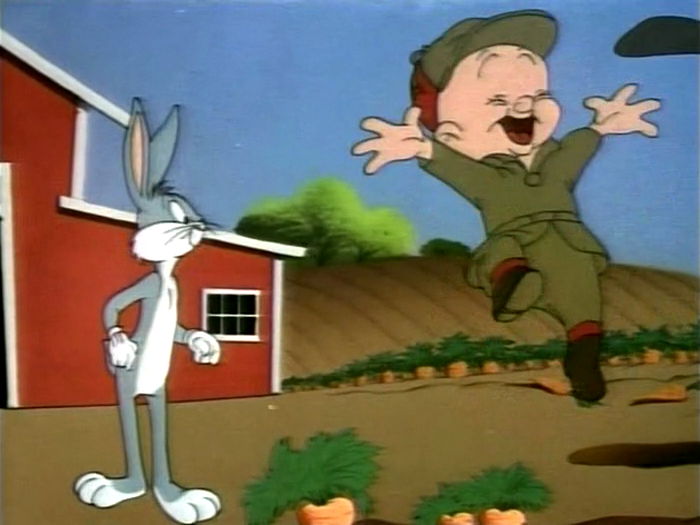
TV cartoons by Bob and Ray? Norman Brokenshire? Al Capp? We’re still waiting for them. But they were among the many animated projects for the small screen announced in 1960.
At the theatrical cartoon studios, Warner Bros. was changing the guard with Johnny Burton leaving, while Hank Saperstein, who had acquired TV rights for the Mr. Magoo cartoons, was about to take over the studio that made them, UPA. Universal had a contract with Walter Lantz, but he was loath to make an animated feature, so the studio bought one from Russia and spent huge dump trucks full of money to promote it. You all remember The Snow Queen.
Meanwhile, at film festivals, European-made and American independent animated shorts were being screened to critical acclaim, including John Hubley’s Moonbird.
Let’s look at what Variety had to say about cartoons in the first half of 1960, with a side glance to Motion Picture Daily. Warners was developing the Bugs Bunny Show. Jack Kinney was working at the Format Films studio churning out Popeyes for TV. They were successes. Less successful were Sam Bassett, Hound For Hire and a series starring the Nutty Squirrels, a Chipmunks musical rip-off who had their idea for a cartoon series ripped off by the Chipmunks. Unfortunately, the Squirrels series was done on the ultra-cheap and the bulk of each show consisted of foreign cartoons for which the producers had acquired the TV rights. King Features had grandiose ideas, few of which came to fruition. And there were the B-listers Q.T. Hush and Courageous Cat.
There were a lot of silly tussles over film titles, too, including one case that Walt Disney actually lost.
January 6, 1960
Five American non-theatrical films which copped prizes at last summer's Venice festival were honored here last week at a special showing sponsored by CINE, the Committee on International Non-Theatrical Events....
The winning films were: ... "Moonbird," produced by John Hubley, cartoon winner.
Walter Lantz was honored by the Los Angeles Board of Supervisors yesterday when the Board presented Lantz with a scroll in recognition of his 40th anniversary as a cartoon film maker.
Supervisor Ernest E. Debs introduced the resolution which paid tribute to Lantz for his many civic and charitable contributions as well as being an outstanding member of the motion picture industry for the past 40 years.
January 8, 1960
Walt Disney Productions and domestic subsidiaries reported yesterday a net profit of $3,400,228 for fiscal 1969, ending last Oct. 8. This figure marks a decline from the previous year's profit of $3,865,473....
Principal reasons why 1959 earnings slumped from 1958, according to the statement, was the smaller margin of profit from some theatrical films, notably the $6,000,000 "Sleeping Beauty," and higher production costs on tv product.
" 'Sleeping Beauty' will be our largest grossing cartoon feature to date," said the statement, "but its production cost probably precludes any profit from its initial three-to-five-year world-wide release."
January 13, 1960>
From Boise, Idaho, to Poland Springs, Me., stations are showing a big city sophistication in buying dubbed foreign pix product from Flamingo Films....
Flamingo is starting to acquire new pix product and by late spring hopes to have up to 52 new pix to distribute to tv. Outfit also is negotiating for a cartoon package.
January 14, 1960
ABC-TV and Warner Bros. have made a deal for a new half-hour "Bugs Bunny" program which the network will slot next fall Wednesdays at 7:30 as its answer to NBC's "Wagon Train."
Series will comprise 26 half-hours, each consisting half of post-'48 theatrical cartoons never shown on tv, and half new animation comprising introductions and additional story-type material on the "Bugs Bunny" character. "Bugs" will host the show as well.
Unusual pattern for the 26 repeats is planned. Each show will be stripped down and reedited so that each of the repeats will constitute a reshuffling of the original material and no one repeat program will be the same as the original.
The pre-'48 "Bugs Bunnies" are currently in television via syndication, being handled primarily by United Artists Associated, the UA subsidiary which took over Associated Artists Productions. AAP acquired the cartoons In its $21,000,000 buyup of the complete WB backlog some five years ago.
January 20, 1960
Rhapsody of Steel
Reviews of industrial films are occasionally warranted on the basis of unusual aspects and there's much about "Rhapsody of Steel" which qualifies it for particular trade attention. This is a 23-minute subject produced for the United States Steel Corp. by John Sutherland, who also has writing credit. It's institutional all the way with no plugs for any individual steel product and with the sponsor's identity given only in the final frame.
An all-animated film, this undertaking was in excess of $300,000 and as of now about 250 prints are in work at theatres across the country. More may be added. A Broadway first-run, the Victoria, has it booked along with numerous other key city showcases, all of whom have the same deal: They neither pay, nor are they paid; it's a gratis arrangement.
Splendidly tinted by Technicolor, the subject is both entertaining and educational. It tells the story of steel, from a giant meteor hurtling through space and hitting the surface of the earth, to the forging of the black metal for primitive weapons and then to the development and refinement and the use of steel in everyone's everyday living. The saga unfolds skillfully. It's done in serious vein for the most part, but with enough whimsy and imagination injected in the cartooning to delight the onlooker.
Along with the pictorial values is a Dimitri Tiomkin score, recorded by the Pittsburgh Symphony, that is fittingly strong and powerful when matching, say, the giant crucibles on screen, and light and airy when the sketched subject matter is not so heavyweight.
An LP album accompanies the print to each theatre but this is not being marketed separately.
After some intra-mural discussion about the wisdom of the move, U.S. Steel went ahead with earlier-drawn plans to open "Rhapsody" at the Stanley Theatre, Pittsburgh, on Dec. 4. One can indeed question the fittingness of such unveiling, in such an area, when the steel industry strike was in full swing.
Otherwise, all's fine with "Rhapsody." Gene.
John W. Burton yesterday resigned as executive in charge of Warner Bros.' cartoon division. He has been with company and division's predecessor, Leon Schlesinger Productions, for 27 years.
January 21, 1960
Warner Bros. yesterday announced the merger of its tv commercial and industrial films division with its cartoon division. David H. DePatie, general manager of the commercial and industrial films division, has bean appointed general manager of a combined division.
Charles M. Jones and Isadore Freeling are continuing under new contracts as the creative talent for the cartoon product.
Under the new management, Warners expects to expand the combined division's activities, which will include 30 theatrical cartoons to be produced this year.
January 27, 1960
"Winky Dink & You" is coming back to tv. The former CBS-TV Saturday ayem cartoons have been put on motion picture film to make 260 five- and six-minute short subjects for the syndication market.
Stations this time around are going to be cut in for 50% of the profits on sale of the "Winky Dink" home drawing kits, if they buy the package. It is understood that one of the reasons CBS-TV decided to cancel the longrunning Saturday series in May of '57 (after four years on the air) was that the affils were demanding a cut of the merchandising profits. To cut the stations in would have created an awkward precedent that might then have been applied to other shows.
The cartoons (which kids at home can draw by applying transparencies to the tv screen and then by tracing) are being distribbed by Frank Abrahams, who has quit the Goodson-Todman office to establish his own distribution company, Manhattan Productions.
Abrahams got rights from Harry Pritchartt, who dreamed up "Winky Dink" in '53 and then took it to Barry & Enright to produce. When it went off the air, all rights to the cartoons reverted completely to Pritchartt, according to Abrahams.
February 1, 1960
The Three Stooges, impressed with the success Screen Gems has been having in the television sale of their old theatrical shorts, are planning a new series of their own. Show, skein of 39 half-hours, will be a co-production between the trio's Comedy Three Productions and Norman Maurer Productions.
Series will be part animation, part live-action, and will be wholly financed by the Stooges and Maurer, who writes most of their material and who will produce. They've already set a deal with TV Spots Inc. for a series of 78 five-minute cartoons featuring the Stooges, and the show would consist of two such cartoon sequences with the balance live-action.
Animation gets underway immediately, and live-action filming on the pilot on Feb. 25. Stooges and Maurer will finance the pilot entirely on their own. The William Morris office will handle sale of the package.
Stooges, Moe Howard, Joe DiRita and Larry Fine, point out that material will be suitable for children, with less violence than the theatrical shorts. Trio has not been sharing in the Screen Gems take, except by personal appearances, cafe dates and a new theatrical pic based on the teleseries' success.
February 3, 1960
Three pix which have just completed their theatrical rerun are being offered as possible web specials by National Telefilm Associates.
The three pix are the full length feature cartoon "Gulliver's Travels," "Hoppity Goes to Town," another feature length cartoon, and David O. Selznick's "Adventures of Tom Sawyer." Pitch for the network airing is to telecast each as a holiday vehicle for a national sponsor.
February 10, 1960
A 16m Dutch film, "Rembrandt," made by Bert Haanstra, snagged the grand prix at the University of Chile's first International Documentary Fest which attracted 43 entries from 17 countries. Eleven awards were made at the festival's closing ceremony.
Two American shorts, "New York, New York" and [John Hubley’s] "The Adventures of X," latter from the Guggenheim Museum—got the kudos for "experimental documentary" and "animated cartoon," respectively.
Five Soviet shorts failed to win any awards.
February 11, 1960
Nominations for best short subjects awards—live action and cartoon—were announced yesterday by the Academy of Motion Picture Arts and Sciences.
Nominations are:
Cartoon subjects: "Mexicali Shmoes," Warner Bros., John W. Burton, producer; "Moonbird," Storyboard, Inc., Edward Harrison, John Hubley, producer; "Noah's Ark," Walt Disney Productions, Buena Vista Film Distribution Co., Inc., Walt Disney, producer; "The Violinist," Pintoff Productions, Inc., Kingsley International Pictures Corp.
February 12, 1960
Universal-International, having registered "Bellboys" as the title for a Walter Lantz cartoon, has filed an MPAA protest against Paramount's "The Bellboy." The Par title is for Jerry Lewis' comedy which currently is shooting in Florida.
UI also protested Paramount’s title, "Scouting For Trouble," basing its complaint on its registration of a similar title, "Looking For Trouble." A third UI protest warn against 20th-Fox’s "Simon Bolivar," based on UPs own registration of the title for Herbert Kline's forthcoming film to be lensed in South America. The 20th registration reportedly was speculative and involves neither a property nor a definite film project.
February 15, 1960
Motion Picture Daily
"Inside Magoo," a special Technicolor animated cartoon starring the nearsighted Mister Magoo and Jim Backus as his voice, has been completed by Stephen Bosustow, head of UPA, and is now available for theatrical bookings by exhibitors across the country, the American Cancer Society announced.
The six-minute cartoon's purpose is to motivate the public through the film medium to visit its doctor for a cancer checkup. Magoo is presented in a series of misadventures before he inadvertently gets his checkup. "Inside Magoo" is being distributed by Columbia Pictures, and exhibitors may order free prints of the film through their local units of the American Cancer Society.
February 18, 1960
Motion Picture Daily
With Sandra Dee, in the role of princess, aided by Tommy Kirk and Patty McCormack, Universal-International's feature-length cartoon, "The Snow Queen," will be accorded a for-kids world premiere at the Fox Empire Theatre next Monday morning, Washington's Birthday and a bank holiday.
A veritable "who's who" among the children of Hollywood notables will [attend] the daylight premiere, many of them accompanied by their famous parents. In addition, the entire Hollywood press corps have been invited to attend the affair with their youngsters.
February 23, 1960
Metro, with "Ben-Hur" in release, has filed protest against a similar title registered by Warner Bros. cartoon.
The title—"Ben Hare."
February 24, 1960
Motion Picture Daily
Exhibitors Told of Big U-I 'Snow' Campaign
By SAUL OSTROVE
Universal-International will spend $250,000 between now and April 24 to publicize "The Snow Queen," the company's Easter release, in a thorough all-media and merchandising tie-in drive, 50 representatives from Greater New York circuits and independent theatres were told yesterday at a campaign luncheon held at the U-I home office here.
To fully publicize the full-length feature cartoon in Eastman Color, U-I hopes to combine the best of "Walt Disney-type salesmanship and the best of our own showmanship," said Philip Gerard, Eastern advertising and publicity director.
Comic pages in the Sunday supplements of the Daily News, Journal-American and Daily Mirror will feature ads for "The Snow Queen" next month. The April number of Parents Magazine and the April 12 issue of Look also will have ads for the film, producing an all-publications circulation of 7,000,000 in Metropolitan New York devoted to exploitation for the film.
Local children's shows on radio and television will lend their services to "The Snow Queen" drive during the next six weeks, as will several adult
programs.
A special events tie-in will be the celebration April 2 of the 155th birthday of Hans Christian Andersen, author of "The Snow Queen."
Grossinger's Hotel in New York State this weekend will observe a "Snow Queen" winter carnival which includes a preview of the picture. National, press, radio and television coverage is guaranteed for the event, Gerard said.
Stars of the picture, whose voices are dubbed in the Russian-produced film, will make key city publicity tours during the campaign.
February 26, 1960
Motion Picture Daily
A special section devoted to the promotional campaign of Universale "The Snow Queen" is published in the current issue of "Motion Picture Herald," out today. The eight-page illustrated section, in color, describes in detail the elaborate national pre-selling and local depth selling for the cartoon feature.
Included are the magazine and newspaper advertising campaign, a tie-in with the Hans Christian Andersen birthday observance, special events, star and personality tours, television and radio, records, a premium deal, merchandise and product tie-ups, organization tie-ups, and national publicity.
February 29, 1960
Motion Picture Daily
Paramount Pictures plans a long-range expansion of its activities in the field of short subjects, it was announced at the weekend by George Weltner, vice-president in charge of world sales. The company will produce and distribute a new series entitled "Sports Illustrated," he said. ...
The Paramount "Sports Illustrated" short subjects will be in addition to the company's regular output of color cartoons. During 1960, Paramount Cartoon Studios will produce 20 new subjects, which will be supplemented by the re-release of eight cartoon "champions" and an additional new series to be announced, consisting of live-action color shorts.
March 9, 1960
UPA has completed a series of animated commercials for General Electric's lamp division featuring the theatrical cartoon character Mr. Magoo (the nearsighted) as a guy much in need of adequate lighting. BBDO is the agency.
March 14, 1960
WALT DISNEY PRESENTS
(This Is Your Life, Donald Duck)
Fri., 7:30-8:30 p.m., KABC-TV
Walt Disney must have sprung a surprise on the lookers-in at his Friday night hour—and also his sponsors. What unfolded for the hour was a Donald Duck cartoon hung on a peg that gave it the semblance of a story line but withal a pen-and-inker of the mischievous quacker. The sub-teeners had their big inning but Hills Bros, (coffee) and Canada Dry, two of the three sponsors, may have wondered if they were selling to the right audience.
Ralph Edwards was freely credited for use of the title but was nowhere about. All of Donald's friends were assembled to pay him tribute in their own frivolous fashion. Disney was the only live segment. Albert Bertino, Dave Detiege and Nick George were credited with scripting; Jack Hannah and C. August Nichols directed. Helm
March 16, 1960
Of the 22 nations (110 pix) represented at the recently terminated Sixth International Short Film Festival of Oberhausen, the U.S. walked off with the highest number of awards, four in all. It captured one of the six major awards (each 1,000 D-Marks) for John Hubley's cartoon, "Moonbird."
Cartoon awards went to "Piccolo" (Yugoslavia), "An Inspector Comes" (Yugoslavia) and "Moonbird" (U.S.).
An effort to hypo the dwindling theatrical cartoon market is being made by Cinemagic Corp. International, a new firm organized by writer-producer Phil Davis and indie distributor Arthur Epstein.
As its initial effort, the company is offering "Hound for Hire," a series written, directed and produced by Davis, who is currently in Europe supervising the final editing and scoring. The animation is being done by cartoon companies in France and Yugoslavia. The original plan is to make 52 films, with an option for 104. The films, which run from five and half to seven minutes, are all fully plotted, featuring Sam, a bassett hound who plays a deadpan private eye. In addition to the central character, the series presents a varied gallery of 85 animal characterizations.
Epstein, who is president and exec producer of the company, revealed that the first three films is to be delivered by April 1, with the others forthcoming at the rate of one a week. The voice track is currently being recorded by American actors in Paris and Rome.
Epstein indicated that the series was originally contemplated for television, but after the principals of the company had viewed the results, they decided to seek theatrical distribution first. Negotiations are currently taking place with two major companies, according to Epstein.
Production of the cartoons abroad has resulted in a 50% savings, Epstein indicated. While it costs $25,000 to make a single comparable animated film in the U.S., Epstein said that the use of foreign facilities brought the budget down to $12,000 per film. As a result, he maintained that they could make money in the theatrical market dispute the low prices paid by exhibitors for short subjects.
Epstein, in a realistic appraisal of the cartoon market, said his company didn't expect to reap big profits immediately, but he pointed to the important residual value of animated films. He noted, for example, that every two or three years there is a new children's market.
Arthur S. Gross, former veepee of Flamingo Films, has been named sales chief of King Features Television Productions. He'll report to Al Brodax, director of the division.
Major activity of the Hearst subsidiary, has been the production of 208 episodes of a new "Popeye" series. On the market since Jan. 1, the new series has chalked up $2,785,344 in sales in 46 markets, On the immediate prospectus for King Features is a trilogy of animated cartoons entitled "The King & Two." Three separate subjects will be joined in a half-hour show. They are "The Little King," "Beetle Bailey" and "The Katzenjammer Twins." In addition, Brodax will produce a pilot based on the cartoon strip, "Mandrake the Magician" which is set for the fall John O'Toole is writing the script.
Chun King, American-oriental foods, will get an unusual promotion ride from local stations on its new tele spot campaign.
Close to $2,500,000 of the company's $3,000,000 campaign spread will go to television. New spots feature four cartoon characters voiced by actors Cliff Norton, Frank Fontaine, Walter Abel and musicomedy thesb Charlotte Rae.
Chun King agency BBDO, Minneapolis, is sending newspaper mats of teaser ads promoting the commercials to stations who have agreed to run them locally as part of the merchandising service. It's believed to be the first newspaper ad campaign to promote blurbs.
In addition, Chun King prez Jeno Paulucci is flying to 30 cities on the campaign circuit to preview the blurbs for food brokers and their salesmen been scheduled for all of 1960, and the company intends to schedule similar outlays for the following three years.
Chun King is the biggest oriental food advertiser and claims half the market.
Metro has registered the title, "The Adventures of Little Samurai," with MPAA, indicating company has made a distribution deal for the Japanese feature-length cartoon.
Pic, produced by Tool Animation Studio, runs 83 minutes and is in Eastman Color.
March 17, 1960
Stephen Bosustow, president of UPA, has named Jerry Hausner director of dialogue for UPA's shorts and tv spots.
Art Clokey has closed a deal with Earl Rettig, prexy of NBC's Cal. National, for 104 issues of "Henry and His Playmates," five-minute cartoon series. Clokey was creator and packager of "Gumby.
March 21, 1960
Motion Picture Daily
"The Snow Queen," the full-length animated cartoon feature in Eastman Color based on the famous Hans Christian Andersen story which Universal-International is releasing, has been booked into 230 key situations for the Easter holidays, it was announced by Henry H. "Hi" Martin, Universal vice-president and general sales manager.
Key openings of "The Snow Queen" for Easter include the Lafayette, Buffalo; the Loop, Chicago; the Hippodrome, Cleveland; the Indiana, Indianapolis; the Broadway Capitol, Detroit; the Fulton, Pittsburgh; the Fox, St. Louis; the Joy, New Orleans, and some 75 theatres in the Greater New York area, including the RKO Theatres circuit.
March 22, 1960
Metro, which has purchased distribution rights to the Japanese feature-length cartoon, "The Adventures of the Little Samurai," has withdrawn the title due to its conflict with "The Seven Samurai."
Latter title is for reissue of the Japanese film which originally was released here under the title, "The Magnificent Seven," but has been changed to the original "Seven Samurai" title because of the current Mirisch Co. production. Mirisch pic, titled "The Magnificent Seven" is based on the Japanese film.
A deal for Toei Films, of Tokyo, to produce 150 4½ minute cartoon segments for television will be closed this week by Arthur L. Wilde, repping C. V. Whitney, and Philip Nasser. Pair leave today for the Japanese city.
Whitney portion of the coin comes from frozen funds derived from Japanese release of his three recent features.
March 23, 1960
Cinemagic Corp. readying a children's album based on the "Hound For Hire" cartoon series. Music and lyrics are being written by the series' writer-producer, Phil Davis.
March 24, 1960
Gerry Geronimi, cartoon director who worked 29 years at Walt Disney in both features and shorts, has joined UPA as director of shorts and tv spots. UPA president Stephen Bosustow has assigned Geronimi as director of the theatrical cartoon, "Magoo's Bear Hug."
Motion Picture Daily
Associated Artists Productions announced here yesterday it has introduced complete synchronization sound striped 8mm color and black-and-white cartoons for home motion picture entertainment.
Fred Hyman, general manager of AAP's 8mm home entertainment movies division, who is presenting the sound innovation this week at the annual Master Photo Dealers and Finishers show in St. Louis, also is providing sample sound films to companies exhibiting 8mm sound projectors at the show. The AAP booth there is showing new films in the 8mm catalogue which is being expanded at the rate of three a month.
March 28, 1960
Paramount - owned KTLA has purchased King Features' new group of 208 "Popeye" cartoons now being animated by several studios throughout the country for the syndicate. Among the animators of the new group — made especially for tv because of the success of the original Paramount group — is Paramount.
John Elliotte, scripter and one-time cartoonist, has been named head of UPA's new story department by prexy Stephen Bosustow.
March 30, 1960
[Technical Oscar to be presented] To Ub Iwerks of Walt Disney Productions for the design of an improved optical printer for special effects and matte shots. This optical printer combines the images from three projection units simultaneously, each adjustable for position, magnification, film direction, and timing with a viewing device for the operator to check his composite results during line-up and operation. As many as six films may be superimposed at one time in this printer.
March 31, 1960
Hanna-Barbera, now employing 25 percent of the animators and cartoon writers in town, looking to expand headquarters because of a new series (their fourth in production, plus added commercial biz. They'll also turn out 12 theatrical cartoons.
Motion Picture Daily
1st 3 ‘Hound’ Cartoons Due Here by April 10
By SAUL OSTROVE
The first three "Hound for Hire" cartoons to be produced by Cinemagic Corporation International will be completed in Yugoslavia and read for examination by American motion picture companies and television networks by April 10, Arthur Epstein president of Cinemagic, said here yesterday.
Epstein and writer-producer Phil Davis, who will depart at the weekend for another production trip to Zagreb Film Studios in Zagreb Yugoslavia, said the "private eye" cartoons series will be shown in theatres throughout Europe. The six-to-seven minute films are now being dubbed in Italian, French, Spanish and German. Davis, vice-president of the corporation, said all 39 cartoons completed are in Eastman color and utilize full backgrounds.
If the cartoons are shown on network television three of them will be packaged to form a 30-minute program. Thirteen of the cartoons are scheduled for foreign distribution by June 15.
Both executives emphasized the "adult concept" of the series. They said they are assured of enthusiastic reaction from parents and teachers because each story has a moral. Whatever violence must be used will be justified, they added.
April 5, 1960
OSCARS
"Moonbird," Storyboard Inc. winning as best cartoon for Edward Harrison and producer John Hubley.
Flamingo Films will distribute a new cartoon series utilizing "The Nutty Squirrels" characters from the recording field. Animated footage will be produced by Transfilm-Wylde Animation, a Flamingo affiliate, and will be combined with non-squirrel theatrical cartoons to make a package of 150 six-minute tv cartoons.
Deal was set with Don Elliott and Sasha Burland, creators of the characters, who also vocalize their Hanover Records releases. Merchandising deal has been set with Syd Rubin Enterprises.
April 6, 1960
Made in Russia cartoon feature, "The Snow Queen," is being handled by Universal Pictures with (a) American actors' soundtrack added and (b) a heavy accent on the Kingdom of Denmark homeland of the author, Hans Christian Andersen.
Danish-angled promotions were underway here in a big way. With Idaho (high percentage of persons of Danish ancestry) and its Democratic senator, Frank Church as host to invitational screening at Motion Picture Assn. headquarters. Ambassador of Denmark Count Kield Gustav Knuth-Winterfeldt was among the guests Monday (4).
Jean Hersholt collection of Andersen, considered to be the second most valuable in the world, was willed to the Library of Congress by the late actor. Dr. Frederick Goff, head of the Library's rare books collection, made a talk at the MPAA party.
Sen. Alexander Wiley (R-Wis.) proposed a national Hans Christian Andersen Week be set aside. In a Senate speech, Wiley said it would be a "well-merited tribute" to the author and a step which would strengthen further U.S.-Denmark ties.
Telefeatures has acquired distribution rights to 52 "Pow Wow" cartoons.
Telefeatures gets a library which includes "Nickelodeon Theatre with Jim Backus," "Comedy Carnival" and "Courageous Cat."
Alan Dinehart, formerly with Lennen & Newell Ad Agency, has joined Hanna & Barbera Productions as associate producer on its new ABC-TV series, "The Flintstones."
Edward Everett Horton, June Foray and Daws Butler have been signed by Ward Productions to record the voices for "Fractured Fairy Tales," animated cartoon tv series. Chris Hayward is scripting "Peabody's Improbable History," a seg of the series.
April 7, 1960
Six staffers have been assigned by Format Films' prexy Herbert Klynn to work on the company's new series of 100 "Popeye" color cartoons for tv distribution by King Features Syndicate. Staffers are Harris Steinbrook, Doris Collins and Ruben Apodaca, assistant animators; Evelyn Sherwood and Jane Phillipi, animation checkers; and Boris Gorelick, background.
April 13, 1960
TV CARTOONERY BIZ JUMPIN’
The bright spot on the syndie horizon is the cartoon end of the biz, with a variety of firms coming out with new animated cartoons.
The roster of newies reads like "Who's Who" of animal and cartoonland. There's Courageous Cat, Telefeatures; The Nutty Squirrels, Flamingo; Popeye, King Features; Krazy Kat, Trans-Lux; Pow-Wow, Telefeatures.
And upcoming are "Henry and His Claymates," a stop motion series co-produced by California National Productions and Fremantle; Bob Elliott and Ray Goulding's cartoon series for adult viewing, titled "Bob and Ray's Hollywood Classics," and "The Katzenjammer Kids," one of the three newies being prepped by King Features. Besides the ones tabbed above, there are others coming from Jayark, Governor TV, et al. The established oldies which were brought from the vaultees of the theatrical studies also are enjoying hefty resales to stations across the country.
The tenor of the cartoonery biz —and its relative prosperity when compared to what's happening in the half-hour field—can be gleaned from the activity of MGM-TV. Dick Harper, MGM-TV sales director, was one of the few distributors to do any biz at the recent National Assn. of Broadcasters Chicago convention. He made verbal deals for some $500,000 on MGM cartoons, 135 oldies recently put into tv distribution.. Harper will be spending the next few days following up on his verbal commitments.
Why all this activity in cartoons in a comparative dull syndie period? One reason is that the spreading network option time has not bitten into the kiddie time periods nearly as much. Stations across the country have daytime hours to fill seven days a week. Cartoons bring the kids to the sets and the ratings look good.
Sponsors, too, appear to be riding the cartoons in a healthy number. Type of advertisers range from foods to clothes to toys. Some hefty national spot biz has gone to CBS Films' "Terrytoons" and Screen Gems' "Huckleberry Hound."
There's hardly a syndie outfit now in the biz which doesn't want to include cartoon, series in its catalog. Reason isn't only the present interest in the field, but the long-range plan of many syndicators to build a diversified backlog of product. With one or two exceptions, most syndie outfits find it more economical today to come into a particular market with a variety of product. If the station doesn't need features, half-hour series can be offered, or perhaps cartoons. Having such a diversified catalog brings distribution costs down.
Another development in the cartoonery end is the acceptability of animation footage done abroad. In addition to footage coming from the traditional Western European sources, there's also animated footage coming from Eastern Soviet sources. Both have found a market in the U.S.
There may be a big question mark concerning the post-'48 features, the half-hour series may be encountering the tough sell, but cartoons are bouncing, tumbling, singing, all at once, and even upside down, depending on the gag.
Motion Picture Daily
The animated ABCartoon situation-comedy telefilm series which will be co-sponsored by Miles Laboratories and R. J. Reynolds Tobacco during the 1960-61 season on Friday nites, will be titled "The Flintstones" instead of the previously announced "The Flagstones."
"Q.T. Hush, Private Eye," a satirical cartoon series distributed by M & A Alexander, has been sold in a number of markets. Roster of deals include. KHJ, Los Angeles; WGN, Chicago; KJEO, Fresno; KCRA, Sacramento; KTVK, Phoenix; KUTV, Salt Lake City; WLUK, Green Bay; KLYD, Bakersfield; and KNBS, Walla Walla.
April 14, 1960
Motion Picture Daily
"Scent of Mystery," the Michael Todd, Jr., film in Smell-O-Vision!, will change from a reserved seat policy at the Warner Theatre here to a continuous run today. A 70mm cartoon called "Tale of Old Whiff" has been added to the program. Popular prices will now prevail.
April 18, 1960
Jerry Hathcock has been named supervising director of all animation at UPA by president Stephen Bosustow.
April 20, 1960
Veteran lyricist E. Y. (Yip) Harburg attributes the decline of the American film musical to the similarity of the plots and the manner of execution. The public, Harburg maintained, is fed up with "big dance numbers and thin content." He believes that just as audiences are accepting the so-called adult and maturer films, so will they go for tune pix that are "about something" and contain what Harburg calls the "guts of life."
As a result, Harburg feels that the time is propitious for a film version of "Finian's Rainbow," the successful Broadway musical which he wrote in collaboration with Fred Saidy and Burton Lane....
The property recently reverted to the authors after it had been held by Fred Schwartz's Distributors Corp. of America which had planned to make it into a feature-length cartoon. A soundtrack costing about $400,000 is being completely scrapped. It featured the voices of Frank Sinatra, Ella Fitzgerald, Ella Logan, David Wayne, Barry Fitzgerald and Jim Backus.
April 26, 1960
Warner Bros, is releasing 15 Technicolor shorts between now and June 25. Lineup includes 11 cartoons: "Lovelorn Leghorn," "Goldimouse And The Three Cats," "Sleepy Time Possum," "Who Scent You," "Cheese Chasers," "Person To Bunny," "Hyde And Go Tweet," "Who's Kitten Who," "Rabbit's Feat," "The Duckaters," "Crockett-Doodle-Do."
Metro hopes to step up its financing of foreign production to two or three films annually from such countries as England, France, Italy and Germany.
An outright acquisition was made two weeks ago by Metro for the Japanese cartoon, "Little Samurai." After it's dubbed into English Metro will make it available for the kiddie trade, probably under the title of "Magic Boy."
May 4, 1960
Screen Gems is getting more mileage out of personal appearances ever since "Huckleberry Hound" and "Quick Draw McGraw" became a fave of children of all ages. The odd situation is that the p.a.'s for the cartoon characters is done by costumed gents. (It's hard to make a real life animated character, even in Hollywood.)
The p.a. tours of Huck, Yogi, and Quick Draw isn't confined to department stores. The costumed characters have opened up the baseball season in Mobile, Ala., appeared with the symphony orchestra in Fort Wayne, Ind., to attract kiddies to performances, have paraded in Chicago and Pittsburgh, etc., etc.
Of course most of their p.a.'s have been in department stores. SG has a big merchansiding campaign going in conjunction with the shows, sponsored by Kelloggs on a national spot basis. The department store p.a.'s give an added lift to sales, described as "animated."
May 6, 1960
Herbert Klynn, president of Format Films, has named Eddie Rehberg, Rosemary O'Conner and Carol Beers to staff to work under Jack Kinney on the "Popeye" tv cartoon series Kinney is producing at Format for King Features Syndicate.
Kinney is now in New York recording Jack Mercer, May Questal and Jackson Beck, who did the original voices for the "Popeye" series over 20 years ago.
May 11, 1960
"Huckleberry Hound" is attracting an adult cult, ranging from college kids, to scientists to Navy men.
KROD-TV, El Paso, received a letter from White Sands Proving Grounds, New Mexico, signed by seven scientists. Letter stated that because of the nerve-wracking work, they would appreciate it if the station would move Huck to a later time slot because they found, it so relaxing, but had a difficulty getting home in time to see it.
Navy men aboard the icebreaker Glacier informed Leo Burnett, agency handling Kellogg, sponsor of the Hanna-Barbera cartoon show, that it named an island off the South Pole Huckleberry Hound. It was discovered last month in Bellingshausen Sea by the U.S.S. Glacier.
Kiddie vidfilm shows are cutting come fancy rating capers, some evidencing a remarkable consistency in market after market.
Checkdown of the ARB-VARIETY charts appearing in this issue, shows "Huckleberry Hound," "Popeye," "Quick Draw McGraw," and "Three Stooges" placing among the top 10 in a multiplicity of markets.
Some of the ratings are imposing. In Seattle-Tacoma, "Huckleberry Hound" copped a 36.6 for its Thursday at 6 p.m. slot on KING. I t was number one in the market, followed bv "Three Stooges" with a 30.9 on KOMO. In Philadelphia, "Popeye" was the number one syndicated show in the market. The "Popeye" series there is stripped Monday through Saturday from 6 to 6:30 p.m.
Cartoons making the top 10 syndicated chart this week were as follows: "Huckleberry Hound," among the top 10 in Seattle-Tacoma, Washington, Pittsburgh, New Orleans, Minneapolis-St. Paul, Atlanta, Baltimore.
"Popeye" was among the top 10 In the following cities: Phila- Philadelphia, Pittsburgh, St. Louis, New Orleans, Atlanta and Baltimore.
"Quick Draw McGraw," placed among top 10 in following markets: Pittsburgh, San Francisco, Minneapolis-St. Paul, Atlanta and Baltimore. "Three Stooges," a non-cartoon kiddie show, placed among tha top 10 in the cities surveyed In the following markets: Seattle-Tacoma, San Francisco and Minneapolis-St. Paul.
There are many five-minute cliff-hanger cartoons which are programmed in a general kiddie show, uch five-minute strips wouldn't show lip in the ARB- Variety Charts which measure half-hour programs, or shows of greater duration.
"Adventures of Spunky and the Tadpole," animated teleseries produced by Beverly Hills Productions, grossed $235,000 for year ended Jan. 31, according to firm's financial statement. Net income was $16,732 on 123,505 shares outstanding. Company is capitalized at $1,000,000, with share par value $1.
May 18, 1960
With the major U.S. film companies almost completely out of the cartoon field, animation companies in foreign countries may become the chief suppliers of both short and feature-length cartoons.
Costs, of course, are the major factor in the new romance with the foreign cartooneries. Estimates differ, but it's figured that a foreign cartoon can be acquired for from 50% to 75% less than one of similar length made in the U.S. These figures are eyeopeners, particularly considered from the standpoint of what theatremen are willing to pay for animated shorts.
There has been a tendency for U.S. film companies to pick up completed foreign-made feature-length cartoons. These animations can be obtained at modest costs. They can easily be dubbed into English, also at a reasonable cost, and are considered eminently suited for release in the U.S. market at a time when the kiddie trade can be captured. The overall investment is small in terms of what it would cost to make a similar feature in the U.S. The return can be exceedingly profitable, if not astronomical.
Examples of this type of operation is Universal’s experience with the Soviet-made "The Snow Queen." The cartoon, acquired outside the cultural exchange program, proved a fairly successful offering for the company during the Easter vacation period. Metro recently acquired a Japanese-made full-lengther titled "The Little Samurai" and is engaged in preparing an English soundtrack. The cartoon will probably be released at a time when the moppet trade can be attracted.
An indie company, Cinemagic International, headed by Phil Davis and Arthur Epstein, has an arrangement with a Yugoslav company for a full cartoon series, either suitable for theatres or television. The series is titled "Hound for Hire." The storyboard is prepared in the U.S. and the actual animations are done in Yugoslavia. The sound portion is also done abroad.
One major company, it has been learned, is considering the possibility of preparing the story for a feature-length cartoon in the U.S. and then farming out the animation activities to a foreign cartoonery.
Norman Brokenshire is getting back into the television picture via a string of new five-minute series to be released through Network Film Industries, headed by Richard Randall. Brokenshire will also act as p.r. administrator for the company.
First out will be "It Happened Today," string of 365 five-minute newsreels of famous events of the past with Brokenshire updating the narration. He'll also narrate a "Cavalcade of Baseball" and ditto for other sports utilizing the five-minute newsreel technique. Ditto on 260 five-minute clips of oddities titled "Incredible— But True."
Also on the slate is series of 50 Japanese cartoons, with Brokenshire, Harold Gary and Phil Kramer dubbing the voices. Network Film Industries is already handling distribution of his 52 five-minute "Your Handyman" segments, filmed a few years back.
MGM-TV has racked up close to $1,000,000 in sales of its 135 cartoons, released to tv about a month ago in conjunction with the April National Assn. of Broadcasters convention.
Cartoon package, which consists of Barney Bears, Screwy Squirrels, Captain Kids, Droopeys and others, has been sold in some 20 markets. The near $1,000,000 mark is exclusive of the Pete Smith shorts, now anchored in about 10 markets.
One reason for the slower pace on the Pete Smith shorts is that special screening material had to be fashioned by Metro in conjunction with the selling campaign. Metro, in packaging the Pete Smith two reelers, culled 101, eliminating more than half of the Pete Smith library, in order to avoid dated material. The Pete Smith shorts run about 10 minutes and airing of them is due to start on various stations in mid-June. Purchasing stations plan to use them among their cartoon kiddie programs, or work them in preceding or following sports events, or in some cases present them as part of a news show.
Walt Disney has put three film ideas into his hopper, projecting the stories as possible entries on his feature and/or television slate. One is a biopic of Leonardo da Vinci; the others are "Elephant Boy" and "Jungle Book." Versions of latter two, based on Rudyard Kipling stories, were released in 1937 and 1942, respectively, by United Artists.
May 23, 1960
Walter Lantz will be honored by the United Community Funds and Councils of America today at a luncheon at the Ambassador for his contribution of a Technicolor cartoon film which will be used to spearhead the charity organization's fall drive.
May 24, 1960
Emmy Nominations
Outstanding Program Achievement in the Field of Children's Programming (A regular program, a special program, or a series. Any length, live, tape or film.)— Captain Kangaroo (Series)-CBS; Huckleberry Hound (Series)— Syndication; Lassie (Series)— CBS; Quick Draw McGraw (Series)- Syndication; Watch Mr. Wizard (Series)-NBC.
May 25, 1960
Martin Gilbert, L.A. ad agency head currently touring Europe in search of films for U.S. release, has picked up two Hungarian and one Russian features, all to be dubbed in English....
Gilbert last year bought the 15-minute Russian cartoon, "Christmas Journey," released nationally over 120 tv stations.
Metro-Goldwyn-Mayer is withholding the Tom and Jerry shorts from tv at this time.
What's holding up the tv release isn't only the fact that the Tom and Jerry cartoons are enjoying a good rerun theatrical ride, but that only a relative handful was made prior to August, '48 cut-off date. Of the more than 125 Tom & Jerry's in the Metro library, over 100 were made after August '48 which brings them smack into the guild residual payment issue.
MGM-TV also feels it might dissipate the Tom & Jerry asset by releasing the 25 cartoons made prior to August, '48. Feeling is that it's much better to come into the tv market with quantity to realize the potentials of the cartoon characters.
Enriki Mathey, formerly an animator with the Disney Studios on the Coast, is currently in New Mexico doing research on aborigines which he plans to incorporate into a full-length animated feature film. Mathey is completing a study of the mountains, plains, pueblos and national monuments of New Mexico and Arizona to back up a theory that an aboriginal people in the area gave birth to the modern Pueblo Indians. He claims he's found fossil impressions, flints and other items to back up his theory.
May 27, 1960
Producers Jay Ward and Bill Scott begin shooting new animated cartoon pilot "Hoppity Hooper" today. Voices will be those of Hans Conried, Alan Reed, Chris Allen and Paul Frees. Pete Burness directs with music by Dennis Farnon.
June 1, 1960
"Deputy Dawg," new cartoon series out of the CBS/Terrytoons production line and quietly sprung on the market a couple of weeks ago by CBS Films, has already pulled down $600,000 in sales in 15 key markets.
Series, available starting Oct. 1, can be utilized as 26 half-hours or in library form as 104 separate cartoons. It's being backed with a heavy merchandising campaign by Murray, Benson's licensing operation at CBS Films, with books, coloring books, costumes, puzzles and games already set and stuffed toys and hand puppets upcoming.
Metropolitan Broadcasting bought the series for its four stations in New York, Washington, Peoria and Sacramento. KTTV bought it in Los Angeles, WBKB in Chicago, WHDH in Boston, WCCO-TV in Minneapolis and WJBK-TV in Detroit, among others.
Trans-Lux Television, which pulled a gold ring with "Felix the Cat," is going ahead with two other five-minute series projects, one a full cartoon series, and the other a project by cartoonist Rube Goldberg. Latter will be part cartoon and part "living" characters.
First to be initiated by under the company's $$,000,000 production-promotion program is "Willie MacBean and His Magic Machine," cartoon series dealing with such subjects as the Trojan Horse, the discovery of fire, invention of the wheel, and the boy from outer space. The "Willie" pilot is ready and the company will be actively selling the series shortly.
The Rube Goldberg series will highlight the zany inventions of the cartoonist. It will be done as a mixture of animation and '"live" characters, embracing a new method worked out by the cartoonist himself. Series will be produced by George George in Hollywood.
"Willie" will, be produced for Trans-Lux by Arthur Rankin Jr. and his Video Craft Co.
"Felix" sales were reported to be over $2,000,000...
Trans-Lux, he added, is expanding rapidly in foreign distribution. It has dubbed "Felix" for the Latino market.
June 3, 1960
Screen rights to Theodore Pratt's novel, "Mr. Limpet," have been secured by New York producer John Rose, a former story editor for Walt Disney. Pic will be done in a combination of animation and live action.
June 6, 1960
UPA Pictures prexy Stephen Bosustow said yesterday his company has embarked on a program designed to more than double its current output—primarily in telefilm and industrials, but also in theatrical product.
Bosustow and Herbert L. Seeley, v.p. and general manager, explained that hiring of Verne Behnke, formerly of CBS Films, as sales manager, is part of an expansion program. Coming out of UPA's sales, rens working with Behnke will be Russ Rayeroft in New York; Bob Kemper, Chicago; Henry Taylor, West. All-Canada Radio & Television Ltd. will represent UPA in Canada.
June 7, 1960
Shortage Of Animators Due To Videmand, Producers Ask Art Inst. To Teach The Art
A far-reaching program of "laying down a vintage of talent" for the animation film industry has been underway locally with "at least" 15 independent animation film producers sponsoring the plan to ease the shortage of trained help.
According to producers Jay Ward and Bill Scott of Ward Productions, "there are only about 1,000 persons trained in the field, and the industry could use at least 2,500 right now." In some cases, it has necessitated producers going out of the country, notably to Japan and Mexico to have their work done.
"The issue is so critical," declared Herb Klynn of Format Films, "we have grouped together and are meeting Thursday night with the Chouinard Art Institute in an effort to have a four-year course set up which will somewhat ease the shortage in the foreseeable future. At the rate of progress this phase of the industry is growing, we can now only barely meet our 1961 commitments and will certainly not be able to expand our programming unless we 'rob' talent from each other."
At the moment, it is known that considerable "moonlighting" is going on, with talent working at one studio during the day and performing for others at night.
Television spot commercials have increased the demand but it is in area of the half-hour animated cartoons that the shortage is most seriously felt. "Cartooning is an essential part of television programming," said Scott, and a successful cartoon series is "worth $7 million dollars." As more talented people entered the field, it became obvious the need for knowledge in the basic crafts was known by but a few, and there has not yet been found a training ground for those who wish to enter the industry.
Jay Ward Productions, planning a one-hour special for this fall, will combine live and cartoon talent in "The Magic of Christmas." However, since the company is already committed to three other shows, it has found it necessary to use animators and artists in Mexico.
"This has proved unsatisfactory," Ward stated, "due to the language barrier. We can't seem to communicate our exact feelings of satire to them and the result is usually not comical or funny but either ludicrous or grotesque."
Among the producers who have banded together to find a practicable solution to the shortage of help, are: Quartet Films, Playhouse Pictures, Hanna - Barbera, Ray Patin Productions, TV Spots, Larry Harmon and Jay Ward. The group has made surveys within Its own ranks and because they have been "vying for particular talent," And they are now "at least 150 people short in key situations and can use 1,000 more right away."
At Chouinard Art Institute, Mr. Mitchell A. Wilder, director, claims there is no such instruction given in any of the universities on the West Coast. "It is a long-range program to satisfy a particular need," he said "and we are meeting with the producers to determine exactly the course of instruction during a four-year course."
The producers have stated they will pay part of the cost of such a program by assigning one of their top executives to teach one day per week, thus providing an adequate faculty to any school program set up.
June 8, 1960
West Coast packager Henry Saperstein is close to firming a deal with Kellogg, through Leo Burnett agency, for a skein of 26 new "Mr. Magoo" cartoons which the cereal company would place in more than 150 markets on a spot basis. "Magoo" television series, which will go Into production as soon as the deal is finalized, probably will supplement or alternate with Kellogg's "Woody Woodpecker" and "Huckleberry Hound" packages. Saperstein owns the tv rights to the Magoo character.
If the sale goes through, Saperstein will become one of the major tv film packagers in the U.S. He now owns "Ding Dong School," "Championship Bowling" and “All Star Golf." Soon he'll go into production on a Dick Tracy series for tv, in association with Chester Gould, creator of the comic strip. Saperstein also holds the merchandising rights to the comic page detective.
He came into tv by way of the character merchandising field, having developed commercial products in the name of Elvis Presley, Debbie Reynolds, "Lone Ranger," "Rifleman," and "Ding Dong School."
June 15, 1960
CBS Films and Al Capp have set a deal for the animation of "Fearless Fosdick" as a half-hour weekly cartoon series geared for prime evening viewing in the 1961-62 season.
Jonathan Winters has been set to do the title voice along with that of other characters, and Rhoda Brown (Ted &) will do the femme voices. Terrytoons, the CBS subsid, is producing the series of 26, and is already in work on a 12-minute presentation reel containing seven minutes of typicalanimation.
Presentation reel will be completed within 30 days, and CBS Films will begin peddling the series in late summer or early fall. Reason for the early sales attempt —a year ahead of airdate, is the complex production schedules involved in a weekly half-hour of animation.
Capp is partnered with CBS Films in the project. He'll also act as on-the-hair host, will supervise the writing and will hire the scripters as well- Three half-hour scripts have already been completed, adaptations of comic books created by Capp. There are about 100 of these stories available. CBS Films will get merchandising rights on future "Fosdick" licensing, though obviously Capp himself has already gotten a lot of merchandising mileage out of the character.
CBS Films is aiming at a network slot with "Fosdick."
Television Personalities Inc., headed by Henry G. Saperstein, has gone into production on an animated cartoon series based on the Dick Tracy comic strip. Intended for syndication, initial skein will have 208 installments of five minutes length, making them adaptable either for separate programming or inclusion in larger kiddie formats on which cartoon films are shown.
Each of the detective's tv outings will contain a complete storyline, with none of the cliffhanger technique used in the newspaper version. The tv yarns, supervised by creator Chester Gould, will be wholly new, none of them reprising the print adventures.
Animation and production is being done at several Hollywood studios.
June 16, 1960
George Pal's Galaxy Pictures, with "tom thumb" in release, has filed protest with MPAA against Warner Bros. cartoon division.
WB title: "Tom Thumb and All That Rot."
Motion Picture Daily
Tele Features, Inc., and Trans Artists Productions, Inc., have finalized a contract calling for co-production of 260 "Courageous Cat" animated cartoon telefilms. President Al Odeal of Tele Features said his firm will finance "over a million dollars" for the series, already in production, at Trans Artists Productions' Hollywood Studio. Tele Features will distribute the series with several major markets already sold.
Odeal also announced that Tele Features will distribute a new cartoon series, "Magic Cat Theatre," produced by Lou Bunin. Other properties of Tele Features include "Comedy Carnival," which has just been sold in Chicago and Detroit, as well as other major markets, and "Pow-Wow."
June 20, 1960
MGM, which marketed for tv a package of 135 pre-1948 cartoons in April, reports deals exceeding $1,000,000 to date with sale of the block to WABC-TV, N.Y. Total key markets now covered are 25.
June 21, 1960
The Emmy Award Winners
Outstanding Program Achievement in the Field of Children's Programming: "Huckleberry Hound" (Series) Syndication.
June 22, 1960
Annency, France, June 14.
Animation, which somewhat languishes, by report, in the United States, is the continued object of French government support, the third annual Animation Film Festival having been held, June 7-12, in this resort town near the Swiss border. Under the Ministry of Culture's Journees du Cinema, this aspect of film-making was originally included as a side-event at Cannes in 1956 and 1958.
The notable fact this year was that the prizes tended to go to those countries, mostly Communist, where the art is under state subsidy. The Yugoslavs were especially conspicuous for their achievements.
Over 150 animators and journalists showed up at resort town near Switzerland. Films were unreeled in a large cinema at a 50c matinee charge and $2 for evenings.
The U.S. was represented primarily by non-commercial pix except for the tv "Huckleberry Hound" of William Hanna and Joseph Barbera and UP's "Mr. McGoo Frankenstein" (Col).
Jury was headed by American cartoonist John Hubley, whose "Moonbirds," shown out of competition, copped the International Critic's Award. Shown was work of Czech animator Karel Zeman, Russia's Dimitri Babitchenko, France's Henri Gruel and the Canadian Grant Munro.
The jury confronted 82 pix from 14 countries. Though the offbeat was mainly in evidence the Grand Prix, a wire bird on a stone pedestal done by sculptor Nil Maillard, went to Czechoslavakia's Bretislav Pojar his puppet pic "The Lion and the Song." Second prize went to two Czech cartoons, Frantisek Vystrcil's "A Place in the Sun" about two little men fighting for a ray of sun and learning to share it, and Jiri Brdecka's "Watch Out" mixing live footage and cartoons to warn against bellicosity.
Yugoslav took the award for originality and humor with two cartoons, Dusan Vukotic's "The Cow on the Moon" and "Vatroslav Mimica's "At the Photographers," with both displaying witty idea and execution on a child sending off rockets to a moon and a photog's attempt to make a man smile. Yank influences were evident but assimilated well to Yugoslav national tastes and outlook.
Yukotic also got the next prize for best music and sound effects for his animated version of a Chekhov tale "The Avenger" about a Jealous husband getting his comeuppance. France got an esthetic research award for Arcady's "Prelude For Voice, Orchestra and Camera." It was somewhat arty in its abstract renditions of music but well made. Special nod for commercial ad entries went to Lemoine and Aymard for their "Necchi" for a weaving factory and Dick Roberts and Jacques Vasseur for their Richards Iron commercial. Best children's pic was the Russo "Petia and Red Riding Hood," a Disneyish story of a boy who gets mixed up with Red Riding Hood. It was an okay entry.
Jury gave a special citation to Charles Chaplin for the influence of his humor and spirit on the animated film comedy.
June 28, 1960
King Features Readying 11 Series; Plans Own Studio To Finance, Distrib Indies
By Ron Silverman
Television arm of King Features Syndicate is in the initial stages of an expanded production-distribution program involving animated and live-action filming of 11 projected tv series. First project—production of 208 5 1/2-minute "Popeye" cartoons—currently is underway in Hollywood and New York under the executive supervision of Al Brodax, director of television for King Features.
Joining Popeye on King's future tv slates are such well-known cartoon characters as the Little King, Barney Google and Snuffy Smith, Krazy Kat, Mandrake the Magician, Beetle Bailey, Prince Valiant, The Phantom, Little Iodine and Juliet Jones. All are part of the comic strip stable of King Features, a division of Hearst Newspapers.
Biggest of the immediate new plans is a half-hour series entitled "Animated Omnibus," a trilogy comprised of Google & Smith, Krazy Kat and a new property, "Samson Scrap and Delilah." Each segment of "Omnibus" will consist three animated shorts plus emceeing by The Little King, a character who has never talked in all his years of comic stripping. Pilot on the "Samson" portion has been completed in New York, where King Features has taken over about 90% of the physical facilities of Paramount's cartoon division. Pilots on the other two portions of "Omnibus" will be done here by Format Films.
Additionally, pilots will be filmed this fall on "Mandrake," as a live-action series. John O'Toole is penning the script, with negotiations now current for Haitian dancer Geoffrey Holder to essay the costarring role of "Lothar."
Also slated for fall is the taping in Canada of a bridge show based on Jay Becker's bridge column in the Hearst papers. Brodax explained all production costs on the show will be paid for by Canadian sales alone.
A $2 Mil A Year Operation
King Features' tv operation—planned at about $2,000,000 a year—entails production and distribution of its own projects as well as financing and distribution of outside packages. Brodax currently is negotiating for two outside packages, one of which would be produced as well as distributed by King.
A strong possibility for filming within the next two years is a series based on "Beetle Bailey," reported to be second largest cartoon strip in the country, just behind "Blondie." Other possibilities are "Prince Valiant" and "The Phantom," with negotiations now being closed with Jimmy Hatlo for his "They'll Do It Everytime" in conjunction with "Little Iodine." Projected plans on "The Heart of Juliet Jones" is to do the property live as a five-day-a-week soap opera.
While "Popeye" is being filmed for syndication, future King projects will be aimed initially for network airing, either in the form of a single half-hour show or combination of three 7-minute shorts. "Popeye" already has been sold to 70 individual tv stations, with the first 60 color segments to be delivered for fall airing and about 10 a month thereafter. KTLA has bought the show locally. Gross to date on the "Popeye" sales is $4,000,000, Brodax said, adding KFS expects another 80 station sales. The 208 segments are apart from the 234 theatrical "Popeye" cartoons now being distributed to tv by United Artists Associated.
Plan Theatrical Feature
Firm plans to establish its own permanent studio and staff and, to get the animation operation off the ground, produce a theatrical feature prior to launching the tv work. Hand-in-hand with all production is King Features' merchandising operation, headed by Chester Well, which "brings in as much it not more than the actual films."
Theatrically, King Features also will produce 10 to 12 "Popeye" cartoons a year, thus taking over the operation from Paramount.
The transfer of comic strips to tv has received a strong shot in the arm from the success of "Dennis the Menace," Brodax said. "We must proceed with caution, though. People really fall in love with cartoon characters. If you don't satisfy them in transferring the characters to film, they'll hit you over the head."
Brodax, who handled the King Features account when he was with the William Morris Agency, is in Hollywood supervising the remaining production on "Popeye." He returns to N.Y. in fall.
June 29, 1960
Jayark Films' "Bozo the Clown" cartoon series is going international in a big way, according to Harvey Victor, syndie firm's sales veepee.
Already in markets throughout the U.S. and Australia and South America, the clown kid strip is being pitched to tele stations in Japan, the Phillippines and Guam. With air dates already set, Victor says "Bozo" will be telecasting in five languages as soon as Japanese dubbing is completed.
Bozo of the animated series is drawn so that he can be imitated by a live costumed emcee.
June 30, 1960
Chanford Productions this week came out victorious over Walt Disney in the MPAA title arbitration hearing on "Snow White and the Three Stooges." With company now having full rights to the title, 20th-Fox is interested in the project.
If deal is wrapped up between Chanford and 20th, it presumably would mark first film work for the Three Stooges outside Columbia Studios, where the comics appeared in more than 200 shorts and three features.
Frank Tashlin will write and direct "Snow White and the Three Stooges" for Chanford v.p. Charles Wick, who would produce for the company headed by Frances Langford. Scheduling of the film depends on the availability of Tashlin, who has his own three-picture deal with 20th.
Disney, of course, protested the Chanford title on the grounds it conflicts with his "Snow White and the Seven Dwarfs." MPAA Title Registration Bureau, in the arbitration hearing held Tueaday, reportedly determined the "Snow White"" portion of the title is in public domain — taken from the original fairytale, "Snow White and Rose Red" — and that incorporation of the "Three Stooges" name would prevent any conflict with the "Seven Dwarfs" portion of the Disney tag.
Saturday, 26 August 2017
Friday, 25 August 2017
Like Coyote, Like Cat
You’ll recall the gag in the 1956 Warner Bros. cartoon Gee Whiz-z-z-z-z-z-z where Wile E. Coyote wore a Batman costume, turned to the camera in satisfaction in his ability to fly and then slammed into a cliff. Well, Mike Maltese didn’t come up with the gag.
In MGM’s The Flying Cat, released four years earlier, Tom does the same thing. About the only difference is he doesn’t order one Batman Outfit (Reg. Size) from the Acme Mfg. Co. He makes it out a girdle in a dresser drawer. Well, and Tom doesn’t bash into a wall of rock.
Like Wile E., Tom has a little trouble getting airborne. He expresses concern, then glee.

A little perspective animation (it is MGM, after all).

No! Don’t look at the camera! Don’t you know that never works in a cartoon?
Told you.
The little flying cats are a nice capper to the gag.
The usual animators are at work here: Ken Muse, Irv Spence, Ed Barge and Ray Patterson.
In MGM’s The Flying Cat, released four years earlier, Tom does the same thing. About the only difference is he doesn’t order one Batman Outfit (Reg. Size) from the Acme Mfg. Co. He makes it out a girdle in a dresser drawer. Well, and Tom doesn’t bash into a wall of rock.
Like Wile E., Tom has a little trouble getting airborne. He expresses concern, then glee.

A little perspective animation (it is MGM, after all).

No! Don’t look at the camera! Don’t you know that never works in a cartoon?
Told you.
The little flying cats are a nice capper to the gag.
The usual animators are at work here: Ken Muse, Irv Spence, Ed Barge and Ray Patterson.
Labels:
Hanna and Barbera unit,
MGM
Thursday, 24 August 2017
Rubber Hose Glow Worms
Glow worms lose their heads in the Silly Symphony Night (1930).
This was back when Disney animation was still full of rubber-hose fun. Two fireflies play their necks like Jew’s harps to the tune of Glow Worm, but their necks snap and their heads leap into the air and then land on the others’ bodies (upside down at first).


The glow worms’ shoes come to life and do a nice ballet step out of the scene.


The glow worms’ shoes come to life and do a nice ballet step out of the scene.
Were these gags used elsewhere? I could have sworn I blogged about a Disney cartoon with a similar head-snapping.
This was back when Disney animation was still full of rubber-hose fun. Two fireflies play their necks like Jew’s harps to the tune of Glow Worm, but their necks snap and their heads leap into the air and then land on the others’ bodies (upside down at first).


The glow worms’ shoes come to life and do a nice ballet step out of the scene.


The glow worms’ shoes come to life and do a nice ballet step out of the scene.
Were these gags used elsewhere? I could have sworn I blogged about a Disney cartoon with a similar head-snapping.
Labels:
Walt Disney
Wednesday, 23 August 2017
Don't Raze Allen's Alley
“People You Didn’t Expect to Meet.” “The Average Man’s Round Table.” “Town Hall News.” No, those aren’t the things you remember if you remember Fred Allen. You remember Allen’s Alley.
The Alley didn’t take up an awful lot of Allen’s half-hour broadcast—and even less time on Armed Forces Radio when it had to be chopped up to remove dated or topical gags—but it’s the one thing that seems to have stuck in people’s minds about Allen’s show.
The Alley was first broadcast December 6, 1942 but I suspect the residents of the imaginary street didn’t become hugely popular until Kenny Delmar joined the cast as the blustery Senator Claghorn at the start of the fall season in 1945.
One critic thought the Allen had outlived its usefulness and, more importantly, Allen’s clever observations could be put to better use on the air. Another critic disagreed. Let’s bring you both sides of the argument. John Crosby’s column is from the October 28, 1947 edition of the New York Herald Tribune. Harriet Van Horne’s response was published November 3rd in the New York World Telegram.
The Alley didn’t take up an awful lot of Allen’s half-hour broadcast—and even less time on Armed Forces Radio when it had to be chopped up to remove dated or topical gags—but it’s the one thing that seems to have stuck in people’s minds about Allen’s show.
The Alley was first broadcast December 6, 1942 but I suspect the residents of the imaginary street didn’t become hugely popular until Kenny Delmar joined the cast as the blustery Senator Claghorn at the start of the fall season in 1945.
One critic thought the Allen had outlived its usefulness and, more importantly, Allen’s clever observations could be put to better use on the air. Another critic disagreed. Let’s bring you both sides of the argument. John Crosby’s column is from the October 28, 1947 edition of the New York Herald Tribune. Harriet Van Horne’s response was published November 3rd in the New York World Telegram.
Prisoner Of ‘Alley’
By JOHN CROSBY
This is probably heresy, but nevertheless I’d like to suggest that Fred Allen change the format of his program. Allen, who possesses the most nimble mind in radio, possibly the only one, has become imprisoned by Allen’s Alley. The Alley, it must be admitted, is a wonderfully elastic formula; in no other alley could you find the farmyard smells and backwoods wisdom of Titus Moody, the lower East Side shrewdness of Pansy Nussbaum, the southern pretensions of Senator Claghorn and the Irish chauvinism of Ajax Cassidy. Yet, over the years, the charm of the Alley has perceptibly dimmed and the original plan of testing a single idea against a cross-section of the country has been almost lost.
CLAGHORN WORE thin the first year. The Irishman never really got started. Mrs. Nussbaum is a little different; she was acquiring a sort of worms-eye view of metropolitan life, a downtrodden but sprightly wisdom which could be preserved. Titus Moody, of course, is in a class by himself. He is a genuine American comic character not a tintype like Claghorn or Cassidy; his grotesque misfortunes (he can’t sleep because he’s got short eyelids) could go on forever. About Mrs. Nussbaum I’m not so sure, but I’m all for keeping Mr. Moody. Nevertheless, I think the Alley could be dispensed with, opening up the first part of the show to something quite new. I’d like to see Allen devote that first fifteen minutes to comment in his acid style on American life, comment that would avoid all but the more comic aspects of politics or world problems, and yet reach somewhat deeper than two-line gags about high prices and the ladies’ new hemline. At its best, it would be a commentary on those things which lie under our noses and which we would never notice until some one called our attention to them.
The new inventions, the newer expressions (How distinguished can you get?), the nation’s songs, and now and then, dipping into the fringes of more important things, the ideas which grip the country like suddenly illuminated truths and then are quickly forgotten. (Whatever became of "the more abundant life," by the way?)
IN A SENSE, Allen has been doing just this for years but he has been wrapping it up in two- line gags. The object has been belly laughs from the studio audience, which automatically limits the range pretty severely. (The two-line joke is going to ruin us eventually for everything except the comic strips.) The sort of comment I had in mind would not be aimed at the belly laughs (although it would probably get some); it would be an extended discussion aimed at giving Allen more scope than he has.
Today the air is full of commentators, all quite justifiably preoccupied with the more serious aspects of world problems. There isn’t any one looking into the minutiae which in many respects are just as important as the doings of Congress. Since the serious commentators get listeners and a lot of listeners, there is every reason to suppose that a witty commentator would get even more of them.
Allen is the only man in or out radio who could manage it. He more widely read and considerably more profound than most of the commentators now pontificating on the air; his wit never really has a chance to get started on the self-imposed limits of his present format; he is so thoroughly established in radio that he could get away with almost anything.
I haven’t the faintest hope that this suggestion will be adopted or even considered. I just thought I’d get it off my chest.
Fred Allen All Aglow Over High RatingA detour was put up around the Alley at the start of the 1948-49 season, but not for any of the reasons mentioned above. Ford had taken over sponsorship of the show and decided Allen should stroll along Main Street, where you were more likely to find Ford cars. Allen tried replacing the Senator and Ajax Cassidy with other characters, but something just didn’t seem right. Main Street didn’t last long; a combination of poor ratings and poor health ended Allen’s show in spring of 1949. He tried bringing back the Alley on one of his failed TV attempts before his death in 1956. Titus Moody and a Texan version of Claghorn appeared on CBS radio’s Funny Side Up at the end of the 1950s. Van Horne was right. It just wasn’t the same without Allen.
By HARRIET VAN HORNE
“Fred Allen died in 1896. What you hear on Sunday nights are transcriptions.”
This was the zenith of Mr. Jack Benny’s humor last night. And it was not without its irony. For the past week end saw Mr. Allen zoom to the top place among the Hooper elite. He came up from 11th, sprinting nimbly past the aforementioned Mr. Benny.
In fact, Allen’s Alley is now tied with Bob Hope at 23.2.
This announcement comes on the heels of a suggestion by one of my most esteemed colleagues that Fred dispense with the Alley and its dearly familiar denizens and devote himself to a witty by profound commentary on the American scene.
It also comes on the heels of an offer by CBS to build an entire show around the cheerful oddities of Allen’s Alley. A show minus Mr. Allen but starring Mrs. Nussbaum, Sen. Claghorn, Titus Moody and Ajex Cassidy.
Just what would happen to these wonderful characters if anyone save Fred wrote for them is too terrible to contemplate. Needless to state, Fred spurned the offer. And I rather think he’d spurn any suggestion—no matter if it came from the sponsor AFRA, Portland Hoffa or George Bernard Shaw—that he toss out a format that has served him so well.
As for the commentary on the American scene—it’s all there, every week. Beautifully contained in the homely mutterings of Titus Moody and the blustering nonsense of Sen. Claghorn.
Fred is the only comedian whose devotion to a set pattern has been unswerving. By now everybody is aware that the first few minutes of the show will feature Fred and Portland, discussing recent events in the news.
The news commentary is always followed by the saunter down Allen’s Alley. It’s a ritual so rigid that Fred even visits his characters in the same order each Sunday night, starting with Claghorn and ending with “the little shanty at the far end of the Alley” where Ajax Cassidy—his most recent creation—lives alone with his aches and his brogue.
Because of this constancy to format, listeners enjoy a fine sense of anticipation with each knock. It’s the pleasure of the initiated who know what is going to happen but not precisely how. But, inevitably, the first knock brings the blustering. “I say, somebody knocked” and the second a tightlipped, “Howdy, Bub.” Even the inflections are the same each week, including the querious note struck by Pansy Nussbaum when she inquries, “Nu?”
You wait for all of it, exactly as you wait for the next line of an old song, humming the melody to yourself. Mr. Allen would be a fool to change one syllable of this routine. Artist that he is, he has provided himself with the framework best calculated to set off his particular talents. The droll observations of Mrs. Nussbaum wouldn’t sound quite Kosher emanating from Fred’s lips. And while he may write the salty sayings of Mr. Moody, he’d be out of order saying them. I am inclined to feel that the Alley will stay as it is, with Mr. Allen happily knocking on the same old doors every Sunday night. It’s a glowing jewel that finds the perfect setting. And Mr. Allen, possibly because he’d just seen the new Hooper ratings (he even had Portland give a subtle nod) seemed to be in quite glow last night.
● ● ●
Besides being in a glow, Fred was also in a rush last night. For he appeared on Edgar Bergen’s show directly preceding his own—which, incidentally, went off the air in the middle of Maurice Chevalier’s “Mimi.” This was as rude a gesture as I’ve ever encountered in radio. This awful tyranny of time made one wish, momentarily, for the easy ways of the BBC. They’d have let Mr. Chevalier finish his song, even if he did run into the next half hour.
Chevalier’s comments on French radio were touched with the Allen satire. He mentioned “Breakfast in Bordeaux” in which a funny fellow pinned dandelions on old ladies. And he got a good-sized laugh with “Gaston Spitalny and his all-mademoiselle orchestra...featuring Fifi and her magic flute.”
By my favorite line came when Fred was describing a Western film he wanted Chevalier to translate into French. A deranged cattle man was the leading character. A psychiatrist was called in.
“The old cattle man is still lying on the couch but he isn’t talking,” explained Fred. “The couch is talking to the psychiatrist. The psychiatrist thinks the couch is an old patient of his who used to think he was a couch.”
Now how could Fred have worked in that line if he changed himself into a commentator?
Labels:
Fred Allen
Tuesday, 22 August 2017
Shooting Adolf Full of Holes
The three little pigs (they're in the Army now) fire at Adolf Wolf, who ridicules them. "You didn't even touch me!" he yells. Wrong again, Adolf.


Tex Avery and his writers (Rich Hogan in this case) used the same sort of gag, usually involving drinking water and then the water flows out of holes in the body.
Ed Love, Preston Blair and Ray Abrams animated this cartoon. Blitz Wolf was the first Avery cartoon released by MGM.


Tex Avery and his writers (Rich Hogan in this case) used the same sort of gag, usually involving drinking water and then the water flows out of holes in the body.
Ed Love, Preston Blair and Ray Abrams animated this cartoon. Blitz Wolf was the first Avery cartoon released by MGM.
Monday, 21 August 2017
The Rabbit Kicked the Bucket
Some cartoons were shown over and over and over on The Bugs Bunny Show and its various Saturday morning incarnations, but you could never get tired of them. One was Friz Freleng’s Robot Rabbit (released in 1953).
There’s so much great stuff in this cartoon, starting with Milt Franklyn’s mechanical arrangement of Carl Stalling’s “What’s Up, Doc” over the opening titles. Mel Blanc and Arthur Q. Bryan harmonise beautifully in character in “In a Little Red Barn” (Bonus: Blanc’s solo performance of “It’s Magic”). There are Elmer’s burns as Bugs keeps outsmarting his robot. And there’s a great scene (by Virgil Ross?) where Bugs pulls off one of his fake dying scenes, and says he’s going to kick the bucket. Pan over to a bucket. Bugs kicks it.
Elmer is joyous. He’s killed Bugs Bunny. Look at him leap into the air. More nice acting as Elmer clenches his fists.

Then my favourite part. Elmer and Bugs join together to dance in a circle and sing “The Rabbit Kicked the Bucket” (with Bugs adding his own lyrics, such as “The bucket kicked the rabbit”).

Elmer stops dancing while Bugs continues. He realises something is wrong, but he’s not sure what.

Bugs thanks Elmer for the dance. More subtle animation. Bugs shakes Elmer’s hand so vigorously, Elmer’s hat has trouble staying on. Elmer has to steady it so it doesn’t fall off.
Look at Bugs’ fingers.
“And away we go!” says Bugs, Gleason-style, as he strolls out of the scene.
Manny Perez, Ken Champin and Art Davis also animate on this cartoon, with the story by Warren Foster.
There’s so much great stuff in this cartoon, starting with Milt Franklyn’s mechanical arrangement of Carl Stalling’s “What’s Up, Doc” over the opening titles. Mel Blanc and Arthur Q. Bryan harmonise beautifully in character in “In a Little Red Barn” (Bonus: Blanc’s solo performance of “It’s Magic”). There are Elmer’s burns as Bugs keeps outsmarting his robot. And there’s a great scene (by Virgil Ross?) where Bugs pulls off one of his fake dying scenes, and says he’s going to kick the bucket. Pan over to a bucket. Bugs kicks it.
Elmer is joyous. He’s killed Bugs Bunny. Look at him leap into the air. More nice acting as Elmer clenches his fists.

Then my favourite part. Elmer and Bugs join together to dance in a circle and sing “The Rabbit Kicked the Bucket” (with Bugs adding his own lyrics, such as “The bucket kicked the rabbit”).

Elmer stops dancing while Bugs continues. He realises something is wrong, but he’s not sure what.

Bugs thanks Elmer for the dance. More subtle animation. Bugs shakes Elmer’s hand so vigorously, Elmer’s hat has trouble staying on. Elmer has to steady it so it doesn’t fall off.
Look at Bugs’ fingers.
“And away we go!” says Bugs, Gleason-style, as he strolls out of the scene.
Manny Perez, Ken Champin and Art Davis also animate on this cartoon, with the story by Warren Foster.
Labels:
Friz Freleng,
Warner Bros.
Sunday, 20 August 2017
She Knew the Walking Man
Jack Benny was a proud cheapskate on his radio show. In real life, he was generous. But he was only indirectly involved in one of the nicest give-aways in radio history—a windfall to a lonely widowed senior citizen.
Truth or Consequences was a show where people performed demeaning stunts on stage in front of a chortling crowd to win prizes. But it also conducted a few contests where listeners could win a cascade of goodies by correctly identifying a sound from new clues every week. In one famous series of broadcasts, footsteps were heard made by “The Walking Man.” The Walking Man turned out to be Jack Benny. And the contest winner was a widow from Chicago. To make things more heart-tugging, the whole thing was tied into a publicity campaign for the American Heart Association.
The winning phone call was placed on T or C’s March 6, 1948 broadcast to Mrs. Florence Hubbard. (You can view a very nice roundup of the preceding events on Martin Grams’ blog). What happened next? The June 1948 edition of Radio and Television Mirror magazine had an in-depth report, supposedly written by Mrs. Hubbard herself. The photos below accompanied the article.
We wrote about the contest on this blog five years ago. She died in Dallas on November 30, 1977.
I Walked into $22,500
For Radio Mirror, the year's favorite Cinderella tells the story behind those famous words that named The Walking Man
By MRS. FLORENCE HUBBARD
THAT day — the day that will always in my mind be "that Saturday" — no dramatist could have set the stage for sharper contrast.
Chicago's weather (and I can assure you that even the natives, though they put up a good front, suffer from it) was really going full blast. That biting wind, carrying rain and snow in from Lake Michigan — how it cut!
And, I must confess, even before I finished my day's work at Carson Pirie Scott and started out to fight the weather on my way home to the Chicago suburb of Austin, I was tired. Saturday's the big day at any department store, and after all, I'm 68! But it wasn't so much physical tiredness as . . . well, just weariness. The salesgirls in the casual clothes department, where I worked as a checker, were many of them just youngsters and the vitality with which they rushed off to their weekend fun, after the hard day's work they'd put in, made me the more tired by contrast.
And Saturday night, after the bustle of the day, is a pretty lonely time. When my husband was alive, even after the 1929 crash, there had been friends to see, guests in the house, plenty of exclamation points to brighten up a week or a weekend.
I scolded myself as I climbed to my little two-and-a-half-room apartment at 48 North Waller Avenue. I still had friends, good ones and enough of them; I had my work— and if I hurried a little I could be out of my wet clothes, through with a steaming hot bath and ready to hear Truth or Consequences by the time it came on. That was enough excitement for anyone— for surely tonight would see the end of the Walking Man contest. It had been going on for ten weeks; everyone was talking about it. I had already sent in thirty contributions with my twenty-five word reason for supporting the American Heart Association, and if need be I could think of thirty more reasons. I have a special interest in the Heart Association, you see it was a heart attack that took Dr. Charles from me, thirteen years ago.
I just about had time to fix myself a plate of chop suey and turn my radio to WMAQ, before Ralph Edwards came on. I don't remember whether or not I ate; I guess not, because just the excitement of hearing Ralph Edwards lead up to the phone call was very bad for digestion! As I waited and listened, it almost seemed as though I could feel everyone around me listening too— people in the next apartment, upstairs, down the street. I guess half the country was listening, at that, for the tension as Mr. Edwards began to make his call seemed to come from all around, to be right in the air and not just in me. . . .
And then, like a scream of excitement, my own phone rang.
People have told me what happened next. I knew my own name, thank goodness, well enough to tell Ralph Edwards when he asked me. And I certainly gasped "Jack Benny" when he asked me to name the Walking Man. But I can't remember another thing, though everyone else heard Mr. Edwards say, "You're not going to cry on me, are you?" and I must have answered something to that. About all I really recall is the shriek my neighbor gave: "Mrs. Hubbard won! Mrs. Hubbard won!" It came through the walls at me. And it was like a signal for Christmas, the Fourth of July, and an old-fashioned election night rolled into one.
Austin is a quiet little suburb of Chicago, and my street is a quiet little part of it. But not that night. Neighbors, reporters, photographers, friends, and a couple of thousand complete strangers seemed suddenly to have fallen from the sky. In fact, inside of twenty minutes the Austin police sent around two squad cars of officers to try to keep the strangers at least from breaking down my door. I wanted the neighbors there. And who could possibly have kept the reporters and photographers away?
MY LITTLE apartment buzzed like a hive and seemed about to burst its seams. On and on rang the telephone; someone would answer it, and then off it would go again Flash bulbs popped, hands moved me from chair to phone, sat me down, stood me up — "Just one more, Mrs. Hubbard. Smile now. That's right — show you're excited. Are you going to Hollywood? What difference will this make in your life? Are you going to keep it all? How're you going to pay the $8,000 income tax on the stuff?"
Do you blame me for being just a bit flustered?
My heart was beating like mad. I guess I even cried a little, I don't remember. They told me later I'd gone on saying "It's wonderful. I never expected it. Nothing like this ever happened to me before!" That was true — I never had expected anything so wonderful, ever. And when I began to make sense out of what I had won, I knew nothing like that had ever happened to anyone before. Just look! —
A home laundry, consisting of washer, drier and automatic ironer.
$1,000 diamond and ruby watch.
New four-door Cadillac sedan.
Gas kitchen range.
16mm. motion picture sound projector and screen, with a print of a current film to be delivered every month for a year.
Two-weeks vacation for two at Sun Valley, Idaho, all expenses paid.
$1,000 diamond ring.
Vacuum cleaner with all attachments.
RCA-Victor console FM and AM radio-phonograph combination and television set.
Gas refrigerator.
All-metal Venetian blinds for every room in the house.
Paint job for the house, inside and out.
Complete wardrobe for every season of the year.
15-cubic-foot heavy duty home or farm freezer filled with frozen foods.
All-metal Luscomb Silvaire standard 65 airplane.
Installation of ceramic tile in kitchen and bathroom.
Furniture to fill dining room and two bedrooms.
Deluxe trailer coach with modern kitchen and sleeping quarters for four.
Typewriter.
$1,000 Persian lamb coat.
Aluminum boat complete with outboard motor.
Piano.
Two years' supply of sheets and pillow cases for every bed in the house.
Choice of $500 worth of electric home appliances.
Electric blanket for every bed in the house.
Three suits apiece for every man in the immediate family.
Desk console electric sewing machine.
One thing, though, I was sure of. I was Cinderella, and this was — what else could it be? — a fairy-tale, but I knew that essentially my way of living would go on being the same. I'd be at the store, if they wanted me, on Monday. And Hollywood? Only if I could be spared from my job.
It was Mr. Pirie himself, John T. Pirie, descendant of one of Carson's founders, who gave me the answer to that question. He outwaited that ringing phone, and sometime — it must have been very late — he got through to me, and said that I absolutely was going to Hollywood to meet Ralph Edwards and be on the show, and with Carson's blessing.
Oh, how tired I was when I finally closed the door on my last visitor. And oh, how happy! Someone, somewhere, had certainly waved a wand over me. How different this weekend was from the one I'd toiled my way home to!
Sunday was really a most thrilling day. Out of everywhere, out of nowhere, came old friends to see me, people I'd been out of touch with for months, sometimes for many years. They had heard the program and came to congratulate me, and we talked on and on about old times and had ourselves a wonderful time. The relaxation was a welcome let-down after all the excitement.
AND Monday, with one detour, I went downtown to the store as usual. The detour was to see an eye specialist, for the exploding flash bulbs had left me with "Kleig eyes." Like a Hollywood celebrity! But I found when I got to the store that there was no question of work. All my friends were lined up and waiting, and you can't pretend the kind of happiness they all felt for my good fortune. I knew every one of them rejoiced with me. I knew, when they said "Mrs. Hubbard, we're so glad for you," that they meant it from their hearts. And my own . . . well, my own was pretty full.
Then came one of the biggest thrills I've yet had. The store gave a big, glamorous, exciting luncheon — for me! With Bruce MacLeish, Mr. Pirie, and the other executives, as well as my co-workers, all sharing my good luck with me, I felt like more than Cinderella I felt like a queen. And then, as a really final answer on whether or not I was going to Hollywood, Carson's gave me new luggage and a complete, wonderful trousseau for my trip. Now I had to go!
By the time I'd fought my way through the crowds — and some more thousands of people had turned up to jam Carson's just as they'd crowded my apartment the night before, so that special police had to be called again — I knew I was really tired. Thanks to my nephews, I escaped in time to get a little rest. They took me to a hotel, and rest and relax I did. Also I did some planning for the big adventure ahead — my three-thousand-mile trip to Hollywood.
Never having been West before, I decided not to fly but to go by train, to see as much of the country as possible. And to make it last as long as possible, and arrive as rested as possible, not just any train, I discovered, would do for me. No indeed; my covered wagon was to be the dazzlingly famous Santa Fe Super Chief! And luckily, I'd have company on the trip. Virginia Marmaduke, Chicago Sun-Times reporter who seemed by this time like an old and dear friend, had been assigned to come along with me, and I was told that I could have a traveling companion of my own choice as well. I chose Mrs. Albert C. Dodds, the daughter of my dearest friend.
"Rested" wasn't, after all, exactly the word for the way I felt when I stepped off the Super Chief. I'd had time to rest, it's true — time to rest, to chat with Virginia Marmaduke and with all the nice people on the train who were so excited and happy for me. But I was too excited to be really rested. Besides, I kept turning over and over in my mind one thought: "Florence Hubbard, you've got to be practical about this! Just exactly what are you going to do with all those prizes? What are you going to do with two rooms of tile work, for instance? Or an airplane, for goodness sakes! Somebody's sure to ask you, so you'd better make up your mind what you want to keep!"
I THOUGHT there'd been excitement enough in Chicago to last a normally quiet-living woman like me for the rest of my life, but I just didn't know what excitement was until we got to California. Just like jumping from the frying pan into the fire, it was, but don't think I didn't enjoy every minute of it just the same! I wonder, looking back on it now, where on earth I got the energy, the get-up-and-go it took to do everything they had planned for me, but I certainly had a reserve of it stored up somewhere — and I tapped that reserve right down to the dregs!
When I got off the train, there was a big crowd of people, and everyone shook hands and congratulated me and everyone introduced everyone else so fast I couldn't possibly get any of the names, until I felt as if my head might begin to whirl 'round and 'round and eventually fly right off. But fortunately I was rescued — there was a big and shiny limousine waiting — with a chauffeur to drive me! — and I was whisked into that and we drove away.
"Where are we going now?" I asked Virginia.
"To a very famous Hollywood restaurant," she told me, "to have lunch with Ann Daggett and Mac St. Johns — they're the Hollywood editor and managing editor of Radio Mirror Magazine, and they're going to help us get together the Hollywood part of your story for Radio Mirror."
About that time we pulled up in front of the restaurant, and I found out that it was called L'Aiglon. That sort of made me feel at home, because we have a very nice L'Aiglon restaurant in Chicago, too. Somehow it was extra nice to have my first luncheon in Hollywood there — bridged the gap between the known and the unknown I told Ann and Mac, when I met them.
They were as nice as could be to me, and explained they'd help me all they could with my story, because they knew even better than I did how busy I was going to be in Hollywood.
Right after lunch, "Next stop, Ralph Edwards' Truth or Consequences office in Hollywood," Virginia told me, "to get all the arrangements made."
"What arrangements?" I asked.
"Well, there's your appearance on Truth or Consequences tomorrow night," she said, ticking them off on her fingers, "and you're going to be on the Jack Benny Show Sunday, and — "
"Will they tell me what to say?" I asked anxiously.
I needn't have worried. Mr. Edwards made everything so clear about my part in the program the next night that I began to have the feeling that I'd been in this business a long time, too! And then, when the arrangements were all made, there came that question I'd known was coming.
"Mrs. Hubbard," he asked me, "have you made up your mind what disposition you're going to make of all those prizes? Of course, there'll probably be some you can't, or don't want to use. What do you think?"
I found that, somewhere along the line, I had made up my mind — at least about most of the prizes.
"I'm not going to take up flying at my age," I told him, laughing. "So I guess I'll sell the airplane. And the Cadillac, too. And the sound projector and screen — none of those seem to fit into life in a two-room apartment in Chicago. As for those two rooms of tile work — "
"We can fix that up for you," Mr. Edwards said. "Let's solve that problem by sending you a check for the labor costs of installing the tile. As for the tile itself, you can dispose of that any way you see fit."
"My nephew, Eber Hubbard, will know what to do about that," I told him. Honestly, I don't know what I would have done without Eber! It's a mighty handy thing to have a lawyer in the family, I always say, and when the lawyer is a good businessman, too — well, that makes it doubly handy!
"The fur coat," I told Mr. Edwards, "I'll certainly keep. My old one has seen better days, and those Chicago winters of ours really call for a fur coat! And I'll keep the television set — now I'll be able to watch the fights, and I love them. And the electric blanket will come in handy on cold nights."
I suppose a lot of people feel the way I did about radio programs — everyone sounds so relaxed and pleasant on the air that you're likely to get the idea that putting on a big network program is a simple business. What a completely wrong idea that is, as I found out on Saturday!
Not only did we rehearse for the Truth or Consequences program, but for the Jack Benny Show the following day as well. We rehearsed and rehearsed — but everything went off well, I think. At least, both Ralph Edwards and Jack Benny said it did. In fact, after the broadcast on Sunday Mr. Benny paid me the nicest compliment ever.
"You performed just like an experienced trouper," he told me. "In fact, you almost stole the show!" Pretty strong words from a man like Mr. Benny to a rank amateur like me!
I had a lot of fun on that program, and everything was so well-planned that it made answering the questions easy. For instance, he asked me if I were thinking of getting married again, now that I had all these things that go to make up a home.
"No, now that I have all this, I don't feel that I need a husband!" I told him.
"But won't you be lonely?" he wanted to know.
Right there I remembered one of the phrases they had used earlier in the program, and I answered back, "Lonely — but loaded!" and had the wonderful experience of hearing the studio audience roaring with laughter.
After the program, Mary Livingstone put her arm around me and told me that everyone was so happy that such a nice person had won the contest. "Chicago couldn't have a better representative," she declared.
I felt tears start into my eyes, and what I said to her in answer came straight from my heart. "Everyone has been so wonderful to me! I don't believe this fairy story could come true in any other country but America, do you?"
I WENT, right after the broadcast, to Ralph Edwards' beautiful home. We had tea before the fire in the Edwards' lovely early American living room, and I met Mrs. Edwards — she immediately insisted that I call her Barbara, and brought the three charming children in to meet me, too. Christine is five, Gary two-and-a-half, and baby Lauren just eighteen months old. Christine surveyed me solemnly and I apparently passed muster, for she broke into a big smile and assured me that she was "awfully glad you guessed the Walking Man!"
The rest of the time spent in California was hectic but absolutely wonderful. On Monday, for instance, I was taken over to the Paramount Pictures lot. I met a very charming blonde girl there and we snatched a moment to sit down and chat. I told her how tired I was from all the rushing here and there and the excitement, and she was as sweet and sympathetic as could be. In a few minutes she said she was pretty busy herself, and had to leave. After she was gone, I asked, "Who was that?"
And what do you suppose the answer was? "Veronica Lake!" I guess she is pretty busy!
Tuesday I did something I'd been promising myself I'd do — something I thought of myself, and wanted to do with all my heart. I drove down to the Long Beach Naval Hospital and saw and talked with some of the veterans. Believe me, an experience like that makes the other things that happen seem pretty trivial to you.
Later in the week, San Francisco was on the itinerary. Then one day in Los Angeles for a round of goodbyes — and I really felt as if I were taking leave of old friends.
As for that Sun Valley vacation — two weeks with all expenses paid — that was one of the prizes, as I told my nephew, "I've gone so many places and seen so many things, I think I'll postpone that for a while, until going someplace will be a real treat to me again, and I can enjoy it to the fullest."
So now I'm back in Chicago — back to my old life, my old routine — but perfectly contented and happy with it, let me assure you. Somehow, I don't think I'll ever be lonely again. I've learned that people are good and kind and wonderful, and I have too many things to live over in my dreams, too many delightful experiences to remember, ever to have time for loneliness again!
Truth or Consequences was a show where people performed demeaning stunts on stage in front of a chortling crowd to win prizes. But it also conducted a few contests where listeners could win a cascade of goodies by correctly identifying a sound from new clues every week. In one famous series of broadcasts, footsteps were heard made by “The Walking Man.” The Walking Man turned out to be Jack Benny. And the contest winner was a widow from Chicago. To make things more heart-tugging, the whole thing was tied into a publicity campaign for the American Heart Association.
The winning phone call was placed on T or C’s March 6, 1948 broadcast to Mrs. Florence Hubbard. (You can view a very nice roundup of the preceding events on Martin Grams’ blog). What happened next? The June 1948 edition of Radio and Television Mirror magazine had an in-depth report, supposedly written by Mrs. Hubbard herself. The photos below accompanied the article.
We wrote about the contest on this blog five years ago. She died in Dallas on November 30, 1977.
I Walked into $22,500
For Radio Mirror, the year's favorite Cinderella tells the story behind those famous words that named The Walking Man
By MRS. FLORENCE HUBBARD
THAT day — the day that will always in my mind be "that Saturday" — no dramatist could have set the stage for sharper contrast.
Chicago's weather (and I can assure you that even the natives, though they put up a good front, suffer from it) was really going full blast. That biting wind, carrying rain and snow in from Lake Michigan — how it cut!
And, I must confess, even before I finished my day's work at Carson Pirie Scott and started out to fight the weather on my way home to the Chicago suburb of Austin, I was tired. Saturday's the big day at any department store, and after all, I'm 68! But it wasn't so much physical tiredness as . . . well, just weariness. The salesgirls in the casual clothes department, where I worked as a checker, were many of them just youngsters and the vitality with which they rushed off to their weekend fun, after the hard day's work they'd put in, made me the more tired by contrast.
And Saturday night, after the bustle of the day, is a pretty lonely time. When my husband was alive, even after the 1929 crash, there had been friends to see, guests in the house, plenty of exclamation points to brighten up a week or a weekend.
I scolded myself as I climbed to my little two-and-a-half-room apartment at 48 North Waller Avenue. I still had friends, good ones and enough of them; I had my work— and if I hurried a little I could be out of my wet clothes, through with a steaming hot bath and ready to hear Truth or Consequences by the time it came on. That was enough excitement for anyone— for surely tonight would see the end of the Walking Man contest. It had been going on for ten weeks; everyone was talking about it. I had already sent in thirty contributions with my twenty-five word reason for supporting the American Heart Association, and if need be I could think of thirty more reasons. I have a special interest in the Heart Association, you see it was a heart attack that took Dr. Charles from me, thirteen years ago.
I just about had time to fix myself a plate of chop suey and turn my radio to WMAQ, before Ralph Edwards came on. I don't remember whether or not I ate; I guess not, because just the excitement of hearing Ralph Edwards lead up to the phone call was very bad for digestion! As I waited and listened, it almost seemed as though I could feel everyone around me listening too— people in the next apartment, upstairs, down the street. I guess half the country was listening, at that, for the tension as Mr. Edwards began to make his call seemed to come from all around, to be right in the air and not just in me. . . .
And then, like a scream of excitement, my own phone rang.
People have told me what happened next. I knew my own name, thank goodness, well enough to tell Ralph Edwards when he asked me. And I certainly gasped "Jack Benny" when he asked me to name the Walking Man. But I can't remember another thing, though everyone else heard Mr. Edwards say, "You're not going to cry on me, are you?" and I must have answered something to that. About all I really recall is the shriek my neighbor gave: "Mrs. Hubbard won! Mrs. Hubbard won!" It came through the walls at me. And it was like a signal for Christmas, the Fourth of July, and an old-fashioned election night rolled into one.
Austin is a quiet little suburb of Chicago, and my street is a quiet little part of it. But not that night. Neighbors, reporters, photographers, friends, and a couple of thousand complete strangers seemed suddenly to have fallen from the sky. In fact, inside of twenty minutes the Austin police sent around two squad cars of officers to try to keep the strangers at least from breaking down my door. I wanted the neighbors there. And who could possibly have kept the reporters and photographers away?
MY LITTLE apartment buzzed like a hive and seemed about to burst its seams. On and on rang the telephone; someone would answer it, and then off it would go again Flash bulbs popped, hands moved me from chair to phone, sat me down, stood me up — "Just one more, Mrs. Hubbard. Smile now. That's right — show you're excited. Are you going to Hollywood? What difference will this make in your life? Are you going to keep it all? How're you going to pay the $8,000 income tax on the stuff?"
Do you blame me for being just a bit flustered?
My heart was beating like mad. I guess I even cried a little, I don't remember. They told me later I'd gone on saying "It's wonderful. I never expected it. Nothing like this ever happened to me before!" That was true — I never had expected anything so wonderful, ever. And when I began to make sense out of what I had won, I knew nothing like that had ever happened to anyone before. Just look! —
A home laundry, consisting of washer, drier and automatic ironer.
$1,000 diamond and ruby watch.
New four-door Cadillac sedan.
Gas kitchen range.
16mm. motion picture sound projector and screen, with a print of a current film to be delivered every month for a year.
Two-weeks vacation for two at Sun Valley, Idaho, all expenses paid.
$1,000 diamond ring.
Vacuum cleaner with all attachments.
RCA-Victor console FM and AM radio-phonograph combination and television set.
Gas refrigerator.
All-metal Venetian blinds for every room in the house.
Paint job for the house, inside and out.
Complete wardrobe for every season of the year.
15-cubic-foot heavy duty home or farm freezer filled with frozen foods.
All-metal Luscomb Silvaire standard 65 airplane.
Installation of ceramic tile in kitchen and bathroom.
Furniture to fill dining room and two bedrooms.
Deluxe trailer coach with modern kitchen and sleeping quarters for four.
Typewriter.
$1,000 Persian lamb coat.
Aluminum boat complete with outboard motor.
Piano.
Two years' supply of sheets and pillow cases for every bed in the house.
Choice of $500 worth of electric home appliances.
Electric blanket for every bed in the house.
Three suits apiece for every man in the immediate family.
Desk console electric sewing machine.
One thing, though, I was sure of. I was Cinderella, and this was — what else could it be? — a fairy-tale, but I knew that essentially my way of living would go on being the same. I'd be at the store, if they wanted me, on Monday. And Hollywood? Only if I could be spared from my job.
It was Mr. Pirie himself, John T. Pirie, descendant of one of Carson's founders, who gave me the answer to that question. He outwaited that ringing phone, and sometime — it must have been very late — he got through to me, and said that I absolutely was going to Hollywood to meet Ralph Edwards and be on the show, and with Carson's blessing.
Oh, how tired I was when I finally closed the door on my last visitor. And oh, how happy! Someone, somewhere, had certainly waved a wand over me. How different this weekend was from the one I'd toiled my way home to!
Sunday was really a most thrilling day. Out of everywhere, out of nowhere, came old friends to see me, people I'd been out of touch with for months, sometimes for many years. They had heard the program and came to congratulate me, and we talked on and on about old times and had ourselves a wonderful time. The relaxation was a welcome let-down after all the excitement.
AND Monday, with one detour, I went downtown to the store as usual. The detour was to see an eye specialist, for the exploding flash bulbs had left me with "Kleig eyes." Like a Hollywood celebrity! But I found when I got to the store that there was no question of work. All my friends were lined up and waiting, and you can't pretend the kind of happiness they all felt for my good fortune. I knew every one of them rejoiced with me. I knew, when they said "Mrs. Hubbard, we're so glad for you," that they meant it from their hearts. And my own . . . well, my own was pretty full.
Then came one of the biggest thrills I've yet had. The store gave a big, glamorous, exciting luncheon — for me! With Bruce MacLeish, Mr. Pirie, and the other executives, as well as my co-workers, all sharing my good luck with me, I felt like more than Cinderella I felt like a queen. And then, as a really final answer on whether or not I was going to Hollywood, Carson's gave me new luggage and a complete, wonderful trousseau for my trip. Now I had to go!
By the time I'd fought my way through the crowds — and some more thousands of people had turned up to jam Carson's just as they'd crowded my apartment the night before, so that special police had to be called again — I knew I was really tired. Thanks to my nephews, I escaped in time to get a little rest. They took me to a hotel, and rest and relax I did. Also I did some planning for the big adventure ahead — my three-thousand-mile trip to Hollywood.
Never having been West before, I decided not to fly but to go by train, to see as much of the country as possible. And to make it last as long as possible, and arrive as rested as possible, not just any train, I discovered, would do for me. No indeed; my covered wagon was to be the dazzlingly famous Santa Fe Super Chief! And luckily, I'd have company on the trip. Virginia Marmaduke, Chicago Sun-Times reporter who seemed by this time like an old and dear friend, had been assigned to come along with me, and I was told that I could have a traveling companion of my own choice as well. I chose Mrs. Albert C. Dodds, the daughter of my dearest friend.
"Rested" wasn't, after all, exactly the word for the way I felt when I stepped off the Super Chief. I'd had time to rest, it's true — time to rest, to chat with Virginia Marmaduke and with all the nice people on the train who were so excited and happy for me. But I was too excited to be really rested. Besides, I kept turning over and over in my mind one thought: "Florence Hubbard, you've got to be practical about this! Just exactly what are you going to do with all those prizes? What are you going to do with two rooms of tile work, for instance? Or an airplane, for goodness sakes! Somebody's sure to ask you, so you'd better make up your mind what you want to keep!"
I THOUGHT there'd been excitement enough in Chicago to last a normally quiet-living woman like me for the rest of my life, but I just didn't know what excitement was until we got to California. Just like jumping from the frying pan into the fire, it was, but don't think I didn't enjoy every minute of it just the same! I wonder, looking back on it now, where on earth I got the energy, the get-up-and-go it took to do everything they had planned for me, but I certainly had a reserve of it stored up somewhere — and I tapped that reserve right down to the dregs!
When I got off the train, there was a big crowd of people, and everyone shook hands and congratulated me and everyone introduced everyone else so fast I couldn't possibly get any of the names, until I felt as if my head might begin to whirl 'round and 'round and eventually fly right off. But fortunately I was rescued — there was a big and shiny limousine waiting — with a chauffeur to drive me! — and I was whisked into that and we drove away.
"Where are we going now?" I asked Virginia.
"To a very famous Hollywood restaurant," she told me, "to have lunch with Ann Daggett and Mac St. Johns — they're the Hollywood editor and managing editor of Radio Mirror Magazine, and they're going to help us get together the Hollywood part of your story for Radio Mirror."
About that time we pulled up in front of the restaurant, and I found out that it was called L'Aiglon. That sort of made me feel at home, because we have a very nice L'Aiglon restaurant in Chicago, too. Somehow it was extra nice to have my first luncheon in Hollywood there — bridged the gap between the known and the unknown I told Ann and Mac, when I met them.
They were as nice as could be to me, and explained they'd help me all they could with my story, because they knew even better than I did how busy I was going to be in Hollywood.
Right after lunch, "Next stop, Ralph Edwards' Truth or Consequences office in Hollywood," Virginia told me, "to get all the arrangements made."
"What arrangements?" I asked.
"Well, there's your appearance on Truth or Consequences tomorrow night," she said, ticking them off on her fingers, "and you're going to be on the Jack Benny Show Sunday, and — "
"Will they tell me what to say?" I asked anxiously.
I needn't have worried. Mr. Edwards made everything so clear about my part in the program the next night that I began to have the feeling that I'd been in this business a long time, too! And then, when the arrangements were all made, there came that question I'd known was coming.
"Mrs. Hubbard," he asked me, "have you made up your mind what disposition you're going to make of all those prizes? Of course, there'll probably be some you can't, or don't want to use. What do you think?"
I found that, somewhere along the line, I had made up my mind — at least about most of the prizes.
"I'm not going to take up flying at my age," I told him, laughing. "So I guess I'll sell the airplane. And the Cadillac, too. And the sound projector and screen — none of those seem to fit into life in a two-room apartment in Chicago. As for those two rooms of tile work — "
"We can fix that up for you," Mr. Edwards said. "Let's solve that problem by sending you a check for the labor costs of installing the tile. As for the tile itself, you can dispose of that any way you see fit."
"My nephew, Eber Hubbard, will know what to do about that," I told him. Honestly, I don't know what I would have done without Eber! It's a mighty handy thing to have a lawyer in the family, I always say, and when the lawyer is a good businessman, too — well, that makes it doubly handy!
"The fur coat," I told Mr. Edwards, "I'll certainly keep. My old one has seen better days, and those Chicago winters of ours really call for a fur coat! And I'll keep the television set — now I'll be able to watch the fights, and I love them. And the electric blanket will come in handy on cold nights."
I suppose a lot of people feel the way I did about radio programs — everyone sounds so relaxed and pleasant on the air that you're likely to get the idea that putting on a big network program is a simple business. What a completely wrong idea that is, as I found out on Saturday!
Not only did we rehearse for the Truth or Consequences program, but for the Jack Benny Show the following day as well. We rehearsed and rehearsed — but everything went off well, I think. At least, both Ralph Edwards and Jack Benny said it did. In fact, after the broadcast on Sunday Mr. Benny paid me the nicest compliment ever.
"You performed just like an experienced trouper," he told me. "In fact, you almost stole the show!" Pretty strong words from a man like Mr. Benny to a rank amateur like me!
I had a lot of fun on that program, and everything was so well-planned that it made answering the questions easy. For instance, he asked me if I were thinking of getting married again, now that I had all these things that go to make up a home.
"No, now that I have all this, I don't feel that I need a husband!" I told him.
"But won't you be lonely?" he wanted to know.
Right there I remembered one of the phrases they had used earlier in the program, and I answered back, "Lonely — but loaded!" and had the wonderful experience of hearing the studio audience roaring with laughter.
After the program, Mary Livingstone put her arm around me and told me that everyone was so happy that such a nice person had won the contest. "Chicago couldn't have a better representative," she declared.
I felt tears start into my eyes, and what I said to her in answer came straight from my heart. "Everyone has been so wonderful to me! I don't believe this fairy story could come true in any other country but America, do you?"
I WENT, right after the broadcast, to Ralph Edwards' beautiful home. We had tea before the fire in the Edwards' lovely early American living room, and I met Mrs. Edwards — she immediately insisted that I call her Barbara, and brought the three charming children in to meet me, too. Christine is five, Gary two-and-a-half, and baby Lauren just eighteen months old. Christine surveyed me solemnly and I apparently passed muster, for she broke into a big smile and assured me that she was "awfully glad you guessed the Walking Man!"
The rest of the time spent in California was hectic but absolutely wonderful. On Monday, for instance, I was taken over to the Paramount Pictures lot. I met a very charming blonde girl there and we snatched a moment to sit down and chat. I told her how tired I was from all the rushing here and there and the excitement, and she was as sweet and sympathetic as could be. In a few minutes she said she was pretty busy herself, and had to leave. After she was gone, I asked, "Who was that?"
And what do you suppose the answer was? "Veronica Lake!" I guess she is pretty busy!
Tuesday I did something I'd been promising myself I'd do — something I thought of myself, and wanted to do with all my heart. I drove down to the Long Beach Naval Hospital and saw and talked with some of the veterans. Believe me, an experience like that makes the other things that happen seem pretty trivial to you.
Later in the week, San Francisco was on the itinerary. Then one day in Los Angeles for a round of goodbyes — and I really felt as if I were taking leave of old friends.
As for that Sun Valley vacation — two weeks with all expenses paid — that was one of the prizes, as I told my nephew, "I've gone so many places and seen so many things, I think I'll postpone that for a while, until going someplace will be a real treat to me again, and I can enjoy it to the fullest."
So now I'm back in Chicago — back to my old life, my old routine — but perfectly contented and happy with it, let me assure you. Somehow, I don't think I'll ever be lonely again. I've learned that people are good and kind and wonderful, and I have too many things to live over in my dreams, too many delightful experiences to remember, ever to have time for loneliness again!
Labels:
Jack Benny
Dick Gregory
Not too many comedians were shot during the Watts riots in 1965.
Dick Gregory was.
He survived to live 52 more years. Gregory has died at a hospital in Washington, D.C.
Gregory’s satirical stand-up act based around race relations quickly turned into real-life activism where he put himself in harm’s way.
He was virtually an overnight success. Here’s a syndicated entertainment column that first appeared in newspapers on March 6, 1961.
In May 1963, he was in Birmingham, Alabama marching for de-segregation. Here’s a snippet of an unbylined story from the California Eagle of May 9th. The Associated Press photo below is from the same day; Gregory shows newsmen where he said police beat him while in jail on charges of parading without a permit.
Gregory later ran for president against Richard Nixon and turned his attention to health and nutrition. He continued to speak to college audiences. “You have a big job,” he told a young crowd at the University of Utah in 1970, “of giving America back its sanity...Stay morally pure, morally honest.”
Not everyone agreed with Gregory, who was prone to generalisations at times. Walter Winchell, who was writing columns back in the days people yucked it up at Stepin Fetchit, called Gregory “a professional bore.” But the best summary of Gregory’s career may have been made at the end of a column in the Syracuse Post in March 2, 1961. Writer Mario Rossi opined: “When Dick Gregory walks off the stage, he leaves us with more than the pleasant exhaustion that comes from rollicking laughter. There is suddenly the old realization that many a truth is spoken in jest.”
Dick Gregory was.
He survived to live 52 more years. Gregory has died at a hospital in Washington, D.C.
Gregory’s satirical stand-up act based around race relations quickly turned into real-life activism where he put himself in harm’s way.
He was virtually an overnight success. Here’s a syndicated entertainment column that first appeared in newspapers on March 6, 1961.
From Car Wash to TV ComedianBut Gregory soon felt more than “a dash of satire” was needed in the real world outside glitzy nightclubs. An editorial by Robert G. Fichenberg in the Knickerbocker News in 1967 stated that Gregory “was stunned by the case of a 78-year-old Negro man who was jailed during a voter registration drive. The man's wife died while he was in jail — on the first night the old man ever spent away from home. At this point, Dick Gregory says, he began to wonder if he "really had it made" when so many of his people were suffering.”
By STEVEN H. SCHEUER
CHICAGO — The Playboy Club here in Chicago is about the busiest nightclub in America. A few deaf diehards night claim the thriving business is due largely to the voluptuous waitresses who serve the undistinguished food and drink. A more likely explanation would link the non-recession laughing crowds to Dick Gregory, who appears tonight for the second time in two weeks on the Jack Paar Show.
Dick is creating more talk in show-business circles than any new performer in months. He's using fresh topical political humor of a brand never heard before in major night clubs or on television. He's an altogether refreshing phenomenon these days—a young man talking previously taboo political truths, but delivering same with such ease that few members of his audience have the time or inclination to be offended.
They're too busy chortling!
Gregory is a personable young Negro college graduate who grew up in St. Louis and moved to Chicago over five years ago. He's a reminder that Lady Luck and Her Magic Show Business Wand is still in business on the New Frontier.
Cash on Hand $1.50
This past Christmas Dick's liquid cash assets amounted to $1.50. He was working for nothing in a local night club on the assumption that the added experience would be helpful and he stood a better chance of being discovered while working than reading poetry at home. Dick was washing cars during the days and on Christmas eve spent two-thirds of his bankroll on three pounds of hamburger for his wife and child. During a break between shows, Dick added "and you just know what kind of treat you can get for three pounds for one dollar."
Thanks partially to a writeup in a national magazine in early February, Dick can well afford to eat filet in early March. His current Playboy Club salary is $250 weekly, up $100 from the starting figure after a successful audition for Playboy talent scouts.
How can I describe his act in 25 words or less? Well, Dick has been referred to in some circles as the colored Mart Sahl. He prefers to remind his audience that "in the Congo they call Mort the white Dick Gregory."
Sullivan Show Shots
Dick's sudden recognition is primarily due to his conviction that public acceptance of even such issues as school integration in America and the need for greater effort in Africa would not suffer from a light touch and dash of satire. Dick told me "my only question was whether my race was mature enough to laugh at our problems. I decided they were. Too many people take themselves too seriously when discussing this subject (integration)."
Dick was pleased by the response to his first network TV appearance and is currently prepping for the first of several guest shots with Ed Sullivan. Dick jests that after the TV debut he was approached by network officials who wanted him to star in "Stagecoach South."
Flips Gregory, "It will be a little different series. The Indians are scheduled to win."
Even in the South the response to Gregory's appearance with Paar was enthusiastic, so Dick can indulge himself with such flippancies as, "in the South they burnt crosses in front of the sets after seeing the Paar Show."
Even his sudden affluence will not easily let Gregory forget some of the things that happened to him two weeks ago today. The day marked not only his first major network TV exposure (he appeared briefly on ABC's "Cast The First Stone," last fall) but his first airplane ride. When he returned to Chicago late in the evening his wife calmly informed him that the finance company had repossessed the Gregory family's television set. As the saying goes, his success couldn't happen to a nicer guy.
In May 1963, he was in Birmingham, Alabama marching for de-segregation. Here’s a snippet of an unbylined story from the California Eagle of May 9th. The Associated Press photo below is from the same day; Gregory shows newsmen where he said police beat him while in jail on charges of parading without a permit.
"Let them use the dogs! We’ll march anyway!"Two years later in August 1965, Gregory was in Watts, urging a throng of 500 rioters to go home when, the A.P. reported at the time, he “stepped behind a barricade of police cars and the shots started. I felt a pain in my leg. I didn’t fall.” It turns out he was shot with a rifle in the thigh. He confronted the man with the firearm and told him to get off the street. The crowd left. Gregory went to hospital, was treated, and then went back to the area to try to help restore order.
Waves upon waves of Negroes have been challenging [public safety commissioner] "Bull" Connor, his snearling, [sic] biting dogs, his pelting water hoses and the whole segregated set-up of Birmingham, Ala. The entire city is in turmoil; shops are closing; schools are emptying.
Sympathy protest demonstrations are being held throughout the country.
HUNDREDS OF CHILDREN
Monday more than 1000 men, women and children were arrested and carted off to jail. Among them were hundreds of school children, some as young as six or seven years old.
Among them also was Dick Gregory, comedian who has made the fight in the South his fight.
Angry Negroes streamed from five churches when word spread that the youngsters had been kept outside in an open jail yard during a sudden drenching thunderstorm.
One Negro woman who refused to get off the sidewalk when ordered to was set upon by five policeman [sic] who wrestled her to the pavement. One of the "law" men kneed her in the neck.
FREEDOM! FREEDOM!
Dick Gregory led the first group of 19 boys and girls from the 16th Street Baptist Church where some 2000 people had gathered. He didn't get very far, only to the first road block.
"Freedom! Freedom!" shouted the youngsters as they were herded into paddy wagons and buses and swept away to jail.[...]
ON THEY COME
Other demonstrators, in groups of 20 to 50, followed those who were with Dick Gregory. Some 200 to 250 more were arrested downtown as they picketed department, drug and variety stores.
Even before the new arrests, the city's jail were packed [sic]. "There's standing room only," commented one official. Hundreds of those taken into custody, including children, were sleeping shoulder to shoulder on concrete floors.
And still the marchers came.
Gregory later ran for president against Richard Nixon and turned his attention to health and nutrition. He continued to speak to college audiences. “You have a big job,” he told a young crowd at the University of Utah in 1970, “of giving America back its sanity...Stay morally pure, morally honest.”
Not everyone agreed with Gregory, who was prone to generalisations at times. Walter Winchell, who was writing columns back in the days people yucked it up at Stepin Fetchit, called Gregory “a professional bore.” But the best summary of Gregory’s career may have been made at the end of a column in the Syracuse Post in March 2, 1961. Writer Mario Rossi opined: “When Dick Gregory walks off the stage, he leaves us with more than the pleasant exhaustion that comes from rollicking laughter. There is suddenly the old realization that many a truth is spoken in jest.”
Subscribe to:
Comments (Atom)