Monday, 14 November 2016

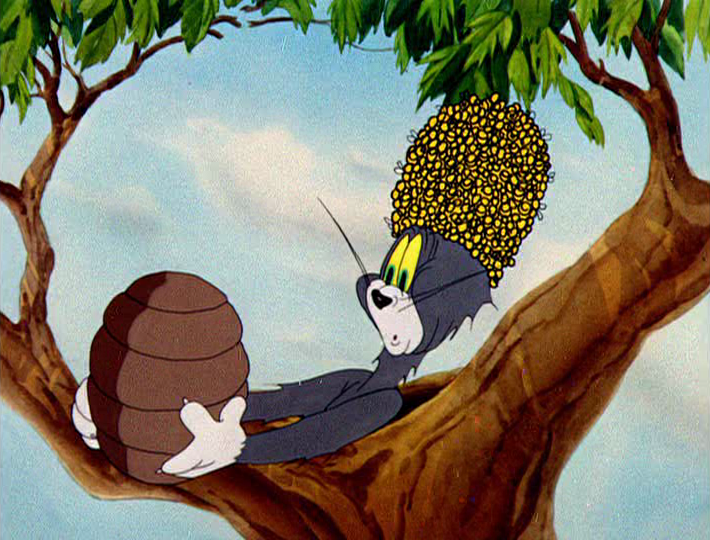
Bee is for Cat

Jerry shoves a bee hive on Tom’s head in Tee for Two (1945). Tom checks it out. The bees form an Abe Lincoln beard around the cat. He reacts.


Tom leaps up.


Besides Irv Spence, Ray Patterson, Ken Muse and Pete Burness get the screen credit for animation.

Sunday, 13 November 2016

He Liked Asparagus With Mustard

Jack Benny had his quirks. And with that statement, we proceed to learn about none of them. What we do get in the January 1934 edition of Radioland magazine is a nuts-and-bolts account of the highlights of Benny’s career, touching only when necessary on his personal life.

I’m presuming the author is the same Cedric Adams whose career at WCCO in Minneapolis spanned the Golden Age of Radio and into television. The tone of the article is pretty newsy and matter-of-fact, not filled with the hyperbole and coziness you find in fan magazines of the day. Benny’s comments about hanging gags around a situation equalling success proved to be quite true. Hardly quirky at all.

A Benny for Your Thoughts
Jack Benny Started in Vaudeville as a fiddler and Became a Star Radio Comedian

By Cedric Adams
WHEN a man's favorite dish is cold asparagus and mustard sauce you may expect here and there in his background a curious trait, a peculiar circumstance. Some people call them quirks. Jack Benny, former star of the famous Canada Dry (a nickel back on the large bottle) program, and principal attraction on the new Chevrolet series of weekly broadcasts, has his quirks.
Examining the Benny beginnings, it is apparent that he's entitled to them. He got a break the day he was born. He was a Valentine's present to his mother and father on February 14, 1894. The Kubelsky family (Jack's father and mother) lived in Waukegan, Ill., a suburb of Chicago. Jack's mother thought it would be better if the Benny heir were born in a larger city than Waukegan. It would be simpler for the child later on in life when people asked where it was born for it to say Chicago rather than Waukegan. That's why the event took place in the metropolis.
Mr. Kubelsky ran a haberdashery business. When Jack was old enough to start making a living the business of selling shirts, socks and neckties didn't have much appeal. With the clothing business definitely out, Jack cast about for a means of making a living. As a child he had taken a few lessons on the fiddle and became fairly proficient at playing the popular tunes of the early 1900's. After finishing high school he organized a dance band, and played at the various Waukegan dances. The violin he played with the orchestra was an Amati, an expensive make. It proved a good investment, however, for it was the same violin that was to land him at the top of the nation's professional entertainers.
Benny's entrance into the theatrical business was a curious thing. His first job in show business. was doorman in a Waukegan theater. It was that job that started him definitely on a theatrical career. The property man in the theater quit and Benny took the job. While he was handling the props in the theater, the yen for the fiddle came back. A year later he was playing in the pit orchestra.
Show business changes come rapidly. The Waukegan house closed and sent Fiddler Benny into a twenty-year stretch of vaudeville. His first act was a violín-piano act, vastly different from the calm, ironic, succinct humor of the Benny shows today.
In 1918 Jack started as a single entertainer.
With him went his fiddle. There were not very many performances, however, before the violin pieces shrunk and the jokes increased. It was adding gags to this act that launched Benny on a career as one of the originators of what we know today as a Master of Ceremonies.
Out of vaudeville into the revues was a short jump. His first "big-time" came in a Shubert show at the Winter Garden in Great Temptations. Jack re-entered vaudeville in 1926 at the Palace in Chicago as Master of Ceremonies. This tour landed him at the Orpheum in Los Angeles. In one of his audiences one night sat several motion picture moguls. They watched the smoothness of his work, recognized in him picture possibilities.
WITH the expiration of his vaudeville contract he signed for his first big picture, The Hollywood Revue. There is nothing quite so pleasant to the movie executives as the clicking of the turnstiles and Benny twirled them. After the success of this picture, Jack Benny made two more films for Hollywood. In 1930 Earl Carroll selected Benny for the big spot in his Vanities. The show played in Gotham for a year and toured another year as a road show. Jack's start in radio was another irregularity in the comedian's life. A New York newspaper columnist was planning a broadcast over one of the New York stations. To give a little variety to the program he solicited the aid of the Benny fellow.
Jack dashed off his script in a couple of hours, went down to the station with no more than his customary urge to entertain. Something about his presentation, his radio audience appeal created a stir in listening circles. The next morning radio critics on the New York papers had paragraphs on the new radio find. Among the tuners-in that night also were members of the advertising agency who were handling the account of Canada Dry. A week later Benny was signed for his first long-time radio contract. Subsequent weeks built Mr. Benny into what many consider the highest paid radio entertainer in the world. Jack doesn't like to discuss openly the figures of his new Chevrolet contract. He did say, however, that he'll probably make more in one half hour program than he would have made all year in the haberdashery business in Waukegan.
A story heard commonly about radio comedians is that they buy all their material from a syndicate of joke writers or dig through old files of joke magazines. Benny's method is neither of these.
During his vaudeville and stage career he wrote every line of his comedy himself. The demands of a twice-weekly broadcast were a little too heavy. One man could not possibly supply sufficient material to lend variety to a series of programs. For years Jack had been an intimate friend of Harry Conn, famed Broadway wit. Arrangements were made for Harry and Jack to collaborate on their radio programs. Today Jack gives Mr. Conn a great deal of credit and praise for the success they have achieved over the air.
THE Bennys have a serious eye on the future. Jack, for instance, believes now that the straight gagging, joking, punning radio comic is on the way out. "When the entire field of humor can be reduced to six or seven basic gags," he says, "there can't be much variation. The modified versions of the original jokes are pretty well shopworn right now. The situation comedy, the type I've used in my three series of commercial programs, has years to go before it will become tedious to the listener."
If you can't step up in front of a microphone and make good, if you can't please the audience there's something more to blame than the fact that you might have whistled in the dressing room before he took the air. And when you're wowing them you can whistle all day and it won't break them." In January 1927, Jack married Sayde Marks who is the Mary Livingstone you've heard over the air with him. His pet name for her is Doll. Her pet name for him is Doll. Their married life is exemplified by their roles in the programs. They laugh themselves through life, enjoy each other thoroughly.

Saturday, 12 November 2016

The Evolution of Tom and Jerry

They won seven Oscars. But did anyone notice. Or care?

Tom and Jerry came along in 1940. In the 1930s, critics fell all over themselves praising the Walt Disney cartoon shorts. Other cartoon studios made imitation versions of them. Then came Snow White in 1937. Everyone stopped talking about cartoon shorts and heaped praise and attention on Walt Disney’s features through the 1940s. So, Tom and Jerry, despite all the Academy Awards and a rather impression body of work, were comparatively flying below the radar.

To be honest, Tom and Jerry got more publicity after the MGM cartoon studio was closed than when it was open. Bill Hanna and Joe Barbera moved from theatrical to TV animation, and the unexpected hit of The Huckleberry Hound Show brought a wealth of publicity for the Hanna-Barbera studio. Bill and Joe never let an interview pass without a reminder that they weren’t running some kind of rinky-drink, cut-rate operation. After all, they were the guys responsible for seven Oscar-winning cartoons. And they reminded people of that in interview after interview after interview for years.

In-depth newspaper features on Tom and Jerry prior to 1957 seem few and far between. But we’ve come across this one from January 24, 1956 in the Christian Science Monitor. It mentions Hanna and Barbera but quotes from Hal Elias, who seems to have been the main lot’s eyes, ears and nose on the cartoon division after Fred Quimby retired. My educated guess is that it was Elias who was “the accountant” Joe Barbera once said was the one who got the initial word the cartoon studio was closing. And, for whatever reason, the last paragraph that refers to the short Good Will To Men omits the fact the cartoon was a rehash of a 1939 MGM cartoon made by Hugh Harman.

Cat and Mouse Win Oscars
By RICHARD DYER MacCANN

Hollywood
The greatest stars in Hollywood today—by Oscar-reckoning—are two masters of make-believe mayhem known as Tom and Jerry.
Nobody knows how many times this durable cat and irrepressible mouse have flattened each other by means of some device that would dismember anybody else.
And hardly anybody, even in Hollywood, realizes that they have won seven Oscars. This makes them supreme, not only in the cartoon world, but in the whole wide world of Hollywood performers.
If stars are rated by the number of their Academy Awards, Tom and Jerry have a right to look down on Spencer Tracy and Fredric March. Two Oscars look pretty sparse compared to seven—or even three and a half.
As for all those statuettes in Walt Disney’s outer office, Hal Elias, manager of M-G-M’s short subjects department, gently but firmly explains that “no other cartoon character has won more than one award—not even Donald Duck.”
Meanwhile Tom and Jerry just go on forever—propelling each other from frying pans into fires, out of windows, through walls.
The terrible cat and the impudent mouse have changed somewhat since they won their first Oscar in 1943. (That was for “Yankee Doodle Mouse,” in which a Fourth of July them was carried out by having Jerry fly through the air in an egg crate labeled “hen grenades.”) For one they, they have slimmed down a little. That’s to be expected, considering what they go through.
They have also become more cultured, which you wouldn’t expect at all. Tom, besides graduating early to hind-leg locomotion, has played, with aplomb, the role of a concert pianist. Jerry, bright boy that he is, has taken to speaking French.
The inordinate and inexplicable enthusiasm which spread through theater audiences in response to this new wrinkle in Jerry’s vocabulary has meant that “Two Mousekeeters” was followed by “Touché Pussycat,” “Tom and Cherie” (cartoonists never could resist an irresistible title), and sooner or later, “Toujours Pussycat.” Public approval is not the only reason, by the way, for rushing out mousketeer sequels. The six-year-old mademoiselle from France who actually speaks Jerry’s lines is rapidly losing not only her youth but her accent.
* * *
Other global adventures have been given a boost by these Gallic successes. “Neapolitan Mouse” was made some time ago. “Mucho Mouse” will no doubt meet a bill in Madrid. It should be further noted—in some awe—that the basic pantomime of Tom and Jerry cartoons can be seen in the theaters of 58 countries of the free world.
I thought maybe if I brushed up on my “bon jours” I could weather an interview with their genial, bloodthirsty pair. But I was resolutely shielded from any direct encounter. Mr. Elias indicated that I would emerge with more information—and possibly with more breath—if I had a quiet talk with the men who do the drawing.
Bill Hanna and Joseph Barbera both started out in life to do something else. Mr. Barbera was comfortably installed in the Irving Trust Company on Wall Street, taking care of income tax returns for 1,6000 trust accounts. He was doing freelance magazine cartoons, however, “on the side.” Somebody once suggested that he look into an animated film company in New York, and shortly afterward he was lost to the banking business.
Mr. Hanna graduated from the University of Southern California with a minor in journalism and a major in engineering. While he was acting as a structural engineer for the Pantages Theater building (now the scene of Academy ceremonies), he fell off the girders a couple of times, and got less and less excited about a construction career. Somebody suggested animated films, and he signed up for art school. He also got a job washing “cells” (individual cartoon frames) for Hugh Harman and Rudy Ising, known as the “Harman-Ising” cartoonists.
After Mr. Barbera joined this melodious group and began working with Mr. Hanna, their division of labor worked out handily. The journalist-engineer now plans story outlines in detail and uses his slide-rule on the timing of sequences and music. The artist and tax expert takes major responsibility for roughing out the basic sketch-book, and incidentally keeps an eye on the expense of designing backgrounds.
This year they are expanding. Now that CinemaScope is firmly established, Metro has announced the addition of a second unit in the cartoon department [headed by Mike Lah, Hanna’s brother-in-law]. Last year there were only 12 new cartoons and 14 reissues. This year there will be 16 new ones, as in the past, and 24 are in preparation for the season to follow (8 of them remakes of old successes), all in CinemaScope.
* * *
Tom and Jerry, incidentally, are developing a new and friendly sense of buddy responsibility. In “Busy Buddies” they take care of a baby who has been left to the tender mercies of a telephone-happy teen-age baby sitter; they rescue the tiny explorer from many a perilous adventure. “Spike and Tyke” (bulldogs large and small) are moving out of the series to start one of their own.
There will be no riding to glory on an Oscar this year. Mr. Elias and his staff have surprised everybody by choosing for Academy exhibition an unusual “message cartoon.” Produced by the former head of the shorts department, Fred Quimby, it shows post-atomic mice singing Christmas songs in a ruined chapel. An elderly organist, leading the mouse choir rehearsal with his sensitive tail, stops long enough to try to describe to the little ones how “men” extinguished one another. Flashbacks of war contrast grimly with passages he points out in “their” Bible. “Too bad,” he sighs, “that they didn’t pay more attention.”

Friday, 11 November 2016

Peace On Earth

Backgrounds from Hugh Harman’s pride and joy, Peace on Earth (1939). The background artist is uncredited. So is the effects animator who drew the slow-moving clouds.


Harman and his artists had come a long way from Sinkin’ in the Bathtub.

Thursday, 10 November 2016

Cartoon Horse Runs To the Camera

Mickey Mouse’s runaway horse gallops toward the camera in The Plowboy. The animator uses a cycle of 32 drawings, one per frame. Here are some of them. I guess this was as close as you could get to 3-D in 1929. I imagine it still looks pretty effective on the big screen. (Oops! The horse’s bottom teeth lose their whiteness for a frame).


Here’s the cycle slowed down.


Hans Perk has posted the story drawings for this cartoon. See them at his excellent site.

Wednesday, 9 November 2016

John Crosby's First Radio Review

Radio and television of the 1940s and ‘50s needed someone to tell it the Golden Days weren’t always so golden. That someone, at least in the minds of many, was John Crosby.

Crosby was handed a radio column by the New York Herald Tribune, which did him the great favour of syndicating it across North America. Newspapers generally ran a “radio highlights” column and may have had PR chatter about some radio stars in gossip columns. Crosby was different. He had a standard that he thought radio should meet and when it didn’t, he didn’t mince words about it. Readers (many, at least) found him refreshing. Editors found him quotable and his quips would end up on the editorial pages. Crosby moved seamlessly into the TV age.

I admit I haven’t researched when Crosby’s column ceased; the Herald Tribune stopped publication in 1962 and had two other TV editors by the time it shut down. But I can tell you his first column appeared on May 6, 1946.

In it, Crosby talks about a show that’s forgotten today. Forever Ernest only ran from April 29 to July 22, 1946 as a summer replacement for Vox Pop. It was sponsored by Bromo-Seltzer. It sounded like the sponsor needed one after listening to an episode. It gave up on Jackie Coogan’s show and put its money behind Inner Sanctum instead. “Duke” mentioned in Crosby’s review was played by Arthur Q. Bryan, the voice of Elmer Fudd. The girl was Lurene Tuttle, one of radio’s most in-demand actresses.

The other sitcom he talks about starred one of Vancouver’s gifts to old-time radio: Alan Young. And considering how much he liked the character, it’s interesting Crosby doesn’t identify the actor who plays Hubert Updike on Young’s show. As radio fans likely know, it was Jim Backus, using the voice he later gave to Thurston Howell III on Gilligan’s Island. The show also benefitted from the talents of Kenny Delmar and Parker Fennelly. The sponsor hated their characters, a loud-mouthed politician and a farmer from New England, so they were kicked off the show. Fred Allen, knowing talent and comedy when he heard it, grabbed them and turned them into Senator Claghorn and Titus Moody. The rest is history. (The sponsor, incidentally, was Bristol Myers, makers of Sal Hepatica). Over the years, Young had a number of different shows on radio and TV, playing earnest young men inexplicably getting into uncomfortable or improbable situations. One of them involved a talking horse. You know the show.
RADIO IN REVIEW
By JOHN CROSBY

[Mr. Crosby begins today a column of comment on radio programs which will appear Monday through Friday each week.]
In the Footsteps of Harold Lloyd
In the mid-1920s Harold Lloyd earned a respectable fortune with a screen characterization that became almost as standardized as Charlie Chaplin’s tramp. Over and over again, to the delight of his millions of fans, Mr. Lloyd played the part of a wide-eyed, timid, awkward but lovable youth who blundered into preposterous situations that didn’t fit her personality. Therein lay the laughs. At the end, of course, Mr. Lloyd always landed somewhat precariously on his feet with the girl in his arms.
Radio, which, after all, is only half the age of the movies, has rediscovered this formula and plunged into it with the enthusiasm of a bobby-soxer hearing the “Liebestod” for the first time. Latest performer to work the old vein is Jackie Coogan, who was starring in pictures just about the time Mr. Lloyd was hanging from that clock in “Safety Last.”
* * *
In his new program entitled “Forever Ernest”, (WABC 8 p. m. Mondays) which started last week, Mr. Coogan plays a lovelorn soda jerk of such fragility that his girl knocks him cold with a single, accidental punch. For half an hour, he stumbles all over his own feet but at the end he has the gangsters covered when the police burst in.
“Stop biting my finger nails,” Mr. Coogan tells his smoothie friend Duke who gets him into all these difficulties.
“She’s really not a girl. She’s more of a blonde.”
Those two lines exemplify the comedy which was fairly sparse the night the program started. In its opening episode the writers have endeavored to mix comedy and melodrama and wound up with a hash which wasn’t either one or the other. Each of these episodes, I take it, will be complete in themselves, and if you’re interested you can tune in tonight.
* * *
However, my advice is to wait until Friday night and to listen to the Alan Young show (WJZ, 9 o’clock), where the Harold Lloyd pattern is utilized far more skillfully. Mr. Young is a twenty-eight-year-old Canadian-born comedian who won a name for himself in his native country before coming to the United States in 1944.
He plays Mr. Lloyd’s old role with a broad wink at the audience which, in this atomic age, it badly needs. The whole program, in fact, kids itself unmercilessly. Mr. Young engages in a running feud with a character named Hubert Updike, a rich boy with a Harvard accent and a Cadillac, who attempts to lure Alan’s girl away with his pretty promises and says “Gloat! Gloat! Gloat!” when he thinks he has succeeded. The show is considerably enriched by the presence of Jean Gillespie, a very clever comedienne indeed. When I listened she was going Hollywood with a feminine intensity that I found very amusing.
“I’ll throw myself into the reservoir,” says Alan, who disapproves of this Hollywood business.
“I don’t care.”
“Do you realize you have to drink that water?”
* * *
It’s that sort of comedy and much of it is pretty funny. As you’ll readily recognize, this ground has been spaded before, but Mr. Young’s writers have, as it were, refertilized it with great ingenuity. I have only two objections to the show I heard. One was a Jane Russell joke of questionable taste. The other was the fact that George Jessel, that tireless guest star, somehow got mixed up in the festivities and dampened them considerably.
I hope Mr. Young steers clear of Miss Russell in the future. As for Mr. Jessel, I don’t imagine he’ll be around again for some time, at least on the Young show. You can’t really avoid Mr. Jessel entirely unless you turn the radio off.
Later in the week, Crosby tackled windfall giveaways to people with pathetic stories, The Theatre Guild of the Air, Mr. District Attorney, and shows with breathless teenaged girls. He ended with a rave about Fred Allen’s “Mr. and Mrs. Morning Show” parody with Tallulah Bankhead, one of Allen’s all-time great sketches. We’ll try to transcribe that one.

I enjoy Crosby’s columns and agree with much of what he has to say. A number have been posted on the blog already. When I find time, I’ll put up a few more.

Tuesday, 8 November 2016

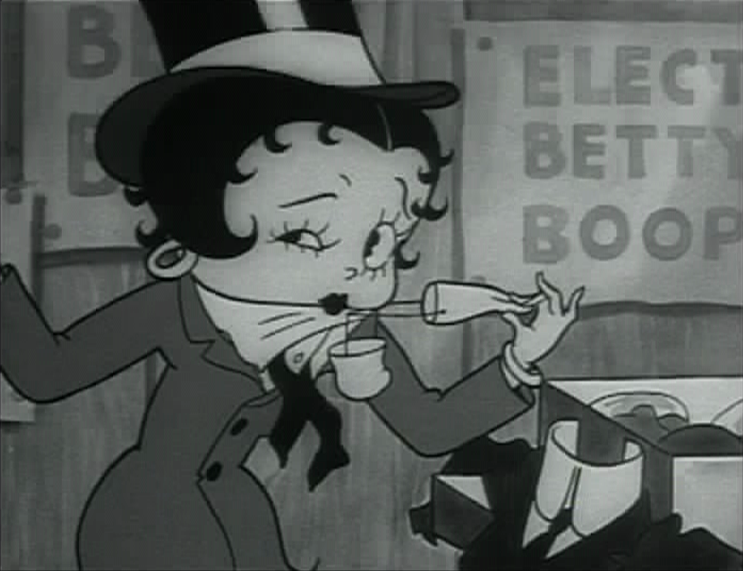
Betty Boop For President

Betty Boop sings a push for votes in Betty Boop For President (1932). And she does impersonations, too, morphing her appearance. Oddly, she doesn’t turn into F.D.R., who won the election that year.


The stiff collar indicates Betty is doing an impression of President Herbert Hoover.


She’s now Al Smith, who lost the Democratic nomination in 1932 to Roosevelt (after losing the presidential vote four years earlier). Comedians made fun of the fact that Smith insisted on calling a radio a “raddio.” Betty does that, too.


Gag’s over. She pulls down the brim of her hat and becomes Betty again.


Betty wins the White House at the end of the cartoon, thanks no doubt to animal rights activists (cars are stopped to allow cats to cross a city intersection) and supporters of heterosexual conversion therapy (a hard-boiled inmate is effeminised).

Seymour Kneitel and Doc Crandall get the animation credits. Mae Questel is Betty. I don’t know if New York-based radio mimic Johnny Woods supplied the voices of Hoover and Smith; I’d have to listen more carefully to see if it sounds like him.

Monday, 7 November 2016

Blast That Tongue

Tex Avery made several cartoons involving noise and escaping it so someone doesn’t hear it. There’s Rock-a-bye Bear, Deputy Droopy and, in a variation on the theme, The Legend of Rockabye Point. All of them zip along with one gag flowing into the next.

Here’s one from Rock-a-bye Bear. The conniving little dog gets Spike caught in a dining room table. He puts a stick of dynamite on Spike’s tongue. Anyone who knows the format of these cartoons can figure out what happens next. But Tex twists things by adding a piece of action after the tongue zooms back into the house and Spike’s mouth. The tongue slaps Spike across the face.


Both Rich Hogan and Heck Allen get story credits in this 1952 release. As far as I know, Hogan left MGM when Avery took some time off around May 1950 and was replaced by Dick Lundy. So it could be that the story stage of the cartoon was started before Avery left and completed when he came back.