Wednesday, 26 March 2014

From the People Who Brought You Woodlo

Bob and Ray were perfect for radio but it was mandatory for anyone who was a radio success story in the early ‘50s to move into television. They did. And then they moved back into radio and pretty much stayed there.

Bob Elliott and Ray Goulding were a unique hybrid. They were, basically, a disc jockey duo that didn’t play discs. They played spoofs of radio instead. They took the ridiculous parts of the medium—banal-dialogued soap operas, slogan-dripping commercials making outrageous claims, recipe-laden housewife programmes, man-on-the-street interviews with redundant answers—and expanded them to their even more ridiculous conclusions. Unlike the satirically-minded Fred Allen, Henry Morgan or even Stan Freberg, they didn’t rely on stooges—except on TV—or have their cadence dictated by laughs of a studio audience. They did it all themselves, and extemporaneously for much of their early career. Listening them play off each other and dropping non sequiturs along the way is astounding and confounding. How they did it, I don’t know. Perhaps they didn’t either.

I didn’t realise the blog had been absent of Bob and Ray clippings. This being Bob Elliott’s 91st birthday, it’s a good time to post a couple. They’re from the period the two were put on television by NBC while still performing completely different shows on radio. It must have been a grind.

They were originally assisted on TV by a young actress named Audrey Meadows who later got hired to work for Jackie Gleason and, well, you know the rest. There’s something about television that doesn’t quite work for them as well as radio. It could be the primitiveness of the medium at the time. It could have been a format where they didn’t really host their own show; Bob Denton introduced their sketches. Or it could have been they’re funnier when the audience can use its imagination to picture what’s going on. Regardless, here’s an Associated Press story from January 13, 1952.

Foolish Fun Brings TV Fame For Zany Pair, Bob and Ray
By CYNTHIA LOWRY

Associated Press Staff Writer
New York — The Smithsonian Institution of Washington, D. C. recently was deluged with postcards and letters each requesting "Bob and Ray's Home Dismantling Kit and Manual."
It reached such a point that the management was forced to send out quantities of form letters stating in part that "the announcement . . . was in error."
This team of uninhibited satirists now is visible and audible on four separate radio and television shows. They bark joyfully at almost any phase of life which seems unwarrantedly serious, but their specialty is nipping gently at the pomposities of radio and television. The boys cover considerable territory in their antics and remind many old-timers of the fresh, breezy and genuinely funny hi-jinks of the late Colonel Stoopnagle and Budd.
Bob and Ray make a point of interviewing persons with unusual occupations (Ray usually plays the guy with the unusual job). Just the other day, he did a moving bit demonstrating on television the technique of inserting tissue paper in wedding announcements.
• • •
ELLIOTT and Goulding are a pair of native New Englanders, who occupationally suffered through long hours of radio's journeyman fare, particularly the daytime menu. Radio announcers by trade, they met for the first time in 1946 when they were discharged from their GI war chores and picked up jobs at the same Boston station.
Bob, now 28 and handsome in a pixie way, was doing a morning disc jockey show, long on recorded music and mimeographed commercials. Ray, 29, mustached and a frustrated heavy, came into the show every hour on the hour to read news bulletins.
Ray took to hanging around the studio and engaging in extemporaneous and—it turned out—funny dialogue, imitations and kidding with Bob. Boston and environs took the boys to its stern New England heart, and next thing they were a team with their own half-hour show every afternoon. Then came New York and an NBC contract.
They developed their repertoire during the next few years. Now each has about seven different voices, including shrill, feminine falsettos, which permit them to play multi-character dramas.
• • •
ELLIOTT and Goulding also delight in commercials, ringing in all the familiar voice switches and appeals to the pocketbook. For some months they've been plugging a product called "Woodlo." This, they assert, is the "new miracle wonder product all America is talking about," which saves half the usual cost and, finally, "is immunized."
What it is and what it does they never have divulged.
Merrily they take apart the popular women's programs with a Ray-played character named Mary McGoon. On television, she is a headless character in front of a work table who nightly demonstrates new and horrible recipes, easily prepared.
Occasionally Mary will undertake a gruesome demonstration of flower arranging or show how to whip up a little house dress.
Away from microphones and television cameras, Bob and Ray are a couple of unassuming, serious young men working earnestly to keep up with the demands of a frightening schedule of broadcasting, a total of 15 1/2 hours a week.
Like so many other comedians, they are almost inarticulate about themselves, their aims and methods. Both have a shy, elusive way of speaking, rarely ending sentences they start.


This National Enterprise Association story is from November 21, 1952.

NBCs Bob and Ray Are Gentle Spoofers
BY RICHARD KLEINER

NEW York (NEA)— Trying to interview Bob and Ray during rehearsal is something like trying to interview two cows at milking time. They have too much else to do.
It's understandable. At one and the same time, Bob and Ray practice their lines, discuss camera angles, plan film backgrounds cut the script, make alleged jokes and otherwise keep busy. Through it all, they manage to maintain their usual air of well-regulated boredom. Bob Elliot, the short, wavy-haired one, and Ray Goulding, the tall, non-wavy-haired one, are the NBC comedians who have built the gentle spoof into a way of life. Their style is such that they might be called Henry Morgan with two pair of pants.
Rehearsing, they relax in folding chairs. The directors, script girl's, technical people and assorted hangers on march back and forth excitedly, but not Bob and Ray. They read their lines with all the spirit of an elderly snail. They debate about the script with all the fervor of a retired turtle.
"Well," Ray will say in a burst of emotion, "I'm not red-hot about the line. You can kill it if you want to."
• • •
ABOUT the only time they show any real enthusiasm is when they kid Audrey Meadows.
She's a tall redhead who appears on the program for the sole purpose, apparently, of wearing funny hats. She shows up for rehearsal in a dazzling leopard skin coat.
"Somebody give you seat covers?" Bob and Ray gently spoof.
"No I have a half interest in a zoo," she gently spoofs back.
At intervals, the interview proceeds. The following definite facts are learned; (a) Bob and Ray like what they're doing; (b) Bob and Ray prefer radio to television but "we have to face facts"; and (c) Audrey Meadows has a leopard skin coat.
More in store: Good things on the way to TV screens include a video version of CBS' famous radio series, You Were There. It's due in February . . . . Also coming is Life With Father and Mother, based on the Clarence Day stories that made wonderful books and plays. Dennis King and Martha Scott will be starred.


Bob and Ray appeared in a variety of formats for years on the radio. The 15-minute shows out of New York had a different feel than the “Matinee with Bob and Ray” half-hours they did for local radio in Boston in the mid to late ‘40s. It’s hard to say if one was better than the other. The half-hour shows drag at times, but Elliott got a chance to toss in his funny Arthur Godfrey impression and other staff members would drop in to kind of fill time until the next sketch. One of them was announcer Norm Prescott, who later achieved fame as one of the wheels behind the Filmation cartoon studio. The quarter-hour shows are slicker and go by almost too quickly. They feature perfected versions of the characters and situations developed on their original show in Boston. One broadcast has Elliott doing a Fred Allen voice for no particular reason for a few lines which must have delighted Allen fans.

After their TV shows went off the air—they were replaced on “Club Matinee” by Mindy Carson—they moved back into radio, with occasional forays onto the screen. They were regulars on NBC’s “Monitor” in the ‘50s. They appeared on WOR, of Mutual fame, in the ‘70s. And their humour found a welcome place for a number of years on National Public Radio. The old shows they spoofed, like “One Man’s Family” and “Ladies Be Seated,” are long gone. But so long as there are things in the world which don’t quite make sense that words can make even more nonsensical, people should enjoy the old work of Bob and Ray.

Tuesday, 25 March 2014

Dance of the Roast Duck

A weird, cross-eyed version of Bimbo takes to the stage along with the roast duck he’s supposed to be delivering to a customer in “Dizzy Dishes” (1930). Note the kitty chorus.


The roast duck takes on a life of its own, as just about everything does in a Fleischer cartoon. It dances.


It lays an egg and gives birth to another roast duck—which dances, too. Inspired stuff.


Eventually, Bimbo and the duck get chased by the customer who ordered the the roast bird, which eventually flies out of the cartoon.

Dave Fleischer is generally given sole credit for gags on the Fleischer cartoons. Grim Natwick and Ted Sears got the animation credits.

Thanks to Devon Baxter for the screen grabs.

Monday, 24 March 2014

Roll Up the Door

Tex Avery’s impossible humour in “Lonesome Lenny” doesn’t wear itself out because it’s a lot of fun to see how Tex executes it.

Here’s a familiar looking gag, pulled off at the usual breakneck pace. Screwy Squirrel goes through a door. But he’s able to roll up the door so Lenny crashes into it.


The gag being finished, the door is back to normal. Lenny opens it and moves on to the next gag.


Heck Allen was Avery’s writer on this one. Ed Love, Preston Blair, Walt Clinton and Ray Abrams are the credited animators.

Sunday, 23 March 2014

Voice of Benny

Some time ago, Tim Lones sent us a note about a Jack Benny radio appearance in 1930. It was in connection with a post here debunking what Benny claimed for years that his first radio broadcast was on the Ed Sullivan show in 1932. Tim mentioned a programme called “Voices From Filmland.”

We stumbled across an ad for the show featuring Benny, which you see to the right. It appears Benny only made a guest shot on the broadcast of January 20, 1930. Unfortunately, I haven’t found anything which specifically states what Benny did on the programme.

The show was broadcast over CBS. The Buffalo Courier-Express of January 12, 1930 describes it thusly:
Voices from Filmland, which began January 6th, originates at KHJ in Los Angeles and presents each Monday evening at 7.30 o'clock (Eastern standard time) music by the Los Angeles Biltmore orchestra, the Biltmore Trio and the M. G. M. studio orchestra, as well as bits from current talking motion pictures. With each program several well-known movie stars will appear.
The debut date may have been incorrect or incomplete. There’s a listing for a “Voice of Filmland” broadcast on a Tuesday morning in June 1929 on a Pittsburgh station.

“Voices From Filmland” aired opposite “Roxy and His Gang” on NBC-Blue and “Piano Twins” (Lester Place and Robert Pascocello) and “Back of the News In Washington” (Elliott Thurston) on NBC-Red. It seems to have been broadcast live from the West Coast; in 1930, few shows did because of the availability and cost of broadcast-quality lines.

The show didn’t last long. The last broadcast was on April 7th.

Saturday, 22 March 2014

Oswald Fades Out

Starring cartoon characters come and go, just as starring actors do in live action. There probably weren’t too many movie-goers in the 1940s lamenting the disappearance of Tom and Jerry (Van Beuren version) or Columbia’s Scrappy or Iwerks’ Flip the Frog. They may not even have noticed.

But at least one person was paying attention to the fading animated stars of yester-years. Here’s a little column by Robbin Coons, who spent part of his newspaper career with the Associated Press, and some of it as a freelancer in Hollywood. This is from November 24, 1943. I’m particularly pleased to see a mention of Lantz animator Pat Matthews. Individual animators, especially outside of Disney, didn’t get much recognition back then.

HOLLYWOOD
By Robbin Coons

HOLLYWOOD—Some of the greatest actors in our town get through their entire careers without squabbling over money, billing, or roles.
They do exactly as they're told, all the time. They’re never jealous of each other. They’re never in the scandal columns. They don’t get divorces and they don’t have fist fights in night clubs. They’re a movie producer’s delight and joy—these creatures compounded of ink and paint and imagination for the screen cartoons.
But even in this realm of fantasy, actors who ride the crest of popularity today may be tomorrow’s has-beens.
• • •
OVER at Walter Lantz’s cartoon studio, looking over some of the new work there, I glanced at the little board on which, in neat lines and squares, the producer outlines his year’s shooting schedule. I looked in vain for any mention of that old friend named Oswald the Rabbit. “Oh,” explained Walter, “he’s there—in ‘The Egg-Cracker Suite.’ We use Oswald in just one a year now, for Easter release.”
Predominant on the schedule were the “Swing Symphonies,” which are based on current or forthcoming (Lantz hopes) song hits: “The Greatest Man in Siam,” “Abou Ben Boogie,” “Boogie Woogie Bugle Boy of Company B,” and so on. Andy Panda (who, I suspect, is the animal who booted Oswald down the chute) is down for three appearances, and an upstart named Woody Woodpecker grabs four.
It’s sad about Oswald, who was bequeathed to Lantz when Walt Disney left Universal in 1926 to go on his own, but less sad than the fate of the first cartoon characters Lantz worked on, when he began in 1916. They were cartoons based on a couple of comic strip characters who have long been off the screen entirely. Oswald at least has been put to clover, like an honored veteran.
• • •
AT Leon Schlesinger’s, the Intrepid Bugs Bunny has all but sidetracked Porky Pig, while at Disney’s Mickey is no longer the fair haired Mouse because the obstreperous D. Duck gets first quack at everything.
Lantz had on display a new creation, a glamour girl of the ink-and-paint pots, the heroine of “The Greatest Man in Siam.”
“Maybe,” said Walter, “she’ll get to be a pin-up girl and we can star her again.”
Maybe so—but Pat Matthews, the young artist who created her, was at his drawing board working on another tasty dish in a hula skirt. Maybe the girl from Siam was headed for Oswald the Rabbit’s clover field already.


Oswald was pretty much relegated to comic books after “The Egg-Cracker Suite,” though he did appear on TV for a period when Lantz sold 179 of his aged cartoons to television in late 1954. Thanks to animation historians, interest was revived many years later as people got to see some of the old Oswald cartoons until he was finally purchased by Disney and made another part of their vast product line.

As for Matthews’ Miss X, she ran afoul of censors, according to Lantz, and was dropped after only two entertaining cartoons. And while other cartoons were on the horizon with starring characters, none were more popular for Walter Lantz than a certain woodpecker.

Friday, 21 March 2014

Kitchen of Tomorrow

An MGM cartoon featured the house of tomorrow, today. No, it wasn’t Tex Avery’s “The House of Tomorrow” (1949). It was “Inside Cackle Corners,” released by the studio on November 10, 1951. Strictly speaking, it wasn’t an MGM cartoon. It was produced by the John Sutherland studio and made for Harding College as an educational film to tell Americans how great capitalism was, with wealth and happiness for all.

Boxoffice magazine reviewed it thusly in its edition a week after the release:

Inside Cackle Corners
MGM (Cartoon) 9 Mins.
Very good. The law of supply and demand is examined in a humorous vein. Mrs. Consumer is a steady customer in one shop until she is lured away by more progressive merchandise and lower prices in the store across the street. The first merchant discovers that his competitor’s success is due to re-investing profits. He does the same thing and wins Mrs. Consumer back. In Technicolor.


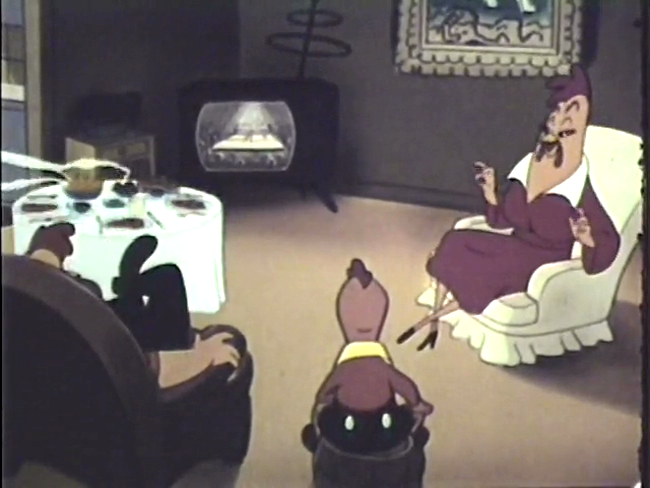
At the end, we see Mrs. Consumer’s modern home (part of the foreground is on an overlay), where a piping-hot dinner for the whole family automatically. An electronic gadget decides on its own that a dinner for three is in order. It beams a light to a box on the wall, a table comes out from a cupboard, stops under something that automatically drops place settings and food on it, then scoots into a cooker, then into the living room where, in an end gag, the family is watching wrestling on TV.


Art direction is by Gerry Nevius and Ed Starr. Animation credits go to Phil Monroe, late of Warner Bros., Arnold Gillespie, Bob Bemiller and Armin Shaffer, formerly of Disney. More top radio talent is in the cast; Herb Vigran (who narrates) and Frank Nelson should be easily recognisable. So should the other two voices but I can’t name them.

“Inside Cackle Corners” isn’t really as fun as some of the other Sutherland entries for Metro; “Make Mine Freedom” (1948) is far more visually interesting. This was the final cartoon from the studio released by MGM. Sutherland carried on to make some stellar industrial films.

Thursday, 20 March 2014

Hound vs Hound

A bulldog unexpectedly tries to make time with George disguised in a dog suit in Tex Avery’s “Hound Hunters.” He turns around them trots right into the face of a huge dog.


Avery pulls back the camera so we can see the take.


The bulldog kind of dog paddles in mid-air before galloping away.


Ed Love, Walt Clinton, Ray Abrams and Preston Blair get the animation credits.

Wednesday, 19 March 2014

Ridin’ to Rigor Mortis

The opening scene of “Wild and Woody” (1948) shows the Walter Lantz studio at its best. Woody is gesturing as he rides a pony, singing “Bury Me Not on the Lone Prairie.” He’s expressive. He drops down to lay on the horse during part of the scene, then forms his fingers like guns and flips them around. Top animation. It’s by Disney veteran Freddie Moore. Here are some frames.


The pony’s attractively designed and has a cute little trot cycle. Part of it is on twos at the start but then is completely animated on ones. Darrell Calker’s score complements the action nicely. Even the usually-flat Bugs Hardaway may never have sounded better than when he crooned the opening tune. And Lionel Stander is the best cartoon villain next to Billy Bletcher. He’s great as Buzz.

Ed Love and Pat Matthews receive the animation screen credits. Lantz had Disney’s Ken O’Brien besides Moore at the time as well. And La Verne Harding. A great animation team with director Dick Lundy and newly-acquired gagman Heck Allen that, unfortunately, was gone not too many months later.

Tuesday, 18 March 2014

No Swearing Now

Big mouth, little head? Must be a Bob McKimson cartoon. Here’s a scene from “Paying the Piper,” released in 1949. Manny Gould at work?


The cat’s about to say something he shouldn’t. A convenient hand saves the ears of the movie theatre audience. The first drawing looks like something from a Bob Clampett cartoon.


Gould, John Carey, Chuck McKimson and Phil De Lara get the animation credits.

Monday, 17 March 2014

A Portrait of Fred Allen

When Fred Allen died on March 17, 1956, there was a great outpouring of respect for his work—and a few attempts to tell the story of the “real” Fred Allen.

Allen didn’t have the reputation as a warm man. He wasn’t someone audiences could really identify with like Jack Benny, or, rather, the character on radio Benny played. People tuned in to Allen to hear him turn a phrase or stick it to deserving targets, like politicians and radio management.

Radio columnist John Crosby was a great admirer of Allen’s, perhaps they both hated the triteness, phoniness and incompetence of the radio industry, both on and off the air. Both were based in New York. Crosby interviewed Allen a number of times and got to know him pretty well. Here’s his tribute to Fred Allen, the person, in his column of March 21, 1956.

Tribute Paid To Kindness of Fred Allen
By JOHN CROSBY

NEW YORK, March 21-- Under a dour exterior, Fred Allen was the kindliest man imaginable. Swarms of out-of-work actors descended on him regularly for handouts which were never refused. There was one actor who put the bite on him every Sunday after church. One Sunday the guy didn't show up and Fred got so worried he went looking for him.
The radio feud between Jack Benny and Fred Allen was legendary, but actually the two men were close friends and their admiration for each other was boundless. But this didn't prevent them from heckling each other unmercifully on stage. Once Benny was appearing on the Paramount stage and Allen sat in the front row and hurled one witty insult after Another at his old friend. After one quip, Benny, non-plussed, waved a $20 bill at the audience and offered it to anyone who could top Allen's last gag. Instantly Allen was on his feet, topped his own gag with a better one, and walked up and claimed the $20.
Fred was a wit's wit. There is not a humorist alive who did not admire him extravagantly, but none imitated him because they couldn't. His was a wonderfully original and well-stocked mind and he had the gift of bringing two frightfully irrelevant things into the same sentence. It was the humor of the ludicrous and a very penetrating wit it was but it does not reproduce well.
His humor was very much of the moment. I remember having lunch with Fred once just after the first atom bomb had gone off at Bikini and had proved to be a bit of a dud. I asked him if he'd heard the broadcast and he said, "Yes, nothing disappeared but the OPA." Well, the OPA had gone out of existence that weekend and it was a very funny remark then, but it doesn't make much sense today. I bring it up only as an example of the way Fred could take two totally unrelated subjects and combine them into one fast quip.
Even his prose style defied imitation. He had a horror of cliche and every sentence that came from his lips hid a newly minted freshness that was unique, even among very literate men. To him, even "hello" or any other ordinary salutation was a cliche and he avoided any form of routine greeting. He'd greet you, on say, a hot day with: "It's so hot out I could take my skin off and sit around in my bones."
In his early days he billed himself as the world's worst juggler and he just about was. He'd keep dropping the Indian clubs and to cover his confusion he'd make wisecracks that would convulse the audience. Actually, Fred was the last of three great American humorists who started the same way. The other two were W. C. Fields, who was a little better juggler than Fred but still no world beater, and Will Rogers, whose rope act was pretty fair, but not much better than that. All used wisecracks to cover their inadequacies with the props and grew into national institutions.
Fred's death came as a particularly terrible shock to me because he took such very good care of his health. He didn't drink or smoke and his diet was of such austerity that rabbit would find it dull. In fact I always thought he'd live to be 103. He had high blood pressure and he had consulted so many doctors and read so many books on the subject he knew more about it than they did.
Any sort of new medical fad would receive his most earnest attention. Once in Florida he stumbled on a cult that believed in fasting as a cure-all for everything. People subsisted on nothing but distilled water for weeks. Fred was fascinated by the project and its effect on the patients.
He was a very simple liver. For decades, although he was a millionaire, he lived in a little apartment on West 38th St. He used to eat lunch every day at the corner drugstore. He never owned a car and never learned to drive. It wasn't parsimony; it simply that luxury didn't mean anything to him. He never got away from the common people and he had a wide acquaintanceship in his little neighborhood with delicatessen store proprietors and local cops.
His kindliness was fabulous. Once a delicatessen store proprietor, a friend of his, lost his liquor license because gamblers had been hanging out there. Fred bought the place, got a liquor license in his own name and turned it over to his friend to run. At the time of his death he was working on his autobiography and he kept looking up old friends of his vaudeville days for material. Every time he found one of these old chums, most of them down on their luck, it cost him the price of a new suit. He loathed sham of any sort and he considered the broadcasting industry, which made him famous, full of it. He always regarded network executives as overgrown office-boys and he was incessantly battling them.
"If the United States can get along with one vice-president, I don't know why NBC needs 26," he once said. Among his other pet dislikes were Hollywood and Southern California. "It's a nice climate," he remarked of California, "if you're on orange."
He also took a dim view of agents and he once remarked of his agent: "he gets 10 per cent of everything I get except my blinding headaches." Years ago Fred was a pretty good drinker, averaging a bottle a day. The day prohibition was repealed he stopped drinking entirely, claiming that he'd drunk so much poison that the good stuff would probably kill him.
The end was sudden. As John Huston remarked after the death of his death: "He was too good a man to be sick. When the time came, he just died."


NBC took a bit of time for their own tribute to Allen. It came on the hour-long sustaining programme “Biography in Sound.” It was first broadcast on May 29th then rebroadcast on December 18th. You can hear the later broadcast by clicking on the arrow. It was written by Earl Hamner, who later created “The Waltons.” I believe the staff announcer giving the ID at the start is Radcliffe Hall and at the end is Vic Roby.