Friday, 19 October 2012

Into the Inkwell

Any child of five should easily be able to grade the Popeye cartoons. At least, as a child of five, I did. The ones with the opening and closing doors at the beginning were the best. They had a flow of funny little things going on, warped stuff like buildings and furniture in the background and John Philip Sousa quickly pumping away as Popeye humiliated and beat the crap out of someone.

These, of course, were the Fleischer studios Popeyes. They vanished from local TV in my area around 1967, never to return to my childhood. Years later, they were released on DVD, and seeing those doors open and close again bring back happy memories. But the DVD versions have something I never saw as a kid.

The television rights to 234 Popeye cartoons were sold by Paramount in mid-April 1956 to PRM, Inc., a shell parent company for Associated Artists Productions that re-did the titles, getting rid of all those nasty references to Paramount. In the process, it cut off stop-motion animation at the end of the first eight Popeyes where the iris out turned into an inkwell.


The titles faded into view as the inkwell flipped up, and the inkwell top did a little spin and landed in its proper place.


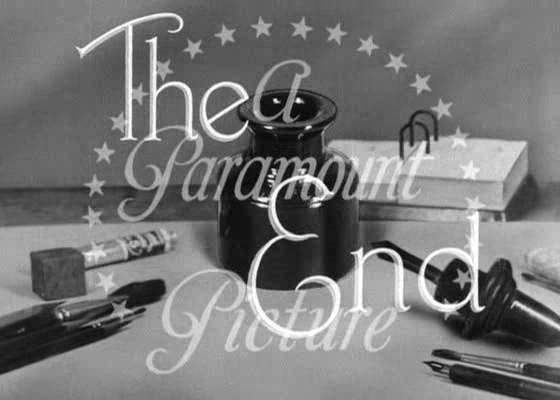


It’s a shame they did away with this ending. It’s distinctive and it’s an appropriate tie-in to Fleischer’s silent-era past with the imaginative Out of the Inkwell cartoons.

Chopping off the ending wasn’t the most egregious abuse these cartoons suffered. That was when they were colourised and re-filmed. The shades of grey enhance the originals and adding colour completely ruined the atmosphere. Fortunately, you can now see them again as they were originally made, with the neat little inkwell included.

Thursday, 18 October 2012

Deputy Droopy and the Cat

I’m not crazy about most of Ed Benedict’s really flat character designs in “Deputy Droopy.” But I sure like the bizarre scraggly cat.

The cartoon is one of several Tex Avery directed where characters run outside to make noise so they don’t disturb someone sleeping inside. It’s late in Avery’s theatrical career where one gag seems to flow right into the next.

Here’s the bit: the one bad guy rests in a rocking chair to recover from the last gag. Droopy moves a sleeping cat’s tail under the chair. Don’t you love the kitty eyelashes to add innocence and cuteness?


The other bad guy anticipates what’ll happen. Would anyone but Tex Avery try a take like this?


Yup, it happens.


The other bad guy runs to the rescue.


The cat doesn’t like the gag.


Gag’s over. The bad guy dumps the cat, ending its animation career, and it’s on to the next gag.


Avery was not only gone from MGM when this cartoon was finally released, his unit had been let go before the cartoon was finished. So the Hanna-Barbera unit animators were brought in, hence credits go to Ray Patterson, Irv Spence, Ken Muse, Ed Barge and Lew Marshall in addition to Walt Clinton. Mike Lah co-directed. Anyone want to pick out Muse’s and Barge’s animation of these kinds of character?

Wednesday, 17 October 2012

Catastrophobe

Everyone laughed at how Jimmy Durante butchered the English language, Durante included. It wasn’t an act. Radio listeners and TV viewers knew it. Durante’s genuineness was one of the reasons for his lasting popularity. Journalists, on the other hand, are proponents of correctness in language, mocking misplaced modifiers and decrying dangling participles (and ridiculing the kind of alliteration you’ve just read). But even journalists liked Durante’s meat-grinder effect on the vernacular. And one grouchy newspaper radio critic in particular. The New York Herald Tribune’s John Crosby took advantage of the Durante-Moore show 1946-47 season opener to wax Durante’s occasional failure to maintain any resemblance of command of the King’s English. Or any other English but his own. This column is from October 12, 1946, one of several he wrote about the Durante show over the next seven or eight years. Radio Review LANGUAGE A LA DURANTE By JOHN CROSBY One of the distinguishing characteristics of American English, says H. L. Mencken in “The American Language,” “is its impatient disregard for grammatical, syntactical and phonological rule and precedent.” Possibly the most impatient breaker of new ground and old precedents is that amiable, fuzz-topped, snaggle-tooth, elephant-beaked, philological explosion known as Jimmy Durante. Durante has violated the language so mercilessly and for so many years that Mrs. Malaprop may yet lose her title and a mangled word may well become a Durante, just as a telephone became an Ameche. The lovable Schnozzle, it seems to me, has established a far more convincing claim to the title than Mrs. Malaprop. Offhand, I can think of only one true malapropism—“You go first and I’ll precede”— whereas I can muster up a dozen Durantes, all of which are far more inventive than anything conceived by Richard Brinsley Sheridan. Maybe it’s wrong even to mention Mrs. Malaprop in the same breath with Durante, who improves the old words rather than misues them. Jimmy, in fact, assaults the language with such dignity and self-confidence that it is sometimes a question whether he is not right and every one else wrong. A “catastrophobe,” for instance, seems a more plausible and descriptive word than catastrophe. A catastrophobe would be a more calamitous calamity than a mere catastrophe, just as anything “colossial” is far larger than the merely colossal. An “exhilirator” certainly sounds as if it would make an automobile go faster than an accelerator. VIOLENT LANGUAGE Under Jimmy’s editing, language assumes a violence it never had before. Chiefly because the Durante personality requires expression beyond the reach of ordinary English. Nothing routine ever happens to Jimmy. On one of his recent broadcasts, Durante told of stoppin’ his town and country jeep for a red light. And what did he find in front of him—a lady driver! That would be only a mild irritant to anyone but Jimmy, who lives in an atmosphere composed of one-third oxygen and two-thirds exclamation points. By the time the lady finished powdering her nose, the light had changed from red to green three times, and Jimmy had a terrible time “keepin’ my impatience from runnin’ amuck.” There is no such thing as a stock phrase in Jimmy's vocabulary, and if he lives long enough there may not be a stock phrase in anyone else’s. "Woman the lifeboats! "Woman the lifeboats!” He roared on one of his programs. “You mean man the lifeboats,” said his partner, Garry Moore. “You stick to your hobby and I’ll stick to mine!” howled Durante. KIDDING THE LANGUAGE On another occasion, in a duet with Moore, the pair sang the following couplet: “You’re going to the dogs, that’s easy to see. “That’s too much like work. The dogs’ll have to come to me.” Jimmy is really kidding the language, particularly the trite and pompous sections of it. On his new and considerably revitalized program (C.B.S., 6:30 p.m. Pacific Time, Fridays), Durante pricks many other pretensions besides those of language. On one broadcast Jimmy made a shambles of the whole decorating profession when he came to grips with “the upholstered mind” of a decorator named Heathcliff. “I told him I didn’t want a naughty pine wardrobe, Chippydale chairs and drunken Fife furniture,” yowled Schnozzle. He was explaining at the time about his living room: “When you step on the carpet you sink six feet—no floor. “My house,” boasted Jimmy, “is composed entirely of rooms.” IT’S SHARP-TOOTHED The new Durante show is far more sharp-toothed than last season’s. On it, Durante has been letting his impatience run amuck at radio quiz shows. "Which would you rather have—Lauren Bacall or a box of palmettos?”—“How many in the box?”; the men of distinction series—“He’s a ‘seven up’ man—he can count up to seven”; and “Queen For a Day.” There are possibly a few too many straight gags, which put constrictions on the Durante personality, but not enough to be bothersome. Jimmy still has trouble with his pianist. “Stabbed in my obbligato by a fortissimo!” he’ll howl when asked for that note (“what a note!” and get the wrong one. And he still sings those dizzy songs in that foghorn of a voice. If you're tired of those same old words day after day, you might try the Durante-Moore show. To put it in Jimmy’s own phraseology, dere’s a million guys on the radio who speak English, but Jimmy’s a novelty. I must confess I’m puzzled by Crosby’s reference to “the new Durante show,” mainly because so few of Durante’s shows with Garry Moore are in circulation to see what he means. I’ve found nothing to indicate anything about the show was new. It had the same sponsor, announcer and vocalist as the previous season. The only change had been made in March and that was in time slots. The real change was the following season. Moore left the programme voluntarily and Durante went through a ridiculously large number of sidekicks over the next three years—Arthur Treacher, Victor Moore, Don Ameche and Alan Young. It’s a shame Garry Moore didn’t stay. Working with Durante showed off his talent far better than anything he did afterward. And the Schnozz never found a radio partner as good as The Haircut; Victor Moore’s whiny little voice just grates after a while. But both Durante and Moore moved into television and carried on with great success. Separating them, as the Durante dictionary would say, was no “catastrophobe.”

Tuesday, 16 October 2012

The Twirling Tom Cycle

Jerry’s anger causes him to develop super-human, er, mouse strength in the penultimate scene of “The Milky Waif” (1946). He swings Tom around in a cycle that takes up a half feet of film and a third of a second.


The animators listed are Ed Barge, Ken Muse and Mike Lah. Mark Kausler, who knows better than anyone, says this is Barge’s work. It looks like Lah after this when Tom is bashed by the garbage can lid then begins to feed milk to the orphan mouse but I don’t pretend to be an expert on picking out animators.

Bill Hanna and Joe Barbera later re-worked this cartoon for TV as “Nice Mice,” except the milk-hungry orphan taken in by mice Pixie and Dixie is a kitten.

By the way, did Joe Barbera have some kind of spanking fetish? The orphan mouse is spanked in this cartoon. I just finished watching “Professor Tom” (1948) and there’s spanking there, too. In both, the animals sprout human-like butts with cleavage. And that doesn’t even take into account the cartoons from the Hanna-Barbera unit featuring someone being stabbed or hit in the butt.

Monday, 15 October 2012

If My Friend Rocky Was in There

A lot of cartoons used the idea of crooks giving up to police so they wouldn’t be abused any more by the main character. None did it better than Bugs Bunny’s “Bugs and Thugs” (released in 1954), which was a reworking of the earlier “Racketeer Rabbit”. It’s the one with the famous scene where Bugs hides the crooks in an oven, turns on the gas and then pretends to be an Irish cop, asking “Would I throw a lighted match in there if my friend was in there?”

Friz Freleng’s animators could produce really subtle expressions and there are some fine ones in this scene. But my favourite part is the brushwork and the multiple eyes as Bugs changes places as he switches roles. Give credit to Art Davis and his assistant.

You know the scene. The “cop” is at the door. Bugs races to the oven to play himself.


Here he is changing spots to be the cop again. These are consecutive frames. They take up less than a second of screen time.


Bugs finishes his line as the cop and backs up, getting set to twirl into position as himself.


Bugs always has a great look of joy when he’s pulling a fast one.

We can’t skip the match part. See Bugs’ expression and how he anticipates the explosion. The drawings start on twos, the last three last only one frame each.


The animators may be Freleng’s best crew, even with Gerry Chiniquy gone. They’re Davis, Virgil Ross, Manny Perez and Ken Champin.