Thursday, 16 August 2012

Fraidy Cat

“The more pantomime, the better” seems to be the operative slogan at the MGM cartoon studio until Tex Avery got there, when it changed to “the more gags, the better.”

Disney cartoons had “personality” ever since Norm Ferguson had Pluto stop and take up time going through easily recognisable actions and reactions. MGM did the same thing. “Fraidy Cat” (1942) is a good example. The bulk of the cartoon involves Jerry putting a sheet over a vacuum cleaner to make Tom think it’s a ghost. One scene has Jerry turning the vacuum switch on and off. Then he laughs. Then he looks at Tom. Then he plays with the switch some more. Then he points. Then he laughs again. Then he plays with the switch some more. Then he laughs again. Then he plays with the switch again. Then he slows down and realises he saw Tom. Then he looks back. Then he looks at the audience. Then—well, you get the basic idea. Lots of pantomime. Lots of personality. But not a whole lot of action.

The same sort of thing happens in another part of the cartoon where Tom is running away from the vacuum cleaner which, for reasons of comedy only, is powerful enough to suck up rugs, telephones, books, pots and the nine lives out of a cat. Tom reacts over and over in different ways.

Here’s one of a bunch of drawings of Tom running in place. The multiple eyes and paws are fun.


He grows extra eyes as his head moves up.


There are some great drawings in this sequence. Tom’s eyes grow wide. The top of his head balloons. Tom’s eyes grow wide in a different way. The head changes shape in a different way. Finally, we come up with three wild consecutive drawings below. Great brush-work.


So Bill Hanna and Joe Barbera justifies the stand-there-and-emote routines of Jerry with frantic drawings of Tom which get lost because they go by so quickly.

There are no animation credits here but just about anything with huge eyes and huge pupils in an MGM cartoon can be pretty safely pinned on Irv Spence.

Wednesday, 15 August 2012

Don't Call Her Mrs. Camel

It’s feast or famine in the freelance world, and no one learned that better than actress Sara Berner. By 1940, she had been appearing on radio and in cartoons but the Census report for that year shows she made only $1000 from all her jobs in 1939 and hadn’t worked in ten weeks when the census-taker came around. (She did a short tour in a stage show, “Temptations of 1939” and had one shot in a summer replacement show called “Man About Hollywood” among her work that year).

But things picked up. We’ve talked about her career on the blog before, but I’ve saved a couple of newspaper clippings. First comes this column from the National Enterprise Association, March 16, 1944.

IN HOLLYWOOD
Erskine Johnson
NEA Staff Correspondent
The girl with the most photographed voice in America could bite through a nail every time she thinks of it. Why, it was awful. For years she wanted to meet a big studio executive. Then the casting office made a date for her to meet Buddy de Sylva, the big man at Paramount who could make you a star overnight. Her heart started thumping as a casting director took her to de Sylva's office,
“Mr. de Sylva,” said the casting director, “I’d like you to meet Mrs. Camel.”
“Oh-o-o-o-o-o, it was terrible,” Sara Berner said. “I talked to de Sylva for 20 minutes. But everybody called me Mrs. Camel. It was Mrs. Camel this and Mrs. Camel that. Nobody even mentioned my name. Nobody called me Sara Berner. Just Mrs. Camel. Even today when I see Mr. de Sylva on the lot he says, ‘Hello, Mrs. Camel.’ It’s heart-breaking.”
De Sylva, you see, had to approve Sara’s voice as Mrs. Camel for that gag sequence in “The Road to Morocco,” which is why the casting director took Sara to his office.
A Thousand Voices
Her name probably doesn't mean much to you, either. But you’re familiar with her voice in a thousand forms on screen and radio. In fact, she has the most famous voice in Hollywood. She’s the voice of Red Hot Riding Hood in those M-G-M cartoons, the voice of Little Jasper in George Pal’s Puppetoons. She’s Josephine of the Amos and Andy show, Gladys Zybisco of the Jack Benny show.
Being just a voice in a town where faces are so important is paving Sara big dividends.
“I can get even with a lot of people,” Sara chuckled. For instance, those “Speaking of Animals” shorts in which the animals speak. “If I don’t like a girl because she’s catty or something. I just copy her voice for a cat or skunk.”
On The Way Up
Like a lot of other young ladies who are attractive—Sara is very much so—and talented, she wanted to be a great actress when she left home in Tulsa, Okla., for New York. But she got only as far as Philadelphia, where she sold hats in a department store. Then she got an acting job on a radio station, later joined a stage unit and was playing the Orpheum Theater in Los Angeles when Hollywood discovered her.
Not long ago Sara received a call from a studio for a role in a picture. “I was thrilled,” she said. “At long last I was to appear in a picture. To have my face on the screen. You don’t know what that means to a voice. Well, the makeup man spent over an hour fixing my hair and putting on my makeup. But all they shot was the back of my head. I was a long distance telephone operator!”
When George Pal first started to make the Little Jasper films they hired a little Negro boy for the voice. By the time they got though, the boy had grown a head taller and his voice was different.
They sent for Sara Berner in a hurry.


And the United Press put this in papers starting December 26, 1944. The reference to Betty Boop is confusing; the Boop cartoons were done on the East Coast and the series had ceased several years before this story was written.

Versatile Sara: Camel One Day, Hippo the Next
By HAZEL HARTZOG
Hollywood, Calif.—(U.P.)—Moviegoers have never seen her face, but just about every one of them has heard Sara Berner’s voice at one time or other. Maybe it was a turtle doing the talking, or a chipmunk, camel or hippo or other animals—but the voice was always Sara’s.
Sara provides vocal chords for most of Hollywood’s familiar cartoon characters. She’s spoken for Red Hot Riding Hood, Little Jasper, Betty Boop and Mother Goose.
And she has verbally caricatured almost every animal known, including the turtle in “The Tortoise and the Hare,” the hippo, elephant and camel in “Speaking of Animals, and the baby panda in the Andy Panda series.
Voice Behind Voice
Currently, Sara is the voice of Jerry Mouse, Gene Kelly’s dancing partner in the cartoon fantasy which high lights “Anchors Aweigh.”
“I’ve been putting words in animals’ mouths for eight years,” the pint sized brunet said.
One of her performances helped win an academy award—that was “Mother Goose Goes Hollywood,” a Disney picture in which she vocally imitated top feminine stars from Shirley Temple to the late Edna Mae Oliver. This winner also spotlighted another Berner talent, that of impersonations.
Has 22 Characterizations
Sara started doing voices for screen animals after a cartoon producer nabbed her from a vaudeville act where she was impersonating Katharine Hepburn. Her first job was being the voice of a baby panda.
From her first cartoon stint, Sara concentrated on animated animals’ voices. She now has 22 characterizations ranging from the thin chirp of a quail to the guttural groan of a crocodile.
Her attorney husband confesses he never knows whose voice will answer the telephone when he calls home.
“It might be Mae West or Bugs Bunny at first,” he said, “but in the end it always turns out to be Sara.”


Incidentally, the man who played Bugs Bunny, Mel Blanc, uniquely listed his occupation in the 1940 Census as “dialectician.” The word certainly fit Sara Berner, and she was one of the best.

Tuesday, 14 August 2012

Ed Looks at Camera

If there’s one cartoon character who gave reaction looks to the camera more than Wile E. Coyote, it had to be Ed Jones the Typical American Sportsman in Tex Avery’s “Field and Scream.” A bunch of gags end with him just staring at the camera.


Other fishermen zoom into his secluded early morning fishing spot.


Fish ask Ed where the kid was that was reeling in their brothers and sisters before Ed got there.


A fish jumps out of the lake, attracted by the lures on Ed’s hat, and swallows Ed’s head.


Ed tries the middle of the lake. The other fishermen zoom in when he catches something.


Ducks are attracted to the Marilyn-esque decoys of Ed’s and fly away with them.


Ed’s elephant gun develops an elephant’s trunk and stuffs Ed’s mouth full of grass.


What would an Avery cartoon be without a mother-in-law gag? Ed dresses his as a deer. She’s shot off frame and brought on before being hauled away. Even she stares at the camera.


About the only time Ed doesn’t stare at the camera is at the end. That’s because a deer has shot him and is driving away with him in Ed’s car.

Ed was designed by (and likely named for) Ed Benedict. Avery was into stylised designs by the time he made this cartoon (Ed has a zig-zag of hair on his thumb). The short was copyright 1953 but wasn’t released until 1955, when Avery’s career at MGM was as dead as Sportsman Ed. The graphics may be modern but some of the gags are old (a boat’s “horsepower” gag is what you might expect).

Grant Simmons, Walt Clinton and Mike Lah were the animators; Simmons and Lah had their own companies by the time the cartoon hit theatres. Johnny Johnsen did the backgrounds.

Monday, 13 August 2012

Confusions of a Nutzy Smear

It’s really tough judging how good of a director at Warner Bros. Norm McCabe could have become. “Daffy’s Southern Exposure” is a funny cartoon by any standards but, more often than not, McCabe got saddled with stories that were heavy on war-time references or outright propaganda and not much else.

“Confusions of a Nutzy Spy” (copyright January 30, 1943) could have been a pretty good cartoon but it suffers because of the characters. Porky’s a clueless dope. His dog is a sneezing dope. The bad guy has a goofy German accent which hardly makes him threatening. Don Christensen gives us more of a situation than gags (other than bad puns in the opening). Oh, well, we beat the Nutzy in the end and that’s the only thing that mattered to the producers and distributors.

While Chuck Jones and Frank Tashlin get praise for experimentation, they weren’t the only Warners directors using stylised backgrounds and odd camera angles. McCabe has them here, too, thanks to layout man Dave Hilberman. And some of the animation’s pretty good, despite the fact McCabe wasn’t working with A-list animators.

Here’s a great take when the Nutzy realises the bomb-in-a-briefcase he threw away has been retrieved by Porky’s dopey dog. First, the realisation.


Then the anticipation.


Now, the big take.


McCabe engages in some smears as the Nutzy juggles the briefcase around before throwing it away.


Izzy Ellis gets credit for the animation. Cal Dalton was in the unit as well but I couldn’t tell you who else (Jack Carey?) was there.

Sunday, 12 August 2012

Irving Fein

Who came up with the phrase “Quick as a flashlight”?

If you said Samuel Goldwyn, you’d be wrong. The answer is Samuel Goldwyn’s assistant publicity man in the 1940s, Irving Fein. Fein admits he made up Goldwynisms because it would get Goldwyn’s name into the papers, not that Goldwyn really needed much help.

Fein’s best-known employers didn’t help getting publicity, either. They were Jack Benny and George Burns. When each of them died, Fein was the one who gave the confirmation to the media.

Fein died last Friday morning at the age of 101.

Some super-agents don’t mind being in the spotlight themselves. Here’s an interview with Irving Fein in the Wisconsin State Journal, November 3, 1963. You’ll notice how Fein’s still in there punching for his client; he turns it from an interview about Irving Fein into an interview about Jack Benny. But we learn about Fein, too, though it doesn’t mention he was hired by CBS in March 1950 to run a west coast promotion bureau and then put in charge of radio publicity on the coast in June 1952—all while still employed by Jack’s company.

A ‘Beatnik’ of the 1920s Comes Home
By ELIZABETH GOULD
(State Journal Staff Writer)

“Guinea pigs,” the campus called them irreverently.
“They were the beatniks of their era,” Irving Fein, who was of them, says with a twinkle.
They were the students of Dr. Alexander Meiklejohn’s famous experimental college which existed on the University of Wisconsin campus from 1926 to 1932. One hundred twenty male students— all of them intellectually superior, most of them determined individualists—lived and worked together in their own dormitory, studying Greek and Roman civilization the first year, American society the second, before they were absorbed into the university proper.
Set apart from the rest of the school as they were, they were regarded by many of their contemporaries as wild-eyed eccentrics.
Heads J and M Productions
There is nothing of the eccentric about Fein today. Lean and casually well-groomed, with a hearty laugh, an easy manner and a tolerant twinkle in his eye, he is the executive producer of the Jack Benny program and the president of J and M (for Jack and Mary) Productions. He now lives in Beverly Hills, Calif.
He came back to Madison last week for the first time since 1939 to visit his daughter Patricia who entered the University as a freshman this fall and is living in one of the new private dorms.
“It’s like the Beverly Hilton,” her father says, shaking his head. “Those kids don’t need all that luxury.”
His Room Shrinks
He himself paid a nostalgic visit to Adams hall to look at his old room there.
“I remembered it as about twice as large as it is,” he grinned. “But the furniture’s the same—same metal desk, same kind of bed.
“My friends advised me not to come back. You know Thomas Wolfe and ‘You Can’t Go Home Again.’ But in spite of all the changes around here, a lot of it looks the same. And it still looks like a great school to me. It is a great school—one of the greatest in the county. [sic] I’m glad I sent my daughter here.”
Fein, whose family home was in New York, went back there after leaving the university and got a job with Warner Bros, doing advertising and publicity. After being transferred to California, he worked for Metro-Goldwyn-Mayer and later for Columbia Pictures.
In 1947 he and Jack Benny founded a company which was sold to the Columbia Broadcasting System, and Fein became vice president of CBS in New York, in charge of advertising and promotion [in 1955].
The J and M Production Co. came into existence in 1956 and, besides the Benny show, has produced “Checkmate,” the Marge and Gower Champion show, the Gisele MacKenzie show, and Wayne and Shuster’s “Holiday Lodge.”
The famous comedian who has built much of the humor of his programs around jokes about his own penuriousness, emerges as a warm, generous, and intensely loyal person, as Fein talks of him.
“A lot of people—and not just in the entertainment world—once they’ve made money, are inclined to forget their old friends. But not Jack. And a lot of stars, at the end of the season, will fire the whole crew of writers and start fresh next year. Not Benny. Two of his writers have been with him for 20 years, and the other two for 14 or 15.
They’re still the new writers.
Raised $3½ Million
“And did you know he’s raised almost 3 ½ million dollars for charity as soloist with the big symphonies—most of it for their pension funds? He loves doing it, Of course, he’s no Heifetz, but he’s a pretty able musician, for all his clowning, and when Isaac Stern wants to raise some money, he calls on Jack. They charge $100 a ticket, and that includes an invitation to a party for Jack afterward, so everyone has a chance to meet him.”
Hartford, Conn., Fein said, was raising money for a new music school and was offered a $400,000 contribution by the president of the Fuller Brush Co., on condition that the city could match that amount. A single concert, with Benny as soloist, raised $438,000 in one night.
Concert in Milwaukee
Fein left Madison Tuesday to join Benny in in Pittsburgh, where he was to play a concert this
week. Then come concerts in Minneapolis and Milwaukee, which will be the end of the concert appearances with the big city symphonies, although there are at least 500 requests from smaller communities.
“We’ll do the Milwaukee concert Nov. 10,” Fein said, “and we'll be out late at the party afterward, then up at 6:30 to catch a plane for Hollywood, and we’ll rehearse that afternoon for a show that’s on the next week. That Benny’s remarkable. He’ll be XX in February, but he acts and work like a 39-year-old fellow.
A sparkle came into the Fein eyes, as he thought of that next Sunday date in Milwaukee.
“Makes it kind of convenient,” he laughed. “With Homecoming Nov. 9 (Saturday) in Madison.”
After all, a man who has a daughter here at one of the greatest schools in the country should get back to visit when he can. Especially since he’s proved to his own satisfaction that you can go home again.


Of Jack’s wife, Mary Livingstone, Fein told the Archive of American Television: “she was a nice lady.” The admiration wasn’t mutual. Livingstone and her brother Hickey Marks were livid to learn a few weeks after signing a deal to write Jack’s biography that Fein had already done the same thing. They refused to mention Fein in their book, despite the fact he had been Jack’s personal manager for almost three decades and began working for him in 1947. And the actor who said “Yeeeeeeees?” on Jack’s show said “No” when it came liking Fein. Frank Nelson felt Fein wasn’t quite honest in his version of the Benny biography and accused the J & M boss of shaving his paycheque to save money.

However, you can hear Fein’s thoughts for yourself. The aforementioned Academy interview can be found HERE. One click and you’re there as quick as a flashlight.

Saturday, 11 August 2012

Random M-G-M Cartoon Clippings

The Tom and Jerry series at MGM couldn’t have been more successful. And it had a far-reaching effect. If directors Bill Hanna and Joe Barbera had flopped with the cat and mouse, do you think they’d have built up enough capital and fame to open their own studio in 1957 and set the course for made-for-TV animation?

Hanna and Barbera never got on-screen credit for the first short in the series in 1940, but that year, an Associated Press reporter ferreted out the information that they, and not Rudy Ising (credited on screen) were responsible. It’s intriguing to speculate who leaked the info to the wire service. Producer Fred Quimby’s re-hiring of Ising (and Hugh Harman) in October 1938 after MGM dumped the Harman-Ising studio the year before must have been uncomfortable at best. No doubt, Quimby would be quite happy to promote someone else over Ising, especially if he could imply that he discovered the Oscar-winning directors.

That’s more or less what he did in this AP column dated June 2, 1944.

Hollywood
‘Oscar’ Goes To Author Of Cartoon
By FRED QUIMBY
(The producer of the Academy Award Winning Cartoon, “Yankee Doodle Mouse” writes today for Robbin Coons. This is the fifth in a series by award winners.)
HOLLYWOOD — Like Jennifer Jones and Paul Lukas, there were two other Hollywood stars who won an Academy Award this year. But little was said about them. Withal, each mail brings requests for their photos. They’re known from Teheran to Terre Haute — from Paraguay to Podunk.
>Success is theirs yet these stars work for nothing. They are never given a vacation — they never complain. Actually, they don’t even know the meaning of the word “temperament.” Neither are they ever bedecked in sable or ermine, nor do they attend the swank night clubs, albeit they were born in a bottle!
* * *
Yes, they emerged from an ink bottle, Feb. 10, 1940. Though christened “Tom Cat” and “Jerry Mouse” they are more familiarly known to millions of fans as just “Tom and Jerry.” Their introduction to the world was in the cartoon “Puss Gets the Boot.” Men, women and children laughed as the brash, bullying Tom tortured the meek mite, Jerry, through the early stages of the film, but the rascally rodent managed to master the situation before the end.
Were they gifted with vision, Tom and Jerry would see their prototypes in the men who direct them—Bill Hanna and Joe Barbera. As is customary in cartoon production, humans first enact the roles of their pen-and-ink creations, thus aiding the animators who draw the animal characters. Hanna is the smirky, blustering Tom Cat. He stands before a mirror and muggs to his heart’s content. Barbara is the Jerry Mouse. With exaggerated facial contortions, he is submissive to Tom's harrangues—while the story is in preparation.
* * *
In reality, neither Hanna nor Barbera is an exhibitionist. Rather would you regard them as the type to inherit the earth, were you to meet them socially. The boys joined my cartoon staff in 1937 as story and layout men. Their ability was soon discernible and promotion to the directorial ranks followed.
We were all very proud of Tom and Jerry for the award—the first ever won in Academy competition with Walt Disney. Could they have made an acceptance speech, I’m sure they would have said, with typical Hanna-Barbera modesty, “Thanks, folks. It’s a great honor. I guess we were just lucky.”


Hanna and Barbera might have been modest, but Fred C. wasn’t. The way some newspaper stories read, you’d swear Quimby himself was at a light board crafting all those funny scenes. There was never a mention of guys like Irv Spence or Ray Patterson. Quimby loved leaving the impression he was a creative force. One 1957 review of “Invitation to the Dance,” the Gene Kelly experimental film that combined animation and live action, wrote “Kelly dances a nimble series with cartoon characters executed beautifully by Fred Quimby, William Hanna and Joseph Barbera.” The words “Mike Lah” were nowhere to be found. Lah was the one apparently responsible for the serpent dance.

Quimby is not only creative but happy-go-lucky in this syndicated news story of July 7. 1947. By all accounts, neither term could be applied to him in real life.

Pair of Film Stars Win Academy Award But it Means No Raise in Pay for Them Because They Are Cartoon Characters
By VICTOR GUNSON
Central Press Correspondent
HOLLYWOOD — Not every Academy award winning star gets fame and fortune—and an oversized swimming pool.
You get a day by day account of the doings of the Ingrid Bergmans, the Greer Garsons, the Ginger Rogers, the Spencer Tracys and the Jimmy Cagneys.
But what about Tom and Jerry?
They are the heroes of an animated cartoon which won an Academy award for their bosses. Besides that, like Mickey Mouse, Minnie Mouse, Pluto the Pup and Donald Duck, they have brought many a laugh to millions of youngsters—and oldsters, too.
Because they are “Oscar” winners, it is well to look behind the curtain to see how Tom and Jerry come into being as you see them on the nation’s screens.
The studio has been releasing cartoons for many years, but it was not until 10 years ago that a building devoted to this sole entertainment field was erected. Occupying 12,000 square feet, the two-story structure houses a personnel of more than 200 persons, each a specialist in his particular field, since cartoon production is a highly creative art.
Of this number, 110 devote their time to Tom and Jerry.
* * *
JUST LIKE Joan Crawford has Jerry Wald as her producer, Tom and Jerry have their guiding genius, too. He is Fred Quimby, a happy gentleman with a full head of hair and a sense of humor.
Tom and Jerry have their own directors as well. They are William Hanna and Joseph Barbera. Both are comparative youngsters but veterans in the cartoon field.
Like any other screen production, the first step in making a cartoon is writing the story.
Unlike any of the others, the authors do not bother with a manuscript. Instead, they rough out their stories in picture form, one panel after the other, and tack them up on a large board.
Quimby likes to be sure of the action, just like he might be if he had Humphrey Bogart or Errol Flynn, so frequently he has co-directors Hanna and Barbera go through parts of the action.
When the trio is satisfied, the animators enter the scene.
Animators take a look at the drawings—or story. Then they go to work making hundreds upon hundreds of separate pictures, each slightly different from the other. This is so when they are later photographed on a strip of film and run through a projection machine, they look as though they were moving.
This film—it is called a story reel in the trade—offers excellent opportunity for each member of the staff to study the story minutely.
It requires more than 16,000 drawings, each photographed separately, to complete an eight-minute cartoon.
* * *
HEAD ANIMATORS draw only the principal sketches, while their assistants, the “in-between workers,” complete the continuity of the scene.
For example, a sequence may require Tom to walk from one side of a room to the other. The head animator makes sketches of Tom as he enters and as he leaves. The “in-betweeners” then fill out the rest of the pictures.
As he works each animator constantly has in front of him master drawings of Tom and Jerry as well as all the other members of the cast. This is done so no artist will start drawing characters to suit his own ideas.
* * *
KEY MEN are those layout artists who plan the backgrounds and plot the action; the technical advisers and the musical director, who is not only a musician and composer but a man long experienced in cartoon procedure.
Sound technicians on cartoons must be the top of their trade. Split-second accuracy is required in giving sound to the little animated figures.
Then there are the people who give voice to the dialogue.
After all the pictures have been put on paper, a group of women artists trace them with water colors to celluloid. They become the finished product when they are photographed on regular movie film.
The cartoon producers admit they have a lot of problems. But, they have one big “break.” Their stars never are afflicted with temperament.


Hanna and Barbera got other mentions in the popular press during their MGM years, but not all that many. Disney got the P.R. by ably spinning each feature release into something new and, therefore, worth writing about. MGM was in the shorts business, and shorts weren’t exactly high in the box office food chain. Here’s a clipping from United Press dated April 16, 1949.

Censors Frown on Nudes—Even in Cat Cartoons
HOLLYWOOD, (UP)—A buxom movie queen lolling in bed isn't the only item that gets axed out of the movies. The long arm of the censors reached out to the love life and hip wiggles in the cartoons, too.
The two guys who create Tom and Jerry, the Oscar-winning cat and mouse, sigh they have to worry about slipping gags past the censors just like the big directors do.
“We have to be careful about Jerry kicking Tom in the backside. Those gags don’t get by so much any more,” says Joe Barbera, who writes and directs the cat and mouse series at M G M with William Hanna.
Tom and Jerry usually don’t wear a stich of clothes in their movies, unlike Mickey Mouse and Donald Duck. But in “Springtime for Thomas” Tom had to crawl into trousers while he yowled his love to a lady cat.
Tom wears goatskin pants and Jerry a Robinson Crusoe outfit in their next movie. But Barbera and Hanna undressed them in a hurry so the 125 animators wouldn’t have to draw clothes in all the 15,000 “frames” that make one cartoon.
Once the Johnston office turned thumbs down on a scene in a cartoon, not of Tom and Jerry, which showed a dog sniffing at a man disguised as a tree.

There was, at one time, an event which brings back wistful memories to those old enough to remember called “The Saturday Kids Matinee.” Local theatres had special programmes for kids consisting of a bunch of old cartoons, some live-action shorts (usual the Three Stooges) and maybe an episode of a serial. TV eventually killed the concept. Alas!

Here’s a column from Madison’s Wisconsin State Journal of April 4, 1953, giving a free plug to a matinee. No doubt part of the information came from an MGM handout. Why else would Fred Quimby get credit?

TOM AND JERRY, funmakers from the MGM cartoon studio, will celebrate their 13th birthdays and their sixth “Oscar” award with two parties Monday at the Orpheum theater.
Tom and Jerry were “born” when Fred Quimby produced their first picture, “Puss Gets the Boot,” in 1940. They became stars at the film’s first showing, when a preview audience laughed long and applauded heartily.
With that sound in their ears, Quimby and Co-Directors William Hanna and Joe Barbera laid plans for a long-range future for the cat-and-mouse team.
So far, there have been 96 Tom and Jerry pictures, and 20 more are in various stages of production on the MGM drawing boards—which produce 11,200 different camera setups for each cartoon comedy. Each release plays about 22,000 bookings in the United States’ 15,000 theaters, figures which indicate many repeat bookings.
Last month. Tom and Jerry won their sixth “Oscar” with “Johann Mouse,” a Viennese caper with Tom playing Strauss music for Jerry’s dancing.
At Monday's parties, the Orpheum will show 25 Tom and Jerry cartoons — three hours of films. Cousin Henry of WISC will be master of ceremonies, and a big bir day cake will be on display in the theater lobby.
The parties will start at 10 a.m. and 1 p. m., with doors for the first one open at 9 a. m.

Fred Quimby was gone by 1955. So Bill and Joe don’t share the credit for their cartoons in this United Press story from somewhere in September 1955.

Cat, Mouse Hold Oscar Honor Record
HOLLYWOOD (UP) – Which performers have won the most Academy Awards?
Nope, not Bette Davis, Frederick March or any other living actor.
The champs are a cat and mouse—“Tom and Jerry.”
Those cartoon characters have copped seven golden statuettes — more than any performers in the business.
Behind this game of cat and mouse are a couple of easy-going, good-nntured guys named Bill Hanna and Joe Barbera who have worked together for 18 years. During that time they've turned out 125 “Tom and Jerry” rib-ticklers for MGM.
“We’ve been working across a desk all that time and never had a beef,” Joe said happily. “I don’t think there’s another team in town ,who can say that.”
“When we started out with Tom and Jerry, mice and cats were strictly passe,” Bill put in. “Thanks to Mickey Mouse and Felix the Cat.”
“Yeah,” Joe laughed. “Cartoonists were going crazy looking for other animals to use—giraffes, zebras, dodo birds and gosh knows what.”
“We decided to stick with the cat and mouse idea because you don’t have to waste time getting into the story. The minute the cartoon starts with the cat chasing Jerry the audience understands the situation”
“What’s more,” Bill added, “The mouse is the eternal ‘little guy’—getting picked on by everyone. Besides, mice and cats are known the world over. We never use much dialogue and foreign markets are as good as domestic releases.”
Barbera and Hanna take 18 months to turn out a single seven-minute picture.
“Of course,” Bill said, “we have several in production at once. Each film contains about 57,000 drawings, which means a total output of a million and a half individual drawings a year.”
How do cartoonists dream up their laugh-getters?
“We sit across from one another and kick around ideas until we get something of a story line. Then as we go along we make faces and expressions we want the characters to have—while one of us makes a face, the other pencils it down.”
“People think we're crazy when they come into the office. They find a couple of grown men making faces at one another and speaking in sound effects,” Joe said.


Within two years of this story, Hanna and Barbera followed Quimby off the MGM lot, along with the rest of the cartoon studio’s staff. The doors were bolted. Metro had become penny wise and pound foolish, deciding all it had to do was spend a few bucks making prints of old cartoons and watch the money roll in. It never counted on the huge windfall television could have provided from the sale of future MGM cartoons. It was a point gladly proven by another studio, one run by Bill Hanna and Joe Barbera.

Friday, 10 August 2012

Fish Fry Surprise

Lots of rubbery and over-the-top animation can be found in “Fish Fry,” a 1944 Walter Lantz cartoon directed by Shamus Culhane.

Lionel Stander plays a scrawny cat out to eat Andy Panda’s goldfish as Andy takes his new pet home. The cat thinks he’s lapped up the fish while glugging down the water in Andy’s fish bowl.

Here’s the take after the cat pokes his tongue pokes around, feels no fish, then sees the fish still in the bowl. The animation is on twos.


Animation credits on screen are given to La Verne Harding and Emery Hawkins.

Thursday, 9 August 2012

The Fall of Betty Boop

No doubt you’ll read on the internet that today is Betty Boop’s birthday, that the first Boop cartoon, “Dizzy Dishes,” was released on this date in 1930.

It may very well have been. But it also appeared in theatres before that. At the right, you can see an ad from the Decatur Herald of July 27, 1930. “Dizzy Dishes” was already appearing. And Decatur, Illinois wasn’t the only place the cartoon was playing before the alleged release date.

This wasn’t an isolated case. Over at the old Golden Age Cartoon Forum, research showed a number of the Warner Bros. cartoons the same year were in theatres before their formal release date. And, on a whim, I recently hunted down a 1946 Tex Avery cartoon in theatre ads and found it playing before it was supposed to be on the big screen.

One has to remember we’re talking about a different era than today. The first concern of a movie company today, after releasing a film, is the weekend box office take as of the following Monday, and how much more money their movie made than the competitor’s—in the same time span. So movies today can’t have an approximate opening. They have to have a definite date to be able to go head-to-head.

Years ago, shorts were thrown in as part of the deal to get a feature. There was no financial competition among them so there was no real need for them to be released on an exact date. Joe Adamson, the author of Groucho, Harpo, Chico and Sometimes Zeppo, explained the situation in a Facebook conversation (his book showed up in Philadelphia ahead of the release date):

The studio had to make a release negative, make many prints, and supply the exchange w/them ahead of the release date -- This involves labs and shippers -- but once the exchange had them, any theater that wanted or needed a short could book it, regardless of the official release date --
Like the publication date for GROUCHOHARPOCHICO, the studio doubtless set a date they were sure they could meet, then targeted an earlier date to make sure they weren't caught short, sometimes ending up with films arriving well ahead of time -- The release date, then, is the earliest date they can guarantee the picture being available to any given theater -- Make sense??
Sometimes these orders were apparently made by the chain (if the theater was part of one), and assignments were apparently done very carelessly -- When I was living in State College, Pa., the same theater showed the same print of an awful Lantz cartoon called GOPHER BROKE with every film I saw there, even DUMBO! I finally complained to the mgr., and he said the chain probably just ordered "a cartoon" and the exchange probably slapped whatever cartoon was there into the pkg. w/o giving it any thot -


In other words, a release date for a Golden Age cartoon, even in reputable trade publications of the day, is a best-guess scenario.

So let’s get back to Betty Boop, the Betty before she became a straight woman to a dog and a grandfather. Betty fit in well with the early Fleischer atmosphere, where things morphed into other things or became temporarily human. And of course, there was the sex. Like in “Betty in Blunderland” (1933). She enacts the part of Alice in Wonderland as she walks through the looking glass and falls down a shaft. Yes, her dress flies up.


She passes some women’s unmentionables.


Then uses a convenient clothespin to keep her dress down.


She falls past a kitchen setting and grabs a jar of jam.


The jam turns into the head of Ed Wynn. Betty is so shocked, the clothespin flies off her dress.


A nude statue (with a bellybutton but not anatomically correct) is conveniently in the path and the jar of Ed Wynn rests there as Betty falls past it and down to the pavement below. The recent hit “Did You Ever See a Dream Walking” plays in the background through the scene.

Doc Crandall and Tom Johnson are the credited animators.

Olive Films has recently licensed some of the Betty Boop cartoons, though apparently not ones in the public domain like “Betty in Blunderland.” The assumption is the company will release them. It’d be a shame if only part of Betty’s body of work was restored and available for fans to snap up—especially if it’s only the later, dull cartoons—but it’d be better than nothing.

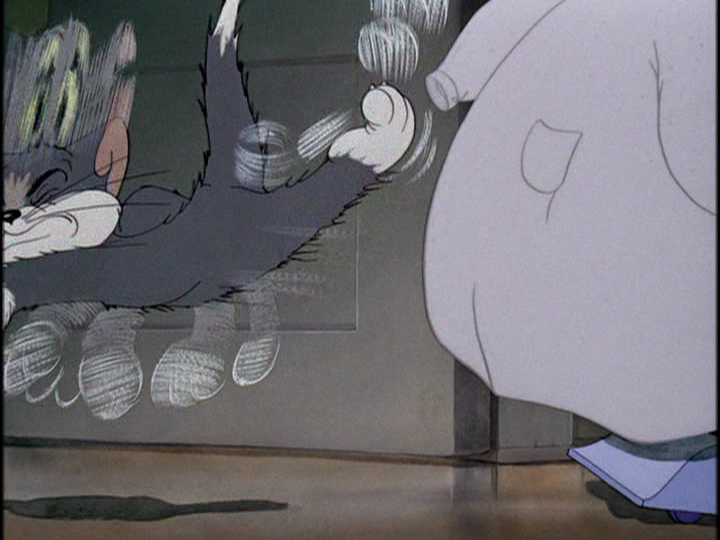
For those of you who want to celebrate Betty, birthday or not, this is from a TV print of her first cartoon.

Wednesday, 8 August 2012

Henry Morgan and Freedom of the Press

Political commentary wasn’t the focus of Henry Morgan’s radio and TV shows. His goal was to ridicule what he saw as stupid—radio and TV shows, generally. But satirists are keen observers by nature and Morgan put his powers of observation to work in what amounts to an essay about the news media.

Morgan didn’t express his opinions on his programme. He picked a more appropriate venue. It was later that John Crosby of the New York Tribune, one of Morgan’s champions in the press, printed what the comedian had to say, verbatim and in totum, in his column of May 23, 1950.

The names have changed in 62 years but Morgan’s points and conclusion are still relevant and accurate, and restricted to no particular country.

Comedian Says His Bit About Press
By JOHN CROSBY
Henry Morgan, a sardonic, sometimes misguided, but always honest man, lumbered to his feet before reporters, columnists, editors and publishers at the annual dinner of the New York chapter of Sigma Delta Chi, the national journalistic fraternity, and delivered a speech. It lasted all of a minute and a half, a fine length for a speech, and it was a fine speech.
In that minute and a half, Morgan, one of the more thoughtful radio comedians, summarized his opinion of the American press. This is a difficult assignment for radio comedian. His listeners—reporters, columnists, editors and publishers—could crucify the man in print if they didn’t like what he said. A radio comedian needs the support of the press. He’d have great difficulty existing without it. Still, Henry spoke his mind about us freely and, while there were some barbs in this small essay, it was on the whole a flattering and (I hope) intelligent estimate. I’d like to pass it along.
COMMON KNOWLEDGE
“I was asked here this evening,” said Morgan, “mainly because it’s common knowledge that I am am authority on this stuff. A number of people here work on newspapers. That isn’t nearly as bad as what I do. I have to read them. Some people produce radio programs. I have it much worse than they do. I work for them—newspapers and radio—the two greatest influences of our time, I figure. You see before you the creature you have made. I am the average warped man.
“Because of you people in this room I believe Owen Lattimore is a Communist. I also believe he is not a Communist. Because of you people I believe F.D.R. was a genius and also that he ruined the country. I believe that there is more crime in this country than ever before and that our police are the best in the world.
MILITARY MAN
“I believe that Eisenhower would make a great President except that I have read that military men don’t make good Presidents and besides he will run if enough pressure is brought, he will not run, he can’t run, he refuses to run, he doesn’t want the job, you can talk him into it, he’s trying very hard to make it look as though he doesn't want it, he’s happy at Columbia, he’s miserable, he’s got a cold, he feels great.
“You have made it possible for me to take seven cents and buy, in one package, a new picture of President Truman, my horoscope for the day, 15 comic strips and the stock market reports. And I’ve read some terrible things about you. You work for money. Advertising dictates your policy. The department stores dictate your editorials. Don’t you think you’d be happier with some other system? Wouldn’t it be nicer to have a bureau of some kind supervise your work? Then, if the bureau didn’t like it, you could adjust or get killed.
GETTING UN-AMERICAN
“Still in all it’s better than having people point at you and say: ‘There’s a man who works for money.’ Somehow it’s getting to be very un-American to work for money. It’s also un-American not to work and to live on unemployment insurance. It’s un-American to have social security and it’s un-American to have such a small amount of social security.
I strongly suspect that this is all your fault.
“In short, you people in this room have put me, the average man, in a peculiar position. I now have to make up my mind for myself. As long as you keep doing that, as long as you keep forcing the man in the street to make up his mind for himself, that’s as long as we’ll have the only working definition of democracy that’s worth a damn.
“Thank you.”

Tuesday, 7 August 2012

Being Real Cheesy

I have a theory about the way they constructed stories for the early cartoons at the Van Beuren studio. They just kept throwing stuff on screen until things couldn’t get more bizarre and they ended the cartoon.

That seems to be what happened in “A Swiss Trick,” which hops along from routine to routine, featuring a shout that forms letters that decapitate a head, a train that leaps away on clouds, singing mountains and goats that butt each other in the butt. Oh, yes, and a pet swiss cheese. On a leash.


And that’s not even getting to the strange part. Tom and Jerry follow the cheese to an inn where they dance, play musical instruments and yodel, accompanied by Gene Rodemich’s usual fine score. They sneak away to get the pet cheese as a moosehead sleeps on the wall.


Mission accomplished. They eat the swiss cheese.


Horrors! They grow holes, just like the cheese. Why? Well, because it’s a Van Beuren cartoon.


That’s not the worst of it. Mice hiding in the room pop up and start chasing the cheesy Tom and Jerry. Patrons at the inn point and laugh. Cut to Tom and Jerry running away from the mice to end the cartoon.


The whole thing is just so baffling, you have to love it.
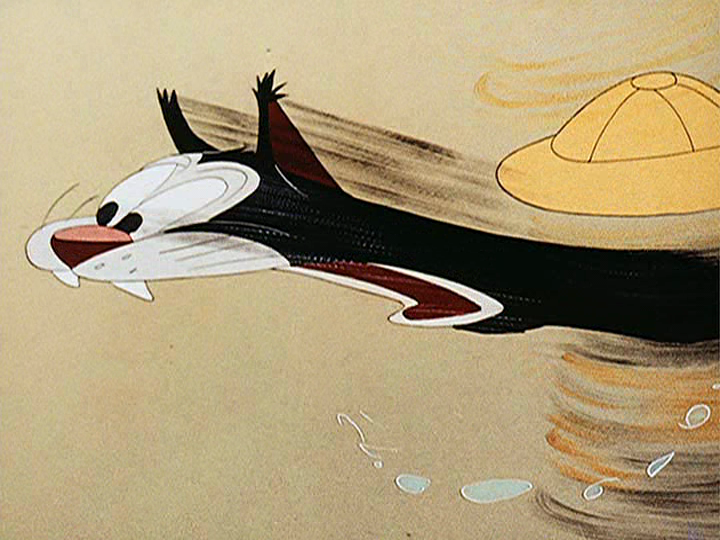
George Rufle and John Foster get the credits on this one.