Friday, 27 July 2012

Felix and the Snakecycle

The silent Felix the Cat cartoons always have at least one imaginative transformation and though the story may not be clear, Felix’s emotions always are.

“Outdoor Indore” (1928) has some nice cycle animation of a tiger and an elephant, a bizarre gag when the elephant sucks up the entire Atlantic Ocean, and a laughing ending I still can’t figure out. But probably my favourite scene is the snakecycle.

Felix is in Africa where, eventually, he finds an elephant to bring back to the United States (whether that was his intention at the outset of the cartoon, I don’t know). His feet become sore and he needs some transportation. The scene cuts to a charmer with a recorder making a snake dance. That gives Felix an idea.


This may be the first time an idea teapot has poured water on a cartoon character’s head.

Anyway, Felix detaches his tail to use as a flute. Sure enough, two snakes come out of the ground and start dancing.


Now the weird stuff. The snakes jump past each other. One snake eats the other, then bites on its own tail, forming a circle.


The head then snakes around (pardon the pun) to form a second little circle. Ta da! Felix has a Pennyfarthing bicycle).


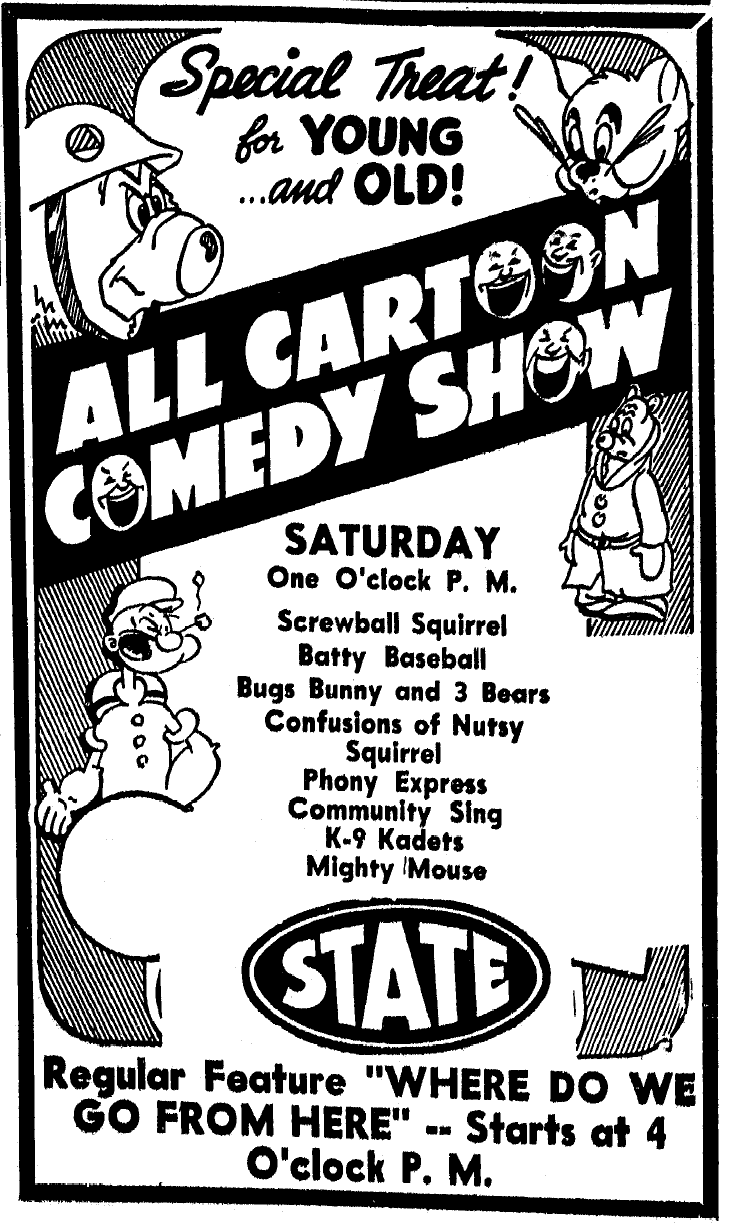
The movie ad above is from 1929; The Film Daily says the cartoon was “Indore” not “Indoor.” The significance of the spelling is lost on me.

Thursday, 26 July 2012

Hollywood Loves Vin Scully

The United Press International’s Hollywood correspondent proved his point, albeit unintentionally.

Vernon Scott wrote a story published 52 years ago today explaining how Los Angeles Dodgers baseball announcer Vin Scully was unknown in most of the U.S. Except in the column, Scott called him “Vince.”

It was ten years earlier in January 1950 that another national columnist, Hugh Fullerton, Jr., revealed that Vin Scully, ex Fordham outfielder and announcer, would be helping out on the Brooklyn Dodgers broadcasts in the summer. And he’s still doing it, 62 years later.

Getting back to Scott’s column, you might wonder why a Hollywood reporter would choose a baseball announcer as his subject. It’s very simple. Hollywood loved baseball.

Bob Hope and Bing Crosby each had a piece of major league clubs. Joe E. Brown had played ball before he made movies (his son was later general manager of the Pittsburgh Pirates), including the baseball-themed “Elmer the Great” (1933). Bill Frawley had a clause in his “I Love Lucy” contract that he was to be given time off to see World Series if the Yankees were playing. Hollywood was the home of the Hollywood Stars of the Pacific Coast League, in those days practically a major league circuit. Stars filled the box seats, some bought shares in the club. And Brooklyn manager Leo Durocher pushed his way into a show business career, guest starring hither and yon on radio comedy/variety shows.

Several of Jack Benny’s radio broadcasts revolved around Benny attempting to listen to a ball game, but being thwarted by the channel switching to wailing soap opera actresses (Bea Benaderet), sinus-congested singers (Sara Berner), cheesy commercials (Frank Nelson) and a variety of running gags. On one show, Nelson pulls off one of the funniest routines of all time as an announcer calling the bottom of the ninth with his mouth stuffed with a hot dog so no one can understand how the game ended. Another broadcast had Jack and Mary watching a PCL contest involving the Los Angeles Angels and the Seattle Rainiers with The Sportsmen Quartet singing a Lucky Strike commercial to “Nobody Loves an Umpire.”

And so it is that Jack and Vin Scully are connected in Scott’s column.

Even Benny Listens to This Celebrity
By VERNON SCOTT
HOLLYWOOD, July 26—(UPI)—Jack Benny fired off the first fan letter in his long career to the most listened-to man in Cinema City—a celebrity’s celebrity who has stars and moguls hanging on his every word.
Outside of Southern California and Brooklyn this imposing figure is almost entirely unknown. But he can break up concerts, stop shooting on the sets and commands fan mail on the grand scale. He’s Vince Scully, the man who announces the Dodgers baseball games.
An 11-year veteran with the ball club, Scully has made Southern Californians a sect of transistor radio fanatics.
When Dodger games are in progress, movie sets, TV stages and the streets are filled with semi-conscious listeners with wires running from tiny radios to their ears.
Scully, an engaging Irishman with a shock of fire-red hair, is delighted with his popularity among movietown’s bigwigs.
“I guess my biggest fan is producer Mervyn Leroy,” Vince said. “He gave me a small role in one of his pictures just for the heck of it.
“Benny sent me a telegram of congratulations for the job I’m doing. He said it was the only fan letter he’d ever written. Kirk Douglas also sent me a nice letter.”
During games in the Coliseum fans can hear Scully’s account of the action clearly—there are that many transistor radios blaring through-out the crowd.
“I think that’s because so many Californians are unfamiliar with major league baseball,” he explained, “and they like to understand what is happening out on the field.”
Scully considers his broadcasting job a part of show business.
“There is always excitement and drama in a ball game, and I depend a great deal on the roar of the crowd to give it punch.
“There have been complaints from the Hollywood Bowl and theaters in this area that people can’t hear what’s going on because of the radios smuggled in to performances. Even the actors can keep up with the games by listening from the stage between lines.”
One performer was embarrassed in a restaurant recently when he approached a patron wearing an ear phone to inquire about the Dodgers' score. It turned out the man he had asked was wearing a hearing aid.
“We’re all mighty happy that the club is so welcome here,” Scully concluded. “Underneath it all, Los Angeles fans are almost exactly the same as the ones we left in Brooklyn.”


What makes Scully a great play-by-play announcer? Perfect timing. Makes going on the air seem effortless. Avoids phoney hype and just builds on the situation as it unfolds around him. Dependable, year in and year out. And a genuine guy.

That descriptions fits one of Scully’s biggest fans, too. It can be said that Vin Scully, really, is the Jack Benny of baseball broadcasters.

Wednesday, 25 July 2012

Not the MGM Lion

What’s the point of being paid by MGM if you can’t make fun of the MGM lion? That’s what Tex Avery does in “Batty Baseball.”

A player sliding into home plate suddenly stops in mid-air. He demands to know what happened to the opening credits of the cartoon, “the lion roar and all that stuff?”


The player then opens his mouth wide, in approximation of a lion roaring, rolling his head before resuming its regular shape. The first four drawings are on ones, the rest are on twos.


This cartoon was released in 1944. I wonder if Avery would have handled the animation and timing differently in later years, with one huge lion take interrupting the player’s spiel.

Picking out 1940s MGM voices for me is a bit of a challenge. The player’s growly voice isn’t the same as the growly voice in Avery’s “The Cat That Hates People,” at least that I can tell. The umpire-baiter is Kent Rogers and the narrator is John Wald, who was the announcer on “Fibber McGee and Molly” in the ‘50s when Harlow Wilcox stuck to playing himself as commercial pitch-man.

The credited animators are Preston Blair, Ed Love and Ray Abrams. Mark Kausler reports this scene is by Blair.

Tuesday, 24 July 2012

Reckless Driver Outlines

“The Reckless Driver” (released 1946) is another Walter Lantz cartoon where outlines of characters are used to quicken the action. You can find them in one scene where lazy cop Wally Walrus is taking Woody Woodpecker’s reflexes. It’s a variation on the old bop-knee-foot-kicks gag. Instead, Woody pecks the cop. Here are a few drawings to give you an idea of the outline effect.


Later in the scene, Wally contemplates how to test the reflexes without getting jabbed by Woody’s beak. These are consecutive drawings leading to Wally drumming his fingers against his face. You’d have no idea Wally’s shrug is in there unless you freeze the scene as it’s there for one drawing. You can see the outlines again.


Les Kline and Grim Natwick get the on-screen animation credits. Mark Kausler reports Natwick animated this scene.

Wally doesn’t have his Swedish accent in this one. It sounds like he’s played by Will Wright in this cartoon. Voice actor and historian Keith Scott says Wright is the devil conscience of Andy Panda in “Apple Andy,” which has the same voice as Wally in this short (and the wolf in “Fair Weather Fiends”).

Monday, 23 July 2012

Porky the Fireman

Today’s cartoon inside jokes come from the Frank Tashlin cartoon “Porky the Fireman” (1938). It features Tashlin’s wide-eyed, squat version of Porky and one of his typical montage sequence toward the end of the cartoon.


Porky’s fire truck rushes past the same wooden buildings four times and comes to a stop. And a fence advertises some cartoons.


Mel Millar wrote the cartoon and his name appears on a couple of stores in the background. Here’s one to the right of another establish run by the illiterate members of Friz Freleng’s family.

The background artists were never credited in the ‘30s. Griff Jay and Art Loomer handled backgrounds for a good part of that decade; these look like BGs from their time a few years earlier.


This is still before 1940 so cartoons don’t have the wild, eyeballs-out-in-two-frames takes that Tex Avery made famous. Tashlin has Porky express surprise by his eyes growing wider (one ones; they take their time). You can see them at their widest above. The eyes kind of grow a second white.

Bob Bentley is the credited animator. I suspect Volney White and possibly Phil Monroe were in Tashlin’s unit at this point.

Sunday, 22 July 2012

TV Needs More J.P. Patches

J. P. Patches died today. Whether he knew it or not, he symbolises what’s wrong with television today. And maybe something greater.

J.P. was really a guy named Chris Wedes. For years, he hosted what was supposed to be a children’s show on Seattle television. The smart kids got what was going on. A guy in a ratty clown outfit ad-libbed ridiculous routines and dialogue with the other member of the cast, who was in either bad drag, an animal trainer’s outfit or as a black-hatted bad guy. J.P. would talk to the announcer. J.P. would talk straight into the camera (which went up-and-down or side-to-side, depending on whether the camera was nodding or shaking its head). J.P. would refer to inanimate objects as if they were living characters (a reference to a rubber chicken named Tikey Turkey would result in the sound guy playing the same gobble noise every time).

There was no slow, condescending talk to the young audience. The pies-in-the-face, deliberately bad puns and guffaws from the camera crew at inside or suggestive lines could have been for adults, too. At least ones that were smart enough to figure out the show was about a couple of guys in goofy costumes winging a bunch of business.

And it was all live.

This was in Seattle. Other cities across the U.S. had similar kids’ shows featuring extremely creative people doing incredibly silly and funny things, and not talking to viewers like they’re brain-dead. Some went on to fame outside their own region. Soupy Sales comes to mind. Thanks to the internet, we can learn about Chuck McCann in New York City and similar shows in Los Angeles, Chicago, Cleveland and so on.

This was all during a time when there were three networks and a few independent TV stations. We have countless more channels today, more than anyone can possibly watch, with a place for every conceivable programming niche. But on no channel will you find anything like the live kids’ shows that one generation grew up with.

What do people laugh at on television today? I shudder to think. Kids can watch modern-day freak shows under the Reality TV banner, where the idea is to laugh at ignorant people inflicting insults on other ignorant people. There are cartoons where the idea is to laugh at rudeness that prides itself in its obviousness.

Where’s the innocent fun?

It could be that audiences today don’t want it. They want gaucheness and cruel ridicule instead. If that’s the case, the problem is far greater than the messenger, television.

What to do with Adolf

Radio programmes, like the rest of the entertainment world, became involved in the war effort during the ’40s. Shows went on location to military bases, war references popped up in the dialogue, Jack Benny even gave up some of his time for a five-minute plug for the U.S.O.

World War Two was pretty black-and-white in everyone’s mind. Hitler and Mussolini were Evil, pure and simple. And I imagine just about everyone in the Allied countries had their personal opinion about what should be done with the pair when our boys marched victorious into Berlin and Rome. Certainly radio stars did.

The National Enterprise Association’s Hollywood columnist put the question to them; no doubt it was one of several questions where the answers could be banked and cobbled together for a subject story during fallow periods of news, like during the Christmas holidays. This one ran in 1943. As you’ll see, some stars treated the question seriously, others cracked jokes. I suspect all of them had answers that would be too blistering for print.

While fans of old radio shows will recognise the stars, though Alan Reed’s name is butchered, the person mentioned at the start of the story may be unfamiliar. Marshal Badoglio conquered Ethiopia for Mussolini in 1936 but soured on Fascism and replaced Il Duce as Prime Minister in 1943, then signed Italy’s unconditional surrender. He died in 1956. His obit warranted only two lines in the U.S. military paper Pacific Stars and Stripes. The war was behind everyone by then.

Hollywood On The Loose...
By ERSKINE JOHNSON
NEA Staff Correspondent
HOLLYWOOD, Dec. 18.—Marshall Pietro Badoglio has an idea on what ought to be done with Hitler and Mussolini after the war. He thinks the Allies should put them both in a cage and exhibit them throughout Europe.
Famous stage and screen comedians have some ideas, too:
George Jessel: “When everything else is done to Hitler and Mussolini that everybody thinks they deserve, I suggest they be put in a small theater, chain them to their seats and have me sing 200 choruses of ‘My Mother’s Eyes’ in a key much too high for me and I should have a cold yet besides.”
* * *
Jack Oakie: “Turn ‘em loose on the field between innings of a Brooklyn-St. Louis baseball game. Instead of pop bottles, supply the Brooklyn fans with hand grenades.”
* * *

NBC’s Fibber McGee and Molly: “Mussolini should be chained on a balcony overlooking a cemetery with nothing for company except copies of his speeches. Hitler should be chained under a loudspeaker playing over and over a Lou Holtz record of ‘Mein Kampf’ in Jewish dialect.”
* * *
Bud Abbott and Lou Costello: “Put Hitler in the Abbott and Costello torture chamber — a room with walls lined with copies of ‘Mein Kampf.’ At intervals, levels behind the books would shoot them out at him. Feed him only leaves from the books.”
* * *
Edgar Bergen: “Hitler and Mussolini should be given parachutes and taken up in an airplane. Hitler should be dropped off over Warsaw and Mussolini over Addis Ababa. Both gentlemen should have free choice as to whether they wanted to open the parachute.”
* * *
Harvey Fischman, 13-year-old Quiz Kid: “I suggest that they be catapulted from a cruiser. But before that I’d like to shave off Hitler’s mustache on a moving train.”
* * *
Bob Hope: “Make ‘em run around a race track for the rest of their lives under Bing Crosby’s colors. They’re taking a beating now but nothing compared to what would happen to ‘em if they ran under Bing’s colors.
* * *
Fred Allen: “Make ‘em listen to Jack Benny’s radio show for the rest of their lives.”
Jack Benny: “I would lock ‘em both in a projection room and make them look at Fred Allen’s movies for 12 hours a day. No—that would be inhuman. Only 11 hours a day.”
* * *
Bob Burns: “Let me serenade ‘em with my bazooka and then eliminate ‘em with a bazooka gun.”
* * *
Cecil Kellaway: “Exhibit ‘em in a cage. Then, at night, give ‘em benzedrine and continuously play a recording of ‘Pistol Packin’ Mama.’”

* * *
Allen Reid [sic], rhyming Falstaff of Fred Allen’s radio show:
“Fetter the international crooks,
“So they cannot get away.
“Then make ‘em listen
“To Baby Snooks from dusk till
break of day.”

Saturday, 21 July 2012

Disney and his Big Bad Wolf


The drawing you see above comes from a feature story published December 23, 1933 in the Charleston Daily Mail. Alice D. Tildesley, syndicated from the Public Ledger, generally wrote enterprise stories on women’s issues, but she delved into animation on rare occasion. The other photos in this post were with the same story.

Tildesley’s feature sums up the making of Walt Disney’s biggest success to date, “The Three Little Pigs” and how the studio operated. It’s interesting the only other name besides Disney’s mentioned here is Frank Churchill’s (unless you count The Rhythmettes).

A Silly Symphony Becomes America’s Slogan
Three Little Pigs Change the Psychology of the Nation—Walt Disney Tells How He Makes Animated Cartoons
By Alice L. Tildesley
“WHO’S afraid of the big bad wolf?” We all could be singing this popular ditty with conviction if we had the confidence of Walt Disney, who has found the answer to this wolf-at-the-door menace.
The answer, according to Disney, is: Invent your own job; take such an interest in it that you eat sleep, dream, walk, talk and live nothing but your work until you succeed. Then you may take on a hobby or two if you feel so inclined.
The creator of the increasingly famous Three Little Pigs started out in business in his father’s garage, his equipment an old still camera and a supply of pens, ink and paper. Now he has his own studio, his own story and music departments, complete equipment and 135 employes on his staff.
The earnings from the eight-minute Silly Symphony in which the pigs get the best of the big, bad wolf have been variously estimated as anywhere from $1,000,000 to $2,000000, but this, alas! like the picture, is just a fairy story.
“All this talk about my making a lot of money is bunk,” declares Disney. “After ten years of pretty tough sledding I am now making a moderate profit on my products, but every dime I take in is immediately put back into the business. I’m building for the future
And my goal isn’t millions; it’s better pictures.
“I’m not interested in money, except for what I can do with it to advance my work. The idea of piling up a fortune for the sake of wealth seems silly to me. Work is the real adventure in life. Money is merely a means to make more work possible.
What They Cost
THE average cost of a cartoon in black and white is $18,000. In color this runs to about $20,000. These figures represent only the actual production cost and don’t include cost of prints—usually 250 prints a picture, but 330 for the pigs—cost of distribution, advertising, foreign taxes, duties, etc.
“It takes a Mickey Mouse comedy twelve months to pay for itself, while the average Silly Symphony doesn’t crawl out of the red for eighteen months.
“On the other hand, these cartoon comedies last for a long time. They are still showing the first Mickey Mouse comedy after nine years. Maybe ten years from now the big, bad wolf will still be huffing and puffing before the door to the house of bricks.”
Certainly the Three Little Pigs should “crawl out of the red” soon, for it’s breaking records everywhere and has been recalled as many as seven times to some theatres. America resounds to “Who’s Afraid?”—not such a bad slogan for any country!—sung over the radio, played by orchestras and whistled by schoolboys.
Yet, if you can believe it, when Disney suggested the idea for the symphony to his staff some nine months ago, the twelve men who compose the story department remained unimpressed.
“It’s lousy! Why don’t you get a real idea?” they chorused.
You see, Disney surrounds himself with good “no” men. Every one of these 135 who work at the one-story building called “Walt Disney Studios” is a member of a co-operating organization. They are not expected to say “yes” when they mean “no,” and nothing is done without a majority opinion in favor of it.
“I think the reason they didn’t like the idea was that at that time the thing wasn’t very clear in my own mind,” confesses Disney frankly. “I withdrew it and tried to forget it, but the pigs and the wolf and the little house kept haunting me. I thought about them until I saw the story clearly, and then I proposed it again. This time they liked it.
“I don’t mean they threw up their hats or that even I thought it would be a tremendous hit. We considered it a typical Silly Symphony.”
If Disney were running any other kind of studio, the proper procedure after deciding on an idea would be to write the story, cast the parts, engage a director and composer, if it were to be a musical, and build some sets.
You can’t do it that way at Disney’s.
First, a one-page story is outlined and read to the dozen members of the story department. Two weeks later this staff must turn in ideas that could be used in the tale, gags that might be included and drawings of their individual conceptions of the characters.
Origin of the La La
FOR the Three Little Pigs, for example, one man may have turned in the gag wherein the pig with the house of straw opens his frail door and pulls in the mat with “Welcome” on it when he sees the wolf come bounding toward it. Another may have suggested that the wolf grab hold of the little pigs’ tails as they flee to safety in the house of bricks.
One wall of the conference room was covered with twelve or more versions of how the four characters looked and sketches of their dwellings. From these selection was made by vote of all present and the animators provided with models of the selections.
In an ordinary picture there is opportunity to rehearse the characters, try things several different ways and select the best “take” for the final product. But in a cartoon comedy, composed of from 10,000 to 15,000 drawings, the director must visualize his action, plan his entire continuity, entrances, exits, dissolves and cuts; in fact editing before a single picture is drawn.
An artist-animator can, with diligence, produce only five feet of action every eight hours, so it is necessary to conserve his time by giving him the kind of work he does best. Some artists are excellent at producing scenes, others can create animated action.
It is difficult for any artist to change his individual style and adopt a standard style for the benefit of the cartoon, so that the little pig drawn by one can’t be distinguished from the little pig drawn by the other. For this reason Disney maintains a group of apprentice artists and trains them in the art of animation. They attend art classes at the studio. Their apprenticeship lasts six months, never less, and sometimes longer, and they are paid as they learn.
A good animator should be a good actor also, for he must, know what, is dramatic, what is comic and what is pathetic.
“We have three musical directors who compose the music, or adapt it, for our pictures,” explained Disney. “Our three picture directors each has a film to direct , and each works with his own musical director
“The music must fit the mood of the story; it should enhance the action, and care must be taken that it does not instead detract from the picture or annoy the audience.
“At first we tried to have the action follow the melody, but we soon saw that wouldn’t do. The musical .score must correspond to the rhythm of the action following the beat of the music.
The problem is simply one of resolving all musical tempos in terms of the standard speed and of making a consecutive series of drawings to fit this tempo. Certain basic tempos, multiples of the frame speed of the film, have been established. The fastest tempo employed is one brat every six frames amounting to four beats a second. The total range is from this to one beat every twenty frames, or one beat every five-sixths of a second.”
In the case of the pigs, one of the staff during the first conference suggested the line, “Who’s afraid of the big, bad wolf?” Whereupon, Frank Churchill, music composer, sat down and wrote the jingly tune in five minutes, after which, the lyric was composed by two of the young men on the staff.
Originally the words appeared like this:
Who’s afraid of the big, bad wolf?
The big, bad wolf, the big, bad wolf?
Who’s afraid of the big, bad wolf?
He don't know from nothing.

But that last line refused to fit, and the boys toiled for some time trying to find a rhyme for “wolf.” At length one said in despair, “Let’s just let the flute take it!” And the well-known “tra la la la la!" was slipped in to finish the first hit melody furnished by a cartoon studio.
The music having been decided upon, the scenic department artists prepare the backgrounds to be used in the action of the film, just as scene painters prepare stage sets or set designers prepare screen sets. The action of the picture moves against these backgrounds, just as it does in an ordinary talking picture.
For the pigs, these backgrounds were the three little houses, from varied angles, exterior and interior. The action of course, was that of the ancient fairy tale, the big, bad wolf who came huffing and puffing to blow the little houses down. The four characters must be opaque figures, so that when placed against the background the scene will not show through.
When the director and musician have settled story, music, situations, gags and approximate footage of film, a layout sheet is made for the guidance of animators. It looks like something prepared by Einstein, but from it the gifted musician is able to prepare a complete music score with all the beats coming at the precise moment the cartoon figure needs them. When a dancing pig puts his plump foot on the ground, the music will keep time, and it will accent his movements when he plays the piano, skips under the bed or shuts his door in the wolf’s face.
The projection schedule, another Einsteinian blueprint, is handed to each animator. From this he discovers that he is to do scenes 25, 26, 27, the footage of each one marked and a description given.
A third cryptic sheet, called the exposure sheet, instructs the animator on the nature of the scene and the tempo of the music.
Completing the Job
THE twenty-five or thirty animators who are to work on the picture have desks, not unlike the desks seen in schoolrooms, the tops being illuminated drawing boards, the light shining through from below, so that pictures may be sketched against their backgrounds, and the next picture in a sequence may be sketched on a transparent sheet just above the first, so that there may be the right amount of difference between the two to give the illusion of action when reeled through the projection machine.
After the drawings of a sequence are completed, they are turned over to the inking and painting department, which traces and inks or paints them onto celluloid sheets, these celluloids then being photographed on their appropriate backgrounds by a camera suspended above an illuminated drawing board.
Approximately 100 hours arc required to photograph a cartoon subject that averages 600 feet of film. The Pigs was considerably longer than this and was composed of 15.000 separate drawings.
While the animators are doing their stuff, the studio orchestra records the musical score. A trio known as the rhythmettes sang the words of the lyric in the Pigs, and a member of the studio staff impersonated the wolf. The sound film resulting is then synchronized with the completed cartoon and the Silly Symphony is ready for release.
“The secret of success, if there is any, is liking what you do. I like my work better than my play. I play polo, when I have time, and I enjoy it, but it can’t equal work!” says Disney.
Oh yes, indeed—who’s afraid of the big, bad wolf? And why?

Friday, 20 July 2012

Music by Screwy Squirrel

Screwy Squirrel cartoons are lots of fun. The only thing wrong with them is Screwy. You can like the gags he pulls but you can’t really like him. And I think that’s the way Tex Avery wanted it. The gags are the real stars in the Screwy cartoons.

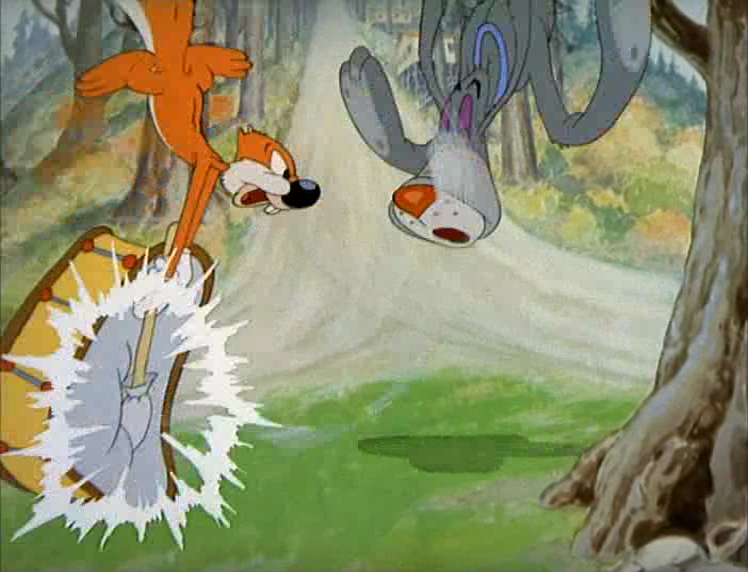
Tex came up with great routines where the business of filmmaking actually appears during the cartoon; he did it at Warners then carried on doing it at MGM. In Screwball Squirrel (released April 1, 1944), Screwy is even responsible for some of the sound in his own cartoon. During one chase scene, the William Tell Overture blares in the background. Suddenly, a portion of the music keeps repeating, like a stuck record. The action on the screen repeats with it. Screwy steps out of the action, walks over to a record player, fixes the skipping record, then the chase resumes (passing behind the record player and on to the next gag). It’s a great little routine that comes out of nowhere.


But the best musical gag comes along later in the cartoon. Meathead the dog is in a barrel, rolling down a steep hill. Musical director Scott Bradley has a drum roll on the soundtrack.


Cut to a shot at the bottom of the hill. It turns out that Screwy is playing the snare drum. Not only that, he provides musical sound effects. When the barrel hits a tree, Screwy bashes a bass drum. Meathead flies up into the air and down. Screwy plays a slide whistle to accompany the action. When Meathead lands, Screwy bashes the bass drum again, then finishes up with a bird twitter as Meathead lays on the ground, dazed.


Only Avery would try a sequence of gags like this. Better still, he doesn’t let the audience rest. The short zooms along from one routine to the next once it gets past the deliberately syrupy opening with the overly-cute, frolicking Sammy Squirrel (who Screwy beats the crap out of behind a tree. Take that, Harman and Ising).

The credited animators are Preston Blair, Ed Love and Ray Abrams. The backgrounds (note the house on stilts) are by Johnny Johnsen. Claude Smith designed the characters; the first model sheet is dated December 1942.